
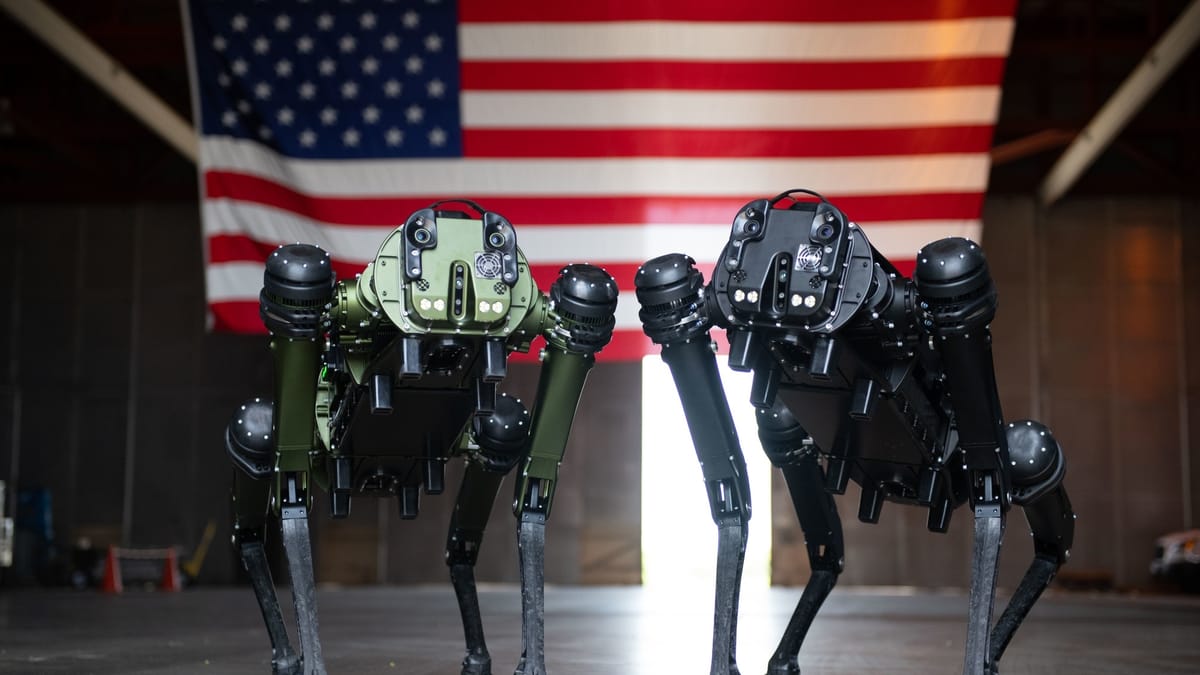
You’ve probably seen the clips. Four-legged robots, some with rifles strapped to their backs, others dragging gear across muddy trenches. Soldiers standing a few feet away, eyes locked on controllers, piloting them like video game avatars. At first glance, it looks like Ukraine just pulled science fiction straight onto the battlefield.
And the pitch is seductive. Why risk a soldier’s life when a robot can carry ammunition, scout a trench, and even detect explosive devices? Where a human would have to take cover under fire, a robot doesn’t feel fear or fatigue, and it can keep moving as long as it remains intact and connected. An army of mechanical dogs would be loyal, tireless, and disposable — the exact thing generals and defense contractors drool over.
But here’s where we have to pause. Because anyone who’s ever seen a robot outside a showroom knows what usually happens the second you take them into the real world. They fall. They freeze. They glitch. And as it turns out, warzones don’t play nice with still-in-progress prototypes. Ukraine attempted to turn science fiction into strategy, but reality pushed back harder than anyone expected.
- BAD-2 battery life
- ~5hours
- Operating range
- Up to 3.5km
- FPV drone cost
- A few hundred dollarseach
- Ground robot cost
- Thousands of dollarseach
- UN deadline urged for autonomous-weapon rules
- 2026
Origins and the Vision
The funny thing is, these robots weren’t originally designed to charge Russian trenches with grenade launchers. Take the BAD-2 units: British-made, four-legged, and about the size of a medium dog. They could run for a few hours, carry supplies, or creep forward with cameras to give soldiers eyes in dangerous terrain. It was the sort of robot that defense expos love to show off — compact, versatile, and looking like it belongs in a Black Mirror episode.
But Ukraine’s soldiers didn’t just see them as toys for parades. Because once you put something like this into the hands of people fighting for survival, they start to tinker. War is brutal, but it’s also a laboratory. If it were possible to make these robots as flexible as soldiers — and also cheaper, faster, and free of the risk of bloodshed — that would be a total reinvention of combat. And that was the vision: a mechanical platoon that would be both adaptable and expendable.
One of the clearest examples is the wave of BAD-series “robodogs” that showed up in eastern Ukraine. The ones you see in footage aren’t bespoke Boston Dynamics monsters; many are lower-cost chassis, some sourced from Chinese makers, that a UK firm refitted and reprogrammed for battlefield use. The company and frontline units describe them as being built for recon, mine detection, and logistics.
This practical beginning matters because it explains what happened next. Depending on the use case, soldiers would take a tracked robot, a wheeled UGV, or a quadruped, and bolt on whatever was needed for the job. Needed to evacuate a wounded comrade? Snap on a stretcher capsule. Needed to blow a blind entrance? Tape on an explosive and set it to run in. There are even plans to mount a machine-gun module and put a shooter behind a screen.
This improvisation was a real tactical advantage, but it also meant the robots were often jury-rigged rather than purpose-built.
At the same time, legitimate industrial players stepped in. Western UGVs — notably Estonia’s THeMIS — were supplied and scaled up for Ukrainian use, with companies describing them as multi-role, modular platforms for tasks like casualty evacuation and ordnance disposal. Governments and manufacturers are treating Ukraine as both a customer and a fast feedback loop: send kits, receive frontline fixes, and push updated production.
But there’s an important caveat in all of this. Ukraine’s robo-dogs are early-generation answers, not finished systems — at least not yet. The machines were adapted from commercial designs and refitted for war, and soldiers are essentially beta-testing them under fire. That makes their advantages real but also fragile.
Modularity and rapid adaptation might win you quick fixes, but they can’t by themselves solve durability, comms security, or the physics of mud and slopes. And that is one of the reasons the project still hasn’t taken off.
The Hype, the Tests, and the Battlefield
The BAD-2 models especially got attention. Small enough to crawl through rubble, strong enough to haul supplies or ammunition, and light enough to be carried in the back of a truck. Five hours of battery life, a range of up to 3.5 kilometers, cameras, and thermal optics built in. Some reports even suggested they were almost invisible to Russian thermal sensors.
If that were true, you can see why people thought these things could be game changers. Imagine being able to sneak a robot through enemy lines while your soldiers stayed safe behind cover.
And of course, the hype machine didn’t stop there. Defense outlets speculated about arming them with rifles or grenade launchers. There was talk of turning them into kamikazes — robots loaded with explosives, sent forward like four-legged suicide bombers. They were the “perfect” disposable weapons, as replaceable as cartridges. It was grotesque, but also strangely logical. If you’re already flying drones into bunkers, why not send a ground robot to finish the job?
If you zoom out, this wasn’t just about a single machine. Ukraine was experimenting with a whole family of uncrewed ground vehicles. Some were designed for logistics, others for reconnaissance, and some as outright combat platforms. The BAD-2 just happened to be the one that grabbed headlines because, let’s be honest, it looked cool. It looked like the future.
And let’s not forget the psychology behind an image like this. A robot dog with a rifle strapped to its back practically sells itself. It speaks to a deep human instinct that holds out hope that technology can shortcut the messy, bloody business of fighting — that if we can just build the right machine, war becomes easier, more efficient, maybe even cleaner.
But anyone who’s watched this pattern before knows how it usually goes. Remember the early days of drones? They were hyped as unstoppable, precise, and revolutionary. And while drones did change warfare, they also proved far more fragile and hackable than anyone admitted at first. The same thing happened with early tanks in World War I — they broke down constantly, overheated, and often got stuck in mud. The technology wasn’t useless, but expecting it to be always magical led to disappointment.
Ukraine’s robot dogs fell right into that same cycle. At first, they were shown off as futuristic saviors. Soldiers drove them around training zones, cameras caught them maneuvering through rubble, and journalists wrote about them like the war had just turned a page. There was even a sense that this was a clever workaround to Ukraine’s manpower shortages. Robots don’t get tired. Robots don’t bleed. Robots don’t need pensions. The kind of logic defense ministries eat up.
And to be fair, there were glimpses where the hype looked justified. A robot hauling supplies across no man’s land at night meant fewer soldiers risking their necks. One even pulled off an evacuation — dragging a wounded soldier to safety when humans couldn’t reach him. For those brief moments, you could almost believe this was the start of something permanent.
But even at this stage, cracks were showing. The robots’ stability looked good on flat ground, but anyone who has seen video of these machines in mud knows how clumsy they can get. And then there were the practical questions: how many units could Ukraine realistically field? How much training did operators need? How much did each robot actually cost compared to, say, a fleet of cheap FPV drones?
Battlefield Reality, and Why It Failed
The problem with prototypes is that sooner or later, they have to meet reality. For Ukraine’s robot attack dogs, that reality wasn’t a test range or an expo in Kyiv. It was mud, artillery, drones buzzing overhead, and Russian electronic warfare saturating the airwaves. And very quickly, all the limits became obvious.
The first issue was terrain. Videos of these robots strutting on concrete or neatly packed dirt told only half the story. Eastern Ukraine isn’t a flat showroom floor; it’s farmland, trenches, rubble-strewn villages, and mud so thick it swallows boots. For a machine with small legs and exposed joints, that kind of ground was a nightmare.
Reports from soldiers described robots getting bogged down, struggling on uneven surfaces, or tipping over when carrying heavy loads. One Ukrainian officer even joked that the robots were “afraid of puddles” — a biting way to say they simply weren’t designed for the brutal messiness of the front lines.
Then came the question of power. Five hours of battery life might look impressive for machinery you can easily recharge, but for robots that would be on the battlefield for an unpredictable amount of time, that number just doesn’t work. Cold weather drained the batteries, and heavy loads reduced endurance. Unlike drones, which can be launched, flown, and retrieved in under an hour, these ground robots need significant energy just to keep crawling forward.
But perhaps the biggest killer was electronic warfare. Russia has turned jamming into an art form in this war — interfering with GPS, scrambling drone signals, and frying communications links. And these robots, like almost every unmanned system, rely on stable signals to function. Once they lose contact with their operators, they freeze.
Some reports even suggested that Russian jamming didn’t just disable them but occasionally confused their control systems. A robot that can be bricked or blinded with the push of a button is a liability.
On the other hand, FPV drones cost maybe a few hundred dollars to build, are fast, maneuverable, and can strike targets with accuracy. By contrast, these ground robots cost thousands of dollars each, are slower than a jogging soldier, and are vulnerable to the same jamming tools. If you’re a Ukrainian commander with limited resources, the math isn’t hard. Why spend precious funds on robots that crawl when you can buy ten drones that fly?
There’s also the human factor. Training operators wasn’t simple. Unlike drones, which could be learned fairly quickly, robots required more specialized knowledge — ground navigation, payload balance, troubleshooting. And the payoff wasn’t always worth the effort.
Soldiers would sometimes get attached to their “dogs,” insisting on a repair instead of a replacement. That meant they might hesitate to make the “sacrifices” the disposable model demanded, or get stuck waiting for a repair that cost more than a brand-new unit.
The mismatch between expectations and reality doesn’t mean the robots were useless. If they can help evacuate the wounded and haul supplies, that’s a pretty good start. But it comes across as disappointing because the hype told an entirely different story — and right now, for their present use case, these robots are still too fragile and costly to justify.
The fact that they don’t meet expectations has shown, again, one of war’s most brutal truths: war is merciless toward half-baked technology. You don’t get to polish, iterate, and refine the way you would in a lab somewhere. If a machine doesn’t work the first time, soldiers lose trust in it, commanders stop requesting it, and resources shift to whatever does work.
Lessons From Failure and the Future of Robotic Warfare
If you think about it, war has always been a brutal proving ground. The first submarines were leaky death traps, the first airplanes in combat were little more than wooden kites with pistols strapped to them, and the first tanks got stuck in mud almost as often as they rolled into battle. Yet today, submarines, aircraft, and tanks define the shape of modern armies. They became indispensable only after decades of failure, redesign, and adaptation.
The same cycle is unfolding with robots. Ukraine’s experiment failed not because the idea was flawed, but because it was implemented prematurely. And what it revealed was just as important: if robots are to succeed, they’ll need autonomy, rugged engineering, and resistance to electronic warfare. Those are solvable problems, but they won’t be solved cheaply or quickly.
Even in failure, Ukraine gave the world something valuable. It showed everyone what not to do. For the U.S. and China, it’s a free battlefield lesson. You can bet defense planners around the world took notes when they saw Ukrainian robots toppled by mud or silenced by jamming. In a sense, Ukraine’s failed prototypes have become unpaid consultants for the next generation of military robotics.
But there’s something deeper here than robots simply taking the place of soldiers: the logic of war itself is changing. Imagine a future where expendable machines fight the dirtiest battles, where swarms of ground drones push into minefields or trench lines before humans ever set foot there. That kind of warfare makes attacks cheaper in terms of lives but more expensive in terms of machines. It could even make wars longer, because machines would cover the human cost that usually forces nations to negotiate.
And this is something we have to start thinking about now, because Ukraine’s failure with robots won’t last forever. Artificial intelligence is improving. Batteries are getting stronger. Materials are becoming lighter and tougher.
The very same things that made drones so lethal over the last decade will eventually make ground robots viable, too. And that raises uncomfortable questions. If robots take on more frontline roles, does that make war easier to wage? Does it lower the threshold for conflict because leaders can risk machines instead of people?
Or does it make war even more terrifying, with the possibility of autonomous systems clashing beyond human control?
Ukraine, without intending to, has forced us into that conversation. And maybe that’s the legacy of its robot dogs. They might not have won battles or changed the course of war, but they revealed how far we have to go — and how quickly we might get there once the lessons are absorbed. So yes, Ukraine’s robot dogs failed in real combat. But if history is any guide, the clumsy prototypes of today are often the terrifying breakthroughs of tomorrow.
The Ethical and Strategic Questions
If the use of robots on the front lines is ever perfected, there’s a question that needs answering: who answers for the deaths when the robots pull the trigger? At the heart of that question is the idea of meaningful human control. It sounds straightforward — humans must remain in charge of life-and-death choices. But actually defining what “meaningful” means is maddeningly tricky.
Human rights groups, the International Committee of the Red Cross, and disarmament activists have all said humans must stay central to the use of force. They’ve pushed different operational definitions — human-in-the-loop (a person fires the weapon), human-on-the-loop (a person supervises and can override), or meaningful supervisory control across the weapon’s lifecycle.
That difficulty is precisely why advocacy groups like the Campaign to Stop Killer Robots exist. Their position is to ban systems that operate without meaningful human control and to regulate or prohibit systems that use sensors to target humans independently. They’ve taken their case to the UN and national capitals, arguing that leaving such decisions to lines of code is incompatible with human dignity and international law.
Governments don’t all agree, though. In 2025, the UN held a consultation with different countries, and Secretary-General António Guterres urged states to set clear rules on the regulation of autonomous weapons by 2026. Yet major powers — including the U.S., Russia, China, and India — favor national guidelines and existing international laws rather than an international ban. That split is the core political problem: civil society advocates for prohibition, many countries seek an international framework, and some major militaries prefer flexible national regulation.
The rise of autonomous or semi-autonomous weapons raises three legal and ethical problems at once: accountability, discrimination, and proportionality. If a self-routing ground robot kills civilians after misidentifying a target, who is responsible — the programmer, the commander, the manufacturer, the operator, or the machine itself? Human Rights Watch and other NGOs have argued that current legal frameworks can’t clearly establish who’s responsible, which might lead to an outright lack of consequences or to wrongful blame.
There’s also the fact that machines make classification errors. Civilian versus combatant isn’t a tidy label; it often depends on context, intent, and subtle human cues — and machines aren’t at the point where they can make those calls reliably, because they lack the moral imagination.
Yet another practical concern is the significant risk that this technology could fall into the hands of unauthorized and unregulated groups. A weaponized ground robot built from commercial components can be copied, modified, or bought on black markets. The technology’s dual-use nature — civil robotics plus weapons — means any lapse in control can let dangerous capabilities spread beyond state oversight.
So what are the policy options on the table? Broadly, two. One: a ban on fully autonomous weapons that lack meaningful human control. Two: state-led national governance, where countries rely on domestic legal reviews — like Article 36-style weapons reviews — plus doctrine and procurement rules rather than an international treaty.
Each has tradeoffs. Bans are clear but politically hard; national rules risk loopholes and inconsistent standards. But if we hope to see these robo-military machines rise in the future, we also have to take precautions. Otherwise, we’ll soon find ourselves asking: Who dies because a machine judged wrong?
Who pays when the line between human judgment and automated action blurs? Those questions are urgent, and the next few years will tell us how seriously the world takes them.
Key Takeaways
- Ukraine’s robot “attack dogs,” led by the British-made BAD-2 quadruped, were largely adapted from commercial chassis and refitted for war — early-generation prototypes, not finished combat systems.
- Their real strengths were logistics, reconnaissance, mine detection, and at least one wounded-soldier evacuation — narrower than the armed “kamikaze” hype that surrounded them.
- They failed in combat for three core reasons: thick mud and uneven terrain, limited battery endurance (around five hours, worse in cold or under load), and Russian electronic warfare that could freeze or confuse them.
- The economics didn’t add up: ground robots cost thousands of dollars and crawl slower than a jogging soldier, while FPV drones cost a few hundred dollars, fly fast, and strike accurately.
- The failure was about premature implementation, not a flawed idea — better AI, batteries, and rugged, jam-resistant engineering could make ground robots viable later.
- The technology forces urgent questions about meaningful human control, accountability, and proliferation, with the UN pushing for clearer rules on autonomous weapons by 2026.

Simon Whistler
Simon Whistler hosts MegaProjects, bringing engineering, infrastructure, and military-machine stories into clear narrative focus for viewers who want the systems, tradeoffs, and human decisions behind the build.
Frequently Asked Questions
What is the BAD-2 robot dog?
The BAD-2 is a British-made, four-legged robot about the size of a medium dog, used by Ukrainian forces. It can run for a few hours, carry supplies or ammunition, and creep forward with cameras to scout dangerous terrain. According to the script, it was built for reconnaissance, mine detection, and logistics rather than as a dedicated weapon.
What were Ukraine’s robot dogs actually used for?
Their genuine, demonstrated roles were logistics, reconnaissance, mine detection, and casualty evacuation — including one instance where a robot dragged a wounded soldier to safety when humans couldn’t reach him. Soldiers also improvised by bolting on stretcher capsules or explosives. The widely hyped armed and “kamikaze” versions were largely speculation about future use.
Why did the robot dogs fail on the battlefield?
Three problems converged. Thick mud and uneven terrain bogged them down or tipped them over; their roughly five-hour battery life shrank further in cold weather and under heavy loads; and Russian electronic warfare could freeze them or scramble their control systems once they lost contact with operators. Together, these limits made them fragile and unreliable on the front line.
Why are cheap FPV drones preferred over ground robots?
FPV drones cost only a few hundred dollars, are fast and maneuverable, and can strike targets accurately. Ground robots cost thousands of dollars each, move slower than a jogging soldier, and are vulnerable to the same jamming. For a commander with limited resources, buying ten drones instead of one crawling robot is an easy call.
Does the failure mean military ground robots have no future?
No. The article argues the experiment failed because it was implemented prematurely, not because the idea was flawed — much like early submarines, aircraft, and World War I tanks that later became indispensable. As AI, batteries, and rugged materials improve, ground robots could become viable, which is exactly why other militaries are studying Ukraine’s experience.
What ethical and legal problems do these weapons raise?
They raise three at once: accountability (who is responsible if a robot kills civilians after misidentifying a target), discrimination (machines struggle to reliably tell combatants from civilians), and proportionality. There’s also a proliferation risk, since weaponized robots built from commercial parts can be copied or sold on black markets. Groups like the Campaign to Stop Killer Robots want a ban on systems without meaningful human control.
What is “meaningful human control” and is it being regulated?
Meaningful human control is the principle that humans must stay in charge of life-and-death decisions, expressed through models like human-in-the-loop or human-on-the-loop supervision. In 2025 the UN held a consultation, and Secretary-General António Guterres urged states to set clear rules on autonomous weapons by 2026. But major powers including the U.S., Russia, China, and India prefer national guidelines over an international ban, leaving the issue unresolved.
Sources
-
Army Recognition: Ukraine Deploys British Alliance BAD-2 War Dogs Combat Robots
-
Army Technology: Ukraine receives Milrem’s THeMIS UGV in CASEVAC configuration
-
Hero image source by Senior Airman Samuel Becker / U.S. Space Force, public domain.
Related Projects
The Punisher Drone: Ukraine’s Stealthy Weapon Russia Hates
How Ukraine's Punisher drone from UA Dynamics uses size, silence and stealth to slip past Russian radar and strike supply lines from 30 miles away
A-10 Warthog: Why the Close-Air-Support Icon Is Finally Leaving
The A-10 Thunderbolt II survived decades of retirement fights, but 2026 divestments show why the Air Force is finally moving past the Warthog.