
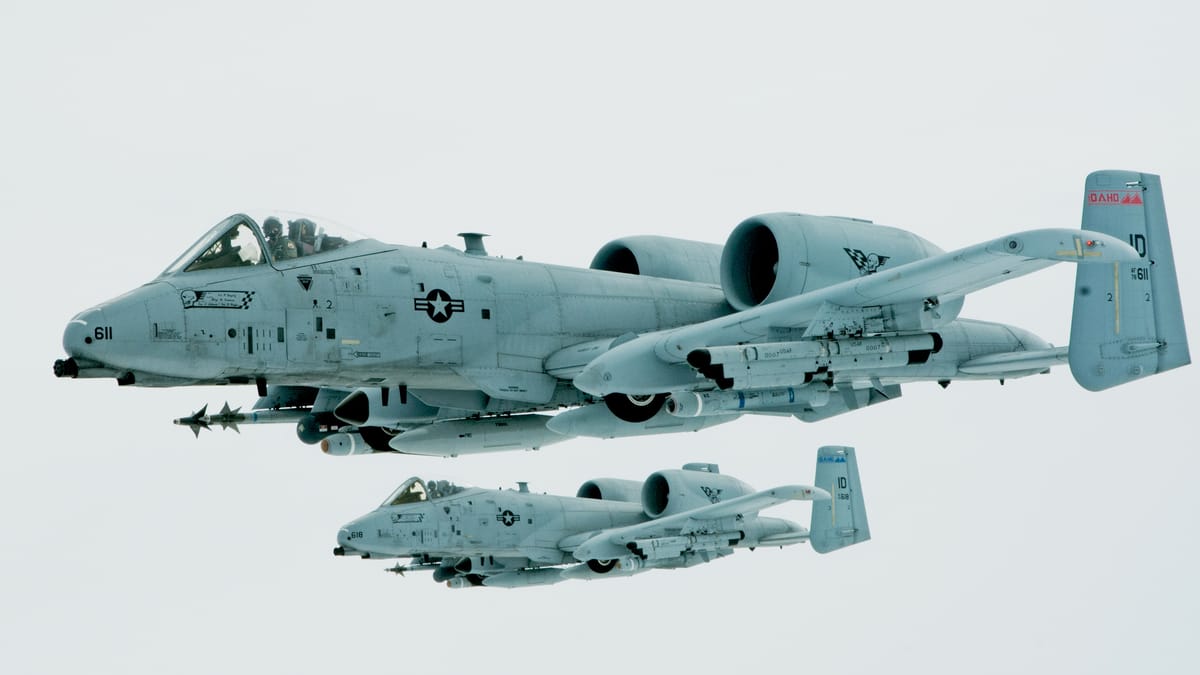
The A-10 Thunderbolt II is one of the rare military aircraft whose reputation became larger than its role.
To pilots and ground troops who loved it, the Warthog was a flying insurance policy: slow enough to stay close, tough enough to absorb damage, and armed around a 30 mm cannon that made the aircraft instantly recognizable. To Air Force planners, it was often a more complicated problem: a beloved single-mission attack jet in a service increasingly built around stealth, long-range sensors, contested airspace, and high-end conflict.
That tension explains why the A-10 has survived so many retirement attempts. The aircraft was not kept alive simply by nostalgia, and it was not targeted for retirement simply because senior leaders disliked it. It endured because it did a real job very well in permissive or semi-permissive skies. It is leaving because the Air Force believes the next war may not give it those skies.
As of June 2026, the retirement fight has moved from theory to physical drawdown. Davis-Monthan Air Force Base has marked final training and maintenance milestones. Hill Air Force Base has closed its A-10 depot-maintenance chapter. Air Combat Command has reported that some A-10s are still planned to remain in service at Moody and Whiteman until 2030, but the direction of travel is clear.
The Warthog is not vanishing in one theatrical final flight. It is being unwound base by base, shop by shop, and squadron by squadron.
Why the A-10 Was Built
The A-10 was born from a blunt Cold War problem: the Air Force needed a purpose-built close-air-support aircraft that could survive near the front, loiter over battlefields, and destroy armor.
Vietnam had exposed the limits of using fast fighters for every ground-attack problem. Speed helped aircraft survive, but it also made it harder to see, identify, and stay with troops in contact. Older attack aircraft could linger, but they were vulnerable. The Air Force needed something different from both the supersonic fighter-bomber and the leftover propeller-driven attacker.
That became the A-X program, which asked for an aircraft designed around close air support rather than adapted to it. Fairchild Republic’s answer became the A-10.
The design was almost stubbornly practical. The straight wing helped with low-speed handling and short-field operations. The high-mounted engines reduced the risk of ingesting debris from rough airstrips and separated the engines from some ground fire. The cockpit sat inside titanium armor. The fuel system was protected. The landing gear did not fully retract, giving a damaged aircraft a better chance of surviving a belly landing.
Then there was the gun.
The A-10 was built around the GAU-8/A Avenger, a seven-barrel 30 mm cannon. The Air Force fact sheet lists the gun at 3,900 rounds per minute and describes the aircraft as capable of carrying up to 16,000 pounds of mixed ordnance across under-wing and under-fuselage stations. In other words, the Warthog was never just a gun with wings. It was a weapons truck, but the gun gave the aircraft its identity.
What Made the Warthog Different
The A-10’s special quality was not speed. It was presence.
The Air Force fact sheet describes the aircraft as able to loiter near battle areas for extended periods, operate from bases with limited facilities, and support ground forces under low ceilings and poor visibility. Those were not glamorous design points, but they were exactly what close air support demanded.
A fast multi-role fighter can deliver precision weapons. A bomber can carry far more ordnance. A drone can stay overhead for a long time. The A-10’s appeal was the package: an armored pilot, a rugged airframe, a slow-speed turning radius, long loiter, short takeoff and landing, a large weapon load, and a culture built around talking to troops on the ground.
That culture matters. Close air support is not just an aircraft performance table. It is a relationship among pilots, joint terminal attack controllers, ground commanders, rules of engagement, radios, identification, and trust. The A-10 community became famous because it specialized in that relationship.
The aircraft’s combat record reinforced the legend. In the Gulf War, the Air Force credits A-10s with a 95.7 percent mission-capable rate, 8,100 sorties, and 90 percent of the AGM-65 Maverick missiles launched. Later wars in Afghanistan, Iraq, and Syria gave the Warthog another generation of defenders.
By the time retirement became a serious recurring debate, the argument was no longer just about an aircraft. It was about whether close air support itself would lose a dedicated advocate.
Why Retirement Became So Hard
The Air Force began trying seriously to retire the A-10 long before the last engine shop ceremony in 2026.
The logic was straightforward. Every aircraft type costs money, people, depot capacity, training pipelines, spare parts, software support, and attention. If the Air Force wanted to buy and sustain F-35s, upgrade bombers, field new missiles, and prepare for adversaries with modern air defenses, it had to make room somewhere.
The A-10 was an obvious target because it was specialized. Its core mission was valuable, but it was not stealthy, not fast, not long-ranged by modern strike standards, and not designed to fight inside dense integrated air defenses. In the Cold War central front or in counterinsurgency wars after 2001, that trade could be acceptable. Against a peer military with layered surface-to-air missiles, advanced fighters, electronic warfare, and long-range sensors, the trade looks much worse.
Congress often disagreed. Lawmakers and soldiers worried that retiring the A-10 would remove the one aircraft designed specifically around ground troops. Congressional Research Service work on the proposed retirement captured why the debate became so durable: the Air Force framed the issue around modernization and cost, while opponents framed it around battlefield risk and close-air-support expertise.
Both sides had a point. The A-10 was old and increasingly hard to justify against the future threat. It was also a uniquely trusted tool for a mission that does not become unimportant just because the aircraft is aging.
That is why the retirement argument lasted so long.
The 2026 Drawdown Is Different
What makes the current moment different is that the support structure is visibly winding down.
In February 2026, Air Force Materiel Command reported that the Ogden Air Logistics Complex at Hill Air Force Base was preparing to send off its final A-10 after decades of sustainment work. That mattered because Hill had been the primary location for structural repair, wing replacement, and major overhauls. When a depot line closes, it is not just one aircraft leaving. It is the end of a repair ecosystem.
In March 2026, Davis-Monthan hosted final A-10 training milestones and a final Luke Days appearance as pilots transitioned toward the F-35A and other Air Force assignments. Then, in May 2026, Air Combat Command reported the final A-10 engine build at Davis-Monthan, a maintenance milestone tied to roughly 50 years of A-10 activity at the base.
None of that means every Warthog is gone immediately. Air Combat Command’s May 2026 report says some A-10s are planned to remain in service until 2030 at Moody and Whiteman. But it does mean the institutional center of gravity has shifted. The question is no longer whether the Air Force can convince everyone that the A-10 should retire someday. The service is already taking apart the infrastructure that kept the aircraft central.
Why the Air Force Wants to Move On
The case against the A-10 is not that it failed. It is that it succeeded in a world the Air Force thinks is passing away.
The Warthog thrives when friendly forces control the air, enemy air defenses are limited, and pilots can work close to the fight. A future conflict with China or Russia could look very different. Aircraft may have to survive long-range missiles, networked sensors, electronic attack, enemy fighters, drones, and mobile air-defense systems before they ever get close enough to help ground troops.
That is why Air Force modernization points toward stealth, sensors, electronic warfare, unmanned teammates, stand-off weapons, and aircraft that can share data across a larger battlespace. Hill’s 2026 A-10 departure story explicitly framed the retirement as part of a broader shift toward high-end conflict, with investment moving toward platforms such as the F-35A and next-generation air dominance systems.
The uncomfortable part is that a better high-end force does not automatically produce a better close-air-support answer. F-35s can support troops. Bombers can support troops. Drones, attack helicopters, artillery, loitering munitions, and long-range fires can all support troops. But none of those things is a one-for-one cultural replacement for a Warthog pilot trained inside an A-10 community.
The Air Force is betting that close air support can be preserved as a joint mission even as the dedicated airframe exits.
What the A-10 Leaves Behind
The A-10’s legacy is easy to reduce to noise: the cannon, the shark teeth, the “brrrt” jokes, the battlefield mythology.
That misses the real lesson.
The Warthog lasted because it was designed around a specific mission and because the people who flew, maintained, and defended it believed that mission deserved specialized tools. It was not elegant in the fighter-poster sense. It was slow, blunt, tough, and purpose-driven. That was the point.
Its retirement does not prove that dedicated close air support was a mistake. It proves that even a beloved, successful aircraft can reach the edge of the threat environment it was built to survive.
The hard question is what comes next. If the Air Force carries the A-10’s close-air-support culture into new aircraft, sensors, weapons, and training, then the Warthog’s influence will outlast the airframe. If it treats retirement as permission to let that specialization fade, the loss will be bigger than an old attack jet.
The A-10 is finally leaving because nostalgia cannot armor an aircraft against modern air defenses. But the mission that made people nostalgic for it is not leaving at all.
Key Takeaways
-
The A-10 Thunderbolt II was purpose-built for close air support, survivability, rough-field practicality, and long loiter near ground troops.
-
Its reputation comes from the full package: rugged airframe, armored cockpit, GAU-8/A cannon, large weapons load, and a pilot community focused on ground-force support.
-
The Air Force has pushed retirement for years because the A-10 is old, specialized, and poorly matched to dense modern air-defense environments.
-
Congress and A-10 defenders resisted retirement because they feared losing a dedicated close-air-support aircraft and the expertise attached to it.
-
In 2026, the drawdown is visible in final training, depot, and engine-build milestones, even though some A-10s are planned to remain in service until 2030.

Simon Whistler
Simon Whistler hosts MegaProjects, bringing engineering, infrastructure, and military-machine stories into clear narrative focus for viewers who want the systems, tradeoffs, and human decisions behind the build.
Frequently Asked Questions
What is the A-10 Warthog?
The A-10 Thunderbolt II is a U.S. Air Force attack aircraft designed for close air support. It is known for rugged construction, long loiter time, short-field operation, and its 30 mm GAU-8/A Avenger cannon.
Why is the A-10 being retired?
The Air Force is retiring the A-10 as part of a broader modernization shift toward aircraft and systems better suited for high-end conflict, contested airspace, stealth operations, sensors, and networked warfare.
Is every A-10 gone in 2026?
No. Major A-10 missions and support lines are closing in 2026, but Air Combat Command reported in May 2026 that some A-10s are planned to remain in service at Moody and Whiteman Air Force Bases until 2030.
Why did Congress fight A-10 retirement?
Many lawmakers and ground-force advocates argued that the A-10 provided a dedicated close-air-support capability that multi-role fighters might not replace cleanly. The debate mixed military risk, budget priorities, local basing interests, and trust in the A-10 community.
Can the F-35 replace the A-10?
The F-35 can perform close-air-support missions, but it is not a direct A-10 clone. It brings stealth, sensors, networking, and precision weapons; the A-10 brought low-speed persistence, ruggedness, and a community built around close air support.
What is the A-10’s lasting legacy?
The A-10’s legacy is not just its cannon or combat record. It proved the value of designing an aircraft and training culture around troops on the ground, then sustaining that specialization for decades.
Sources
-
Air Combat Command: A-10 engine build marks closing chapter at Davis-Monthan
-
Davis-Monthan Air Force Base: A-10 makes final Luke Days appearance
-
Air Force Materiel Command: Final A-10 prepares to depart Hill AFB
-
Congressional Research Service: Proposed Retirement of A-10 Aircraft
-
Hero image source by Master Sgt. Becky Vanshur / U.S. Air National Guard, public domain.
Related Projects
Dassault Mirage
The Dassault Mirage family turned France's postwar fighter crisis into a global export success, from Mirage III and Mirage 5 to F1 and Mirage 2000.
Boeing E-4 Nightwatch
How the E-4 Nightwatch became America's airborne command center, built to keep national command authority alive through nuclear war, disasters, and crises.
Talon-A2
Talon-A2 is not a fielded missile yet. It is a reusable Mach 5-plus test vehicle that could change how fast the Pentagon learns hypersonics.
MQ-28 Ghost Bat
Australia's MQ-28 Ghost Bat is a Boeing-built collaborative combat aircraft designed to team with crewed jets, fire missiles, and scale allied airpower.