

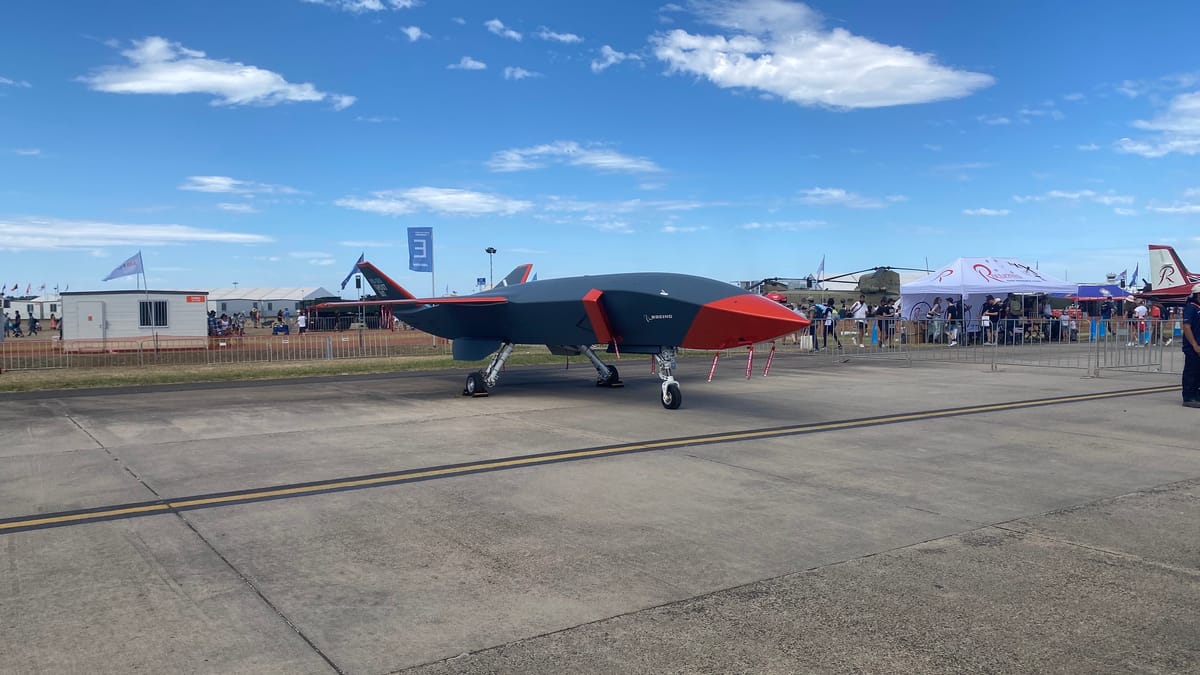
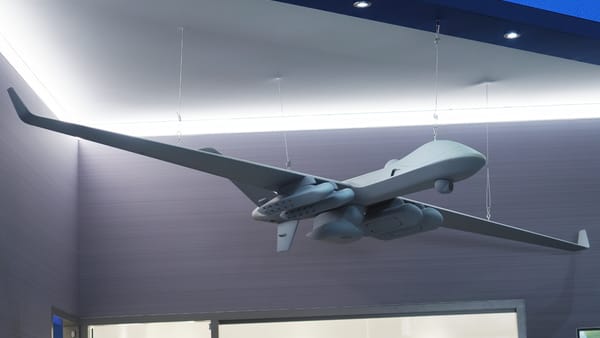
The MQ-28 Ghost Bat matters because it is not just another drone. It is Australia’s attempt to build a fighter-adjacent aircraft that can fly with crewed jets, extend their sensors and weapons, and add combat mass without putting another pilot in the cockpit.
That is the idea behind a collaborative combat aircraft. Instead of treating an uncrewed aircraft as a remote-control scout orbiting far away from the fight, the Ghost Bat is meant to work inside the air battle. It can fly with a Super Hornet, take direction from a Wedgetail command aircraft, use its own autonomy to reduce operator workload, and carry mission packages in a swappable nose.
The larger bet is political and industrial as much as technical. Australia has built a modern combat aircraft at home for the first time in more than half a century. Boeing has a product it can pitch to allied air forces that want autonomous wingmen quickly. And countries watching the cost of crewed fighters now have a serious example of what “affordable combat mass” might look like.
The Ghost Bat is still moving from test aircraft toward operational service, so the cautious question is not whether it has already transformed air warfare. It has not. The better question is whether it has crossed the line from impressive demonstrator to credible weapon system.
By 2026, the answer is starting to look like yes.
Why Loyal Wingmen Exist
Modern air forces have a simple arithmetic problem. Advanced crewed aircraft are extremely capable, but they are also expensive, scarce, and dependent on highly trained pilots. Losing one in combat is a strategic, financial, and human blow.
Uncrewed aircraft promise a different balance. A loyal wingman does not need life support, a cockpit, an ejection seat, pilot training pipelines, or the same political calculation before sending it into danger. It can fly ahead of a crewed aircraft, carry sensors, jam radars, act as a decoy, or fire a weapon after a human authorizes the shot.
That does not make pilots obsolete. It changes what the pilot or mission commander controls. The model is less like flying every aircraft by hand and more like assigning tasks to several machines that can handle the mechanics of flight and parts of the tactical routine themselves.
The Ghost Bat sits in that space. Boeing describes the MQ-28 as an uncrewed collaborative combat aircraft designed to team with existing military aircraft. Its published specifications put it at 38 feet long, with a 24-foot wingspan, fighter-compatible speed up to Mach 0.9, a ceiling above 40,000 feet, and a range of more than 2,000 nautical miles.
Those figures explain why it is more ambitious than a reconnaissance drone. It is meant to keep up with fast jets, operate over large distances, and survive long enough to matter in contested airspace.
Australia’s Unusual Bet
The Ghost Bat began as the Boeing Airpower Teaming System, a partnership between Boeing Australia and the Royal Australian Air Force. The first aircraft was rolled out in 2020, and Boeing says the first flight came in early 2021.
The location matters. Australia is not the United States, China, Russia, or one of Europe’s traditional fighter-building powers. It does not operate a massive air force, and it usually buys high-end aircraft from abroad. Its F-35A fleet, Super Hornets, Growlers, Wedgetails, tankers, and maritime patrol aircraft all sit inside a network of allied supply chains and foreign designs.
Building the Ghost Bat at home gives Australia something different: a sovereign project that can support local industry, create a national uncrewed-aircraft ecosystem, and give the RAAF a platform shaped around its own geography.
That geography is unforgiving. Australia has enormous distances, a small population, and a defense strategy increasingly focused on the Indo-Pacific. A force that can add uncrewed aircraft to crewed jets without multiplying pilot demand is attractive for a country that needs reach and persistence more than symbolic fleet size.
Boeing Australia also built the aircraft with export in mind. The MQ-28 is modular, with an open architecture and a missionized nose that can be swapped for different payloads. That matters because a buyer does not just want Australia’s drone. It wants a platform that can accept its own sensors, communications, weapons interfaces, and national requirements.
The Nose Is the Point
The Ghost Bat’s detachable nose is one of its most important design choices.
On a conventional aircraft, changing the mission can mean expensive internal modifications. On the MQ-28, the nose is designed as the place where mission systems can be changed. One configuration might emphasize intelligence, surveillance, and reconnaissance. Another might prioritize electronic warfare. Another could carry sensors or interfaces for weapons employment.
That makes the aircraft easier to pitch internationally. Germany, Japan, the United Kingdom, Canada, or any other potential operator will have different radios, data links, rules, industrial partners, and weapons priorities. A platform that can be adapted without redesigning the whole airframe is more useful than a closed system built only for one customer.
The modular nose also hints at the longer-term value of the aircraft. Autonomy software, sensors, processors, and electronic warfare tools age quickly. Airframes can last decades. If the mission package can change faster than the airplane around it, the Ghost Bat has a better chance of staying relevant after its first operational version is no longer cutting edge.
That is the promise. The risk is that modularity can become a slogan unless integration is simple, tested, and affordable. Every customer-specific payload still has to be certified, secured, supported, and connected to the rest of the force.
From Demonstrator to Weapon
For several years, the MQ-28 looked like a sophisticated but still cautious test program. It flew. It teamed. It showed the RAAF and Boeing how an uncrewed aircraft could operate with command-and-control aircraft and fighters. But the question that followed every loyal wingman project was obvious: can it actually fight?
In December 2025, Boeing and the RAAF announced a major step. During a test at the Woomera Test Range in South Australia, an MQ-28 teamed with an E-7A Wedgetail and an F/A-18F Super Hornet, received targeting data, repositioned, and used an AIM-120 AMRAAM to destroy an airborne target drone.
That test matters for two reasons.
First, it showed the Ghost Bat moving beyond passive support. A drone that can only look, listen, and distract is useful. A drone that can join a weapons engagement is a different category of problem for an adversary.
Second, the test showed the command structure Boeing and the RAAF want people to understand. The MQ-28 was not acting as an independent killer robot. It was operating as part of a crewed-uncrewed team, with a human operator in the loop and other aircraft contributing sensor and control inputs.
That distinction matters. Collaborative combat aircraft depend on autonomy, but they also depend on trust. Air forces will not field them at scale unless commanders understand what the aircraft can do, when a human authorizes force, and how the system behaves when communications are degraded.
The missile shot did not answer every question. It did, however, give Australia and Boeing a concrete demonstration they can point to when customers ask whether the Ghost Bat is still just a technology demonstrator.
The Funding Signal
The day after the live weapons announcement, the Australian government said it would invest about A$1.4 billion to advance collaborative air capabilities and move the MQ-28A toward an operational warfighting role.
That funding included contracts with Boeing Defence Australia for six operational Block 2 aircraft and development of an enhanced Block 3 prototype. It also placed the Ghost Bat inside Australia’s broader investment in uncrewed and autonomous systems.
That is a meaningful signal. Governments praise prototypes all the time. Funding production-relevant aircraft is different. It means the program has moved far enough that Australia sees it as a real capability path, not merely an experiment to learn from and shelve.
It also changes the export conversation. A foreign air force is more likely to consider a system that its home country is buying and developing into service. If Australia treats the Ghost Bat as a core part of future air combat, buyers can argue they are joining a live ecosystem instead of purchasing an orphaned demonstrator.
Germany Is the Test Case
The most visible export push came in March 2026, when Boeing Australia and Rheinmetall announced a strategic partnership to offer the MQ-28 to Germany for its collaborative combat aircraft requirement.
That partnership is important because Germany is not simply shopping for an aircraft. It needs integration, national industrial participation, sustainment, and a path into its existing and future command-and-weapon systems. Rheinmetall gives Boeing a German system manager with local credibility and the industrial reach to help adapt the aircraft to Bundeswehr requirements.
For Boeing, Germany is a chance to prove the Ghost Bat can travel. For Rheinmetall, it is a chance to participate in the uncrewed combat aircraft layer without waiting for a clean-sheet European system to mature. For Germany, it is an option that may arrive faster than a domestic alternative, though that speed will have to be weighed against sovereignty, politics, and integration risk.
The Ghost Bat will not be alone. Airbus has promoted its own Wingman concept for Europe. The United States is developing the YFQ-42A with General Atomics and the YFQ-44A with Anduril. Kratos has the XQ-58A Valkyrie flying with U.S. services. Turkey has the Bayraktar Kizilelma. China, Russia, and India are also pursuing related ideas.
That competition is the point. The Ghost Bat is not entering an empty market. It is entering the first serious international race for autonomous combat aircraft.
The Hard Problems
The Ghost Bat’s biggest challenge is not proving that an uncrewed jet can fly. That part is already done.
The challenge is proving that it can be useful, reliable, secure, and affordable at operational scale. An aircraft like this has to communicate in contested environments. It has to resist jamming and cyberattack. It has to know what to do when links are degraded or lost. It has to be maintainable by ordinary squadrons, not just by engineers supporting a test program.
There is also the human workload problem. The loyal wingman pitch often imagines one pilot controlling several drones. That sounds powerful, but fighter pilots are already busy. If controlling three uncrewed aircraft turns the cockpit into a management nightmare, the concept fails. The autonomy has to be good enough that the human gives intent and permission rather than constant flight instructions.
Cost is another pressure point. The Ghost Bat is designed to be cheaper than crewed combat aircraft, but “cheaper than a fighter” is not the same as disposable. If each aircraft becomes too expensive, commanders will hesitate to risk them. If it becomes too cheap and limited, it may not survive or contribute enough to justify the logistics chain.
The useful middle ground is attritable but capable: valuable enough to carry real sensors and weapons, inexpensive enough to send forward, and replaceable enough that combat losses do not cripple the force.
That is a narrow target.
What the Ghost Bat Could Become
In its most useful form, the Ghost Bat is not a replacement for the F-35, Super Hornet, or Wedgetail. It is a way to make those aircraft more dangerous.
A fighter could use Ghost Bats to scout ahead, complicate enemy targeting, carry extra sensors, or present multiple possible threats at once. A Wedgetail could help coordinate uncrewed aircraft over a larger area. A tanker or surveillance aircraft might eventually use them as protective escorts. In a strike package, one Ghost Bat might jam, another might look, and another might carry a weapon.
That is why the phrase “combat mass” keeps appearing around these programs. Modern airpower is not just about the best individual aircraft. It is about how many sensors, weapons, emitters, decoys, and decisions can be put into the battlespace at once.
The Ghost Bat gives Australia a way to increase that mass without matching the scale of larger air forces. It gives Boeing Australia a rare homegrown combat aircraft story. It gives allied customers a mature candidate in a market that still has more concepts than operational fleets.
None of that guarantees success. The history of advanced aircraft is full of prototypes that seemed to point toward the future and then ended up as footnotes. The Ghost Bat still has to enter service, scale production, win customers, and prove it can survive the electronic and missile environment it was built for.
But it has already crossed several thresholds that many programs never reach. It has flown more than a token test schedule. It has teamed with crewed aircraft. It has fired a live air-to-air missile in an integrated mission. It has secured fresh Australian funding. It has a serious German industrial partner.
That makes the MQ-28 Ghost Bat one of the clearest signs that the loyal wingman idea is leaving the slide deck and entering the inventory.
Key Takeaways
-
The MQ-28 Ghost Bat is an Australian-designed Boeing collaborative combat aircraft built to team with crewed platforms.
-
Its modular nose and open architecture are central to the export pitch because customers can adapt mission systems to national needs.
-
The December 2025 AIM-120 test moved the Ghost Bat from support-drone concept toward credible weapons employment.
-
Australia’s A$1.4 billion funding decision signaled a shift toward operational Block 2 aircraft and a more advanced Block 3 prototype.
-
Germany, through the Boeing-Rheinmetall partnership, is an important test of whether the Ghost Bat can become an allied export product.

Simon Whistler
Simon Whistler hosts MegaProjects, bringing engineering, infrastructure, and military-machine stories into clear narrative focus for viewers who want the systems, tradeoffs, and human decisions behind the build.
Frequently Asked Questions
What is the MQ-28 Ghost Bat?
The MQ-28 Ghost Bat is an uncrewed collaborative combat aircraft developed by Boeing Australia with the Royal Australian Air Force. It is designed to fly with crewed military aircraft and add sensors, mission systems, and potentially weapons to an air combat formation.
Is the Ghost Bat a fighter jet?
Not in the traditional sense. It is an uncrewed jet-powered aircraft with fighter-like performance, but it is built to support and extend crewed aircraft rather than replace a pilot-operated fighter one-for-one.
Can the Ghost Bat carry weapons?
Yes. In December 2025, Boeing and the RAAF announced that an MQ-28 had used an AIM-120 AMRAAM during a crewed-uncrewed engagement at Woomera, destroying an airborne target drone.
Why is Australia building the Ghost Bat?
Australia wants a way to add combat mass, reach, and survivability to its air force without simply buying more crewed aircraft. The program also supports Australian defense industry and gives the country a sovereign uncrewed combat aircraft capability.
Why is Germany interested in the MQ-28?
Germany is seeking collaborative combat aircraft for future airpower needs. Boeing Australia and Rheinmetall partnered in 2026 to offer the MQ-28 as a platform that could be adapted to German command, weapon, sustainment, and industrial requirements.
Does the Ghost Bat operate without humans?
The Ghost Bat uses autonomy to fly and execute mission tasks with reduced workload, but the public concept is crewed-uncrewed teaming. Weapons employment is presented as a human-authorized mission, not a fully independent combat decision.
Sources
-
Original MegaProjects video: The Boeing MQ-28: The Drone Everybody Wants
-
Boeing Australia: Boeing, RAAF achieve CCA missile fire from MQ-28 Ghost Bat
-
Australian Defence Ministers: Funding boost for Australian-made Ghost Bat
-
Boeing Australia: Rheinmetall and Boeing partner on German MQ-28 Ghost Bat
-
U.S. Air Force: YFQ-42A and YFQ-44A collaborative combat aircraft designations
-
Hero image source by HoHo3143 / Wikimedia Commons, CC BY-SA 4.0.
Related Projects
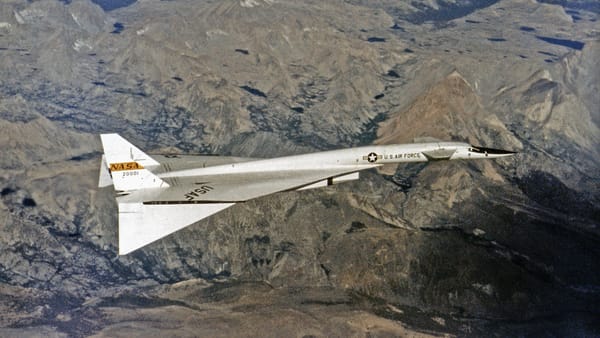
Aurora Spy Plane
The Aurora legend began with a black-budget line item, sonic booms, and triangular sightings. The evidence points to something murkier than one spy plane.
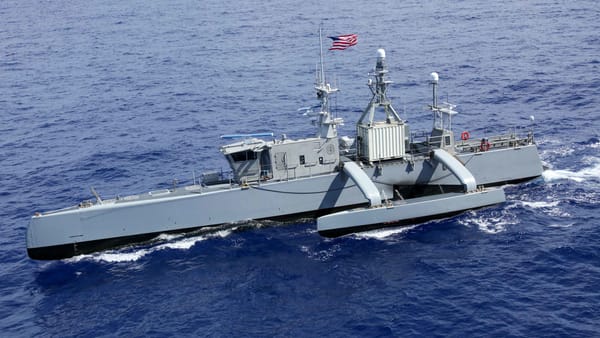
Sea Hunter
How Sea Hunter grew from a DARPA submarine-tracking prototype into a fleet-controlled unmanned surface vessel for the U.S. Navy.
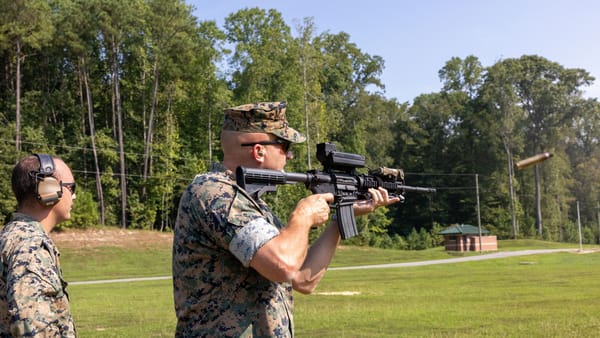
SMASH 2000L
How SMARTSHOOTER's Smash 2000L fire-control optic helps infantry engage small drones, and why smart rifle scopes still face hard battlefield limits.


.jpg)