
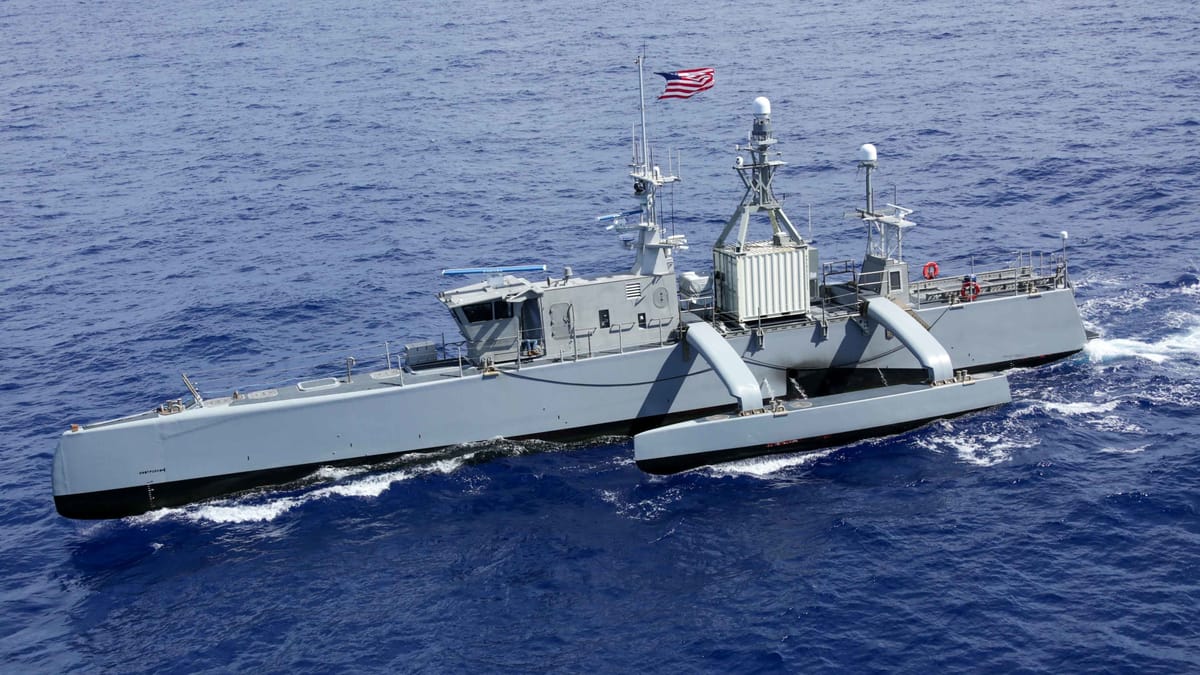
The U.S. Navy’s Sea Hunter looks, at first glance, like a science-fiction support craft that wandered into a real naval exercise. It has a narrow central hull, two outriggers, a low grey profile, and no bridge full of sailors looking out over the bow.
That missing bridge is the point.
Sea Hunter was built as a medium displacement unmanned surface vessel, or MDUSV: a seagoing platform designed to travel thousands of miles without a crew aboard. Its original mission was brutally practical. The Navy wanted a vessel that could trail submarines for long periods, carry sensors into risky water, and do the exhausting parts of maritime surveillance without tying up a manned warship and its crew.
The program began as DARPA’s Anti-Submarine Warfare Continuous Trail Unmanned Vessel, better known as ACTUV. By 2016, the prototype was in open-water testing. By 2018, DARPA had transferred Sea Hunter to the Office of Naval Research for further development. By 2026, Navy officials were describing Sea Hunter and its follow-on, Sea Hawk, as no longer just experimental craft but fleet-controlled systems being moved into operational use.
That makes Sea Hunter important beyond its own hull. It is not merely a drone boat. It is one of the first serious attempts to answer a much larger question: what happens when naval power no longer requires every sensor, decoy, supply run, and patrol station to carry people?
Why the Navy Wanted a Crewless Ship
For most of naval history, endurance meant people. A ship could only stay useful as long as its crew could be fed, housed, rested, protected, trained, and rotated. Even a lightly armed patrol vessel needs berthing, life support, sanitation, safety systems, medical planning, and the operational discipline that comes with keeping humans alive at sea.
An unmanned vessel changes the arithmetic. Remove the crew and a ship can be smaller, cheaper to operate, and less politically costly to risk. It can loiter in boring patrol boxes, take on dangerous missions, or act as a forward sensor without asking a commander to put dozens or hundreds of sailors in harm’s way.
That was especially attractive for anti-submarine warfare. Modern submarines are hard targets. Diesel-electric boats using air-independent propulsion can be extremely quiet. Nuclear submarines can stay submerged for long stretches. The ocean is huge, cluttered, noisy, and uneven. Finding a submarine is less like spotting a ship and more like noticing a faint pattern in a storm.
Sea Hunter’s original promise was persistence. A manned ship might need to leave station for fuel, maintenance, or crew needs. A drone ship designed for long endurance could keep listening, following, and reporting. DARPA described the vessel as a way to create a new class of ocean-going platform able to cross thousands of kilometers over open water for months at a time without a crew aboard.
That does not make Sea Hunter a magic submarine detector. It still depends on sensors, mission planning, communications, and the wider naval kill chain. What it does is move more of that search burden onto a platform that can stay out longer and cost less than a manned combatant.
The ACTUV Prototype
ACTUV was not designed as a remote-controlled speedboat. DARPA wanted a vessel that could handle much of the routine work of safe navigation on its own.
That distinction matters. Remote control still requires a human operator to steer moment by moment. Sea Hunter was built around a more autonomous model: operators assign mission goals and constraints, while the vessel’s onboard systems handle route execution, collision avoidance, and compliance with maritime rules inside those parameters.
During development, DARPA and the Office of Naval Research tested the vessel’s ability to operate under the International Regulations for Preventing Collisions at Sea, the rules that keep vessels from turning normal traffic into chaos. A crewless ship has to recognize nearby contacts, predict how they are moving, and behave in a way other mariners can understand.
The hull form supports that mission. Sea Hunter is a trimaran, with a main hull and two smaller outriggers. The shape gives the vessel stability and efficiency, both of which matter when the platform is expected to remain at sea for long stretches and carry sensitive sensors. Public figures commonly describe the craft as roughly 132 to 135 feet long, displacing around 135 tons, with endurance measured in weeks or months rather than days.
It also has no obvious heavy weapon system. That can make the vessel seem less dramatic than the phrase “future of naval warfare” suggests, but sensors are often the first step in naval power. A ship that finds a target, relays data, acts as a decoy, maps an area, or helps a task group understand the ocean around it can change a fight without firing a shot itself.
What Sea Hunter Can Do
The headline mission is submarine tracking, but the platform’s value is broader than that.
Sea Hunter can serve as an anti-submarine sensor platform, patrolling wide areas and feeding contacts to manned ships, aircraft, or shore-based commanders. It can also support intelligence, surveillance, and reconnaissance. A crewless vessel can be sent into areas where commanders want more information but do not want to escalate by sending a destroyer or frigate.
Mine countermeasures are another natural fit. Mines are dangerous, slow to clear, and politically awkward because clearing them often means putting people close to explosive devices. A drone surface vessel that can carry mine-hunting payloads gives the fleet another way to inspect or sanitize risky water.
The same logic applies to decoy work. An unmanned vessel can imitate signatures, distract sensors, force an adversary to reveal itself, or complicate the enemy’s target list. In a distributed fleet, forcing an opponent to spend attention and weapons on the wrong contact can be as valuable as adding another missile launcher.
Watch the Video
Open VideoSea Hunter also fits logistics and relay missions. It can act as a maritime communications node, carry modular payloads, inspect undersea infrastructure, or support search and rescue. None of those jobs is as cinematic as a missile strike, but all of them consume time and manpower in a fleet that is trying to cover huge ocean spaces.
The Navy has also kept the payload discussion deliberately broad. Public reporting in 2026 described future unmanned surface vessels as candidates for surveillance, counter-mine work, kinetic effects, and other modular missions. That does not prove Sea Hunter is carrying weapons today. It does show that the Navy is thinking about unmanned vessels as flexible fleet nodes rather than single-purpose test craft.
Why Autonomy at Sea Is Hard
The ocean is not an empty testing range.
A crewless vessel has to deal with commercial traffic, fishing boats, weather, debris, mechanical faults, communications dropouts, contested electromagnetic environments, and the simple reality that salt water breaks things. It must know where it is, understand what is around it, and keep behaving safely when conditions change.
Maintenance may be the hardest practical problem. A human crew can notice a strange vibration, reset a system, check a leak, or improvise a repair. An unmanned vessel has to monitor itself, report failures, and degrade gracefully. If it loses propulsion or power far from friendly ships, the problem becomes operational very quickly.
Sea Hunter’s own test history shows why this matters. During a 2019 autonomous transit between San Diego and Pearl Harbor, public reporting said an escort had to board the vessel several times on the outbound leg to correct mechanical problems. The return trip was smoother, but the lesson was obvious: autonomy is not only software. It is reliability, maintenance design, redundancy, and the Navy’s ability to support a new kind of vessel at sea.
Command authority is another unresolved question. Who gives a drone ship orders? How much autonomy is appropriate near other vessels? What happens if it is jammed? How does a task group commander trust data from unmanned sensors? How does the Navy keep a human in the loop if a payload could someday create kinetic effects?
These are not arguments against Sea Hunter. They are the reason Sea Hunter matters. It gives the Navy a real platform for turning abstract questions about autonomy into doctrine, training, and fleet procedures.
From Prototype to Fleet Control
Sea Hunter did not stay alone for long. In 2017, the Navy contracted Leidos to build a second vessel based on lessons from the prototype. That follow-on craft, Sea Hawk, was delivered in 2021. Together, Sea Hunter and Sea Hawk became the pathfinders for a larger medium unmanned surface vessel effort.
They appeared in major exercises, including RIMPAC 2022, where Sea Hunter sailed in formation with manned warships and other unmanned systems. Those exercises matter because they force unmanned systems to operate around real fleets rather than in isolated demonstration lanes.
The operational step came in 2026. Navy officials said Sea Hunter and Sea Hawk would move under fleet control and cease being treated purely as experimental vessels. Public reporting on June 4, 2026, identified Sea Hawk as preparing to deploy with the Theodore Roosevelt carrier strike group, a milestone for integrating medium unmanned vessels with normal carrier operations.
That does not mean a fully robotic navy has arrived. It means the Navy is moving from experiments toward working out how these craft actually fit into task groups, watches, communications plans, maintenance cycles, and command relationships.
The larger ambition is clear. Officials have described a future surface force with a major unmanned component, and 2026 reporting described the Navy selecting companies for at-sea medium unmanned surface vessel prototype testing. Sea Hunter’s job, in that context, is to prove the first layer of the idea: that unmanned vessels can be trusted enough to operate with the fleet and useful enough to justify scaling.
The Naval Future Sea Hunter Points Toward
Sea Hunter is easy to oversell if it is treated as a single revolutionary ship. Two grey trimarans will not replace destroyers, frigates, submarines, or carriers. They do not carry the command facilities, missile magazines, air-defense systems, aviation facilities, or damage-control capacity of manned warships.
The real shift is cumulative. A fleet with dozens of unmanned surface vessels can put more sensors in more places. It can make adversaries sort real warships from decoys. It can send cheaper platforms into places where a commander would hesitate to send sailors. It can stretch human crews across a wider operating area.
That kind of force is not less complex. It is more complex. It requires doctrine, communications discipline, maintenance systems, cyber protection, rules of engagement, training pipelines, and commanders who understand what autonomy can and cannot do.
Sea Hunter is therefore less a finished answer than a working prototype of a new naval habit. It shows how a crewless vessel can sail with the fleet, take on persistence missions, and begin shifting some risk away from people and onto machines.
If the Navy succeeds, the warships of the future may still have crews, but they will not sail alone. They will move through a wider network of unmanned scouts, relays, decoys, supply craft, and sensor platforms. Sea Hunter is one of the first serious shapes that future has taken.
Key Takeaways
-
Sea Hunter began as DARPA’s ACTUV program, an unmanned vessel built to trail submarines and test large-scale maritime autonomy.
-
The vessel is a trimaran medium unmanned surface vessel, designed for long endurance without a crew aboard.
-
Its core value is persistence: it can carry sensors, patrol, relay data, and support risky missions without tying up a manned warship.
-
Sea Hunter and Sea Hawk moved from prototypes toward fleet-controlled operational use in 2026, according to public Navy reporting.
-
The platform’s hardest questions are not just technical; the Navy still has to refine doctrine, maintenance, command authority, and human oversight.

Simon Whistler
Simon Whistler hosts MegaProjects, bringing engineering, infrastructure, and military-machine stories into clear narrative focus for viewers who want the systems, tradeoffs, and human decisions behind the build.
Frequently Asked Questions
What is Sea Hunter?
Sea Hunter is a U.S. Navy medium unmanned surface vessel that began as DARPA’s ACTUV prototype. It was built to test autonomous long-endurance maritime operations, especially submarine tracking and sensor missions.
Is Sea Hunter remotely piloted?
Sea Hunter is not meant to be steered moment by moment like a simple remote-control boat. Operators can assign mission goals and constraints, while onboard autonomy handles route execution, safe navigation, and other routine decisions within those boundaries.
What was Sea Hunter built to track?
Its original mission was anti-submarine warfare. The idea was to create a persistent unmanned vessel that could use sensors to help find and trail submarines over long distances without requiring a crewed ship to remain on station.
Does Sea Hunter carry weapons?
Public imagery and reporting do not show Sea Hunter as a heavily armed combatant. The Navy has discussed modular payloads and future unmanned vessels with possible kinetic effects, but Sea Hunter’s publicly demonstrated role is primarily sensing, autonomy testing, and fleet integration.
What is the difference between Sea Hunter and Sea Hawk?
Sea Hunter came first as the DARPA prototype. Sea Hawk is a follow-on Leidos-built vessel delivered to the Navy in 2021, informed by lessons from Sea Hunter. Public reporting often discusses them together as medium displacement unmanned surface vessels.
Why does the Navy want unmanned surface vessels?
Unmanned surface vessels can reduce risk to sailors, extend surveillance coverage, perform repetitive patrol tasks, carry modular payloads, and complicate an adversary’s targeting problem at a lower cost than many crewed warships.
Has Sea Hunter entered operational use?
In January 2026, Navy officials said Sea Hunter and Sea Hawk would no longer be treated purely as experimental vessels and would come under fleet control. Public reporting in June 2026 also described Sea Hawk preparing to deploy with a carrier strike group.
Sources
-
Original MegaProjects video: DARPA Just Unveiled its New Autonomous Unmanned Surface Vehicle
-
DARPA: ACTUV Sea Hunter Prototype Transitions to Office of Naval Research
-
Breaking Defense: No longer experimental, Navy to deploy drone boats this year
-
Military Times: U.S. Navy selects companies for at-sea MUSV prototype testing
-
Hero image source by MC3 Aleksandr Freutel / U.S. Navy, public domain.