
By the late 2000s, the United States Navy had an uncomfortable problem: it had spent years preparing to strike land targets while its long-range ship-killing muscle faded.
The Harpoon missile remained in service, but it was a Cold War weapon with a range that forced launch platforms dangerously close to modern defenses. The anti-ship version of Tomahawk had been retired after the Cold War. Carrier air wings, bombers, and surface ships still had plenty of firepower, but the specific ability to find and hit enemy warships at long range had not kept pace with the threat.
Then the Pacific problem became harder to ignore. China invested in anti-access and area-denial systems, including long-range missiles intended to threaten U.S. carriers and surface combatants. American ships could not assume they would be allowed to close the distance before firing first. A fleet built around sea control needed a weapon that could reach out, survive, and discriminate targets in a contested maritime environment.
That weapon became the AGM-158C Long Range Anti-Ship Missile, or LRASM.
LRASM is not spectacular because it is the fastest missile in the world. It is subsonic. Its value comes from a different bet: stealth, range, onboard sensors, and enough autonomy to finish the hardest part of the mission when an enemy is trying to jam or deceive the kill chain.
Why the Navy Needed LRASM
The U.S. Navy’s anti-ship gap was partly a result of success elsewhere.
After the Cold War, American naval aviation and surface combatants spent much of their combat time projecting power ashore. Tomahawks hit land targets. Carrier aircraft flew strike missions over Iraq, Serbia, Afghanistan, Syria, and other theaters. The Navy became extremely good at precision attack against fixed land targets.
Ship-versus-ship combat moved to the background. The Navy had not fought a major surface action since Operation Praying Mantis in 1988. The Harpoon remained the standard anti-ship weapon, but potential adversaries kept investing in newer sensors, longer-ranged missiles, dense air defenses, and electronic warfare.
The imbalance mattered most in the Pacific. A U.S. carrier strike group is powerful, but it is not invulnerable. If adversary missiles can threaten carriers and escorts from farther away than the Navy can threaten enemy ships, the entire operating model comes under pressure.
Developing a brand-new weapon through the normal acquisition pipeline could take too long. So the Navy and DARPA pursued a faster route. DARPA’s role was unusual for an operational missile, but it made sense: the agency could prototype quickly, accept technical risk, and move around the slowest parts of conventional procurement.
The program originally explored two ideas. LRASM-A was a stealthy, subsonic missile based on the AGM-158B JASSM-ER airframe. LRASM-B pursued a higher-speed approach. By 2012, the faster concept had been dropped as too expensive and risky for the urgent timeline. The program consolidated around the stealthy, smarter, subsonic missile.
That choice defined LRASM. Instead of trying to outrun every defense, it would try to be hard to detect, hard to classify, and capable of finding the correct ship even when the target had moved.
The JASSM-ER Foundation
LRASM’s airframe comes from the AGM-158 family, particularly the JASSM-ER, a stealthy cruise missile originally built for land attack. That inheritance gave the program a proven body, propulsion architecture, and low-observable shape.
But turning a land-attack cruise missile into an anti-ship weapon is not a simple software update.
A fixed building or bunker stays where intelligence says it is. A ship moves. It may operate in a group with escorts, decoys, commercial traffic, emissions control, and active jamming. By the time a missile reaches the general target area, the original coordinates may no longer be enough.
LRASM had to solve that terminal problem. It uses inertial navigation and GPS for the transit phase, but its defining feature is the sensor and mission-system package that takes over near the target area. Public descriptions identify a multi-modal sensor suite, anti-jam GPS, a weapons datalink, and a 1,000-pound penetrator/blast-fragmentation warhead.
The missile is designed to approach a search area, use onboard sensors to sort contacts, and select the intended high-value target. That kind of semi-autonomous behavior reduces dependence on continuous communications from the launch aircraft or ship, a major advantage in a fight where datalinks may be jammed or cut.
This is why LRASM is often described as smarter rather than simply faster. Speed can reduce reaction time, but it does not solve target discrimination by itself. A missile still has to hit the right ship.
Stealth Instead of Raw Speed
The most obvious criticism of LRASM is that it is subsonic. Against a modern warship, why not build something that screams in at Mach 3 or faster?
The answer is that speed creates its own costs. Supersonic missiles usually demand more fuel, larger propulsion systems, hotter airframes, and more engineering compromise. They may be easier to see on sensors because they are physically hot and often fly more predictable profiles. They can be extremely dangerous, but they are not automatically better for every mission.
LRASM took the JASSM-ER path. It flies below the speed of sound, using low-observable shaping, route planning, sea-skimming approach profiles, and onboard targeting to compress the defender’s decision window. The goal is not to give a ship plenty of warning and then race its interceptors. The goal is to arrive late in the defender’s awareness cycle and force the ship to solve a difficult identification and engagement problem quickly.
Watch the Video
Open VideoThat approach also fits air-launched employment. A B-1B or F/A-18E/F can release LRASM from standoff range, while the missile covers the final distance on its own. The launching aircraft does not need to remain in a neat, vulnerable communication chain all the way to impact.
The result is a weapon built around maritime ambiguity. Enemy ships move, hide, emit, jam, and travel among other vessels. LRASM’s value is that it was designed for that messy environment rather than for a clean coordinate strike.
The Test Program
LRASM moved quickly because it had to.
In 2013, the program demonstrated key air-launched capabilities over the Pacific. The missile flew planned waypoints, entered a target area containing multiple vessels, used onboard systems to identify the intended target, and struck a decommissioned ship. Follow-on testing showed additional maritime targeting and flight performance.
Surface-launch work also advanced. Engineers tested compatibility with the Mk 41 vertical launch system and shipboard command systems, proving that a canister-launched LRASM was technically possible. But the early operational path focused on aircraft, where the urgency was greatest and integration risk was lower.
In February 2015, a joint Navy, Air Force, and DARPA test evaluated low-altitude performance and obstacle avoidance. NAVAIR said the missile launched from a B-1 bomber, navigated through pre-planned waypoints, detected an object placed in its flight pattern, avoided it, and continued the mission profile.
Those tests mattered because LRASM’s premise depended on more than propulsion. The missile had to show it could fly a complex route, adapt near the target area, and use its mission systems without constant operator steering.
The program then moved from DARPA demonstration toward operational weapons procurement. That transition was not inevitable. It required the Pentagon to treat LRASM as an urgent operational capability, accepting a faster acquisition pathway because the anti-ship gap was considered real and pressing.
From Stopgap to Mainstay
LRASM was often described as a bridge: a near-term weapon that would hold the line until later anti-ship programs arrived. In practice, bridges can become roads.
The Air Force declared early operational capability with LRASM on the B-1B Lancer in December 2018. The B-1B pairing is important because of volume. A single bomber can carry a large internal load of cruise missiles, allowing one sortie to generate a serious anti-ship salvo.
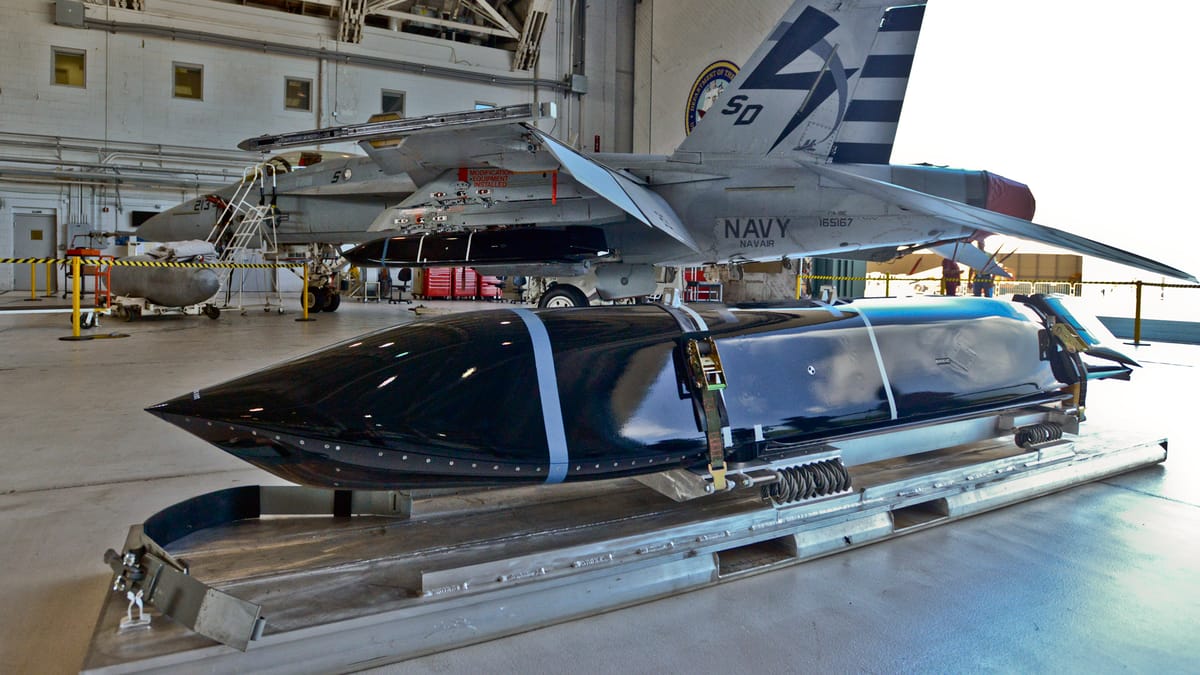
The Navy followed with early operational capability on the F/A-18E/F Super Hornet in November 2019. The Super Hornet cannot carry as many LRASMs as a bomber, but it operates from aircraft carriers. That gave carrier strike groups their own long-range anti-ship punch without relying only on land-based aircraft.
By the 2020s, LRASM was no longer just a temporary patch. It was a fielded weapon with production, allied interest, and modernization underway. Australia received U.S. approval to buy LRASM, and the missile became a key part of long-range maritime strike planning in the Indo-Pacific.
The Department of Defense’s FY 2026 weapons documentation describes LRASM as a Navy-led joint interest program derived from JASSM-ER. It also notes the early operational capability dates on B-1B and F/A-18E/F and describes the Navy’s procurement of the LRASM C-3 Extended Range variant beginning in FY 2024.
That extended-range path matters. As threats improve, LRASM has to keep its reach, survivability, datalink, and software relevant. A missile fielded quickly in response to an urgent gap still needs continuous upgrades if it is going to remain useful.
What LRASM Changes at Sea
LRASM restores a kind of uncertainty that favors the attacker.
A warship defending against older short-range anti-ship weapons can focus on a narrower danger zone. A warship defending against LRASM has to worry about launch aircraft much farther away, missiles arriving from more complex routes, and salvos that may not behave like simple coordinate-following weapons.
That changes the planning problem. A carrier air wing with LRASM-armed Super Hornets can threaten ships at greater distance. A B-1B force can place a heavy anti-ship salvo into the air from outside the immediate naval battle space. Allies equipped with the missile can add their own long-range maritime strike layer.
LRASM also fits distributed maritime operations. The Navy increasingly wants sensors and shooters spread across wider areas rather than concentrated in a few obvious formations. A missile that can accept external cueing, travel far, and finish the terminal search with onboard systems is well suited to that networked style of warfare.
The limitations are real. LRASM still needs useful targeting data to get into the right search area. It is expensive compared with simpler weapons. It is not a universal answer to every ship, every decoy, or every defensive system. It also competes for bomber and fighter payload space with other missions.
Even so, it fills a gap that had become strategically awkward. The United States did not need an anti-ship missile that looked impressive on a brochure. It needed one that could be fielded, carried by real aircraft, and make enemy surface combatants behave as if they were at risk from much farther away.
That is what LRASM did. It bought time, restored reach, and gave the fleet a modern ship-killing weapon while the next generation of maritime strike systems continues to evolve.
Key Takeaways
-
LRASM was developed to close a long-range anti-ship gap that emerged after the Navy focused heavily on land-attack missions.
-
The missile is derived from the AGM-158B JASSM-ER family but adds maritime sensors, targeting software, anti-jam navigation, and a ship-killing warhead.
-
Its design bets on stealth, range, and semi-autonomous target discrimination rather than high supersonic speed.
-
LRASM reached early operational capability on the B-1B in 2018 and the F/A-18E/F Super Hornet in 2019.
-
The missile began as a near-term solution, but modernization such as the C-3 Extended Range variant has made it a continuing part of U.S. maritime strike planning.

Simon Whistler
Simon Whistler hosts MegaProjects, bringing engineering, infrastructure, and military-machine stories into clear narrative focus for viewers who want the systems, tradeoffs, and human decisions behind the build.
Frequently Asked Questions
What does LRASM stand for?
LRASM stands for Long Range Anti-Ship Missile. The fielded air-launched version is designated AGM-158C.
Is LRASM based on another missile?
Yes. LRASM is derived from the AGM-158B JASSM-ER cruise missile family, but it adds anti-ship sensors, maritime targeting logic, and other mission systems for moving naval targets.
Why is LRASM subsonic?
LRASM emphasizes stealth, range, route flexibility, and onboard target discrimination instead of raw speed. The idea is to be detected late and make the defender solve a difficult targeting problem under pressure.
What aircraft can carry LRASM?
LRASM reached early operational capability on the U.S. Air Force B-1B Lancer in 2018 and the U.S. Navy F/A-18E/F Super Hornet in 2019. Public testing has also explored integration with F-35 variants.
Does LRASM need constant guidance from the launch aircraft?
No. LRASM still needs cueing to reach the right search area, but it is designed to use onboard sensors and mission software near the target so it can continue even if communications are degraded.
What kind of target is LRASM built to attack?
LRASM is designed to attack high-value surface combatants, especially ships protected by modern air defenses, jamming, decoys, and other systems that complicate older anti-ship missiles.
Is LRASM a temporary weapon?
It was originally framed as a near-term solution for an urgent anti-ship gap, but it has become a continuing part of U.S. maritime strike planning. The Navy has been procuring and modernizing extended-range LRASM variants.