
Small drones have turned one of infantry’s oldest problems into something newly urgent: how do you hit a small, fast, awkward target with a rifle before it finds you, fixes you, or drops something unpleasant on your position?
For decades, soldiers and Marines learned to treat the sky as someone else’s job. Aircraft were handled by air defense. Artillery was handled by counter-battery radars and bigger guns. The rifle was for people and nearby things on the ground.
The cheap quadcopter has made that division much less comfortable.
A drone hovering over a treeline can spot a squad, guide mortar fire, adjust artillery, relay coordinates, or carry its own munition. It may be small enough to miss by eye until it is already close. It may be cheap enough that an enemy can send several. It may also be operating in a place where jamming is unreliable, missiles are too expensive, and a vehicle-mounted counter-drone system is not available.
That is the niche SMARTSHOOTER’s SMASH 2000L is trying to fill. It is not a magic laser, a miniature Phalanx, or a rifle that aims itself. It is a fire-control optic: a sighting system that uses camera-based tracking, image processing, and a trigger-control mechanism to help a shooter place a round where a moving target is going to be.
For Marines staring at a small drone through heat, dust, wind, recoil, and stress, that is a serious promise. It is also a promise with limits.
Why Small Drones Are So Hard To Shoot
Shooting a stationary target with a rifle is already a trained skill. Shooting a small drone is a different problem.
The target is small. It may be partly silhouetted against a bright sky, dark trees, buildings, or smoke. It can move laterally, rise, dip, hover, accelerate, or stop in ways that are not as predictable as a human crossing a road. Range is difficult to judge. The shooter may not know whether the drone is 70 meters away or 170 meters away, and that difference matters when the target is small and moving.
Then there is the psychological problem. A drone is often not just a target. It is a timer. If it is watching you, something else may be coming. If it is carrying a munition, the engagement may have to happen immediately. If it is one drone in a swarm or reconnaissance chain, spending too long on it can expose the shooter to everything else happening around them.
Traditional small-arms fire can work, but it is inefficient. A rifleman can fire many rounds at a drone and still miss because the lead, range estimate, and shot timing are wrong. Shotguns and specialized ammunition can help at close range, but they impose their own logistics and reach limits. Jamming can be valuable, but not every drone depends on a vulnerable control link at the moment it is engaged.
The result is an awkward gap between cheap threats and expensive answers. A missile or electronic-warfare system may be the right tool for some drones. A rifle may be the only tool immediately available for others.
SMASH 2000L is built for that gap.
What Smash 2000L Actually Does
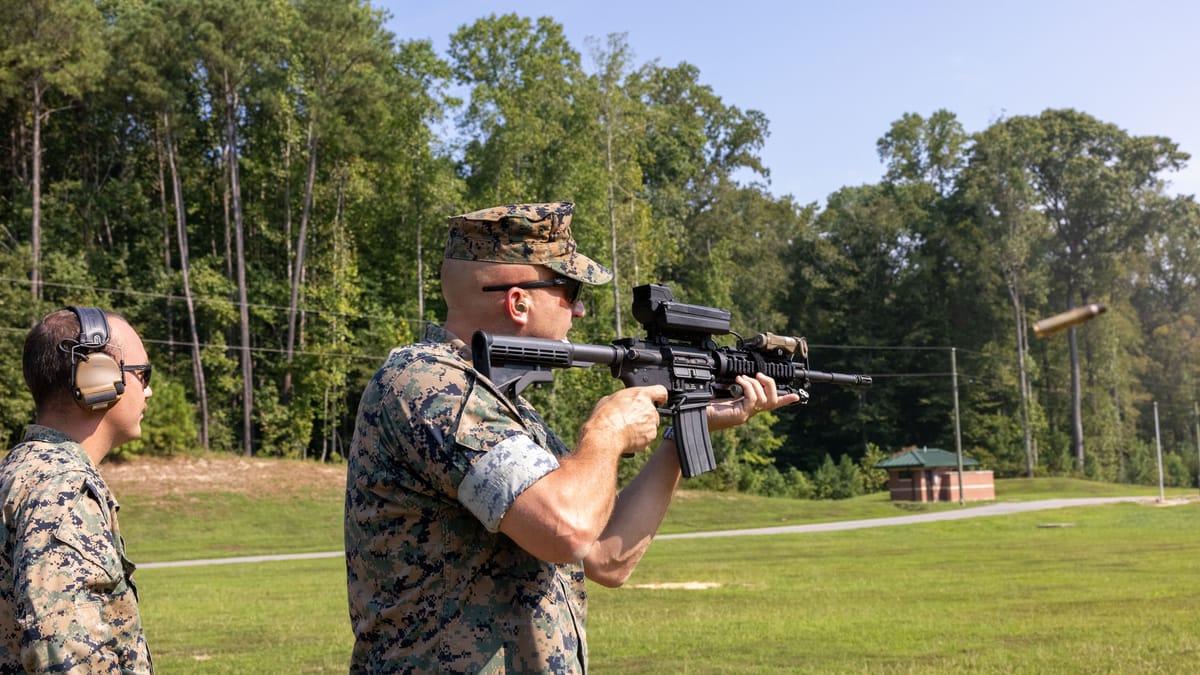
The SMASH 2000L looks like a bulky optic mounted on top of a normal rifle, but the important part is not magnification alone. It combines a camera, display, processing software, target tracking, ballistic calculation, and a trigger-control element.
The shooter still finds the target and decides to engage. Once the system is activated, the optic can track the selected target, calculate a firing solution, and block the shot until the weapon is aligned with that solution. The operator still pulls the trigger, but the system attempts to release the shot at the moment the rifle is pointed where the projectile needs to go.
That is a very different idea from an ordinary red-dot sight. A red-dot sight helps the shooter aim. SMASH tries to help with the timing problem: when the target, rifle, shooter, and ballistic solution line up closely enough for the shot to make sense.
SMARTSHOOTER describes the SMASH 2000L, also marketed as SMASH 3000, as a lighter and more advanced fire-control system that integrates target acquisition and tracking algorithms with image-processing software. Public reporting from National Defense also describes the system as a rifle-mounted optic using artificial intelligence, computer vision, and advanced algorithms to locate and engage targets.
The company has been careful to sell the system as weapon-agnostic. In practice, that matters. A counter-drone optic that only works on one boutique rifle is much less useful than one that can be fitted across common small arms. If it can sit on rifles that units already carry, it becomes a supplement rather than a new weapon family.
The Marine Corps interest is easy to understand. DVIDS imagery from September 2023 shows Marine Corps Security Forces Regiment training with the SMASH 2000L at Naval Weapons Station Yorktown. The accompanying caption describes Marines using the sight to improve their ability to engage unmanned aerial systems and ground targets.
That is the best way to understand the system: not as a replacement for the rifle, but as a bolt-on attempt to make the rifle useful against targets it was never optimized to kill.
The 95 Percent Claim
The most attention-grabbing claim around SMASH is hit probability.
In 2022, National Defense reported that the U.S. Army had acquired SMASH 2000L systems for counter-small-UAS work. In that article, a SMARTSHOOTER executive said the system could hit very small drones at about 170 meters with more than 95 percent probability. That is a manufacturer-linked claim, not a universal law of combat.
The distinction matters.
Range conditions, shooter training, drone size, drone speed, lighting, weather, weapon type, ammunition, battery state, system calibration, target presentation, and stress all affect real performance. A clean demonstration lane is not the same as a squad fighting from a damaged building while artillery lands nearby. A slow quadcopter moving predictably across a range is not the same as a low, fast first-person-view drone diving through visual clutter.
But even with those caveats, the claim points to the system’s core value. If a rifleman would otherwise need a spray of rounds, a lucky estimate, or a shotgun-range engagement to stop a drone, then a fire-control optic that materially raises first-round or short-burst hit probability is operationally interesting.
The goal is not perfection. The goal is to make a common weapon useful enough that a cheap drone is no longer guaranteed to survive the first few seconds of contact.
Why It Is Not an Automatic Drone Killer
The phrase “smart scope” makes the SMASH 2000L sound more autonomous than it is.
It does not search the sky independently and shoot anything it dislikes. It does not remove the human decision to fire. It does not turn a service rifle into an air-defense cannon. It gives the shooter an assisted firing solution and a controlled release window.
That human role is essential, because the battlefield target problem is messy. A drone may belong to the enemy, a friendly unit, a news crew, an aid organization, or a civilian hobbyist in a rear area. A small flying object can be a lethal threat, a harmless distraction, or something commanders do not want shot down in that moment.
The sight also has physical limits. A rifle round has limited reach, limited terminal effect, and a finite probability of destroying a small aerial target even when it passes close. The shooter needs line of sight. The optic needs to see and track the target. The operator needs enough time to acquire the drone and enough exposure to take the shot.
That last point is easy to understate. A rifleman engaging a drone is usually looking up. Looking up can mean not watching the treeline, the street, the window, or the trench. If the drone is part of a combined attack, the soldier who focuses on the sky may be exposed to the threat on the ground.
So SMASH is best seen as one layer in a counter-drone stack. It can complement jammers, radars, acoustic sensors, electronic detection, shotguns, dedicated interceptors, and vehicle-mounted weapons. It is not a substitute for all of them.
The Hopper Problem
SMARTSHOOTER has also pursued related remote weapon concepts, including the SMASH Hopper light remotely controlled weapon station. The company has shown Hopper integrated with radar for counter-UAS work, which pushes the same basic idea in a different direction: keep the fire-control logic, but remove the individual shooter from the immediate firing position.
That makes sense. A remote weapon station can be mounted on a vehicle, tripod, tower, or defensive position. It can be connected to sensors and used for perimeter defense. It can reduce exposure for the human operator.
It also changes the problem. A rifle optic is portable and attached to a weapon infantry already understands. A remote station requires power, mounting, transport, communications, maintenance, deconfliction, and rules for who controls it. It may be more capable in a fixed defensive role, but it is not something every rifleman can simply carry on patrol.
That tradeoff shows why SMASH 2000L is interesting. It is not the most powerful counter-drone weapon in the world. It is an attempt to push useful counter-drone capability down to the individual or squad level, where the first contact with a small drone often happens.
Smart Optics Keep Meeting Reality
Armies have been fascinated by computerized fire control for small arms for a long time. The appeal is obvious. If tanks, ships, missiles, and aircraft can use sensors and ballistic computers, why should riflemen still rely entirely on eyeballs, training, and muscle memory?
The answer is not that smart optics are useless. It is that infantry gear lives a harder life than glossy demonstrations imply.
It gets dropped, dragged, frozen, soaked, overheated, bumped against doorframes, buried in dust, scraped against concrete, and carried for days by tired people who already have too much weight on them. It has to work after transport, after battery drain, after a software fault, and after a private does something no engineer put in the test plan.
Recent U.S. experience with other advanced optics makes the caution concrete. The Department of Defense’s FY 2024 operational test report for the Next Generation Squad Weapon program said soldiers assessed the usability of the XM157 fire-control optic as below average or failing, and that the XM7 rifle with the mounted XM157 showed a low probability of completing a 72-hour wartime mission without a critical failure.
The XM157 is a different system from SMASH 2000L, built for a different requirement. The point is not that one optic proves another will fail. The point is that adding electronics to infantry weapons always adds operational questions: weight, battery life, ergonomics, training burden, ruggedness, maintenance, and whether the assist actually makes the average shooter better under field conditions.
SMASH may be valuable precisely because its mission is narrower. It does not have to become the universal rifle optic for every engagement. It can be issued, trained, and maintained as a specialized counter-UAS tool.
The Doctrine Problem
Technology is only half the story. The harder half is deciding how units should use it.
If a squad has one SMASH-equipped rifle, who carries it? Is that Marine the designated counter-drone shooter? Do they stop doing another job when a drone appears? How does the squad avoid having everyone look up at once? When is rifle fire worth revealing the unit’s position? When should the unit jam, move, hide, or call for another system instead?
Those questions sound mundane, but they decide whether a promising gadget becomes useful equipment.
A SMASH-equipped rifle also creates command questions. Small drones can be valuable intelligence sources. Shooting one down may be tactically wise, but it can also tell the enemy that you saw it, where you fired from, and what kind of capability you have. In some circumstances, the better answer may be to move, deceive, or wait for a better countermeasure.
There is also the ammunition problem. A fire-control optic can improve the timing of a shot, but it cannot make rifle ammunition behave like a proximity-fuzed air-defense round. If a unit expects to fight drones frequently, it needs a realistic ammunition plan and training standard, not just an optic in an arms room.
Doctrine is where the promise either becomes routine or fades into a clever demonstration.
Where Smash 2000L Probably Fits
The most realistic role for SMASH 2000L is not universal issue to every rifle in every platoon. It is selective issue to units that face a clear small-drone threat and need an immediate kinetic option at short range.
That could include security forces protecting bases, air-defense-adjacent units, vehicle crews, checkpoint teams, shipboard security, critical infrastructure protection, and infantry operating where drones are common but heavier counter-UAS tools are scarce. It could also be valuable in training because it forces units to practice drone detection, target handoff, engagement authority, and the transition between ground and aerial threats.
The sight’s appeal is that it meets the drone problem at the level where the problem often appears. A quadcopter does not wait for a perfect air-defense architecture. It appears over a wall, near a road, above a trench, or at the edge of a patrol base. The first person with a line of sight may be a rifleman.
Giving that rifleman a better chance is worthwhile.
But the old lesson still applies: no infantry device is allowed to be magic. SMASH 2000L can improve a shot. It cannot simplify the battlefield. It cannot eliminate training. It cannot remove the need for jammers, sensors, tactics, and disciplined fire control.
In a world crowded with cheap drones, that may be enough. The future of counter-drone warfare will not be one perfect system. It will be layers. SMASH 2000L is one of the more interesting attempts to make the bottom layer - the rifle already in a Marine’s hands - relevant again.
Key Takeaways
-
SMASH 2000L is a rifle-mounted fire-control optic designed to improve hit probability against small drones and ground targets.
-
The system does not shoot independently; it assists a human shooter by tracking a selected target and controlling the shot release window.
-
Its most useful niche is short-range kinetic counter-UAS work where jamming, missiles, or vehicle-mounted systems are unavailable or unsuitable.
-
Manufacturer-linked claims about high hit probability should be treated as test-context claims, not guarantees under every combat condition.
-
The system’s long-term value depends as much on training, doctrine, maintenance, and issue strategy as on the optic itself.

Simon Whistler
Simon Whistler hosts MegaProjects, bringing engineering, infrastructure, and military-machine stories into clear narrative focus for viewers who want the systems, tradeoffs, and human decisions behind the build.
Frequently Asked Questions
What is SMASH 2000L?
SMASH 2000L is a SMARTSHOOTER rifle-mounted fire-control optic. It uses target tracking, image processing, ballistic calculation, and a trigger-control mechanism to help a shooter engage small drones and other targets.
Does SMASH 2000L fire automatically?
No. The shooter still identifies the target, chooses to engage, and pulls the trigger. The system assists by tracking the target and attempting to release the shot when the rifle is aligned with the firing solution.
What kind of drones is it meant to counter?
It is aimed mainly at small unmanned aerial systems that are close enough for rifle fire to matter. That includes quadcopters and similar small drones, not high-altitude aircraft or targets that require dedicated air-defense weapons.
Why are small drones hard to shoot with normal rifles?
They are small, moving, hard to range, and often seen under stress. A shooter has to judge distance, lead, timing, and target motion quickly, while the drone may be observing the unit or guiding other weapons.
Is SMASH 2000L replacing normal marksmanship?
No. It can assist the shot, but the operator still needs weapons handling, target identification, judgment, and unit tactics. It is a specialized tool, not a replacement for training.
Who has used or tested SMASH 2000L?
Public reporting and imagery show U.S. Army acquisition interest and Marine Corps testing or training. DVIDS imagery from 2023 shows Marines with Marine Corps Security Forces Regiment training with the SMASH 2000L in Virginia.
What are the system’s biggest limitations?
It needs line of sight, a trackable target, a trained operator, battery and maintenance support, and a target close enough for the weapon to be effective. It also has to fit into unit doctrine so Marines do not neglect other threats while looking for drones.
Sources
-
Original MegaProjects video: Smash 2000L: The US Marines’ New Drone-Killing Scope
-
DVIDS: Marines With Marine Corps Security Forces Regiment train with Smart Shooter sight
-
National Defense: Army Purchases Fire Control System to Counter Small Drones
-
SMARTSHOOTER: SMASH Hopper Light Remote-Controlled Weapon Station
-
Hero image source by SSgt. Servante R. Coba / U.S. Marine Corps, public domain.