
After decades of being dependent on imports because of a defense sector that was technologically dragging behind the world’s greatest defense innovators, European countries have finally decided to make a proper investment and close that technological gap. The first step in that direction is the investment in all kinds of drone technologies.
The United States, China, and even Russia to an extent, have all been investing heavily in research and development of various drone systems, such as collaborative combat aircraft, unmanned supply helicopters, and long-endurance reconnaissance drones. Europe has barely tipped its toes in that particular pond so far, but it is now taking a proper dive.
Dozens of European drone and anti-drone innovations have been presented at the Berlin Air Show in June of 2026, signaling to everyone that Europe can take care of its own defense needs.
These are the best and most important of the unveiled European drone projects.
Chapter 1: The IRIS-T SLS MK4
Diehl, the company behind the IRIS-T missile and its fire unit, which will soon be in use by half of Europe, recently unveiled its newest fire unit called the IRIS-T SLS Mark IV.
The IRIS-T missile, which stands for ‘infrared imaging system thrust-vector controlled’, is a short-range air-to-air missile designed to replace the legendary AIM-9 Sidewinder. It is the product of a European collaboration and it’s an effective and cheap alternative to similar American missiles, with thousands of IRIS-Ts currently in use all over the world.
With an operational range of about 25 kilometers or 16 miles, a top speed of Mach 3, three times the speed of sound, and a 11.4-kilogram warhead, it’s a very potent air-to-air missile…and therein lies the issue. It was designed to be used by combat aircraft, not to be a surface-launched missile, but someone in Diehl realized that it would be a really effective anti-air option, especially for drones, if only they had a launch platform for it.
This is how the IRIS-T SLS was born. SLS stands for Surface Launched Standard, not to be confused with the IRIS-T SLM, standing for Surface Launched Missile, which is an air defence system that launches much larger missiles with greater range, flight altitude, and speed.
The SLS system, however, is what will soon form the brunt of Europe’s short altitude air threats. It’s already in use by Germany and Sweden, with both nations currently waiting for deliveries of more units, it’s actively being used in Ukraine, while Austria and Norway are waiting on their first units. Some other European countries, such as Bulgaria, Estonia, Denmark, Slovenia, Latvia, and Switzerland have opted for its sister system, the SLM.
The SLS however, is the European close-in drone fly swatter of choice. It first entered service in Sweden in 2020 with an operational range of twelve kilometers and a height ceiling of eight kilometers, which means that the term ‘close-in’ should be taken quite literally in this case. This is the type of system you would normally see set up around a powerplant, for example, or a weapons factory as a final layer of defence against drones.
The system comes with the Swedish Saab Giraffe 1X radar, and the same radar is in use with the newest iteration of the launch system. This radar was developed for short-range air defense and it’s very effective at ranges between ten and 400 kilometers.
The Mark IV SLS system can launch a maximum of eight IRIS-T missiles with three locking-on capabilities. There’s the obvious lock-on before launch operation mode, where the missile is launched after a target is detected and tracked. However, the SLS can launch a missile without actually locking onto anything.
If the operators detect a target in the missile’s range but for whatever reason don’t want the missile to head for it immediately, they have the option of launching the IRIS-T and only providing it with the target’s data later on. The third option is only to be used if the radar is unavailable. The IRIS-T missile has its own target designator with an infrared camera and a laser rangefinder, which allows the crew to transmit target data to the missile.
With all that said, it’s not difficult to see why the IRIS-T missile family and its SLS launch platform are an ideal solution for protecting an area from large drones, such as the Russian Geran-2, which is based on the Iranian Shahed-136 drone, which is the primary large one-way attack drone used by Russian forces in Ukraine.
The newest SLS system, the Mark IV, which was just recently unveiled at the Berlin Air Show, introduces a few major improvements. The first is the ability to launch missiles on the move, which allows for fast response time and also allows the system and the crew to get out of dodge if they’re the target of the incoming drone. Also, unlike the original SLS, which consisted of two separate vehicles, the Mark IV has an integrated radar and command system, which makes it inherently more mobile than the original.
It also carries 15 of Diehl’s Cicada drones. This is a brand new small interceptor drone design, created for the self-defense of static systems such as the SLS against incoming drones, and it can be armed with a warhead as well as with a net launcher that captures and downs the drone instead of shooting it.
This makes the SLS Mark IV the most well-developed short-range anti-air system in Europe, but what’s really important here, beyond the question of which system is better, is the fact that it was mostly designed to counter drones. Diehl envisions the SLS as just the thinnest layer of the multi-layered drone defense that consists of the SLM system as a medium-range anti-drone option, and the upcoming SLX, the long-range anti-drone system.
The reasoning behind this is the recent experience in Ukraine, which has shown that drones aren’t a weapon of the future, but a weapon of the present. With that in mind, Germany’s designing a brand new anti-drone drone.
Chapter 2: Cobra 600 - The Missile Uber
Even though the IRIS-T is a very effective air-to-air missile, its 25-kilometer range is limiting. By observing how Russia strapped cameras, communication gear, and air-to-air missiles to their Geran-2s, someone in Germany got the idea to simply strap an IRIS-T missile to a drone and have the drone taxi it to the target. This is how the Cobra 600 was born.
Designed by Polaris, a German startup that specializes in military aviation, the sole purpose of this drone is to take off with an IRIS-T missile, loiter in an area until the missile is launched, and return home. The Cobra is supposed to be in communication with a ground-based SLS or SLM system, and act as a launching extension of said system.
The design of the Cobra 600 is actually very similar to the Geran-2. The 19.6-feet or 600-centimeter-long drone, which was named after its length, was designed with a fuel-efficient delta-wing formation. Vertical stabilizers extend from the tips of the wings, and since this isn’t a one-way attack drone, it comes with retractable landing gear, just like a fighter jet would. Thanks to its unimpressive size and weight, it could also be launched from a highway or just a long and clear enough stretch of road.
To achieve this, the Cobra 600 will be powered by four turbojet engines. The engines displayed at the Berlin Air Show were the JetCat P1000-PRO micro turbojet engines, and each of those provides the Cobra with around 250 pounds of thrust.
Most importantly, the fuselage and the propulsion were engineered around the IRIS-T missile. It is the sole purpose of the Cobra to carry and extend the effective range of the missile, and this is really important to NATO as it already has thousands of these missiles in various armories around Europe, and since the Cobra 600 extends their range from 25 to hundreds of kilometers, the practical usability of the missiles is greatly expanded.
The Cobra will have a combat range of about 250 miles or around 400 kilometers, and with that it has the potential to turn the SLS and SLM platforms into long-range anti-drone platforms. Remember, the radars aboard the SLS and the SLM are capable of detecting threats hundreds of kilometers away, it’s the missile that can’t be launched that far. Once the Cobra is introduced, however, all of this will change.
This, of course, comes with a few disclaimers. The range doesn’t account for the reaction time of the operators and flight conditions, but the Cobra is, nevertheless, a great development of Europe’s anti-drone capabilities because of its loitering ability. The Cobra 600 could, for example, be sent to perform air patrols in an area where enemy drones might appear. Once a drone blips on the radar of an SLS or SLM launcher, the operators will direct the Cobra to engage.
The biggest downfalls of the Cobra, at least so far, are its lack of onboard sensors and the fact that it can carry only one IRIS-T missile. The Cobra cannot detect and track a target on its own, it can only be operated by the crew of an SLS or SLM platform, and once it takes its shot, it has to return to base.
It is, however, a cheap solution to an expensive problem that doesn’t require an actual pilot to put their life at risk, and European militaries will obviously be interested in that. The intensity of the Russo-Ukrainian war and the rate at which drone technology has been evolving on the eastern-European front has been a wake up call for the remainder of Europe, which has largely been neglecting its drone and anti-drone technologies.
The Cobra 600 is just one of many solutions, but it checks all the right boxes. It’s effective, at least according to the few tests conducted so far, it can be employed in a multi-layered anti-air defense framework, and, most importantly, it’s cheaper than a long-range surface-to-air missile and the drones it’s supposed to take down. This is something we talked about extensively in our Flamingo video, but in order to win a drone war, the drones you’re using to take down enemy drones have to be cheaper to produce than the drones of your enemy. This is something that the Cobra does really well, and it’s possible that we’ll see it substitute the IRIS-T missile for something smaller and cheaper with time as the missile itself is going to be more expensive than the drone, and the only reason it’s so prominent is its massive European stockpile.
Since the IRIS-T is such an uneconomic answer to cheaper drones, it’s likely that we’ll only see it launched by the Cobra 600 when facing a top-level threat, such as a cruise missile closing in on critical infrastructure or a close air-support aircraft reaching the front lines. These situations require immediate intervention, regardless of the cost, but it’s likely that cheaper threats will be addressed with cheaper countermeasures.
The Cobra 600 is far from the only European combat drone emerging on the market, as it’s likely that the Eurodrone will, after years of waiting, finally premiere in 2027.
Chapter 3: The Eurodrone
The Eurodrone is a medium-altitude long-endurance drone that’s become somewhat of a joke in European defence circles due to how long everyone’s been waiting on it. Just like all other joint defence projects in Europe, there are only two ways its story can end - it will either fall through the cracks and never move to the production phase, or, alternatively, it will simply take an eternity to move into production. The Eurodrone is, incredibly, a potential example of both.
The project started in 2015 with an excruciatingly long study to define it and come up with a preliminary design, which was followed by an invitation for offers sent to contractors, mainly Airbus, Dassault Aviation, and Leonardo. The contracts weren’t signed until 2021. It took the Organisation for Joint Armament Cooperation, the European multigovernment body that oversees and manages joint projects, six years to get from point A - the realization that European militaries need domestically produced MALE UAVs in order to avoid overreliance on American MQ-9 Reapers and Israeli Herons - to point B, signing contracts with contractors.
This is the major reason why ambitious European projects are the butt of so many jokes in the defense industry - the lack of urgency and lackadaisical approach always results in the product being technologically obsolete by at least half a decade.
Nevertheless, the Eurodrone really is here now and it’s going to take its maiden flight in 2027, so it’s high time to see whether the wait was worth it.
It’s going to assume the role of a medium-altitude long-endurance drone for the Italian, Spanish, French, and German Air Forces, flying at altitudes between three and nine kilometers for days on end. The Eurodrone is primarily supposed to provide surveillance, intelligence, and reconnaissance, but it can also provide support to troops on the ground with precision-guided munitions.
This is a clear copy of the General Atomics MQ-1 Predator, or its grandchild, the MQ-9 Reaper. Those two UAVs embody the meaning of long-endurance reconnaissance and ground support, with the Reaper being used by pretty much the entirety of NATO.
Similar to the Reaper, the Eurodrone will use pusher propellers powered by two engines. The two-engine feature may sound like an overkill for a 13-ton drone, especially when you realize that the engine in question is a General Electric Catalyst engine, which has a maximum power output of 1,600 horsepower…and the Eurodrone has two of them. For comparison, the Reaper’s max weight is 4.76 tons and it’s powered by a Honeywell engine with 900 horsepower, rarely with any issues.
Germany, however, insisted upon a dual-engine configuration because the Eurodrone may need to be operated in urban areas. In case the one and only engine fails, the drone that weighs more than five BMW X7s, including the weight of four 500-pound bombs, will drop on the residential area below. Sensible thinking from Germany, but it delayed the production and added way too much weight to the drone, which in turn got the Germans into an argument with the French, which we know never happens because the two countries are historically extremely friendly.
France hated the dual engine idea because it never intended to use the drone over urban areas, and it also required an increase in size and weight to an incredible 11 tons before equipping it with bombs and missiles. The Reaper, for comparison, weighs five times less at 2.2 tons. The monstrous weight and size, which prompted Christian Cambon, who oversaw the project, to call it a drone suffering from “obesity”, reflected poorly on the drone’s production schedule, endurance, range, and speed.
You may be wondering why didn’t France and Germany simply part ways and each develop their own drone if each country’s requests were so different, but that’s not the way we do things in Europe. If we have to delay a joint defence project by a decade and completely destroy diplomatic relations with half the continent just to end up with a useless, half-baked product, by God we will do it just so we could say that we did it together!
On a positive note, though, the use of two engines improved reliability by default, as the Eurodrone can continue to operate even if one of the engines gives out, and it also improved its performance. The two engines can keep the drone in the air for up to 40 hours, which is 13 hours more than the Reaper, at a marginally higher speed.
The Eurodrone will be armed with the 500-pound or 227-kilogram GBU-49 Enhanced Paveway II bomb, which is a GPS and laser-guided bomb capable of blowing up pretty much anything, ideally tanks and hardened structures. As for missiles, it will carry the Brimstone air-to-air missile, which is the Royal Air Force’s and the Luftwaffe’s go-to air-to-air solution, and the Akeron MP, which is a French anti-tank guided missile which will be modified into an air-to-surface anti-tank missile for the Eurodrone. Another positive side of equipping the Eurodrone with way too much horsepower - or Pegasus-power, since it’s flying horsepower - is the ability to carry an entire ton of weapons on board.
In spite of the infighting and the internal disagreements, the Eurodrone is still going to fly. The first test flight is scheduled for 2027, and once it goes into full production, it will be adopted by France, Spain, Germany, and Italy, with Japan and India joining the project as observers, implying that they have at least some interest in the Eurodrone.
All of this was at least the plan until very recently. Just a few months prior to recording this, all major news outlets reported that France was pulling out of the project in favor of cheaper drones. The French simply couldn’t justify the Eurodrone’s pricepoint, which was launched into the stratosphere by the Germans’ insistence upon the drone being 110% ready for every possible combat scenario. Because of this, funding for the project was left out of this year’s National Security Document, which includes the planned defense funding.
However, the latest bit of information on the project comes from Airbus’s Head of Air Power, Jean-Brice Dumont, who, just a few days ago, said that France is still “committed to the programme” and added that the French specifically asked him to state that. He insists that all the four nations that originally signed on - France, Germany, Spain, and Italy - are still part of the Eurodrone project. Dumont added that the situation is not black and white and that France can still order the Eurodrone later, the fact that the funding was left out for this year doesn’t mean that the project isn’t moving along.
So, is the Eurodrone a joint European project that will fall through or will it just be late? We, frankly, don’t know. The writing on the wall at the moment is that France might be pulling out its resources, but the project will, just like Celine Dion’s heart, go on. It wouldn’t be surprising, however, if France begrudgingly remained part of this because in spite of all the differences between the countries, they have the same goal - a sovereign drone which ends their dependence upon American systems.
No matter how the Eurodrone story ends, it’s still far from the end of European drone investments.
Ukraine is simultaneously making big individual strides in a completely different department - ground drones. It’s the country’s goal to produce at least 50,000 vehicles this year, which is double of what it produced in 2025.
About 99% of drones used on the frontlines are of Ukrainian origin, according to Andrii Hrytseniuk, the CEO of Brave1, a Ukrainian drone production company. There are currently around 280 companies in the country producing unmanned ground vehicles that are used to deliver supplies, rescue wounded combatants, and take down Russian unmanned aerial vehicles. In one operation in the summer of 2025, a UGV strike unit actually captured a group of Russian combatants and led them to Ukrainian lines, which was a first for this war.
The sheer mission scale of these UGVs validates such a massive production. In March of 2026, they conducted 9,000 missions, and that number surpassed 10,000 in April. The UGVs come in a variety of designs, ranging from unarmed ones, equipped only to deliver supplies, to small-caliber UGVs used to take down smaller drones, and even UGVs with 12.7-millimeter guns that can take down larger drones, even smaller aircraft.
Ukraine now has a completely capable and self-sustainable drone production network, marking yet another significant jump in Europe’s expansion of drone production abilities.
The drone story in Europe is, however, far from over, as Airbus presented a whole line of upcoming drones in Berlin.
Chapter 4: The Ravenstorm
Airbus revealed an entire portfolio of drone designs at the Berlin Air Show, and the Ravenstorm is one of the company’s most prominent designs.
It’s possible that the Ravenstorm was supposed to be one of the loyal wingman drones for the cancelled joint next-gen fighter program called the Future Combat Air System, which broke down thanks to, you guessed it, the Germans and the French disagreeing on something.
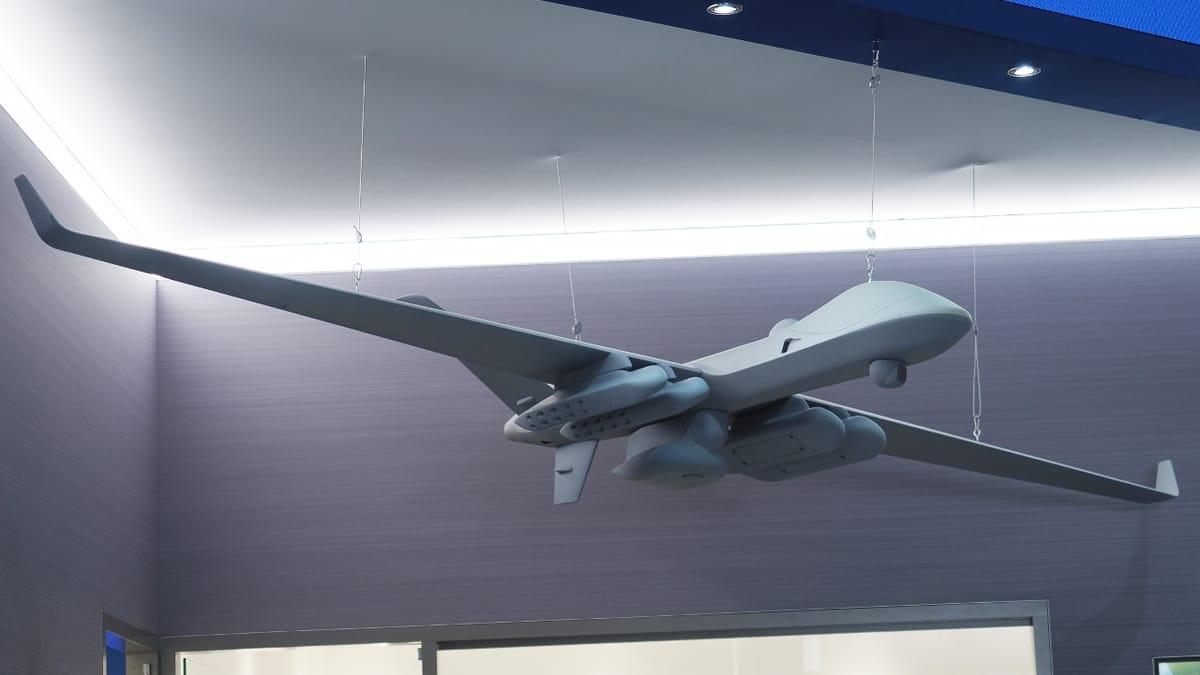
The drone measures 43 feet or 13.1 meters in length with a wingspan of 33 feet or 10 meters, and thanks to its size, shape, and swept-wing configuration, it’s reminiscent of the General Atomics Dark Merlin UCAV - a highly secretive drone that’s been in development for quite a while now. The Ravenstorm has a large topside air inlet, and the shape of the inlet is a dead giveaway that the drone was designed for stealth.
Radar energy gets into the very cavity of an air inlet, as well as the exhaust, and it bounces off the engine parts before spraying back out toward the radar. This is a great way of getting spotted, which is why the air inlets on recent stealth designs, such as the F-22, F-35, and J-20, are all of similar shape, and all are angled. The less flat and more angled a surface is, the lower the chances of a radar signal bouncing off at exactly the right angle to give away the position. The use of radar-absorbent materials is another way stealthiness is improved, but it’s unclear whether the Ravenstorm uses RAM.
The Ravenstorm has a claimed maximum takeoff weight of six tons, with an internal payload capacity of 500 kilograms and additional external hardpoints. According to Airbus, it will carry precision-guided munitions, and air-to-surface and air-to-air missiles with medium and long-range capabilities, while also being equipped for electronic warfare. The specific missiles shown on the mockup at the Berlin Air Show are the Meteor air-to-air and Spear air-to-surface missiles, both developed and produced by MBDA.
Not much is known about the Ravenstorm’s speed and endurance, but Airbus intends for it to serve as a wingman for the Eurofighter Typhoon EK, an electronic combat variant being developed by Germany and expected to join the Luftwaffe’s ranks soon.
What’s particularly important about it, similar to the Eurodrone, is that the Ravenstorm will be a domestic and sovereign alternative to imports. Germany will most likely acquire the license to start domestically producing their own variant of the Kratos Valkyrie, but that’s still going to be subject to international arms treaties. If Airbus develops its own equivalent in the shape of the Ravenstorm, European countries won’t be dependent upon overseas exports.
The story is similar to Airbus’s new autonomous helicopter.
Chapter 5: The U145 Autonomous Helicopter
A few months ago, we published a video on the U-Hawk, Lockheed Martin’s new autonomous helicopter. Take a look if you want every tiny little detail, but to summarize it, the helicopter is capable of planning its own route, it doesn’t require active operation, and it will mostly be used to move supplies.
Airbus looked at that and decided to copy Lockheed Martin’s homework, so they created the MQ-72C Lakota Connector, which is the autonomous version of the Airbus H145 used in the United States. However, an expansion of that is coming in the form of the U145.
The H145 is a helicopter platform that’s proven itself all around the world in both the civilian and military sector, and as a utility helicopter it was used to do pretty much everything you can think of, similar to the legendary Huey. The U145, however, will be a primarily high-volume cargo supply helicopter.
It will have a 2,600-pound or 1,180-kilogram payload, which is, at first glance, less than the Lakota Connector’s 4,000 pounds, but it must be pointed out that the Lakota Connector will also carry loads via a sling. If that same ability is introduced with the European version of the autonomous helicopter, it will likely be able to handle the same load.
Airbus is, however, refusing to limit the U145 to the sole role of a supply helicopter as it’s pitching it to militaries around the world as an armed scout and surveillance helicopter. Given the original platform’s adaptability, it would probably be easy to produce an autonomous U145 with these specific roles in mind. They could also be used as drone motherships, according to Airbus. Similar to the U-Hawk, they could carry drones onboard, launch them near a combat zone, and control them from the helicopter.
Autonomous route planning is another similarity between the two platforms. The U145 will be equipped with a top of the line sensory suite and an AI module that will independently navigate along a predetermined route that can either be decided by the operator or by the software on its own.
To maximize cargo space, the cockpit will be entirely removed from the helicopter, a clamshell nose door will be installed alongside a loading platform and a dedicated cargo door.
The design is still in its early stages, but the feeling at Airbus is that making the switch from the H145 to the U145 isn’t that big of a challenge and the first test flight, with an on-board pilot on standby, is expected by the end of 2026.
You may have noticed a trend by now. All of these drone and anti-drone systems are either something that was, until this point, purchased by European countries from the United States with no domestic production, or something that was pioneered in the States that Europe wants to have in its own backyard. This means that the European Union, while still trying to stay friendly with the States, is making a clear step away from buying everything from the biggest defense manufacturer in the world, and it’s starting to massively invest into domestic production.
This is backed up by numbers. According to the EU, the member states’ defense expenditure has been on the rise, year after year, for more than ten years now. The defense expenditure in 2025 was 11% greater in comparison to 2024 and a fantastic 63% higher than 2020.
There are two drivers behind this investment. The most important one is the Russian invasion of Ukraine, which was a reminder for the rest of Europe that the largely peaceful times we got used to after the Second World War shouldn’t be taken for granted. The second driver is the USA-EU relationship, which has started to deteriorate ever since Donald Trump won the United States presidential election.
The 45th and 47th President of the United States declared, quite openly, that Europe can no longer count on the United States’ favorable export agreements and unconditional support in the defence sector. For better or for worse, with the looming threat of Russia and its strongest ally turning its back, European leaders, led by French President Emmanuel Macron, decided to revive the continental defense industry.
Projects that were cancelled or put on ice beforehand were revived, projects that were moving slowly were sped up, and projects that were deemed crucial now have top priority.
From a defense manufacturing standpoint, Europe is dragging behind the United States and China in both quality and quantity of weapons, finding itself in an ‘all hands on deck’ situation, which is the ultimate reason behind this massive investment into European drone technology. With that being said, it’s likely that we’ll see European armies fielding more and more domestically-produced weapons in the coming years as a result of multi-state projects, as no European country ever truly stands alone.
Key Takeaways
- Europe is investing heavily in drone technologies to close the technological gap with global leaders like the US and China.
- The IRIS-T SLS Mark IV is a short-range anti-air system designed to counter drones, with improvements for mobility and self-defense.
- The Cobra 600 drone extends the range of IRIS-T missiles, enhancing Europe’s anti-drone capabilities at a lower cost.
- The Eurodrone project, despite delays and disputes, aims to provide a European alternative to American and Israeli drones.
- Ukraine’s rapid expansion of ground drone production highlights Europe’s growing self-sufficiency in drone technologies.

Simon Whistler
Simon Whistler hosts MegaProjects, bringing engineering, infrastructure, and military-machine stories into clear narrative focus for viewers who want the systems, tradeoffs, and human decisions behind the build.
Frequently Asked Questions
What is the IRIS-T missile?
The IRIS-T missile, which stands for ‘infrared imaging system thrust-vector controlled’, is a short-range air-to-air missile designed to replace the legendary AIM-9 Sidewinder. It is the product of a European collaboration and it’s an effective and cheap alternative to similar American missiles, with thousands of IRIS-Ts currently in use all over the world.
What is the IRIS-T SLS MK4?
The IRIS-T SLS MK4 is a surface-launched missile system designed to launch IRIS-T missiles. It is the European close-in drone fly swatter of choice and is used to protect areas from large drones.
What is the Cobra 600?
The Cobra 600 is a drone designed by Polaris, a German startup. Its sole purpose is to take off with an IRIS-T missile, loiter in an area until the missile is launched, and return home. It extends the effective range of the IRIS-T missile from 25 kilometers to hundreds of kilometers.
What is the Eurodrone?
The Eurodrone is a medium-altitude long-endurance drone designed for the Italian, Spanish, French, and German Air Forces. It is primarily used for surveillance, intelligence, and reconnaissance, but it can also provide support to troops on the ground with precision-guided munitions.
What are the key features of the Eurodrone?
The Eurodrone can fly at altitudes between three and nine kilometers for up to 40 hours. It is armed with the GBU-49 Enhanced Paveway II bomb, the Brimstone air-to-air missile, and the Akeron MP anti-tank guided missile. It can carry an entire ton of weapons on board.
What is the Ravenstorm?
The Ravenstorm is a drone designed by Airbus. It measures 43 feet in length with a wingspan of 33 feet and is designed for stealth. It can carry precision-guided munitions, air-to-surface and air-to-air missiles, and is equipped for electronic warfare.
What is the U145 Autonomous Helicopter?
The U145 Autonomous Helicopter is an autonomous version of the Airbus H145. It is designed to be a high-volume cargo supply helicopter but can also be used as an armed scout, surveillance helicopter, or drone mothership. It has a payload capacity of 2,600 pounds and can plan its own route.
Why is Europe investing in drone technology?
Europe is investing in drone technology to close the technological gap with the United States, China, and Russia. The Russian invasion of Ukraine and the deteriorating USA-EU relationship have driven this investment, leading to a significant increase in defense expenditure.
What is the significance of the Berlin Air Show in 2026?
The Berlin Air Show in June 2026 showcased dozens of European drone and anti-drone innovations, signaling Europe’s capability to take care of its own defense needs. It highlighted the continent’s advancements in drone technology and its commitment to reducing dependence on imports.
Sources
- Original MegaProjects video: Unmanned Everything: Europe’s Going All-In On Drone Tech
- Hero image source by Boevaya mashina / openverse, by-sa.