
Most vessels are built around one simple expectation: they should cross water without sinking. R/P FLIP was built around a stranger idea. It was supposed to sink itself on purpose, stop halfway, and then become a floating laboratory standing upright in the open ocean.
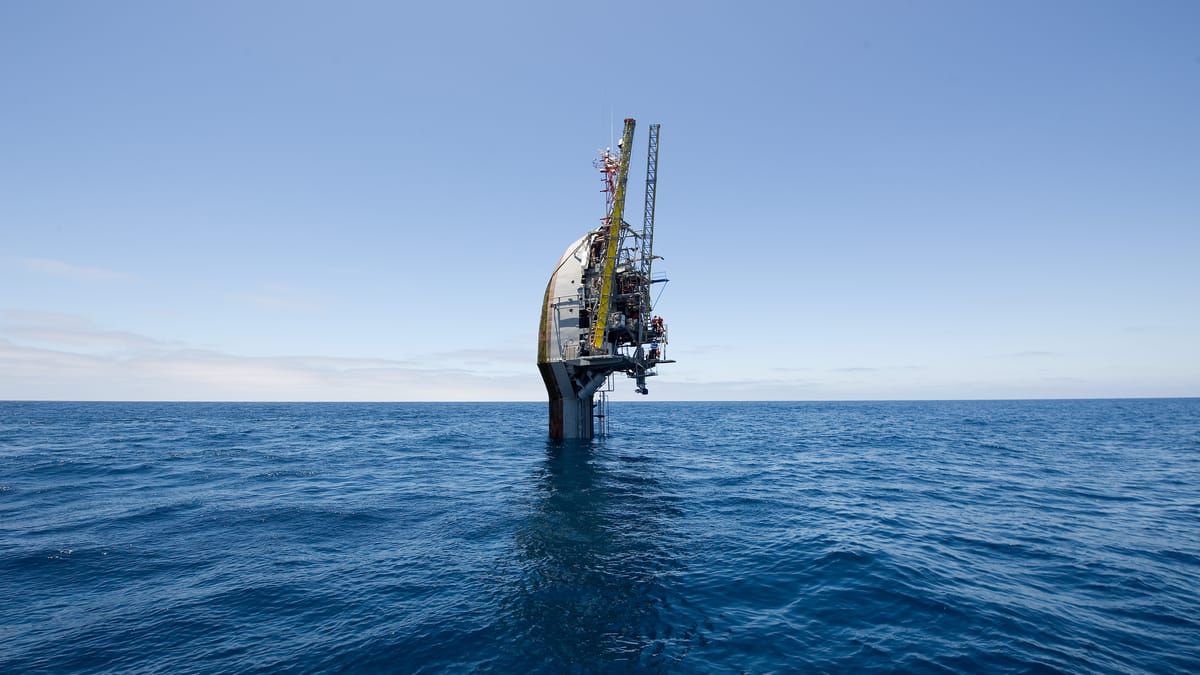
That is why FLIP became one of the most recognizable research platforms ever built. In its horizontal position, it looked like a ship with an impossibly long tail. On station, it flooded its ballast tanks, rotated through 90 degrees, and left only the front 55 feet above the surface while roughly 300 feet hung below the waves.
The result was not a ship in the ordinary sense. It had no propulsion, no normal voyage plan, and no interest in acting like a conventional research vessel. FLIP was a 355-foot instrument platform designed to become a spar buoy: quiet, stable, and able to hold sensors in the ocean while ordinary ships pitched, rolled, yawed, and heaved around it.
It was strange because it had to be. The Navy and Scripps needed a platform stable enough to study the ocean without the platform itself becoming the loudest, messiest part of the experiment.
Why the Navy Needed FLIP
FLIP’s origin sits in the Cold War world of underwater acoustics.
The United States wanted to understand how sound moved through the ocean, especially for submarine detection and long-range naval sensing. Sound underwater is not simple. It bends through temperature layers, changes with salinity, interacts with the sea floor, and can be distorted by waves and currents. If the point of an experiment is to measure subtle acoustic behavior, the platform doing the measuring cannot be lurching around like a normal ship.
Scripps notes that FLIP was built in 1962 to help study long-range sound propagation for submarine warfare. ONR later described it as a key enabler for ocean acoustics, meteorology, oceanography, and air-sea interaction research.
The first obvious answer was to use existing vessels. That did not work well enough. Ships move. Submarines move. Their propulsion systems make noise. Their hulls disturb the water around them. Even when they are suitable for many kinds of oceanography, they are not ideal for experiments that need a fixed, quiet reference point extending deep below the wave zone.
The solution was radical only because the problem demanded it: stop thinking of the platform as a ship and start thinking of it as a huge floating instrument.
The Giant Floating Mop
The central insight behind FLIP was spar-buoy stability. A long, weighted, mostly submerged body does not respond to surface waves the same way a normal hull does. Most of its mass sits below the most violent wave motion, so the platform can remain unusually steady while the surface is moving.
The writer’s script preserves the classic image: a scientist noticing how a mop floated upright and stayed stable in choppy water. Whether told as engineering folklore or design shorthand, the point is right. FLIP worked because it behaved less like a ship and more like a long vertical float.
The platform measured 108 meters, or 355 feet, overall. Scripps’ Air-Sea Interaction Laboratory describes it as a large floating platform able to host instruments for atmospheric and oceanic measurements. In vertical position, only the forward 17 meters, or 55 feet, protruded above the water.
That shape also explains why FLIP had no propulsion. Propellers, engines, shafts, and machinery would have made noise and complicated the very measurements it was meant to support. FLIP had generators for power, laboratories, living space, and research equipment, but it had to be towed to and from its work area.
Once there, the platform could drift or be moored. Sensors could be mounted on three long booms, attached to the submerged hull, or lowered through the water column. The whole point was flexibility: give scientists a stable, quiet structure and let them bring the instruments each cruise required.
How the Flip Worked
FLIP’s signature maneuver was slow, deliberate, and slightly unnerving.
After being towed horizontally to the research site, the crew opened valves that let seawater into ballast tanks in the long aft section. As those tanks filled, the stern lost buoyancy and began to sink. The platform rotated backward until the long body hung vertically beneath the bow.
The process took about 20 to 30 minutes, depending on the source and operation. ONR described the platform flipping in about 30 minutes. DEEP’s current FLIP page gives about 20 minutes. Either way, the point is that this was not a sudden capsize. It was a controlled transformation.
In the horizontal position, FLIP drew only about 13 feet of water. In the vertical position, its draft was about 300 feet. That deep, water-filled lower section became the stabilizing weight that made the platform so valuable.
Everything aboard had to respect the two orientations. Doors, bunks, sinks, toilets, lab fixtures, and passageways were arranged so the platform could function horizontally and vertically. Visitors often described the interior as disorienting, because a wall in one mode became a floor in the other.
At the end of a mission, the crew used compressed air to push water back out of the flooded ballast tanks. The order mattered. Done correctly, FLIP returned to the horizontal position and could be towed home. Done carelessly, the forces involved could twist the platform in ways nobody wanted to experience.
Life on a Vertical Research Platform
FLIP could support a small team for extended work at sea. ONR described a complement of five crew and 11 researchers, with operations lasting up to 30 days without resupply. Other technical summaries describe missions of roughly a month and an endurance around 35 days.
That endurance mattered because the platform was not useful if it had to leave whenever the ocean became inconvenient. Once flipped, it could hold station for long observation periods and let scientists measure the same patch of ocean from above the surface down through the water column.
The strange interior was part of the price. FLIP had two directions of life. A room needed to make sense after the world turned sideways. A ladder in one orientation might become something else in the other. Portholes could end up overhead. Equipment had to be secured not only for rough seas, but for the planned rotation itself.
The reward was stability. Scripps and ONR both emphasize that FLIP’s vertical orientation made it nearly motionless compared with ordinary vessels. That let researchers study waves, currents, turbulence, acoustics, marine mammals, and the exchange of gases and energy between ocean and atmosphere with less platform noise and motion contaminating the data.
It also made FLIP oddly calm in conditions that would make nearby boats miserable. The platform was not invincible, but its mass below the wave zone gave scientists something close to an island in places where no island existed.
What FLIP Made Possible
FLIP’s original naval value came from acoustics. A quiet, stable platform could support hydrophones and related instruments without the constant motion and noise of a conventional ship. That helped researchers understand how sound traveled through complicated ocean conditions.
Its usefulness quickly broadened.
Scripps lists FLIP’s research fields as including geophysics, meteorology, physical oceanography, and other scientific disciplines. ONR credited it with work on internal waves, air-sea interaction, ocean mixing, boundary-layer dynamics, acoustic thermometry, and marine mammal sounds. The Air-Sea Interaction Laboratory describes deployments involving imaging systems, lidars, meteorological stations, turbulence sensors, thermistor chains, CTDs, and acoustic Doppler current profilers.
The platform’s booms were especially valuable. Instruments could be held away from the structure, reducing distortion from the platform itself. Researchers could mount equipment above the surface, along the hull, or deep in the water. That let FLIP support experiments that required a vertical slice of the ocean rather than a single sensor package dragged behind a ship.
It was also unusually good for observation. A high vantage point above the water gave researchers a stable place to watch marine mammals and correlate visible behavior with acoustic recordings. That kind of coordination is hard from a ship that is constantly moving, rolling, and making its own noise.
In short, FLIP was a platform for research that normal platforms made difficult.
The Limits of a Brilliant Oddity
For all its genius, FLIP was not magic.
It could not move itself. It needed a tow. It was not suited to every ocean environment. The writer’s script notes concerns about very long wave periods and cold conditions in far northern waters, and Scripps’ later history shows that even a successful platform needed constant inspection, tank work, dry dockings, and maintenance to remain viable.
The ocean also reminded crews that stability is not the same as invulnerability. Scripps’ retirement story recounts a 1969 incident north of Oahu when swells exceeding 80 feet knocked out power and forced the crew to abandon FLIP for safety. The platform survived, but the event showed the edge of the design’s comfort zone.
Cost became the final limit. After its last research voyage, reviewers concluded that the renovation expense could not be justified. Scripps says FLIP was towed to a dismantling and recycling facility in August 2023, six years after its final research voyage. ONR said age and life-extension costs led to disestablishment.
That should have been the end of the strangest platform in oceanography.
It was not.
Retirement, Rescue, and the Next Flip
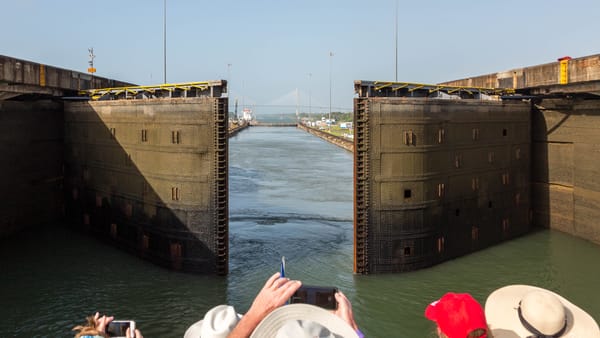
In October 2024, DEEP announced that it had rescued FLIP after the platform had been towed to Mexico for scrapping. According to DEEP, the platform was moved through the Panama Canal and across the Atlantic to the Mediterranean for a 12- to 18-month refit and modernization in France.
DEEP’s stated plan is to relaunch FLIP with new instruments, sensors, computing capability, communications systems, and the ability to support other technologies and research assets. Its current FLIP page presents the refit as a future-facing modernization and invites academic researchers to register interest in using the platform.
That makes FLIP’s status unusual. It is no longer the old Scripps-operated Navy platform, but it is also not simply gone. As of June 2026, the public record shows a retired research platform being refit for a second life rather than a confirmed return to routine operations.
That is fitting. FLIP’s whole career was built around refusing to behave like a normal vessel. It did the thing ships are not supposed to do, then turned that apparent failure into its greatest strength.
Key Takeaways
-
R/P FLIP was a 355-foot research platform built in 1962 with Office of Naval Research funding and operated by Scripps Oceanography for the U.S. Navy.
-
It worked by flooding ballast tanks so the platform rotated from horizontal to vertical, leaving about 300 feet submerged and only the forward 55 feet above the water.
-
FLIP had no propulsion and had to be towed, which helped keep it quiet for acoustic and oceanographic research.
-
Its spar-buoy-like vertical position made it exceptionally stable for work on ocean acoustics, waves, air-sea interaction, meteorology, and marine mammal observation.
-
Scripps and ONR retired FLIP in 2023, but DEEP later announced that it had rescued the platform for refit and modernization.

Simon Whistler
Simon Whistler hosts MegaProjects, bringing engineering, infrastructure, and military-machine stories into clear narrative focus for viewers who want the systems, tradeoffs, and human decisions behind the build.
Frequently Asked Questions
What does R/P FLIP stand for?
R/P FLIP stands for Research Platform Floating Instrument Platform. It was an ocean research platform rather than a normal self-propelled ship.
How long was FLIP?
FLIP was 355 feet, or 108 meters, long. In vertical position, roughly 300 feet were submerged and about 55 feet remained above the surface.
Did FLIP actually sink?
It partially sank in a controlled way. The crew flooded ballast tanks so the stern rotated downward, but the platform remained buoyant and stable rather than going to the bottom.
How did FLIP return to horizontal position?
At the end of a mission, compressed air forced seawater out of the flooded ballast tanks. As buoyancy returned in the correct sequence, the platform rotated back to horizontal so it could be towed.
Why did FLIP have no engines?
FLIP had no propulsion because engines and propellers would add noise and vibration. That quiet design made it better for ocean acoustics and other sensitive measurements.
What kind of science did FLIP support?
FLIP supported research in ocean acoustics, meteorology, physical oceanography, air-sea interaction, internal waves, turbulence, marine mammal observation, and related fields.
Is FLIP still operating?
Scripps and ONR retired FLIP in 2023. DEEP announced in 2024 that it had rescued the platform for refit and modernization, and its current public materials describe a future relaunch and research use.
Sources
Related Projects
Sea Hunter
How Sea Hunter grew from a DARPA submarine-tracking prototype into a fleet-controlled unmanned surface vessel for the U.S. Navy.
SLAM
Project Pluto's SLAM missile paired a Mach 3 low-altitude cruise missile with an unshielded nuclear ramjet and a string of thermonuclear warheads.