
SLAM, the Supersonic Low-Altitude Missile, was a late-1950s United States plan for a nuclear-powered intercontinental cruise missile. The design called for a Mach 3 vehicle skimming the ground at roughly 1,000 feet, carrying between 14 and 26 thermonuclear warheads. Its propulsion came from an unshielded nuclear ramjet that pulled in air, heated it through a fission reactor core, and pushed it out the back as radioactive exhaust.
Engineers at Livermore Laboratory called the airframe the Flying Crowbar, a reference to its dense, reinforced shape. The full program ran under the name Project Pluto, and it received real funding, real contracts, and real ground tests in the Nevada desert. By 1964, the team had run a full-scale reactor at more than 500 megawatts of thermal power for nearly five minutes.
The mission profile was straightforward in outline and horrifying in detail. SLAM would launch from American soil on solid rocket boosters, light its reactor over the ocean, and cruise for hours or days while waiting for orders. On command, it would descend below radar coverage and race across enemy territory at three times the speed of sound, ejecting hydrogen bombs onto separate cities as it went.
After the warheads were gone, the missile itself remained a weapon. Its low-altitude shockwave could shatter windows and rupture eardrums, while its exhaust trail spread fission products across the ground beneath it. The Air Force and the Atomic Energy Commission canceled Project Pluto on July 1, 1964, only weeks after its most successful reactor run.
No complete missile was ever assembled. No flight test was ever attempted. The central question is how serious engineers got this close to building it, and what made them stop.
Why Project Pluto Was Born
After 1945, the United States poured money into almost every plausible use of atomic energy, including aircraft propulsion. The Manhattan District seeded a study called Project NEPA, short for Nuclear Energy for the Propulsion of Aircraft, in 1946. The Air Force and the Atomic Energy Commission later folded that work into the Aircraft Nuclear Propulsion program, hunting for a bomber that could stay aloft for days on a single reactor load.
The bomber idea ran into the same wall again and again: shielding weight and crew radiation limits. Engineers still liked the underlying appeal of a reactor as a near-infinite heat source for flight, but putting people near it was the hard part.
Soviet developments sharpened the search. The first Soviet hydrogen bomb test came in August 1953, and by the mid-1950s American planners assumed Moscow was building surface-to-air missiles capable of threatening high-altitude bombers such as the B-52. Intelligence estimates also warned of a coming Soviet intercontinental ballistic missile, which the R-7 launch in August 1957 confirmed.
American deterrence needed something that could still reach Soviet cities after enemy defenses had thickened. In October 1956, the Air Force issued a formal requirement for a nuclear-powered strategic cruise missile that could fly low, fast, and far enough to slip under radar coverage. The AEC agreed to develop the propulsion reactor, and on January 1, 1957, the joint effort became Project Pluto.
The reactor work went to Lawrence Radiation Laboratory at Livermore, California. Livermore had been founded in 1952 as a second weapons lab, partly to compete with Los Alamos. Los Alamos already had Project Rover, the nuclear rocket assignment for upper-stage spaceflight. Pluto gave Livermore its own headline reactor program, aimed not at vacuum, but at atmospheric flight.
Theodore Charles Merkle, a physicist who had worked on weapons design at Livermore, took charge of the Pluto division. He was technically aggressive and willing to defend the program in front of skeptical Pentagon and AEC officials. His key choice was an open-cycle ramjet: outside air would pass directly through the reactor core. The exhaust would be radioactive, but the engine would be brutally simple.
What SLAM Was Supposed to Do
On paper, SLAM was a heavy, wingless cylinder roughly 26 to 27 meters long and about 1.5 meters in diameter. It weighed close to 28,000 kilograms fueled, with a dense forward section, a large ventral air intake, and short trident-style fins at the tail. It carried no conventional wings. At the speeds involved, the airframe relied on body lift.
Launch came from American soil on a cluster of solid rocket boosters strapped to the rear. Those boosters accelerated SLAM to about Mach 3 before falling away. At that speed, ram pressure through the intake was high enough for the reactor-heated ramjet to take over.
The intended flight plan began with a climb to high altitude over the Pacific, where controllers brought the reactor up to full power. SLAM could then cruise at around 35,000 feet for hours or even days, holding in racetrack patterns while the National Command Authority decided whether to send it in. Range estimates ran past 100,000 kilometers at cruise power, giving commanders an unusually long loiter window for a Cold War weapon.
On a strike order, SLAM descended to roughly 300 meters and accelerated through enemy territory at Mach 3 or higher. At that altitude and speed, late-1950s Soviet radar and interceptor defenses would have struggled to track or catch it.
Guidance came from an inertial navigation platform for the long ocean cruise, backed by a terrain contour matching system for the low-level dash. TERCOM compared radar-altimeter readings against stored maps of the ground below, allowing the missile to follow specific approach corridors. The electronics had to be radiation-hardened because the guidance bay sat near an unshielded reactor producing hundreds of megawatts of fission heat.
The warheads rode in internal bays along the upper fuselage. As SLAM passed each assigned target, a thermonuclear bomb would be ejected upward by a gas charge and lofted into a ballistic arc toward a separate city. Plans called for between 14 and 26 weapons per missile.
The damage did not stop with the bombs. At 300 meters and Mach 3, the shockwave alone could rupture eardrums, shatter windows, and collapse weaker structures along the flight path. The open-cycle reactor would scatter fission products and contaminated dust along the route. After the last warhead was gone, planners proposed flying the empty missile over more cities before crashing the hot reactor into a final target.
The Nuclear Ramjet
A ramjet has no compressor or turbine. Forward speed forces air into a shaped intake, compresses it against the geometry of the duct, heats it, and pushes it out a nozzle faster than it came in. The vehicle must already be moving quickly before the engine can produce useful thrust, which is why SLAM needed solid boosters before its own propulsion could operate.
In a normal ramjet, the heat comes from burning fuel in the airstream. Pluto replaced that flame with a fission reactor sitting directly in the duct. Air entered the intake, slowed and compressed, passed through thousands of narrow channels in a hot reactor core, expanded, and exited as thrust. There was no coolant loop. The atmosphere was the coolant, the working fluid, and the exhaust.
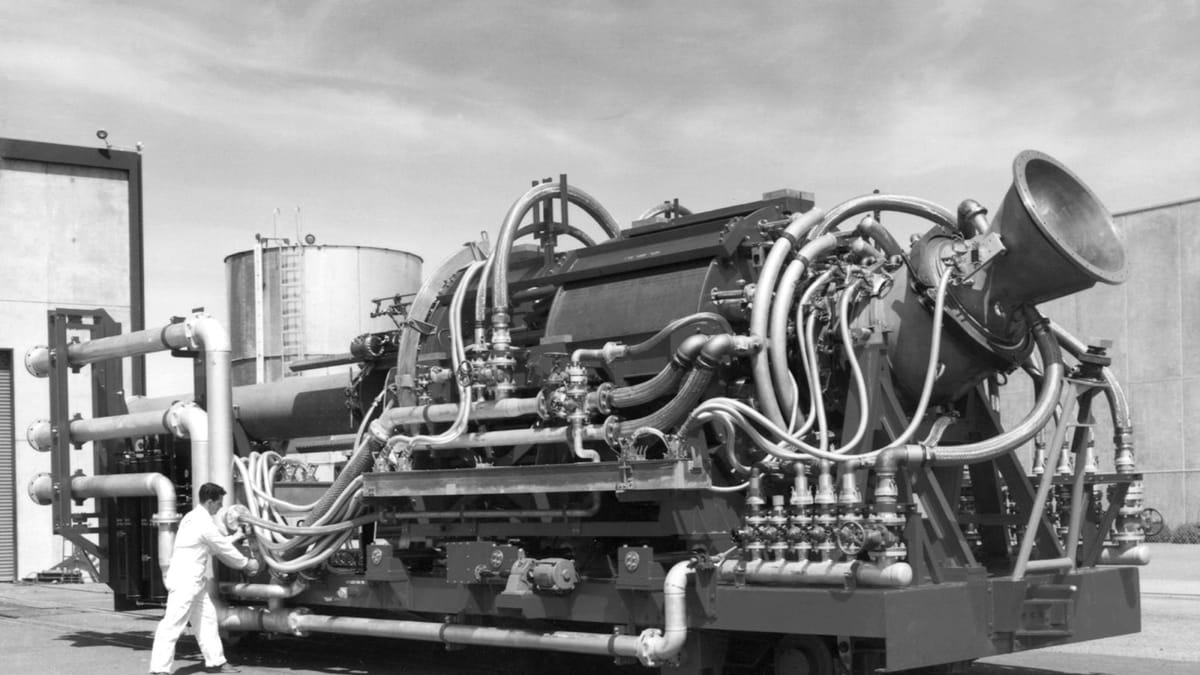
Livermore built test reactors under the name Tory. Tory-IIA was the proof-of-concept unit. Tory-IIC was the full-size flight-weight reactor, designed around 600 megawatts of thermal power and recording about 513 megawatts during its 1964 run. That output had to fit inside a missile roughly 1.5 meters in diameter.
To save weight, the reactor had no heavy gamma or neutron shielding. A shielded core would have been too heavy for a ramjet missile, so Pluto accepted the radiation problem and pushed the burden onto the airframe, the guidance bay, and the mission itself.
The fuel was ceramic rather than metal. Engineers needed a material that could hold its shape above 1,250 degrees Celsius while neutrons hammered it and supersonic air scoured it. They settled on small hexagonal blocks of beryllium oxide loaded with uranium dioxide. Each block had round holes drilled through it, and the blocks stacked into a honeycomb with about 27,000 individual air channels running front to back.
Manufacturing those blocks became one of the program’s harder industrial jobs. Beryllium oxide is toxic to machine and difficult to fire consistently, but Pluto needed hundreds of thousands of pieces matched to tight tolerances. Livermore contracted Coors Porcelain Company in Golden, Colorado, best known for ceramics and for being next to the brewery. Its high-temperature ceramics division grew significantly because of the work.
Watch the Video
Open VideoThe underlying physics was simple: heat air, expel it fast, get thrust. The engineering was not. Pluto needed a 500-megawatt fission core to remain intact for hours while Mach 3 air ripped through tens of thousands of channels at more than 1,200 degrees Celsius.
Building the Flying Crowbar
The reactor was only one part of the vehicle. Around it, Pluto needed an airframe that could survive Mach 3 flight at 300 meters altitude for hours without flexing apart or losing its intake geometry.
Chance Vought, later Ling-Temco-Vought, won the airframe contract in 1961. Marquardt Corporation handled the ramjet inlet and the integration of the propulsion duct around the Tory reactor. Both companies had supersonic experience, but neither had built anything meant to hold together at three times the speed of sound only a thousand feet above the ground.
At that altitude and speed, aerodynamic stress and heating were severe. Skin temperatures along the nose and intake lip reached around 540 degrees Celsius. A raindrop hitting the airframe at Mach 3 could pit hardened steel, and a hailstone could punch through a thin aluminum panel.
The Flying Crowbar nickname captured the answer. SLAM was designed as a dense, heavy cylinder with thick skin sections, internal bracing around the reactor bay, and a forward fuselage packed tightly enough to absorb impacts without losing aerodynamic shape. Three short fins at the tail provided control without the vulnerability of long wings.
Electronics had to survive the radiation field. Pluto engineers worked with vendors on radiation-hardened transistors and diodes, using doped silicon and protective packaging that could tolerate neutron and gamma exposure. Standard lubricants broke down under radiation, so the inertial platform used gas-bearing gyroscopes. Reactor control vanes used pneumatic actuators driven by compressed nitrogen, because hydraulic fluid would decompose in the neutron flux.
Cabling used inorganic insulation. Structural adhesives had to be screened. Every ordinary engineering assumption had to be checked against a simple fact: this missile carried its own unshielded reactor.
Jackass Flats Proves the Impossible
The Tory reactors could not be flown for testing, and they could not be run in an ordinary engine cell. A 500-megawatt open-cycle reactor needed a test stand that could feed it the airflow conditions of Mach 3 while keeping the radioactive aftermath manageable.
The site chosen was Jackass Flats, inside the Nevada Test Site, about 145 kilometers northwest of Las Vegas. Livermore built Site 401 with a dedicated pad, a control bunker buried two miles back, and a disassembly building where the reactor could be taken apart by remote handling after each run.
Feeding the reactor took an air supply unlike anything in normal engine testing. Engineers laid roughly 25 miles of oil-well casing as high-pressure storage tubes, routed the air through steel-pebble heaters, and warmed it to about 730 degrees Celsius before it reached the core. The system could deliver Mach 3 conditions at the reactor face for several minutes.
Tory-IIA ran for the first time on May 14, 1961, at low power. Over the following months, the team brought it up to design temperatures and confirmed that beryllium oxide fuel elements could survive neutron flux and supersonic airflow without cracking apart.
Tory-IIC was the full-size core. On May 20, 1964, with Atomic Energy Commissioner Glenn Seaborg and a row of Air Force and AEC officials watching from the bunker, the team brought the reactor to full power and held it there for nearly five minutes. Instruments recorded about 513 megawatts thermal and roughly 35,000 to 38,000 pounds of thrust. Air ripped through the 27,000 channels at more than 1,200 degrees Celsius, and the core held together.
That result settled the central technical question. A nuclear ramjet could be built, fueled, and operated at full design power inside an airframe-sized package. The reactor worked. The harder questions were no longer about physics.
The Questions No One Could Answer
The first unsolved question was where to fly a complete missile.
SLAM could not be recovered. Its reactor would be intensely radioactive after a single run, and the airframe was meant to crash at the end of its mission. A test article might carry no warheads, but it would still scatter fission products along its path.
Engineers briefly floated a tethered test, with the missile flying in a huge circle around an anchor point. The forces and cable lengths required made it absurd almost immediately.
The next idea moved the test to the Pacific. Planners drew flight corridors west of Hawaii toward the Wake Island area, where SLAM could fly racetrack patterns over open water before diving the reactor into deep ocean. Oceanographers raised concerns about long-term contamination, and the AEC did not have a clean answer for how to characterize the release.
Operational use raised the same problem on a larger scale. Any route from the continental United States to Soviet targets crossed allied or neutral airspace. A SLAM passing at low altitude over Western Europe or the Arctic would bring shattering sonic booms and a radioactive exhaust trail before it ever reached its target.
By 1963 and 1964, the strategic case was also weakening. Atlas and Titan ICBMs were operational. Minuteman silos were filling the northern plains. Polaris submarines were on patrol. Those systems could deliver warheads in roughly 30 minutes without radioactive overflight or a nuclear ramjet wandering for hours.
Critics inside the Pentagon and AEC called SLAM “Slow, Low, and Messy”. Strategic Air Command planners increasingly saw it as a weapon without a mission. Any target it could attack was already covered by faster, cleaner systems. Cost worked against it too: about $260 million had already gone into Pluto by mid-1964, and projected unit costs were far higher than a Minuteman missile.
The diplomatic environment had shifted as well. The Limited Test Ban Treaty of 1963 banned nuclear weapons tests in the atmosphere, underwater, and in space. It did not prohibit SLAM directly, but it marked a clear turn against deliberately releasing fission products into the environment. A flight test program built around a reactor venting hot exhaust over the Pacific became much harder to defend.
Cancellation and Afterlife
On July 1, 1964, the Air Force and the Atomic Energy Commission canceled Project Pluto. The program had run for seven and a half years and consumed about $260 million. Six weeks earlier, Tory-IIC had delivered the strongest technical result in the program’s history. No complete SLAM was ever assembled, and no flight test was attempted.
Ted Merkle gathered the Livermore Pluto team for what they called the Last Supper a few days after the cancellation order. He had tie tacks made in the shape of SLAM and handed them to the engineers who had carried the program. He also distributed bottles of Pluto Water, a mild laxative mineral water, as a parting joke. Merkle died in 1966 at the age of 41.
The program still left residue. Radiation-hardened transistor work fed into satellite electronics. Beryllium oxide and uranium dioxide fuel-element research pushed high-temperature ceramics work forward. Terrain contour matching developed for SLAM’s low-altitude dash helped shape the guidance logic later used in Tomahawk cruise missiles.
The idea itself did not vanish either. Russia revealed the 9M730 Burevestnik, called Skyfall by NATO, in 2018 as a nuclear-powered cruise missile of supposedly unlimited range. A 2019 test accident near Nyonoksa killed five Rosatom personnel and produced a brief radiation spike along the White Sea coast. The basic concept points toward the same family of problems Livermore proved at Jackass Flats in 1964.
Most canceled Cold War weapons died because the engineering failed or the budget collapsed before hardware existed. Pluto died the other way around. Tory-IIC ran at 513 megawatts and held together. The ceramic fuel elements survived. The guidance work was advancing. By proving that the missile could, in principle, work, the Pluto team forced the Pentagon to look directly at what such a vehicle would actually do.
The reactor worked, and that was the problem.
Key Takeaways
-
SLAM was a proposed Mach 3 nuclear-powered cruise missile that would fly at low altitude while carrying multiple thermonuclear warheads.
-
Project Pluto’s open-cycle nuclear ramjet heated outside air directly through an unshielded reactor core, turning the atmosphere into coolant and radioactive exhaust.
-
Livermore successfully tested the Tory-IIA and Tory-IIC reactors at Jackass Flats, with Tory-IIC reaching about 513 megawatts thermal in 1964.
-
The missile’s own flight path would have created destructive shockwaves and radioactive contamination even before its warheads detonated.
-
Project Pluto was canceled because ICBMs and submarine-launched missiles made it strategically unnecessary, while testing and operating it created unsolved political and environmental problems.

Simon Whistler
Simon Whistler hosts MegaProjects, bringing engineering, infrastructure, and military-machine stories into clear narrative focus for viewers who want the systems, tradeoffs, and human decisions behind the build.
Frequently Asked Questions
What was SLAM?
SLAM stood for Supersonic Low-Altitude Missile. It was a proposed U.S. nuclear-powered intercontinental cruise missile designed to fly at roughly Mach 3 near the ground while carrying multiple thermonuclear warheads.
What was Project Pluto?
Project Pluto was the Air Force and Atomic Energy Commission program that developed the nuclear ramjet reactor intended to power SLAM. Livermore Laboratory led the reactor work and built the Tory test engines.
How did the nuclear ramjet work?
The ramjet used forward speed to force air through an intake and into a reactor core. Instead of burning chemical fuel, the reactor heated the incoming air directly; the hot air expanded out the nozzle as thrust. Because the air passed through an unshielded reactor, the exhaust was radioactive.
Why was SLAM nicknamed the Flying Crowbar?
Engineers used the nickname because the missile had to be dense, heavy, and extremely strong to survive Mach 3 flight at roughly 300 meters altitude. Its reinforced cylindrical structure was designed to withstand severe heating, impacts, and aerodynamic loads.
What did the Jackass Flats tests prove?
The Jackass Flats tests proved that a nuclear ramjet reactor could operate at full design power in an airframe-sized package. In May 1964, Tory-IIC ran for nearly five minutes at about 513 megawatts thermal and produced tens of thousands of pounds of thrust.
Why was Project Pluto canceled?
Project Pluto was canceled because its strategic need had faded. ICBMs, Minuteman missiles, and Polaris submarines could deliver nuclear warheads faster and more cleanly, while SLAM created enormous problems with radioactive exhaust, flight testing, allied overflight, cost, and political acceptability.
Was a complete SLAM missile ever built or flown?
No. The reactors were successfully tested on the ground, but no complete missile was assembled and no flight test was attempted before the program was canceled on July 1, 1964.
Sources
-
Original MegaProjects video: SLAM: The US’ Most Insane Missile Project
-
Hero image source by the Federal Government of the United States, public domain.
Related Projects
Project Babylon
The true story of Gerald Bull, the Canadian artillery genius who helped Saddam Hussein build a gun capable of firing satellites into space.

Boeing E-4
How the E-4 Nightwatch became America's airborne command center, built to keep national command authority alive through nuclear war, disasters, and crises.