
In the late 1980s, a Canadian artillery genius with a grudge against the West found himself in the deserts of Iraq, working hand-in-hand with Saddam Hussein. His goal was to build the biggest gun the world had ever seen — a weapon so enormous, so powerful, that it could fire satellites into space or chemical warheads across continents. Codenamed Project Babylon, it was equal parts science experiment, vanity project, and doomsday machine. And for a while, it looked like it might actually work.
But when you’re smuggling giant cannon barrels across borders, paying engineers in briefcases of cash, and boasting to anyone who will listen about your “space gun,” you tend to make enemies. Deadly ones.
This is the wild, conspiratorial, and very real story of how Saddam nearly got his hands on a superweapon — and how the world, terrified of what that might mean, stopped it.
The Man Who Dreamed Too Big
To understand how a supergun project found its way to Saddam’s Iraq, we first need to meet Gerald Bull, the man behind the dream.
Bull was not your average arms engineer. He was a child prodigy of ballistics, a Canadian whiz-kid who had been obsessed with projectile science from a remarkably young age. And from early on, he was captivated by one grand idea: could you fire a projectile into space using a giant cannon?
Most experts scoffed at the notion, but Bull was determined to prove it possible. In the 1960s, as a young professor at McGill University, he spearheaded a research program that would make him a legend in certain circles. It was called Project HARP — the High Altitude Research Project — and it was nothing short of spectacular.
With quiet backing from the US Army, Bull took two 16-inch naval guns, welded them end-to-end to create a single 118-foot-long artillery piece, and installed the resulting monster on the Caribbean island of Barbados. The so-called “HARP space gun” then began thundering shots into the sky that rattled windows across the island. Using fin-stabilised projectiles — Bull called them Martlet shells — his team fired dozens of rounds to the fringes of space.
In November 1966, the project peaked, both literally and figuratively, when one of the gun-launched projectiles reached an altitude of 111 miles — a world record for any gun-fired object. For context, “outer space” is generally agreed upon to start at the Kármán Line, a mere 62 miles up. Bull had shot well past it.
Flushed with success, Bull then envisioned even bigger cannons and rocket-boosted shells that could go higher still. Ballistically, he argued, a cannon had certain advantages over rockets: a gun’s “fuel” — explosive propellant — delivers a massive instant impulse, and its barrel provides inherent accuracy and guidance.
The drawbacks, of course, were enormous too — chiefly the 10,000g acceleration force that would crush most payloads, not to mention any hypothetical astronaut. Undeterred, by the mid to late 1960s, he was drawing up plans for a 32-inch calibre space gun that he envisioned as being able to lob small satellites into orbit — quickly, cleanly, and above all else, cheaply. This was his life’s big idea, and he pursued it with evangelical zeal.
Yet reality came crashing down in 1967. Funding for Project HARP was abruptly cut off. The Canadian government grew uncomfortable with how overtly military Bull’s space research appeared, and the American scientific establishment was putting its money on rockets, not giant guns. Practically overnight, Bull’s grand experiment was terminated.
The sudden end of HARP devastated him. Colleagues recalled that he took it as a personal betrayal; after pouring his soul into the space-gun project, he felt cast aside by the very governments he thought he was helping. And if Bull couldn’t get government support for his peaceful space launcher, he decided to go private — and go military.
From Academic to Arms Dealer
In the 1970s, Bull transformed himself into a freelance weapons designer and arms dealer, adapting his high-altitude research into cutting-edge artillery technology. He founded a company, Space Research Corporation, straddling the Canada–Vermont border, and began selling advanced munitions to anyone who would bankroll his work.
He also developed the GC-45 howitzer, a 6.1-inch gun with an extended range that outclassed standard NATO artillery. And he sold thousands of them — to countries like Israel (which used them in the 1973 Yom Kippur War), Saudi Arabia, Singapore, and even countries that were decidedly on NATO’s naughty list, including apartheid-era South Africa, China, Iran, and Iraq.
The range of the GC-45 cannot be overstated. When being fed with Bull’s specialist “Base Burn” shells — a type that continues to burn propellant after it leaves the barrel, creating an area of low pressure behind the shell that reduces in-flight drag — they could top out at a range of 24.6 miles. For comparison, the L118 Light Gun, then and now the UK’s go-to field piece, tops out at a range of 12.8 miles even using Base Bleed shells.
The M777 Howitzer, the US equivalent (which also happens to be British-designed), can reach out to 14.6 miles firing its standard M795 projectile, and has only recently — as in from 2007 — been able to push that out to 25 miles using the expensive and still rather rare M982 Excalibur round. Bull’s howitzers were very, very good.
His dealings with those “naughty” countries came back to bite him, however. In 1980, he was caught covertly supplying his howitzers to South Africa, which was then subject to a UN-imposed arms embargo. He was prosecuted in the United States and spent six months in prison.
The prison stint didn’t reform him — quite the opposite. It created a deep resentment within him towards Western authorities. He felt he’d been scapegoated and shunned, and it fuelled his resolve to pursue his ambitions independently, even if it meant working with pariah states.
And so it was that in late 1987, Bull — who by then had relocated his operations to Brussels — was quietly approached by Iraqi officials with a tantalising offer. They had bought their GC-45s back in 1984, and having found themselves rather pleased with the weapons, they invited him to Baghdad, expenses paid, to discuss potential collaborations.
For a man like Bull, the timing was perfect: Iraq was exactly the sort of patron he needed — wealthy, outside the Western sphere, and motivated to acquire cutting-edge weaponry by any means necessary. And for Iraq, Bull was the prize catch — the world’s foremost artillery expert, a man who could give them a decisive edge against their enemies.
Saddam’s Grand Idea
When Gerald Bull arrived in Baghdad in 1988, he found a regime eager to think big.
Saddam Hussein had just expended countless lives and billions of dollars fighting Iran to a brutal stalemate in the Iran–Iraq War, which had ended in August of that year, and while doing so, he had built up the fourth-largest army in the world. And yet, despite that immense force, Iran’s sheer manpower and vast-scale missile attacks had shown the limits of Iraq’s reach and forced a status quo peace. Saddam found himself hungry for super-weapons that could help turn the tables.
He also craved prestige on the world stage — the kind of prestige that comes from technological triumphs. It did not escape Saddam’s notice that Israel, his arch-enemy, had launched its own satellite — the Ofeq 1 in 1988 — and was consequently edging into the space club. For the Arab world’s self-styled champion, this was both an affront and a challenge.
And then, in walked Gerald Bull, brimming with exactly the kind of grandiose vision that appealed to all facets of Saddam’s ambition.
Bull pitched the Iraqis on an updated version of his old dream: a space cannon that could launch satellites for Iraq — and potentially for all Arab nations — into orbit at a fraction of the cost of rockets, as well as launching ordnance at intercontinental ranges.
It was a compelling pitch. Iraq struck a deal with Bull and christened the endeavour Project Babylon — a codename invoking the grandeur of ancient Mesopotamia’s wonders.
Bull’s contract was generous: by 1989, the Iraqis were reportedly paying him $5 million a year — not adjusted for inflation — just to revamp their conventional artillery, with far larger sums promised for the supergun itself. He was given near-free rein at Iraq’s top-secret military engineering sites as well, like the sprawling Saad 16 complex in northern Iraq, where missile and arms development was underway. He knew his stuff, and Saddam knew he knew his stuff.
With his extensive contacts and companies in Europe, Bull also became a key node in Iraq’s procurement network. This was a time when Baghdad, flush with oil revenue and not yet under full international sanctions, was buying up advanced technology globally in semi-secrecy. Western governments were publicly embargoing arms to Iraq, but in practice, numerous companies — and some clandestine agencies — were quietly assisting Iraq, seeing it as a counterweight to revolutionary Iran. Bull’s involvement in Project Babylon thus fit neatly into a larger pattern of covert cooperation.
In Iraq, Bull had finally found the patron with vision he had always wanted. Saddam’s imagination was as grand as his own — and importantly, Saddam was willing to foot the enormous bill. With handshake deals and millions on the table, Bull set about making Saddam’s wild wish a reality, with the project officially underway by the close of 1988.
Building the Beast
The scope of Project Babylon was immense. According to later intelligence assessments, the ultimate goal was to construct a gun with a 39.3-inch bore — meaning the barrel’s diameter would be as wide as a manhole cover — and a barrel length of at least 512 feet. To put that in perspective, such a barrel would stretch longer than a football field and a half.
It would dwarf even the infamous German WWII superguns — like the V-3 cannon and Schwerer Gustav railway gun — in scale, and if assembled vertically, it would have stood over 328 feet tall. This was essentially a building-sized gun, something that could only be assembled in situ, probably welded into a mountainside or supported by a custom-built structure of concrete and steel.
As for weight, the massive barrel alone was expected to weigh over 1,500 tons. Add support structures, recoil mechanisms, and mounting, and the whole assembly would tip the scales at well over 2,000 tons — equivalent to the displacement of a small warship.
Thanks to its immense proportions, there would be no moving this beast once built. It would be a fixed installation, likely embedded at a carefully chosen hillside in western Iraq — intelligence later pinpointed a site in the remote Jabal Hamrin hills as the planned location. The gun would be angled skyward permanently, not steerable or elevatable like normal artillery.
What Comes Out the Business End
Watch the Video
Open VideoProject Babylon was designed to fire three primary types of projectiles: subcalibre kinetic energy penetrators, gun-launched rockets (GLRs), and potentially large conventional explosive shells. The subcalibre rounds, such as the “S-32” projectile, were saboted darts intended for extreme velocity and armour penetration — similar in concept to modern anti-tank munitions, but dramatically bigger.
The gun-launched rockets were multi-stage projectiles fitted with fins and internal propulsion, intended for long-range bombardment of strategic targets — essentially combining gun-launch acceleration with guided missile capabilities. Lastly, although not completed before the project’s collapse, conventional high-explosive shells were reportedly under design, which would have been packed with enough explosive force to level tower blocks in a single shot.
Project Babylon was also intended to have civil application, in the form of launching satellites. Bull boasted to his Iraqi partners that his cannon would be able to put small satellites into space for as little as $5,000 per launch (in 1980s money) — a sum that is a mere rounding error compared to the cost of a conventional rocket launch. If true, that would have been revolutionary, although of course only very rugged, unmanned payloads would have been able to survive such a launch.
Baby Babylon: The Prototype
Before attempting to build the full colossal gun, Bull sensibly opted to create a working prototype at a smaller scale. This prototype was nicknamed “Baby Babylon.”
Baby Babylon was hardly small itself — its bore was 13.8 inches, and its barrel length about 150 feet. In real terms, this was a supergun in its own right, roughly comparable in size to the largest artillery pieces of World War II.
By mid-1989 — so barely any time at all — Bull’s team, which included both expat engineers and Iraqi specialists, had assembled the Baby Babylon gun on a test site. It was initially laid out horizontally and test-fired with high-explosive propellant and heavy lead slugs to gather data. Then, with those preliminary tests having proved satisfactory, they repositioned it at a 45-degree elevation on a hillside to simulate operational firing angles.
They had a very specific goal with Baby Babylon. The core premise — that being, put enough bang behind something and you can fling it off into space, or into another country as the case may be — was readily apparent and not up for debate. What they were more interested in was the specific ins and outs of how one actually did such a thing. Key points of contention included how you even make a barrel that big, and how you make it strong enough to not just immediately blow itself up under a full combat or space-launch load.
There was no tooling in Iraq — or anywhere, for that matter — which could simply produce a 512-foot barrel in one go. Bull opted to have the vast barrel made in segments, then bolted together at the launch site. While this solved the problem of actually manufacturing the thing, it also created the fear of catastrophic failure at launch — every single seal between segments was, as far as Bull was concerned, a potential weak point that blast pressure would exploit if given the chance.
As for how Baby Babylon performed in its tests — the results were decidedly mixed.
On the one hand, the gun actually worked: it could hurl a projectile hundreds of miles, with calculations suggesting a maximum potential range of over 460 miles if everything went perfectly. On the other hand, the tests exposed serious engineering challenges. The enormous pressures and stresses in the barrel caused persistent problems with the seals between barrel segments, exactly as Bull had feared, with one test even resulting in a damaging explosion that blew out part of the barrel.
Essentially, Baby Babylon revealed that building a supergun was not as simple as scaling up existing artillery — new techniques in metallurgy, machining, and assembly were needed to keep the segments tightly fitted under extreme pressure. Nonetheless, these setbacks did not deter Bull or the Iraqis. No one had expected such an envelope-pushing project to be free of challenges, and so all the problems represented were engineering puzzles to solve on the road to the full-sized gun.
Covert Manufacturing Across Europe
Meanwhile, the manufacturing of Big Babylon’s components was in full swing — not in Iraq, but covertly in Europe.
Given the specialised industrial capacity required — Iraq’s own factories couldn’t forge huge ultra-thick steel tubes with the needed precision — Bull tapped his network of overseas contacts to source parts. Through front companies and third-party brokers, Iraq ordered giant maraging steel sections from firms in Britain, Germany, France, Spain, Switzerland, and beyond.
The critical barrel segments — each a thick steel tube dozens of feet long — were contracted out to Sheffield Forgemasters in the UK and a smaller firm, Walter Somers Ltd. These companies were told they were producing “petrochemical pressure vessels” or pipeline parts for an oil project. In truth, the specifications — 39-inch internal diameter thick-walled tubes — were unlike any ordinary pipeline, but apparently the orders raised little suspicion at the time.
Other crucial components like breech blocks and recoil cylinders were ordered from firms in Western Europe under similar disguises. Even the special slide bearings needed to support the gun barrel were procured from manufacturers in Spain and Switzerland, under the ruse of civilian use.
The entire procurement operation for Project Babylon was a masterpiece of deception — and a testament to how globalised the arms market was. Iraqi front companies and Bull’s own connections channelled millions of dollars to Western suppliers. Drawings were often split up and labelled innocuously.
More astonishing still is the fact that, for a time, this all occurred under the nose of Western governments — at least nominally. Later investigations revealed that intelligence agencies like MI6 and the CIA were aware of some aspects of these transactions but allowed them to proceed for various geopolitical reasons.
A declassified CIA intelligence assessment from 1991, titled Project Babylon: The Iraqi Supergun , discusses exactly this at length, noting how the agency was fully aware that British firms were engaged from 1988 onward. But elements in London and Washington reportedly viewed the supergun as a useful distraction that could be leaked to the media to provide cover for other, more strategically important covert arms deals — reasoning that the story of a big, shiny super cannon would push those more sensitive transactions out of the news cycle.
Scaling Up — and the Unsolved Problems
By late 1989, components for at least one Big Babylon gun were nearing completion. The full barrel was to comprise some 26 huge sections bolted together, plus smaller segments for the chamber and muzzle. Each of those 26 sections alone weighed in the order of 20 tons.
Both Bull and Saddam were dreaming even bigger. With all seemingly going well enough, they were actually envisioning building two Big Babylons — one for testing, and one for actual field use. Further still, there were whispers of “Phase II” guns — aimable versions with smaller 13.7-inch barrels mounted on swivelling bases. These would have had a smaller range, with estimates topping out at 621 miles, but the fact that these would be fully traversable, and thus aimable in all dimensions, was deemed a very worthwhile trade-off.
There were, however, critical unsolved problems. First among them was recoil. In a normal artillery piece, recoil is handled by a management system built into the gun mount — typically a combination of hydraulic cylinders and compressed gas reservoirs. When the gun fires, the barrel is driven backward by the explosive force, but instead of transferring that energy directly into the ground or vehicle, it’s absorbed by these mechanisms.
The fluid and gas compress to cushion the blow, then slowly return the barrel to its original position. This not only protects the weapon from damage but also keeps it stable and on target, enabling rapid, repeated fire.
For Big Babylon, recoil was to be handled in essentially the same way, only on a vastly larger scale, with four gigantic recoil cylinders — each around 60 tons — being planned. By all expert accounts, these would have been perfectly sufficient, though they wouldn’t exactly have turned Big Babylon into a precision instrument.
Then there was the issue of guidance. A shell shot from an immobile gun can’t be aimed once it’s in flight, so hitting any precise target — especially with a non-orbital shot — would require some form of terminal guidance on the projectile, which was a whole other unsolved problem.
In truth, as one US intelligence analysis noted, this fact alone would have made Big Babylon nearly useless as a battlefield weapon in any traditional sense. It couldn’t be re-aimed to track moving targets, would have had an extremely slow rate of fire, and the firing would produce such a signature — massive flame, noise, and likely a literal shockwave — that it would be instantly spotted and destroyed by enemy aircraft after one shot during wartime.
Iraq already had Scud missiles that were far more practical for delivering explosives. However, pure practicality wasn’t really the point. Saddam and Bull were aiming for spectacle and terror. A supergun could fire beyond the range of any missile Iraq had, potentially even into low orbit or halfway around the world.
And as a one-shot terror weapon, it could, for instance, fling a chemical or biological warhead at a distant city with virtually no defence against it. This was asymmetric warfare thinking: an immobile superweapon carries a certain doomsday cachet even if it’s not militarily efficient.
By early 1990, Project Babylon had made significant progress. The Baby Babylon test gun, despite its issues, had proven the concept feasible enough to proceed. Many of the Big Babylon barrel sections had already been delivered to Iraq via ship and truck — hidden in false shipments, arriving at Iraqi ports and being spirited away to the assembly site. Iraqi and European engineers were reportedly preparing the foundation at the chosen hillside, ready to start bolting the behemoth together that summer.
In short, Saddam’s supergun was on the verge of becoming a physical reality.
A Conspiracy Unravels
Bull was brilliant — but dangerously indiscreet. As Project Babylon advanced, word began to circulate in intelligence circles: Iraq was importing massive steel tubes, and Bull was linked to a covert ballistic program. Even the name “Project Babylon” surfaced in intercepted communications. By late 1989, as that declassified CIA report confirmed, the jig was up, and the world’s military elites were aware of exactly what Bull and Saddam were up to.
For Israel, the implications were unacceptable. Saddam’s regime had already tried to develop nuclear weapons before Israel bombed the Tuwaitha Nuclear Research Centre in 1981, and now it was chasing long-range delivery systems. A supergun — even a theoretical one — was a risk that Tel Aviv simply couldn’t ignore.
Bull, for his part, suspected danger. In early 1990, he told friends he felt watched. Reports suggest he quietly approached US contacts about returning to the fold, perhaps realising he’d gone too far. He may also have grown frustrated with Iraqi demands — or non-payments — and was exploring a way out. If true, that made him a liability: a man who knew everything about Iraq’s covert weapons programs, suddenly signalling he might talk.
The Assassination
On 22 March 1990, someone decided he wouldn’t get the chance. As Bull returned to his Brussels apartment, a gunman shot him five times in the neck and head with a silenced .32 calibre pistol. There were no witnesses, no fingerprints — just a body and a mystery.
Officially, the case remains unsolved. Most experts point to Mossad. The method, timing, and motive all align with Israel’s prior suspected operations — such as the reported killing of Yahya El Mashad, the head of the Iraqi nuclear program, who was killed in a hotel room in Paris in 1980.
Whatever the truth, Bull’s death derailed the project. His Iraqi contacts were left reeling. Western suppliers panicked. And within weeks, intelligence tips flowed to authorities.
The Seizure
This came to a head on 11 April 1990, when British Customs at Teesport seized eight enormous steel tubes bound for Iraq — all of them prospective parts for Project Babylon.
From there, it all simply fell apart. Iraq couldn’t get the parts anymore, and no longer had the expert know-how to see it completed even if they could.
Project Babylon was dead.
The Aftermath
In Britain, Project Babylon became a political scandal: the “Supergun Affair.” Major firms like Sheffield Forgemasters had been quietly supplying Saddam’s regime, and documents revealed government officials had been warned as early as 1988. Both the media and opposition MPs were furious and wanted answers.
Legal cases followed, but most collapsed. Further damage came when reports surfaced that MI6 had known about — and possibly even supported — some of the exports. Eventually, however, with the arrival of new news cycles and new scandals to fill them, both the public and the powers that be stopped caring about Project Babylon, and the whole sordid affair fell into the history books with minimal consequences.
Saddam, for his part, denied everything, claiming the parts were for petrochemical use. But the evidence piled up — and then Iraq invaded Kuwait in August 1990. The resulting Gulf War saw Iraq get comprehensively defeated, and in the ensuing disarmament processes, UN weapons inspectors descended upon Project Babylon’s half-completed, dust-covered skeleton and destroyed everything still left on the ground.
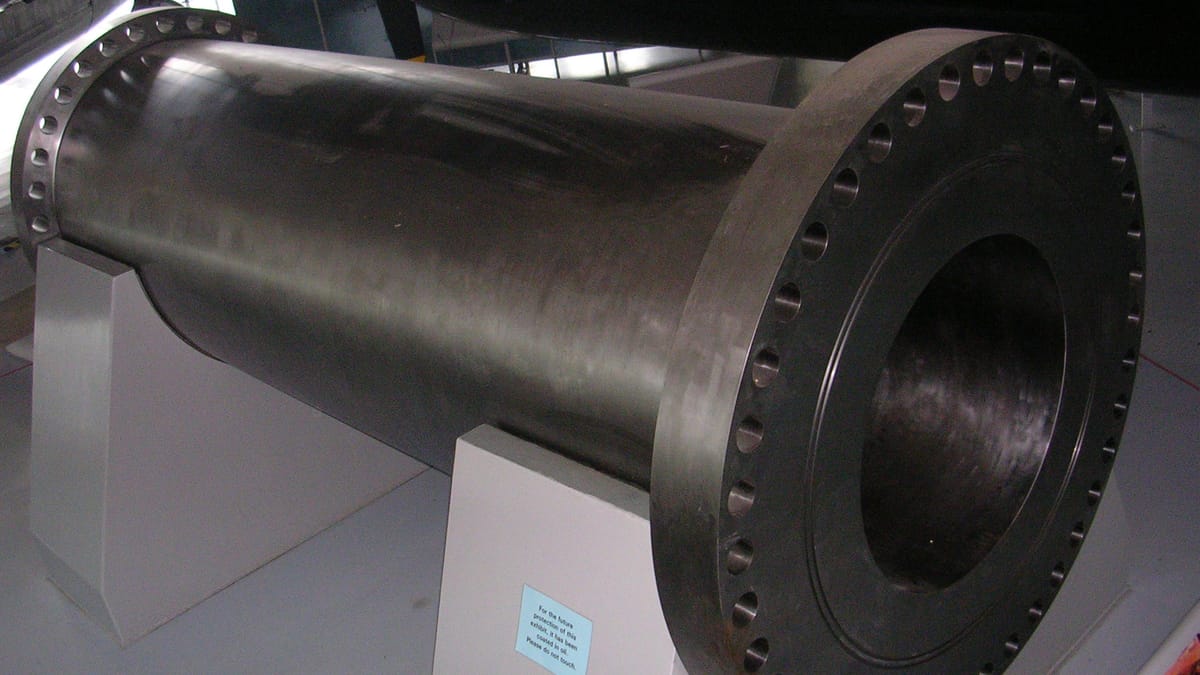
Unexpectedly, however, it isn’t exactly hard to find remnants of the project today. The British government was surprisingly generous in distributing the parts it seized at Teesport to military museums across the country, where they remain on display.
When all was said and done, Project Babylon died with Gerald Bull — undone not by physics, but by politics, bullets, and the unforgiving world of international espionage. The supergun was, in the end, a weapon that was always more terrifying as a concept than it could ever have been as a reality. But for a brief window in the late 1980s, an artillery genius and a dictator came closer than anyone thought possible to building the biggest gun the world had ever seen.
Key Takeaways
-
Canadian artillery genius Gerald Bull partnered with Saddam Hussein to build a massive supergun capable of launching satellites or weapons.
-
Codenamed Project Babylon, the ambitious endeavor required covertly manufacturing enormous steel barrel segments across Europe under the guise of oil pipeline parts.
-
The massive 512-foot weapon would have weighed thousands of tons and remained permanently embedded into a remote Iraqi hillside.
-
The superweapon project abruptly collapsed in 1990 following the mysterious assassination of Gerald Bull and the seizure of critical barrel components.

Simon Whistler
Simon Whistler hosts MegaProjects, bringing engineering, infrastructure, and military-machine stories into clear narrative focus for viewers who want the systems, tradeoffs, and human decisions behind the build.
Frequently Asked Questions
Who was Gerald Bull in Project Babylon?
Gerald Bull was a Canadian ballistics prodigy and artillery engineer who became the driving force behind Project Babylon. By the late 1980s he was working with Saddam Hussein in Iraq to build an enormous supergun capable of firing satellites into space or warheads across vast distances.
What was Project Babylon designed to do?
Project Babylon was designed around an enormous gun intended to launch satellites into space, but it also had the potential to fire chemical warheads across continents. It was presented as part science experiment and part prestige project, while also carrying obvious doomsday implications.
What earlier project made Gerald Bull famous before Project Babylon?
Bull first gained fame through Project HARP, the High Altitude Research Project, in the 1960s at McGill University. With quiet backing from the US Army, he welded two 16-inch naval guns into a 118-foot artillery piece in Barbados and, in November 1966, fired a projectile to 111 miles, a world record for a gun-fired object.
Why did Gerald Bull turn from academic research to weapons dealing?
Project HARP lost funding in 1967 after the Canadian government became uneasy with its military character and the American scientific establishment backed rockets instead of giant guns. Bull took the collapse as a personal betrayal, then went private and military in the 1970s by founding Space Research Corporation and selling advanced artillery technology abroad.
What made Gerald Bull’s GC-45 howitzer notable?
The GC-45 was a 6.1-inch howitzer with extended range that outperformed standard NATO artillery. Using Bull’s Base Burn shells, it could reach 24.6 miles, and he sold thousands to customers including Israel, Saudi Arabia, Singapore, South Africa, China, Iran, and Iraq.
How did Bull’s dealings with sanctioned states shape his later work with Iraq?
In 1980, Bull was prosecuted in the United States for covertly supplying howitzers to South Africa in violation of a UN arms embargo and served six months in prison. That experience deepened his resentment toward Western authorities and strengthened his determination to pursue his ambitions with pariah states, setting the stage for his Iraqi partnership.
Why was Saddam Hussein interested in Gerald Bull and supergun technology in 1988?
Saddam emerged from the Iran-Iraq War in August 1988 with the fourth-largest army in the world, yet Iran’s manpower and missile attacks had exposed the limits of Iraq’s reach. He wanted super-weapons to change that balance and also sought prestige after Israel launched the Ofeq 1 satellite in 1988, making Bull’s grand artillery vision especially attractive.
Sources
-
Original MegaProjects video: Project Babylon: Saddam Hussein’s Supergun
-
Hero image source by en:User:Bluemoose, licensed under by-sa.
Related Projects
The Maxim Gun
How Hiram Maxim built the first true machine gun in 1884 — its recoil-operated design, devastating service history, and why it still fights today
SLAM
Project Pluto's SLAM missile paired a Mach 3 low-altitude cruise missile with an unshielded nuclear ramjet and a string of thermonuclear warheads.

Project A119: Nuke the Moon
In the late 1950s, the US Air Force developed a top-secret plan to detonate a nuclear warhead on the Moon. Discover the bizarre story of Project A119, Carl Sagan's involvement, and why it was ultimately abandoned.