

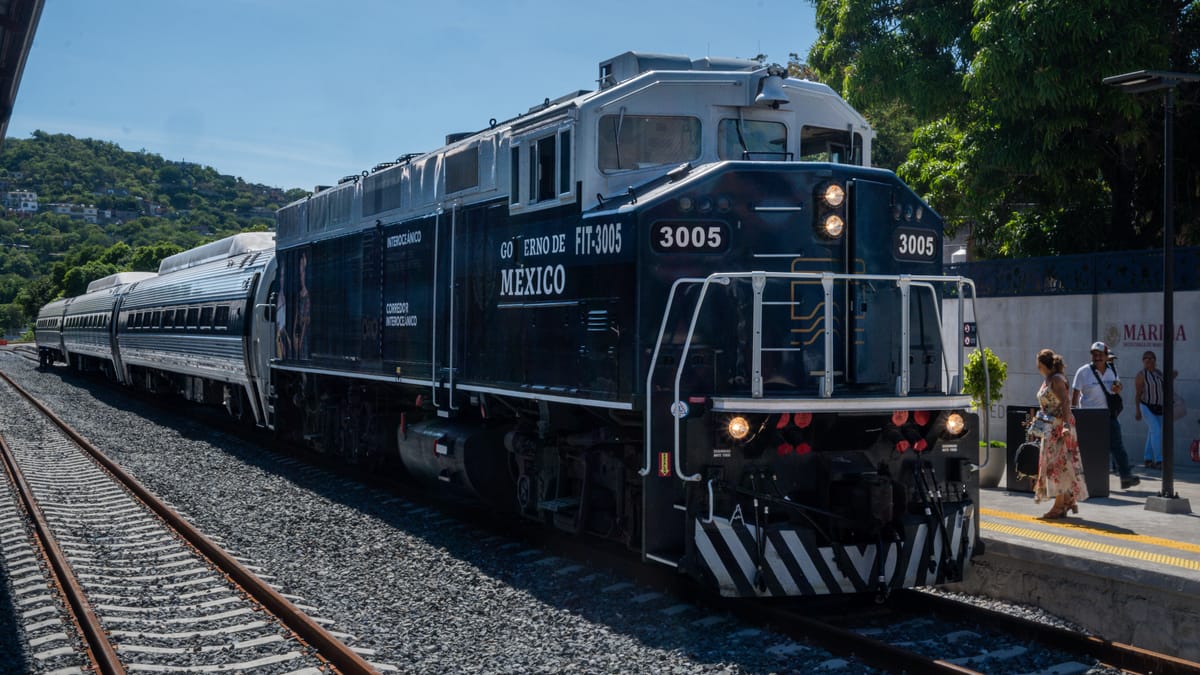
Upon its completion, the Panama Canal became an instant game changer for global shipping. Prior to its construction in the early 1900s, the quickest way to get from the Atlantic to the Pacific by boat was by going all the way underneath South America, a trip that is not only incredibly long, but one that also takes you through some of the roughest seas on earth, such as the Drake Passage.
Slicing a waterway through Central America’s land changed all of that, with the added benefit of providing some sweet revenue to whoever owns the canal. Panama gathered two and a half billion dollars in 2023 from the shipping lane alone.
But if all goes according to plan, Panama may soon have some competition on the horizon. In the last few years, Mexico has revived a centuries-old project to create its own streamlined shipping lane connecting the oceans, with the ambitious goal of being both faster and cheaper than the Panama Canal. This is the Interoceanic Corridor of the Isthmus of Tehuantepec, and today we’re going to dive into the history and massive scope of the project, how much has been completed thus far, and the huge economic boom this ocean-and-railway corridor could bring to Mexico in the coming years.
- Panama Canal revenue (2023)
- $2.5billion
- First rail line completed
- 1894
- Coatzacoalcos port investment
- 70 billionpesos (~$4 billion)
- Projected jobs added
- 550,000
- Projected share of national GDP
- Up to 5%
- President's coast-to-coast trip
- 9hours
A New World, A New Route
The idea of forging a shipping lane through Mexico is not a new one. All the way back in the 1500s, the Spanish Crown recognized the potential for such a venture, and correctly identified the Isthmus of Tehuantepec as the most suitable place for it, as this is the point where the Gulf of Mexico gets the closest to the Pacific Ocean.
Vague talks of connecting the oceans here went on for years, with interest expressed by various world powers, but the first concrete plans were published by a German geographer named Alexander von Humboldt. He pointed out that creating a canal at this location was ideal due to its close proximity to the port of Veracruz, which would allow for the rapid growth of reliable shipping back to Europe.
Once Mexico gained its independence, the ideas began to be looked at more seriously as a way to boost its young economy — but by now, not as a canal dug between the oceans, but rather a system of railroads connecting the ports. Inspired by the rails being constructed in western Europe in the early 1800s, several Mexican presidents in a row announced various plans to build railway systems connecting important cities, with Veracruz almost always a top priority. Not a single one of these projects ever made it off the drawing board.
Then came a man named Jose de Garay, who struck a deal with the Mexican government: if he could secure funding and create the channel, he would be entitled to a significant portion of its profits for 50 years. Through months of surveying, Garay scrapped the rail plan and settled on the idea of digging canals to connect local rivers and lakes to carve a path through the land. The project seemed feasible and affordable, and he was even given a task force of a few hundred convicts to use as free labor — but still, not a single thing was built.
Garay eventually sold the canal rights to a British firm, who decided that rails were actually the better idea, but who then sold it to some American entrepreneurs. Once this group had assembled a team of engineers to survey the area, the Mexican government suddenly stepped in and claimed that Garay had never sold the rights properly, and that the project still belonged to Mexico.
Long story short, nobody could ever get started — even after the discovery of gold in California meant that such a canal would receive loads of business facilitating shipping between the US east and west coasts. The Mexican-American War, a brief civil war, and numerous other conflicts and tensions hampered any chance of the project getting off the ground. It wouldn’t be until the late 1800s that Mexico would finally be in a position of enough political stability to actually get started. With proper funding and a private English company, the ocean-connecting railway finally began to come together, and by 1894, the first line had finally been finished.
A Railway That Briefly Ruled the Trade
This first rail line connected the cities of Salina Cruz and Coatzacoalcos, allowing you to depart from the coast of one ocean at six o’clock in the morning and arrive at the other at four o’clock in the afternoon. Over the following years, the rails were bolstered, finally reaching a point where they could reliably deliver large shipping containers between the coasts. The route was inaugurated by the transport of 11,000 tons of Hawaiian sugar, which was first unloaded on the Pacific half, shipped across on a train, and picked up by an American ship on the Atlantic half to continue the journey to New York.
It was an incredible success. Into the beginning of the 20th century, the railway transported hundreds of thousands of tons of cargo every year, mostly between New York and Hawaii, and the coastal towns it connected were booming, transforming from small fishing villages into bustling port cities.
But all of this prosperity took a steep dive in 1914 when the Panama Canal was opened, stealing the vast majority of Mexico’s transoceanic business. Coupled with the onset of the Mexican Revolution, the entire project gradually lost support and slipped into relative obscurity.
The Modern Project Begins
Since the 1990s, basically every single Mexican president has made some form of commitment to investing in the railways, and nothing ever came of it — until the year 2018. It was here that the government presented a project called the “Program for the Development of the Isthmus of Tehuantepec,” and this time around, it wasn’t just a vague proposal to stir up the media. They actually got to work on it within a year, and it gained its official name of the Interoceanic Corridor.
Renovations on the existing railway infrastructure began in 2020, modernizing and expanding the current rails to not only support modern freight trains, but also high-speed passenger trains. Much of the time-consuming work consisted of clearing out large deposits of basalt, repairing old rails, and clearing trees for the new lines. Hundreds of bridges have had to be fortified or torn down and rebuilt from scratch to support modern train cars, and drainage canals have had to be expanded across the entire length of the track to support the jump in size.
In 2023, it was announced that one of the rail lines was nearly completed, and the corridor’s first locomotive was introduced: Tehuana. The locomotive was immediately put to the test on the new rails, successfully transporting two tanks of hydrofluoric acid and ten hoppers of cement to Salina Cruz. Crowds gathered to receive the train, cheering as it arrived, as this was the first time the tracks had been operational in over 20 years.
The trip was such a success that a few weeks later, Mexican president Andrés Manuel López Obrador had to try it out for himself, completing the 9-hour journey between the oceans and reaffirming his support for the project’s completion. Obrador declared on multiple occasions that while the cargo lines are considered the top priority for the project’s economic future, the passenger lines are crucial for the future of Mexican public transportation. Their success here could lead to more passenger trains across the rest of the country in coming years, with the hope to model the efficiency of European and Asian railways.
Currently, though, these rails are far from being fully completed, with Line K, for instance, being reported as only 5% finished as of late 2023.
More Than Just Rails
And the rails are only a portion of the overall project. The primary port cities, Salina Cruz and Coatzacoalcos, are in desperate need of modernization to support the scale of this project. So far, investment into this infrastructure has included the building of new highways, the creation of new access ports and customs lanes, and extensive breakwater systems to ensure the safety of ships in port.
By the project’s completion, it is believed that these two cities will have the largest ports in all of Mexico — a testament to just how much funding is being pumped into them. In fact, so far, the Mexican government has invested over 70 billion pesos into new infrastructure at Coatzacoalcos alone, equivalent to around 4 billion US dollars.
Another part of the project is the construction of a natural gas pipeline between the ports, which will allow for simpler export of natural gas to Asia. This pipeline will also fuel the ten or so industrial parks that are being planned along the route, which are intended to be filled by local and foreign investors who will use the spaces for industries like oil refining and electricity production. Perhaps the most lucrative companies to express interest in these industrial zones are Taiwanese chip and semiconductor manufacturers, who could bring enormous business to the region.
Economic and Cultural Impact
According to most analysts, the Interoceanic Corridor has the potential to completely revitalize Mexico’s economy, especially the southern part of the country.
The six states in Mexico’s south are all the poorest in the country, with an estimated 60% of the Isthmus living in poverty and as much as 16% living in extreme poverty. The thousands of jobs that this project will create has the potential to lift up these local economies and transform the region’s way of life. To add to the benefits, modernization of the transportation infrastructure has already brought the improvement of local infrastructure, such as water purification and sewage treatment, further improving quality of life for the surrounding area.
However, there are still many locals who oppose it. Between 30 and 60 percent of the inhabitants of this region identify as indigenous, and many are strictly opposed to the use of their land for national industries. Most recently, their protests have been aimed at highlighting the environmental impact of the corridor, with the most extreme activists blocking the workers from reaching their worksites and even threatening them with machetes. One activist was even found dead from a suspected blunt-force head wound after he publicly criticized the handling of a land payment given to his local leaders.
Overall, the construction of the corridor has divided many of these communities between those who accept the coming change and those who wish to reject it.
A Rival, or a Complement?
Regardless, the Mexican government isn’t making any concessions any time soon. One lead coordinator on the project declared that by its completion, the corridor will account for as much as 5% of the entire country’s GDP, and over the coming decades will add a staggering 550,000 jobs to the nation’s market. It’s believed that it will be an attractive option to several world powers, but most importantly to the United States, as it would make for shorter trips for American ships who wouldn’t need to go all the way south to the Panama Canal. Such a convenience for the United States could easily lead to future trade agreements that benefit both neighbors.
The Panama Canal has also been criticized recently by several economists for not sufficiently expanding its capacity to meet modern supply, with one director on the corridor stating that the Panama Canal “is saturated and cannot cope with all the demand,” meaning that Mexico could easily snatch up some of its customers.
However, the rivalry between the two shipping lanes may not be as tense as it seems. Panama’s ambassador to Mexico stated in 2023 that, instead of considering the Interoceanic Corridor a competitor to the Panama Canal, it should be viewed as complementary — a boon not just to Mexico’s economy, but to the development of all of Central America. This is the kind of project that many analysts believe is desperately needed for the region to diversify its industries and establish deeper relations with world economic giants like the US and China.
Perhaps the success of this ambitious project was best summed up by Mexico’s former Secretary of Government Adán López, who said that the Interoceanic Corridor “is an old dream of the Mexicans and it’s now a reality for all the inhabitants, from Salina Cruz to Coatzacoalcos; it’s not just about connecting the country, it’s about connecting the world.”
Key Takeaways
- The Interoceanic Corridor of the Isthmus of Tehuantepec is Mexico’s modern bid to rival the Panama Canal, using a rail link rather than a waterway to move cargo between the Atlantic and Pacific.
- The concept dates back to the Spanish Crown in the 1500s; the first rail line connecting Salina Cruz and Coatzacoalcos was finished in 1894, only to fade after the Panama Canal opened in 1914.
- The current revival began with a 2018 government program, with railway renovations starting in 2020 and the first locomotive, Tehuana, debuting on the line in 2023.
- The project goes far beyond rails — modernized ports, new highways, a natural gas pipeline, and around ten industrial parks aimed at investors including Taiwanese semiconductor makers.
- Officials project the corridor could account for up to 5% of Mexico’s GDP and add 550,000 jobs, though parts of the rail network remain far from finished.
- The project has divided indigenous communities along the route, with opposition centered on land use and environmental impact.
Priya Menon
Priya Menon covers tunneling, ports, rail corridors, and the procurement choices that determine whether large public works become durable assets or permanent disputes.
Frequently Asked Questions
What is the Interoceanic Corridor of the Isthmus of Tehuantepec?
It is a Mexican project to connect the Atlantic and Pacific Oceans across the narrowest stretch of the country, using a modernized rail system between the port cities of Salina Cruz and Coatzacoalcos rather than a canal. The goal is to offer shipping that is both faster and cheaper than the Panama Canal. It also includes upgraded ports, highways, a natural gas pipeline, and industrial parks.
Why didn’t earlier attempts to build the route succeed?
The idea was recognized as far back as the 1500s, but plans repeatedly collapsed. A series of Mexican presidents announced railway schemes that never left the drawing board, an entrepreneur named Jose de Garay failed to build anything despite a deal and free convict labor, and disputed ownership stalled American investors. The Mexican-American War, a civil war, and other conflicts further hampered progress until the late 1800s.
What happened to the original railway after it was built?
The first line, completed in 1894, became an incredible success, carrying hundreds of thousands of tons of cargo a year — including 11,000 tons of Hawaiian sugar at its inauguration — and turning small fishing villages into bustling port cities. But when the Panama Canal opened in 1914, it stole the vast majority of Mexico’s transoceanic business. Combined with the onset of the Mexican Revolution, the project lost support and slipped into obscurity.
How far along is the modern project?
Renovations began in 2020, and in 2023 one rail line was announced as nearly complete, with the first locomotive, Tehuana, successfully running cargo to Salina Cruz. President Andrés Manuel López Obrador rode the 9-hour coast-to-coast journey himself. However, parts of the network remain unfinished — Line K, for example, was reported as only 5% complete as of late 2023.
What economic impact is the corridor expected to have?
Officials project the corridor could account for up to 5% of Mexico’s GDP and add 550,000 jobs over the coming decades. Backers hope it will revitalize Mexico’s poorest southern states, where an estimated 60% of the Isthmus lives in poverty, and attract foreign investment including Taiwanese semiconductor manufacturers into the planned industrial parks.
Is the corridor a competitor or a complement to the Panama Canal?
It depends who you ask. Project directors argue the Panama Canal is “saturated and cannot cope with all the demand,” suggesting Mexico could capture some of its customers, especially American shippers. But in 2023 Panama’s ambassador to Mexico framed the corridor as complementary rather than a rival, calling it a boon to all of Central America.
Sources
-
Original MegaProjects video: The Interoceanic Corridor: Mexico’s Attempt at a Panama Canal Rival
-
Interoceanic Corridor of the Isthmus of Tehuantepec — Wikipedia
-
Corredor Interoceánico del Istmo de Tehuantepec — Government of Mexico (CIIT)
-
Interoceanic Corridor of the Isthmus of Tehuantepec — Proyectos México
-
Hero image source by ProtoplasmaKid / Wikimedia Commons / CC BY-SA 4.0, CC BY-SA 4.0.
Related Projects
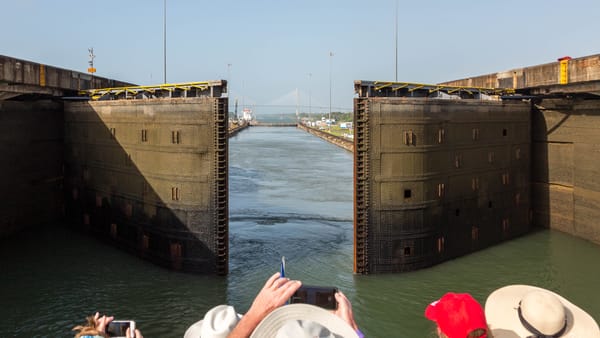
The Panama Canal Water Crisis Exposed a Fragile Shortcut
The Panama Canal's 2023-24 drought showed how a global shortcut depends on rainfall, Gatun Lake, and the contested Rio Indio reservoir.
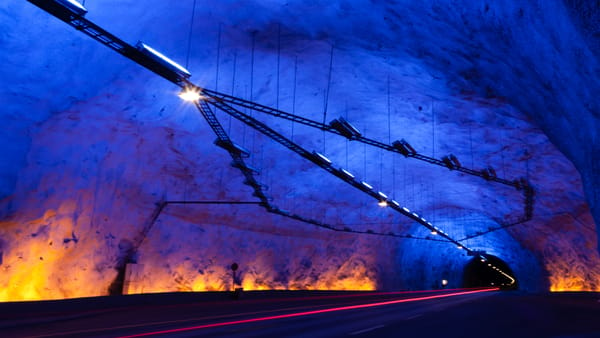
The Laerdal Tunnel: The Longest Road Tunnel in the World
Inside Norway's 24.5 km Laerdal Tunnel, the longest road tunnel on Earth, where psychologists helped engineers fight driver fatigue and fear
_3.jpg)