
The Panama Canal runs on freshwater.
That is the detail hiding inside one of the world’s most famous shortcuts. A ship does not simply slide from the Atlantic to the Pacific through a trench at sea level. It is lifted up to Gatun Lake, carried across Panama’s interior, and lowered back down by a chain of locks that work by gravity.
Every transit spends water from the canal’s reservoir system. The figure normally used in canal coverage is about 50 million gallons per crossing. That water begins as rain, moves through the Chagres River watershed, fills Gatun and Alajuela, runs through lock chambers, and then leaves for the ocean.
For more than a century, the bet was that enough rain would keep arriving.
In 2023, that bet failed badly enough to shake global shipping. Rainfall across the canal watershed fell roughly 30 percent below average. Gatun Lake dropped to unusually low levels. The Panama Canal Authority cut vessel draft, reduced daily transits, and warned customers that booking slots would keep shrinking if the dry spell continued.
The emergency has eased since then. The canal reported a strong FY2025 recovery, and 2025 rains lifted reservoirs above expectations. In May 2026, the authority said Gatun Lake had been kept at historically high levels, that it was maintaining 38 daily transits, and that current data did not forecast transit restrictions through December 31, 2026. But the underlying problem did not disappear.
The canal is still a freshwater machine serving ships, power generation, and more than half of Panama’s population. Panama’s answer is a new reservoir on the Rio Indio, and that project has already become a fight over water, homes, trade, and who pays the price for keeping the shortcut open.
The Original Design Bet
The French tried to build a sea-level canal through Panama first. Ferdinand de Lesseps had succeeded at Suez, and in 1881 he backed a similar idea across Central America. Panama was not Egypt. The terrain was steeper, the cuts were less stable, and disease devastated the workforce. The French effort collapsed by 1889 after bankruptcy and enormous loss of life.
The United States took over in 1904 with a different plan. Instead of cutting a sea-level route through the whole isthmus, engineers would dam the Chagres River and create an artificial lake about 26 meters above sea level. Ships would rise through locks, cross the lake, and descend through locks on the other side.
That choice made Gatun Lake the center of the system. It was not only the waterway ships crossed. It was also the stored energy that made the locks work. The Panama Canal Authority describes the locks as water lifts: Gatun Lake water flows by gravity through culverts into the chambers, raising ships from sea level to lake level, then drains away as ships descend.
The canal opened in August 1914. The system was brilliant because it avoided the worst excavation problem. It was vulnerable because it tied a global trade route to a managed tropical watershed.
The pattern was visible early. In 1935, Madden Dam, now associated with Lake Alajuela, added upstream storage on the Chagres system. The canal’s water managers have been building, storing, rationing, and planning around rainfall ever since.
How a Transit Spends a Lake
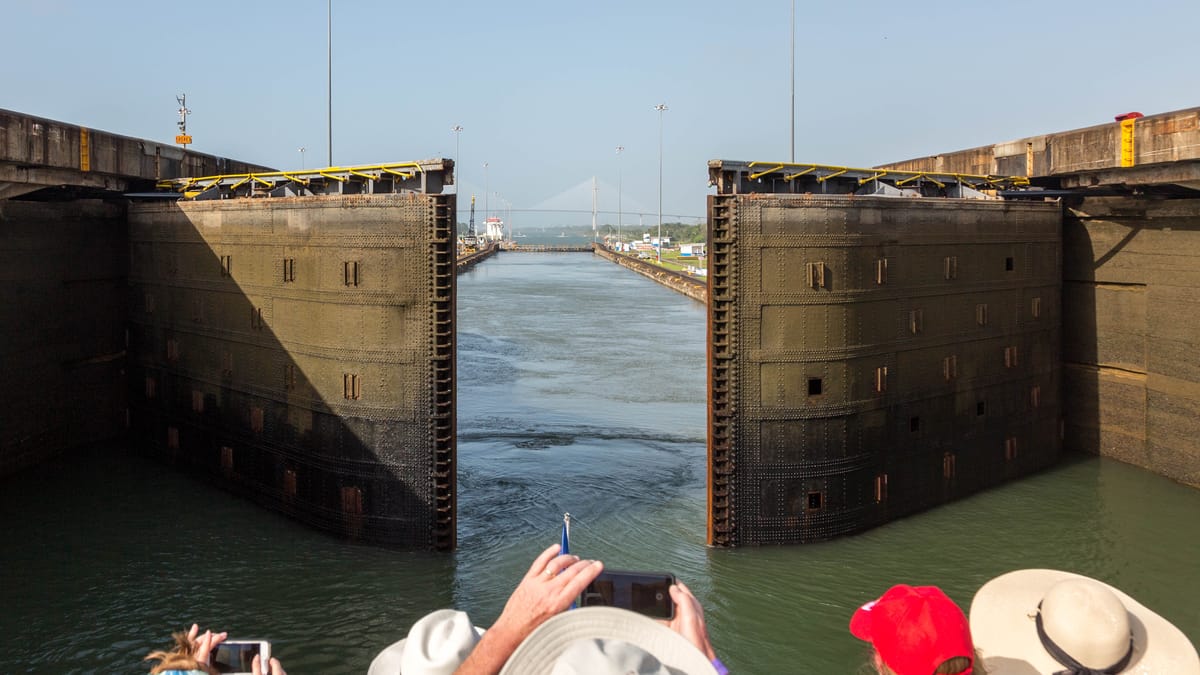
A vessel arriving from the Atlantic enters the Gatun Locks, a staircase of chambers near the Caribbean coast. Gates close behind it. Valves open. Water from Gatun Lake flows down through gravity into the lock chamber, and the ship rises with the water.
The ship repeats the process until it reaches Gatun Lake. After crossing the lake and canal cuts, the process reverses on the Pacific side. The chambers drain, the ship descends, and the water moves out toward the sea.
The original locks do not pump that water back up. Once a lockage has drained, the freshwater has been spent.
That would matter less if the canal used seawater or had endless inflows. It does not. Gatun and Alajuela are part of the same freshwater system that supports navigation, hydropower, and drinking water. Panama Canal materials describe those reservoirs as main water sources for about two million people, with human consumption prioritized before navigation.
The 2016 expansion added larger Neo-Panamax locks with water-saving basins. Those basins reuse a large share of each lockage, and they are a major engineering improvement. But the new locks are bigger, and the canal expansion was built to increase traffic. Efficiency helps. It does not eliminate the dependency on rain.
The Drought That Made the System Visible
The canal has had drought warnings before. El Nino years in 1982-83, 1997-98, and 2015-16 all stressed the watershed and forced operational adjustments. In 2019, another dry year pushed the canal authority toward a freshwater surcharge.
The 2023 drought was more severe. Panama Canal advisories said October 2023 rainfall was the lowest recorded for that month since 1950, and Gatun Lake kept falling despite conservation measures. The authority reduced booking slots in stages, from 25 slots in early November to 24 later that month, 22 in December, 20 in January 2024, and 18 from February 2024 if conditions did not improve.
At the same time, draft limits cut how deeply ships could sit in the water. A vessel that cannot meet the draft restriction must carry less cargo or skip the canal. That turns a water shortage into a supply-chain problem: the same ship may arrive, but it moves fewer containers, fewer tons, or no cargo through the shortcut at all.
The Bureau of Transportation Statistics summarized the effect on U.S. trade: Gatun Lake levels hovered near 80 feet through much of 2023 when the rainy season would normally leave the lake much closer to 88 feet, and the canal restricted ship transits and draft in response.
The cause was not mysterious. World Weather Attribution found that low rainfall in the 2023 rainy season contributed to the very low Gatun Lake levels, and that strong El Nino conditions were a key driver. The study also noted rainfall about 30 percent below average and unusually low Gatun levels in the second half of 2023.
When the Shortcut Slows, the World Pays
The canal handles a large share of trade between Asia and the U.S. East Coast, along with bulk, energy, vehicle, and container routes across the wider world. When Panama limits transits, the problem does not stay in Panama.
Ships with reservations can move. Ships without them wait, bid, reroute, or miss schedules. Carriers can send vessels around Cape Horn, use Suez where that makes sense, reduce loads, change rotations, or absorb delays. Each workaround costs time, fuel, vessel capacity, or reliability.
The disruption also hits Panama directly. Canal tolls are a national economic pillar. During the drought, canal leadership projected hundreds of millions of dollars in lost revenue for FY2024. That matters because the canal is not just a company with a water problem. It is one of Panama’s central public assets.
There was also a more basic tension. Ships and people were drawing from the same reservoir system. Panama Canal water managers have said the reservoirs must secure drinking water first, then adjust navigation levels. During the drought, every transit represented water that could not be used for another purpose.
That is the uncomfortable reality of the canal. It is a global infrastructure asset with local hydrology. The world experiences the disruption as freight rates, queues, rerouting, and late cargo. Panama experiences it as a fight over the water that also runs through homes.
Rationing Buys Time, Not Water
The canal authority’s emergency tools were practical but limited.
Draft restrictions reduced how much water the system needed to maintain safe lock operations. Transit caps reduced the number of times per day water left the reservoirs. The freshwater surcharge priced scarcity into each crossing and funded water-management work. Cross-filling and other operating changes reused water where possible. The expanded locks’ basins recovered water that would otherwise have drained away.
Those measures were necessary. None created a new reservoir.
That is why the canal could recover operationally when rains improved, while still needing a long-term water project. A wet year can refill a lake. It does not make future dry years harmless. A system that depends on one watershed remains vulnerable if demand keeps rising and drought cycles keep returning.
The FY2025 rebound shows the canal is not permanently broken. The Panama Canal Authority reported 13,404 transits in FY2025, up 19.3 percent from FY2024, and said it was financially prepared for investments beginning in 2026 to strengthen water capacity and route competitiveness.
That recovery is important context. The story is not that the canal stopped working forever. The story is that one bad rainy season exposed how little margin the system had.
Rio Indio Is the New Bet
Panama’s main long-term answer is the Rio Indio reservoir.
For years, the canal authority’s ability to expand beyond the existing watershed was limited by a 2006 legal restriction tied to the canal expansion. In 2024, Panama’s Supreme Court removed that barrier, reopening the way for new water-supply projects outside the old limits.
The Rio Indio plan would create a new lake west of the current Gatun-Alajuela reservoir system and transfer water toward Gatun Lake. The Panama Canal Authority says the lake could store about 1,294 million cubic meters of water, a volume close to Gatun’s active storage and almost double Alajuela’s cited figure on the project page.
The basic logic is simple: if the canal’s old storage is no longer enough, build another reservoir.
The politics are not simple at all. AP reported in May 2025 that residents protested the planned reservoir by boat on the Indio River. The canal authority argues that the reservoir is the best way to secure water for more than two million people and keep the canal efficient. Protesters said communities would be flooded and thousands of people could be forced to relocate.
Both sides are describing real stakes. The canal supports Panama’s treasury and world commerce. The Rio Indio communities would bear the most direct cost of a project built for national and international benefit. Panama built its original canal by reshaping rivers and flooding land. A century later, the country may be asking some of its own citizens to accept a similar bargain.
The Canal’s Next Century Is About Water
The Panama Canal is often treated as a solved engineering problem: build the locks, move the ships, collect the tolls. The drought made it look less like a finished machine and more like a weather-dependent public utility.
That does not make the canal obsolete. It makes water management the central project of its next century.
The canal still does what no other route can do in the same place. It shortens voyages, supports Panama’s economy, and gives global shipping a strategic shortcut. But its limiting factor is no longer just ship size or lock capacity. It is whether enough freshwater can be stored, shared, and defended through wet years and dry ones.
The 2023-24 crisis was a warning. FY2025 showed recovery. Rio Indio is the proposed insurance policy. The fight over that reservoir will decide more than how many ships Panama can move each day. It will test whether the country can keep a global trade route running without treating the communities in its watershed as an afterthought.
The canal was designed around a century-old assumption that rain would keep arriving on schedule. Its future depends on what Panama builds when it does not.
Key Takeaways
-
The Panama Canal is a freshwater lock canal, not a sea-level cut, and every transit spends water from Gatun Lake and the wider reservoir system.
-
The 2023 drought exposed the canal’s dependence on rainfall, with low Gatun Lake levels forcing draft limits and deep cuts to available transit slots.
-
The crisis disrupted shipping and Panama’s toll revenue, but it also raised a domestic water question because the canal watershed supplies drinking water for more than half of Panama’s population.
-
The canal recovered significantly in FY2025 as conditions improved, but the authority is still pursuing long-term water-storage investments.
-
The proposed Rio Indio reservoir could add major storage, but it is contested by communities that fear flooding, relocation, and loss of farmland.

Simon Whistler
Simon Whistler hosts MegaProjects, bringing engineering, infrastructure, and military-machine stories into clear narrative focus for viewers who want the systems, tradeoffs, and human decisions behind the build.
Frequently Asked Questions
Why does the Panama Canal need freshwater?
The canal uses locks to lift ships from sea level to Gatun Lake and lower them back down. Water from the reservoir system flows by gravity into and out of the lock chambers, so each transit consumes freshwater.
How much water does a canal transit use?
Coverage and canal-related reporting commonly cite roughly 50 million gallons, or about 189 million liters, of freshwater for a ship crossing. The exact operational impact depends on which locks are used and how much water can be reused.
What happened during the 2023 drought?
Rainfall in the canal watershed fell far below average, Gatun Lake dropped, and the Panama Canal Authority reduced vessel draft and daily transit capacity to conserve water.
Is the Panama Canal still in drought crisis now?
No. The worst 2023-24 disruption eased after rainfall improved, and FY2025 transits recovered strongly. The long-term vulnerability remains because the canal still depends on rainfall and stored freshwater.
What is the Rio Indio reservoir?
Rio Indio is the proposed new reservoir project west of the current Gatun-Alajuela reservoir system. It is intended to add major storage and feed water toward the canal system for navigation and drinking-water security.
Why are communities protesting Rio Indio?
Residents along the river fear that a dam and new lake would flood homes, farms, and communities. The project is framed nationally as water security, but locally it raises relocation and compensation disputes.
Sources
-
Original MegaProjects video: The Panama Canal Is Running Out of Water
-
Panama Canal Authority: FY2025 operational and financial strength
-
Panama Canal Authority: operational stability during 2026 El Nino risk
-
Bureau of Transportation Statistics: U.S. trade and low Gatun Lake water levels
-
World Weather Attribution: low water levels in the Panama Canal and El Nino
-
Hero image source by David Brossard / Wikimedia Commons, CC BY-SA 2.0.