
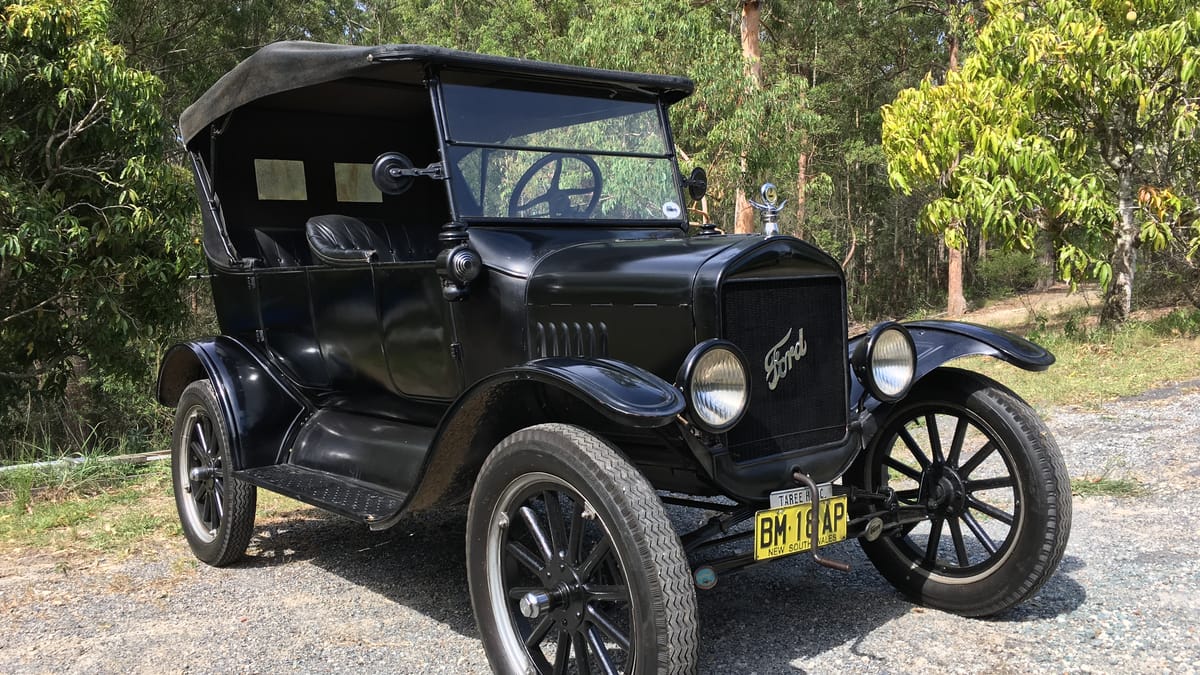
It was the kind of invention that rewrites history — the kind that shifts the world on its axis and leaves no time for second thoughts. It was the rare invention where we can write history in terms of what happened before, and what happened after, this single great game-changer arrived on the scene. We’re talking, of course, about the Ford Model T, an automobile that first rolled off the production line in 1908 and sold over fifteen million copies in the next twenty years. Affordable and widely available, it prompted the evolution of an entire industry of auto manufacturing, and the Model T is revered today as the machine to which every modern car can pay homage.
But the Model T also had one hell of a dark side. It earned a reputation as a death trap, and it played a massive role in building a manufacturing industry that often dehumanized and exploited its workers. While it was largely responsible for the creation of a massive American middle class, it was just as responsible for the rise in wealth inequality that left millions of others in the dust.
Here we’ll look at both ends of the Model T’s legacy — as a revolutionary, busted, innovative, troubled car that left all of America in its wake, for better or for worse.
- First production year
- 1908
- Units sold (over ~20 years)
- 15 million+
- Assembly time (1914)
- 93minutes
- Top speed
- 45mph
- Price by 1924
- Under $300
- Ford wage (1914)
- $5 aday
Building Tin Lizzie
Today, the name “Henry Ford” conjures a very clear image: a super-wealthy business magnate in a top-tier suit, hand resting proudly on the frame of one of the millions of Model Ts his Ford Motor Company churned out. But ask anyone on the streets of Detroit in 1893, and you’d get one of two responses. The first would be blank confusion — not many people knew who, or what, a “Henry Ford” was at all.
Those who did recognize the name would tell you not of a billionaire entrepreneur, but of a humble engineer from just outside the city. Ford, then the chief engineer at Edison Illuminating Company, was evolving into the picture of a turn-of-the-century American success story: a good job, a lovely wife, and his first son newly arrived.
But Ford had another baby on his mind — a brainchild that could change all of their lives, and the world too. It was a gasoline engine, one he first got fired up for thirty seconds on Christmas Eve, 1893, and within a couple of years had worked into shape. Ford wasn’t doing anything new by building an internal combustion engine; those existed as early as 1860, first built by the Belgian engineer Étienne Lenoir and made practical a year later by Nicolaus Otto of Germany.
Automobiles existed too, as early as the 1880s. But Ford hoped to take the auto business from a fascination — “horseless carriages” as an oddity for the rich and famous — into a real industry that made good, functional, accessible machines for the mass market.
Ford’s first automobile, the 4-horsepower Quadricycle, was a valuable proof of concept. His successor designs — the Model A in 1903, the Model B and Model C in 1904, and a number of follow-on cars — worked him closer and closer to a winning design. By this time, Ford had left his prior job and founded the Ford Motor Company in Michigan, the state where he’d spent his whole life.
After nineteen designs labeled A through S were drawn out, examined, and either shelved or put into production, the company finally found its golden goose. Designed by three of Ford’s engineers — an American named Childe Harold Wills and two Hungarians, Joseph Galamb and Eugene Farkas — the Model T came together in early 1907. It was built with two goals in mind: to be affordable for the average American, and to be sturdy enough to handle dirt roads, ice, snow, and the other tough conditions across the country.
Ford’s prior cars were good for their time, but they hadn’t addressed those concerns the way Ford wanted. It was up to the Model T to finally change that.
A Car Designed for the Masses
The automobile was designed with simplicity in mind — eliminating sources of failure rather than adding bells and whistles. Its engine, a simple four-cylinder capable of 20 horsepower, was built to run not just on gasoline, but on kerosene, already commonly available as tractor and generator fuel, and ethanol, which people could brew at home. The engine and every part of the car were designed for ease of repair: a local repairman with a few spare parts should be able to maintain his town’s Model Ts all by himself, without factory support.
The frame kept the engine clear of water and protected the most important parts rather than leaving them exposed. These might seem obvious steps today, but in Ford’s time each was a major improvement on the status quo.
And if Ford was going to sell an automobile to the masses, he also had to teach them to drive the damn thing. To make the Model T as user-friendly as possible, his engineers developed an epicyclic gearbox that let a driver change gears without difficulty. They installed an accelerator as a lever on the steering wheel, and a floor-pedal system with no gas pedal — just a brake, a gear shifter, and a clutch. The cars could double as a stationary power source in agricultural settings, running generators, threshers, or water pumps, and were easily modified when an owner’s needs didn’t fit the base version.
Ford captured the dream in his own words: “I will build a motor car for the great multitude. It will be large enough for the family, but small enough for the individual to run and care for. It will be constructed of the best materials, by the best men to be hired, after the simplest designs that modern engineering can devise.
But it will be so low in price that no man making a good salary will be unable to own one — and enjoy with his family the blessing of hours of pleasure in God’s great open spaces.” But just as important as creating the supply was whether the public could generate the demand — or whether the Ford Motor Company and its business allies could convince the world that the Model T was what they needed.
Henry Ford’s Wondrous Wagon
The Model T first hit the production line in the fall of 1908, built by hand so slowly that only eleven were made in the first month. In those early days, Ford hadn’t broken from the typical patterns of auto manufacture. But by New Year’s Day, 1910, the company took a massive step in the right direction, moving production from its first plant at Piquette Avenue in Detroit to a new plant at Highland Park. A few years later, Ford perfected an innovation that was perhaps even more meaningful, in the long arc of history, than the Model T would ever be: the modern assembly line.
The Model T was a major step toward standardization — a manufacturing process whose goal isn’t to produce a unique, striking masterpiece each time, but to ensure the same product, of the same quality, is produced every single time. In practice, that meant taking a legion of workers and assigning each one a single task, rather than treating each as a craftsman who could build a whole vehicle. If a worker was assigned to spin a couple of nuts onto a specific couple of bolts, the point wasn’t to attach as many as they could or do it with any particular finesse; as long as every car ended up with the same correct number of nuts on the same bolts, they were doing their job just fine.
This meant Ford was looking for massive numbers of what economists would call unskilled or low-skilled workers — people whose jobs were to perform a task, not build a thing. It was a point of pride for Ford and his executives that those workers were well-paid, making double what other industrialists paid at around five dollars a day, and bringing home enough that they too could save up for a Ford one day. But more important in practice was that a Model T could start as a collection of parts lying around the factory and be put together in pre-determined order in a matter of hours.
With workers arranged around conveyor belts and working as a unit, Ford sped production so much that by 1914 a Model T could be fully assembled in 93 minutes. And the model had ancillary benefits for Ford’s own pockets: even the best-paid unskilled worker didn’t command half the price of a true craftsman.
With mass production, Ford had no trouble finding demand. In 1912, a Model T cost about $600, compared with the average American household’s earnings of $592 — prohibitively expensive for the average person. But by 1924, when the average American earned $1,300 a year, the Model T cost less than $300, and as many as ten thousand were coming off the Detroit assembly lines every single day.
Sales took off, then doubled, then doubled again, until the Model T became synonymous with automobile technology itself. Between 1917 and 1923, Ford wouldn’t run a single ad — the car was already so normalized, so ubiquitous, that there was no need.
Reshaping Daily Life
For drivers and families, the Model T revolutionized daily life. Communities became far more integrated, regions of individual states cohered into their own economies, shipping became far more feasible in rural areas, and the cars became a testbed for new advances in materials engineering. They were praised for their modularity — the ease with which they could be modified, converted, or even deconstructed and reconfigured into things like ice saws that bore little resemblance to the original car.
The Model T set off a cascade of aftermarket companies, each marketing packages and modifications to turn it into anything from a tractor to a hay baler to an electrical generator. Their engines were converted for homemade aircraft, and they became popular in the northern reaches of Canada, where they were outfitted with skis and dubbed “snowflyers.”
The car’s resounding popularity led to some 15 million units sold, at one point making up over fifty percent of all the cars in the United States. Even when the Model T was eventually brought down, it was replaced by cars from other manufacturers that had been forced to directly improve on Ford’s model rather than go off in their own directions. When Ford began issuing new models, it started again at Model A, stating that everything done before the Model T represented an era that no longer existed.
Around the world, Model Ts were built in Canada, England, Japan, Germany, Argentina, Spain, France, Brazil, and elsewhere, sowing the seeds for automakers in other countries to gain the expertise and machinery they’d use to start new companies later. In 1999, the Global Automotive Elections Foundation declared the Model T the Car of the Century, and it’s regarded today, rightly so, as the single most important automobile of all time.
The Model T in Practice: A Death Trap on Wheels
In its early years, the Model T didn’t even have wheel brakes — the only brake was on the transmission, meaning that even in a car that could hit 45 miles an hour, stopping was a perilous or even terrifying affair. Ford only fixed the issue after third-party manufacturers began mass-producing their own wheel brakes for customers to add after purchase. And the problems got worse — way worse — in a crash.
The windshield, made of flat glass, could deliver truly gnarly cuts to anyone thrown into or through it, and it had a knack for impaling the unfortunate souls who fell only partially through. The gas tanks, located under the front row of seats, were a fantastic fire hazard in an accident, leading to horrific burns. The crank starter had an inconvenient habit of swinging backward and breaking people’s arms when the engine backfired, and it wasn’t unheard of for the handle to explode off the car like a javelin.
The Model T also suffered serious vibration issues, especially when small pebbles or debris lodged in the engine, or when low-quality fuel was used.
Whether these longstanding safety issues resulted from Ford’s cost-cutting or merely coincided with it isn’t for us to say — but it’s worth noting that Ford’s production lines were a penny-pincher’s perfect fantasy. The car was first offered in a number of colors, but by 1913 Ford’s famous quote, “you could have any color as long as it was black,” had become the rule of law, because black paint was relatively cheap. Ford also believed it dried faster, letting cars move through the assembly line quicker.
Beyond aesthetics, any number of the Model T’s issues could have been solved in successive model years, but Ford and his executives weren’t interested in that kind of rapid advancement. The car evolved only a few times in its nineteen years of production, and many of its most critical safety issues went unaddressed.
The Human Cost of the Assembly Line
While we’re on the subject of the assembly line, it’s worth opening that whole other can of worms. Credit where it’s due for Ford’s commitment to fair pay — but that commitment only tells half the story. For those five dollars daily, workers lived through a repetitive and painfully monotonous job, often in conditions where the natural lapses of attention that come with eight hours of the same simple task could lead to accidents and injury.
In the words of one auto worker in the 1920s: “the machine that I am on goes at such a terrific speed that I can’t help stepping on it in order to keep up with it. The machine is my boss.”
These workers also found themselves inside a factory system in which floor workers became expendable. Stay home sick, make a few minor errors, or lose a finger in an accident, and a worker faced a real risk that the next day they’d find someone else doing their job. This functionally eliminated the leverage workers had to advocate for themselves and their rights — a gaping hole that modern unions and regulators still struggle to address.
Then there’s the illusion that the Five-Dollar Day produced some great manufacturing renaissance for Americans — an illusion that falls apart quickly under scrutiny. Within the first few years of production, Ford had replaced many American-born laborers with Eastern and Southern European unskilled workers willing to work for lower pay. By 1914, three quarters of Ford employees were foreign-born and many didn’t speak English. While there’s a strong argument that the company was a lifeline to people trying to make a new life in America, it was not the paragon of American manufacturing it’s often held up to be.
Under such a rigorous system, Ford was on the forefront of developing social-control measures to keep laborers moving at the highest possible pace. A few seconds cut from one worker’s allotted time could mean a dozen or two dozen or even a hundred extra cars per week, without hiring anyone new. So workers were closely scrutinized all day, every day, by a small army of foremen and inspectors encouraging them to move faster.
Failure to keep pace with the line was grounds for dismissal — and so was failure to keep up with the peak capability of a tool or piece of equipment. If a drill could screw in ten screws a minute but a worker only managed seven, that was the worker’s problem. Worker burnout went through the roof, a process repeated in hundreds of thousands of assembly-line plants worldwide, all following the model Ford laid out.
The Catch in the Five-Dollar Day
We’ve got to poke into that Five-Dollar Day a little more, divided as it was into two sections when the system debuted in 1914. A floor worker was actually making only two dollars and forty cents in wages; the remaining two dollars and sixty cents were “profits,” which they would only receive if they satisfied Ford’s requirements. That included consistently working at a bloody-fast pace, but also exhibiting so-called “American values” in and out of the workplace, living in homes Ford and his executives deemed appropriate, and following at-work habits the company set out.
The financial incentive of those “profits” — a little more than half of what a worker hoped to make in a day — gave Ford incredible leverage. Talking on the factory floor was prohibited; bathroom breaks were tightly restricted; workers went without pay for the time it took to set up their equipment; and Ford was able to intimidate and coerce his workers to avoid unionization until as late as the 1930s.
Amid all the questionable practices on the factory floor, we’ve also got to consider how those factories’ existence impacted the rest of the world. It’s not unreasonable to claim that the Model T directly led to the obsolescence of classical craftsmen, whose higher-quality artisan work simply couldn’t compete with big-name branded items that did just fine at the same task. Assembly lines, and the companies that operated them, quickly came to dominate manufacturing in America and around the world, wiping out small-shop innovators who had occupied the same niche and rendering their expertise irrelevant in a world where every assembly-line worker made the same wage, regardless of how many years they’d devoted to their craft.
Wealth, Inequality, and a Toxic Legacy
Then there’s the Model T’s effect on wealth distribution. For a car often touted as having built the American middle class, it actually did very little to increase the wealth of the people who owned it. From 1917 to 1929, the Model T’s heyday, the bottom 90% of Americans endured a steady loss of wealth overall, compared with considerable gains in the following five decades.
In those same years, income inequality continued to rise, peaking in 1926 when the top 1% of Americans collected more than twenty percent of nationwide income. And while people who could get a Model T enjoyed the mobility and other perks that helped them become true middle-class Americans, those who couldn’t had no way to make up the deficit in a world that increasingly treated cars as a base requirement for success.
Lastly, we’ve got to pull back the curtain on an especially nasty part of the Model T’s history: Henry Ford’s decision to use his bestselling car as a tool to propagate antisemitism. By the late 1910s, Ford had become a virulent anti-Semite, blaming Jews for every form of evil he could perceive, and in 1918 he purchased the Dearborn Independent, a local newspaper from his hometown. Within eighteen months he was publishing radically hateful articles claiming America was being infected by a Jewish conspiracy.
And those articles? Ford dealers were required to sell their customers a subscription to the Dearborn Independent with every Model T they sold. It’s impossible to overstate the effect Ford’s practices had on spreading antisemitism across the US — but suffice to say that Adolf Hitler took a personal interest in praising Ford’s work, and even awarded him the Grand Cross of the German Eagle, just a year before Nazi Germany’s invasion of Poland.
So with all this in mind, we can clearly see the Ford Model T and its complex legacy. It was a revolutionary invention, a car that shaped the entire automotive industry and, moreover, the entire world. It was the harbinger of a century of mass manufacturing, a tool to bring about a more accessible and interconnected world, and one that raised the American standard of living to a massive degree.
But it was also an absolutely busted automobile, one whose passengers often paid the price for Henry Ford’s decision to cut costs. It was a driver of wealth inequality, of appalling antisemitism, and it left behind a legacy of worker exploitation that’s largely been whitewashed in the modern day. It’s a complex history, for a complex machine that was, for better or for worse, among the most influential of all time.
Key Takeaways
- The Ford Model T launched in 1908 and sold over 15 million units in roughly twenty years, at one point making up more than half the cars in the United States.
- Ford’s perfected assembly line cut Model T build time to 93 minutes by 1914, pioneering standardized mass production that reshaped industry worldwide.
- The car was riddled with safety flaws — no wheel brakes early on, a flat-glass windshield that could impale occupants, gas tanks under the seats, and a crank starter that broke arms.
- Ford’s much-praised Five-Dollar Day was actually $2.40 in wages plus $2.60 in conditional “profits,” used to control workers’ pace, behavior, and home lives, and to suppress unionization until the 1930s.
- Despite being credited with building the middle class, the bottom 90% of Americans lost wealth during the Model T’s heyday while income inequality peaked in 1926.
- Henry Ford used Model T sales to spread antisemitism, requiring dealers to bundle subscriptions to his hateful Dearborn Independent with every car sold.
Priya Menon
Priya Menon covers tunneling, ports, rail corridors, and the procurement choices that determine whether large public works become durable assets or permanent disputes.
Frequently Asked Questions
When was the Ford Model T introduced and how many were sold?
The Model T first rolled off the production line in the fall of 1908, with only eleven built by hand in the first month. Over roughly the next twenty years it sold more than fifteen million units, at one point accounting for over fifty percent of all the cars in the United States.
How did the assembly line change Model T production?
After moving production to the Highland Park plant on New Year’s Day, 1910, Ford perfected the modern assembly line, assigning each worker a single repeated task rather than treating them as a whole-vehicle craftsman. This standardization sped production so dramatically that by 1914 a complete Model T could be assembled in just 93 minutes.
Why was the Model T considered a death trap?
The car had no wheel brakes in its early years, relying only on a transmission brake even at speeds up to 45 mph. In a crash, its flat-glass windshield could deliver severe cuts or impale occupants, gas tanks under the front seats created a fire hazard, and the crank starter could swing back to break arms or even fly off like a javelin.
Was Ford’s Five-Dollar Day as generous as it sounds?
Not quite. When it debuted in 1914, only $2.40 was actual wages; the remaining $2.60 was conditional “profits” paid only if a worker kept a fast pace and followed Ford’s rules on behavior, home life, and habits. This structure gave Ford enormous leverage to control employees and suppress unionization until the 1930s.
Did the Model T really build the American middle class?
It’s a popular claim, but the article shows it did very little to increase the wealth of the people who owned it. From 1917 to 1929, the bottom 90% of Americans actually lost wealth overall, while income inequality rose to a peak in 1926, when the top 1% collected more than twenty percent of national income.
What was Henry Ford’s connection to antisemitism?
By the late 1910s Ford had become a virulent anti-Semite, and in 1918 he bought the Dearborn Independent, which soon published articles alleging a Jewish conspiracy in America. Ford dealers were required to bundle a subscription with every Model T sold. Adolf Hitler praised Ford’s work and awarded him the Grand Cross of the German Eagle a year before the invasion of Poland.
Sources
-
Original MegaProjects video: The Model T: A Terrible Car Which was Terrible for Society
-
Detroit Historical Society — Encyclopedia of Detroit: Model T
-
Hero image source by ModelTMitch / Wikimedia Commons, CC BY-SA 4.0.
Related Projects
The Interoceanic Corridor: Mexico’s Attempt at a Panama Canal Rival
Inside Mexico's Interoceanic Corridor across the Isthmus of Tehuantepec, a centuries-old dream revived to rival the Panama Canal with rail, ports, industry

The Laerdal Tunnel: The Longest Road Tunnel in the World
Inside Norway's 24.5 km Laerdal Tunnel, the longest road tunnel on Earth, where psychologists helped engineers fight driver fatigue and fear