

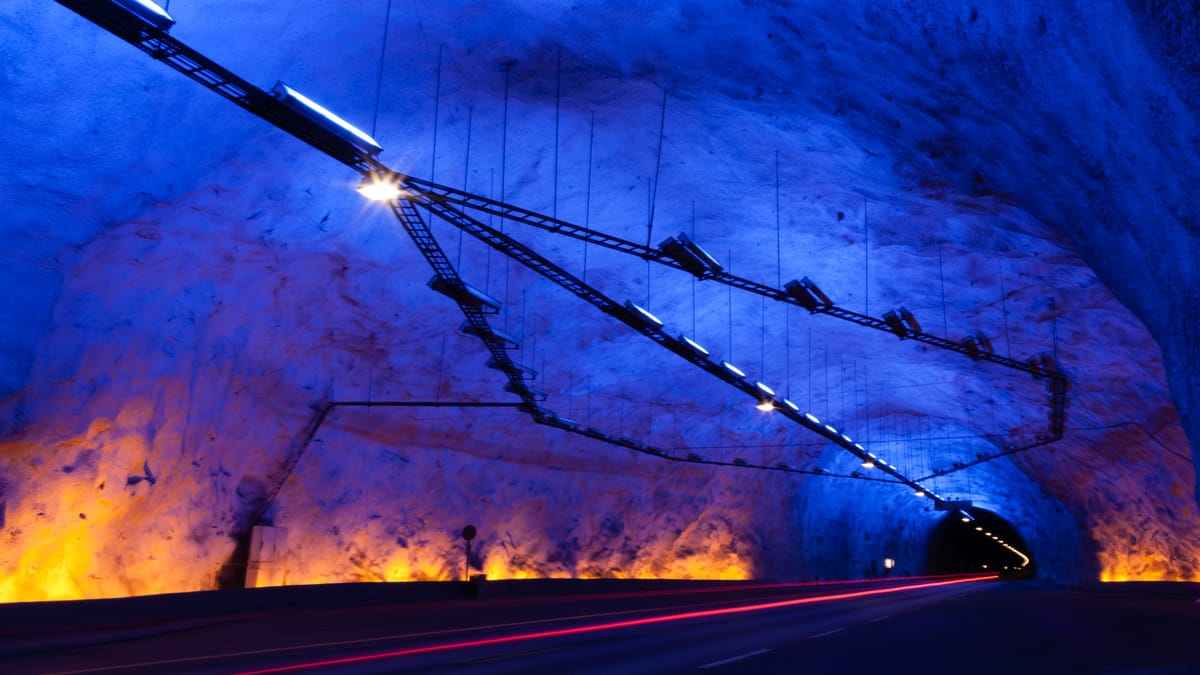
If you were to take a vacation traveling up the Norwegian coastline, you’d be treated to some of the most beautiful scenery in the world: deep, plunging fjords, craggy, mountainous islands, and several of the largest glaciers on Earth. But traveling northward from the Seven Mountains of Bergen toward the picturesque city of Trondheim, you might be surprised when one of the rocky tunnels you drive through just… keeps on going. And going. And going.
At a total length of just over 24-and-a-half kilometers, Norway’s Laerdal Tunnel is the longest road tunnel in the world. Eerily beautiful, carefully designed, and built to serve the needs of the people traveling through it, the tunnel is a fantastic example of human-factors engineering done right.
Why Norway Needed the Tunnel
To understand why the Laerdal Tunnel needed to exist at all, you have to account for the unique demands of driving in the world’s northernmost regions. The area of Norway where the tunnel was built is a mountainous landscape pockmarked with fjords and natural boundaries — beautiful, absolutely, but also a bit of a pain to navigate. During the 1990s, the Norwegian Parliament was working to make this area safer, cheaper, and easier to move through, building a new highway that would be the main artery between Bergen, Norway’s second-largest city, and Oslo, the capital and largest city. But one particular zone of the highway, situated between the small towns of Aurland and Laerdal, was proving especially thorny.
- Total length
- 24.5km
- Rock excavated
- 2.5 millionm³
- Peak interior elevation
- 265m
- Opened
- September 1999
- Daily traffic (2019)
- ~2,000vehicles
The roads here were especially unreliable, partly due to their narrowness and the high likelihood of bad weather during the colder months, and partly because of a particular risk of rockfalls. Fun fact about Norwegians: they tend to be generally against getting their cars crushed by boulders, so that wouldn’t do. The terrain would also have made any large-scale earth-moving operation difficult, as the existing infrastructure couldn’t get heavy machinery where it needed to go. And the area between the two towns was mostly empty, possessing stunning natural beauty — not the sort of thing Norway wanted to spoil by running a highway through it.
The answer was to build a tunnel, and both then and now, tunneling is an area where Norway holds particular expertise. But this one would have some unique demands, considering its length.
Designing for the Human Mind
Norway is ahead of the field in a lot of ways when it comes to this sort of engineering, but perhaps nowhere more so than in its keen awareness of human-factors engineering: not just building something, but building it in a way that reflects the characteristics and limitations of the people who are going to use it. In a super-long tunnel, this would be especially important. Driver inattentiveness, fatigue, claustrophobia, or unexpected crises could all lead to an emergency situation where first-responders might take a long time to arrive. By designing a tunnel that got ahead of those issues, Norway stood a better chance at reducing the risks of sending traffic through such a unique space.
A team of experienced psychologists worked closely with engineers to design the tunnel, which was expected to take about twenty minutes to traverse. Because of the high-speed traffic passing through, the tunnel had to be designed so that passengers could see at least a thousand meters ahead of them at any point — but keeping them alert would be another problem entirely. The team used simulations to figure out what kind of lighting levels worked best for holding people’s focus while illuminating the road, and how to make the road curve, rise, and fall enough that someone would at least have to stay awake to operate their vehicle, while maintaining visibility.
The final design called for the tunnel to divide into four sections, separated by three massive caves inside the mountain. These were meant to give drivers an opportunity to stop, stretch out, or take a rest. If they were dealing with intense enough claustrophobia that they were beginning to regret entering the tunnel, they could turn around at the first cave rather than carry on the entire way or try turning around in the middle of the road.
The tunnel would be lit with blue and yellow lights meant to simulate a rising sun, alternating with stretches of white light meant to wake people up. Fire extinguishers, turning areas, kilometer markers, and emergency stop-offs would be clearly marked, both to stop people from getting too nervous and to spruce up the interior so drivers wouldn’t nod off in the low light. Taken together, the design group hoped, the passage would be pleasant — and get drivers to operate their vehicles without creating any risk for somebody else.
Construction and Its Challenges
Construction of the tunnel took place in four phases: drilling, blasting, loading, and landscaping. The process had to be extremely precise, especially the blasting, since construction that dug into the mountain from both sides would have to meet up in the middle — a full kilometer underground and ten kilometers inward from either direction. It’s difficult to express just how hard this would be to do by hand, but you can basically imagine a couple of blindfolded archers trying to shoot their arrows directly toward each other, hoping the arrows collide head-on in midair. And that’s before considering that Norway wasn’t attempting a straight shot; they would have to climb some 260 meters in the process, while including bends and turns in the design.
Of course, by the 1990s neither Norway nor any other developed nation had to do this in analog. Instead, Norway used computer-controlled jumbo-drills paired with traditional drill-and-blast techniques, leveraging navigation satellites to guide their path into the mountain. Laser beams were used to keep the bearings of the tunnel, and a computer-controlled mechanism used this laser data to automatically position drilling equipment for the major boring process. Other parts were dealt with the old-fashioned way: drilling holes in the rock, sticking dynamite in, and trucking out the debris.
This process was not without issues. Because of the immense pressure the mountain above exerts on the tunnel structure, rock bursts were not uncommon. At one point during construction, a weakness in the mountain’s interior caused about a thousand cubic meters of rock to fall from the tunnel ceiling. This required a major recalibration — the entire affected area was filled with concrete and the tunnel was partially rerouted — but nobody was hurt.
Once rock was dislodged within the tunnels, it was brought out in dump trucks that used fresh, new road inside, which was being constructed just a little way behind where the blasting was taking place. Once a stretch was blasted and paved, more workers followed behind, touching up the tunnel walls, blasting out the three main caverns, and installing all the lighting, signage, and other equipment needed for a functioning road. The whole process moved along at about 60 to 70 meters per week, advancing inward at each face of the tunnel.
What to Do With 2.5 Million Cubic Meters of Rock
The biggest challenge in constructing the tunnel was figuring out what to do with all the extra rock. The project excavated a total of 2.5 million cubic meters from the mountain — which, remember, couldn’t just be scattered around a landscape Norway was trying to preserve. Instead, the builders constructed a secondary access tunnel about two kilometers long, which fed out the side of the mountain into a little valley known as Tynjadal. There, this enormous mass of rock could sit safely tucked away, with no risk that the debris would pollute local waterways.
Ventilation was a second obstacle. Even if a constant, stiff breeze from one end could reliably keep air moving through twenty-four kilometers of caves, that does very little about all the noxious pollutants cars leave behind as they pass through. The tunnel uses a single air exhaust shaft, with an air-quality treatment plant — the first in the world dedicated to a single road tunnel — housed in a small side tunnel that filters out major pollutants. This layout lets the tunnel avoid drawing too much power, and while a person probably shouldn’t hang out sucking fumes at the side of the road all day, the air quality is constantly monitored to ensure it doesn’t pose any risk of harm if a person, say, wanted their windows down while driving through.
Built for the Worst-Case Fire
Fire and emergency preparedness took on the highest importance when finishing up the tunnel. In enclosed spaces like road tunnels — with limited oxygen, no room to turn around, and very little space to disperse a fire — flames can burn with extreme intensity, and flashover combustion within clouds of smoke becomes far more likely. A year before the Laerdal Tunnel opened, 39 people died in a fire in the Mont Blanc Tunnel in France, and a year after it opened, a fire claimed eleven lives in Switzerland’s Gotthard Road Tunnel.
So when it came to the Laerdal Tunnel, Norway wasn’t willing to cut corners. The dry rock around the tunnel and its fire-resistant cladding were a good start, and advanced monitoring technology was installed all up and down the tunnel to ensure that any problems with the ventilation systems, emergency equipment, lighting, or traffic signals would be known as soon as they happened. Fire extinguishers and emergency telephones are set up at uncommonly short intervals, and the tunnel is set up for rapid closure and evacuation, should it ever be needed.
The Finished Product
Upon its completion, the Laerdal Tunnel became the longest road tunnel in the world. The tunnel is 24-and-a-half kilometers long — or, for our long-time fans of Shaq Units, that’s the length of 11,352 Shaquille O’Neals all just laying down vibing. It’s nine meters wide, with a peak interior elevation of 265 meters, running at a two-and-a-half-percent grade for most of the way through. Reinforced by two hundred thousand rock bolts and forty-five thousand cubic meters of shotcrete, the tunnel is safe, sturdy, and well-insulated against collapse.
In 2019, the tunnel saw just over two thousand vehicles per day, and in the years since it opened in September 1999, only a handful of accidents have taken place. One of those, just before opening day, put its fire preparedness to the test: a bus with about 50 passengers caught fire while deep inside the mountain, but no one was hurt, and the bus was eventually able to leave under its own power.
That’s not to say the tunnel hasn’t had its problems. Speeding has become commonplace inside, either by drivers who lose focus and begin to lose track of how fast they’re going, or by people who take advantage of the tunnel’s relative emptiness and seclusion. In response, Norway has installed speed cameras inside, and set up photo inspections and automatic measures to track all the vehicles moving in and out.
When crashes do occur, it can take emergency vehicles a long time to reach the victims’ location, and there have been several fatalities due to crashes over the last several decades. But all things considered, the tunnel is seen in Norway as a safe, reliable section of road. It’s become a tourist attraction in its own right, and it’s even hosted the occasional wedding.
Those who drive through often remark on the peace of mind granted by Norway’s design choices, pointing out that although it may be easy to feel claustrophobic or threatened in such a small space, the caverns and clear emergency preparedness really do help drivers stay calm and collected. Travelers also point out the strange, almost forlorn beauty of the three main caverns, and the unique feeling of traveling so far while feeling so acutely aware that an entire mountain lies overhead. For the people of Norway, the Laerdal Tunnel ensures they can pass through their country by road quickly and efficiently, with no need to take long journeys by ferry or risk being stuck at high altitude during frequent Scandinavian snowstorms. For everyone who uses it, the tunnel ensures safe, user-friendly, and even — dare we say — enjoyable passage through yet another mountain tunnel in one of the most unique landscapes on Earth.
Key Takeaways
- At just over 24.5 kilometers, the Laerdal Tunnel between Aurland and Laerdal is the longest road tunnel in the world, completing the main highway artery between Oslo and Bergen.
- It was conceived in the 1990s to replace unreliable, rockfall-prone roads through terrain that was difficult to build on and that Norway wanted to preserve.
- Psychologists worked alongside engineers, using simulations to tune lighting, curves, and grade to fight driver fatigue and claustrophobia over the roughly twenty-minute drive.
- The design splits the tunnel into four sections separated by three large caverns where drivers can rest, turn around, or recover, lit with sunrise-mimicking blue and yellow light.
- Construction excavated 2.5 million cubic meters of rock — stored away in the Tynjadal valley — and the tunnel features the world’s first air-treatment plant dedicated to a single road tunnel.
- Opened in September 1999 with heavy investment in fire and emergency preparedness, the tunnel has seen only a handful of accidents and is regarded in Norway as safe and reliable.
Priya Menon
Priya Menon covers tunneling, ports, rail corridors, and the procurement choices that determine whether large public works become durable assets or permanent disputes.
Frequently Asked Questions
How long is the Laerdal Tunnel, and where is it?
The Laerdal Tunnel is just over 24-and-a-half kilometers long, making it the longest road tunnel in the world. It runs between the small towns of Aurland and Laerdal in mountainous western Norway, forming the main highway link between the cities of Oslo and Bergen.
Why was a tunnel built instead of a surface highway?
The roads in the area were narrow, prone to bad winter weather, and at risk of rockfalls, while the terrain made large-scale earth-moving operations difficult. Norway also wanted to avoid spoiling the area’s stunning natural beauty with a highway. A tunnel solved all three problems, and tunneling is an area of particular Norwegian expertise.
How does the tunnel keep drivers awake and calm?
A team of psychologists helped engineers design the tunnel to counter fatigue, inattentiveness, and claustrophobia over the roughly twenty-minute drive. The road curves, rises, and falls to keep drivers engaged; lighting alternates between sunrise-mimicking blue and yellow tones and stretches of alerting white light; and three large caverns let drivers stop, rest, or turn around.
What happened to all the rock that was excavated?
The project removed about 2.5 million cubic meters of rock, which couldn’t be scattered across a landscape Norway was trying to preserve. Builders dug a roughly two-kilometer secondary access tunnel that fed the debris into a valley called Tynjadal, where it could be stored without polluting local waterways.
How does the tunnel handle air quality and fires?
The tunnel uses a single air exhaust shaft plus an air-quality treatment plant — the first in the world dedicated to a single road tunnel — to filter out pollutants, with air constantly monitored. For fire safety, it has fire-resistant cladding, advanced monitoring all along its length, closely spaced fire extinguishers and emergency telephones, and provisions for rapid closure and evacuation.
Has the tunnel had any accidents or problems?
Since opening in September 1999, only a handful of accidents have occurred. Just before opening day, a bus carrying about 50 passengers caught fire deep inside the tunnel, but no one was hurt and the bus left under its own power. Speeding has become a problem, prompting Norway to install speed cameras, and there have been several fatalities from crashes over the decades, since emergency vehicles can take a long time to reach the scene.
Sources
-
Original MegaProjects video: The Laerdal Tunnel: The Longest Road Tunnel in the World
-
Lighting effects in the longest road tunnel in the world — the Lærdal Tunnel (Geotech)
-
Hero image source by Markus Trienke / Wikimedia Commons, CC BY-SA 2.0.
Related Projects
The Interoceanic Corridor: Mexico’s Attempt at a Panama Canal Rival
Inside Mexico's Interoceanic Corridor across the Isthmus of Tehuantepec, a centuries-old dream revived to rival the Panama Canal with rail, ports, industry
Montenegro’s Road to Nowhere: The Chinese-Built Highway That Nearly Bankrupted a Nation
How a billion-dollar Chinese-financed highway plunged one of Europe's smallest countries into catastrophic debt — and still ended at a village of fewer than 100 people.
.jpg)