
It’s one of the smallest, poorest countries in Europe. A Connecticut-sized slice of rugged mountains, untouched forests, and deep gorges home to a mere 620,000 people. At only 13,812 km², Montenegro is the sort of place the word “diminutive” was coined for. As Berlin Policy Journal once memorably put it, it’s “a country with fewer people than Frankfurt and a gross domestic product on par with the Bavarian town of Bamberg.”
Yet tiny Montenegro has something neither Frankfurt nor Bamberg can claim. Since 2022, it has been home to one of the most expensive stretches of road in the entire world.
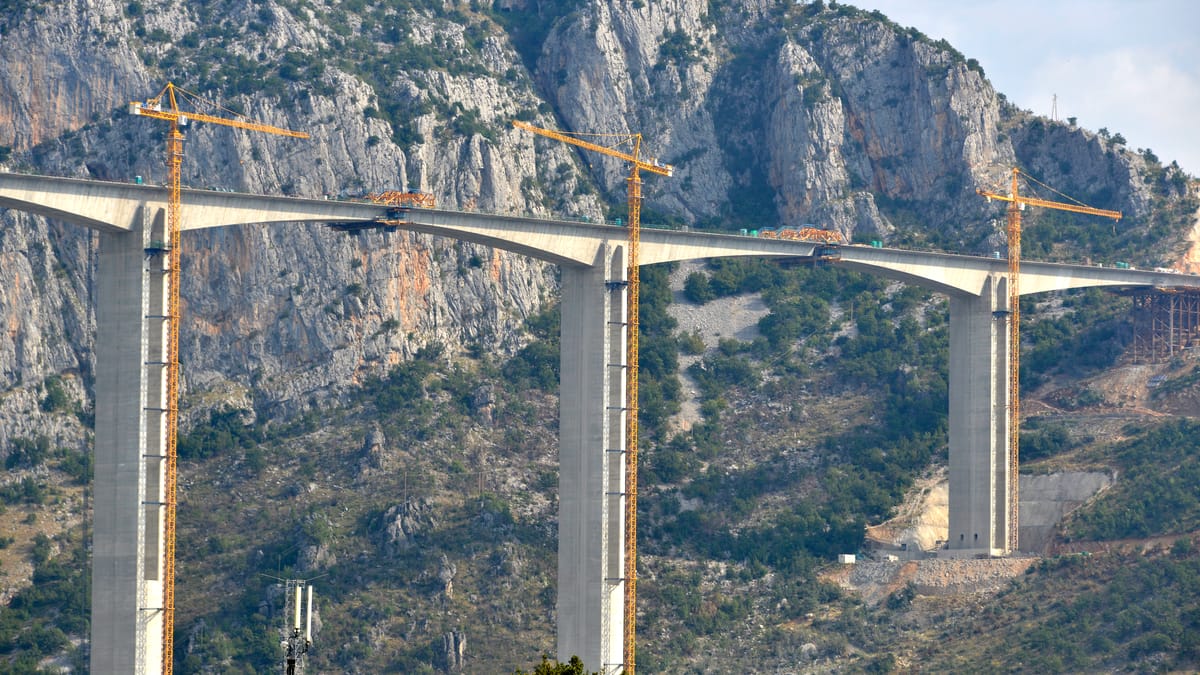
Running from the capital Podgorica to the village of Mateševo, the A-1 highway is an engineering marvel — dotted with 20 bridges and 16 tunnels, sweeping drivers effortlessly through some of the Balkans’ most stunning landscape. But this scenic drive came with one hell of a price tag. Financed with a massive loan from China, the road left Montenegro one billion dollars in debt and, for a time, teetering on the edge of bankruptcy. Even now, it remains unfinished.
- Highway cost
- $1billion
- Road length built
- 41km
- Total proposed route
- 163km
- Montenegro GDP
- $5.86billion
- Public debt peak
- >90% ofGDP
- Daily traffic vs. target
- 6,000 vs. 25,000vehicles
A Miracle of Engineering — and a Monument to Miscalculation
When the first stretch of the Bar to Boljare highway opened in 2021 — two years behind schedule — almost everyone agreed on at least two things.
First, the road was spectacular. An imposing line sliced cleanly across the Montenegrin landscape, a landscape famous for being anything but flat. Covered with low mountains and dotted with deep gorges, this tiny nation packs in nearly as much spectacular scenery as far larger Switzerland. Building a gleaming, direct road across its rumpled countryside was a genuine miracle of engineering — only 40 percent of it is made up of what we might call regular road.
The rest is a collection of soaring bridges and tunnels bored through thick rock.
Second, the road hadn’t come cheap. With a GDP of $5.86 billion, Montenegro has long been one of Europe’s poorer countries. That billion-dollar price tag amounted to the equivalent of pulling 1,600 euros from the pocket of every man, woman, and child in the country.
Yet supporters — led by long-serving President Milo Đukanović — were bullish. The highway was intended to eventually connect the port city of Bar with the Serbian capital Belgrade, turning Montenegro into an important transport hub. Its route across the north was meant to equalize the national economy, spreading some of the coastal south’s relative prosperity to the impoverished, mountainous interior.
Take Mateševo, for example — a village just 41 km north of Podgorica as the crow flies, but historically forced to take a 180 km detour along roads notorious for their fatalities. With the highway open, locals could make the same drive in under 25 minutes.
There was only one problem: the road stopped at the edge of Mateševo. That billion dollars had not forged the full 163 km highway from Bar to Serbia’s border. It had built a little over a quarter of the proposed route — a 41 km stretch of engineering genius ending at a village with a population of fewer than 100 people, most of whom couldn’t even afford the highway toll of three and a half euros.
For the cost of a fifth of their entire GDP, Montenegro’s leaders had created a road to nowhere.
The Long Road to China
The origins of the A-1 highway stretch back to 2005, when Montenegro wasn’t even an independent country — it was still part of the State Union of Serbia and Montenegro. Prime Minister Đukanović’s dream of connecting Bar to Belgrade could have been read as a bid to cement common identity between the two nations. In reality, just a year later, he led Montenegro to independence, the last former Yugoslav republic to do so.
As early as 2007, the new nation was commissioning feasibility studies. A French company, a British firm, and American engineering giant Bechtel all took a look and returned similar verdicts: building a grand highway across Montenegro’s terrain was effectively impossible — not literally, but in the sense of “impossible for a small economy that doesn’t want to bankrupt itself.” The French said traffic would never justify it; the British said terrain costs would be unfeasible; the Americans offered to upgrade existing roads instead.
Đukanović’s government was undeterred. A Croatian company was contracted, then lost its tender as the Eurozone Crisis hit. By the time Montenegro needed a new partner, there was one nation posting extraordinary growth while Europe stagnated: China.
In 2013, Xi Jinping launched the Belt and Road Initiative — a plan to export Chinese influence through massive infrastructure investment worldwide. Montenegro was quick to raise its hand. Within a year, contracts were signed: Podgorica would take a loan from the Export-Import Bank of China and hire the China Road and Bridge Corporation to do what Western firms had declined to attempt.
For Beijing, it was an easy win. Soft power, a showcase for engineering capability, and a toehold in the Western Balkans — a region outside the EU but expected to join, potentially establishing Chinese influence right on the EU’s doorstep, as NPR has speculated.
For Montenegro, the upsides were less clear. The loan contract gave China the right to seize Montenegrin land and property in the event of a default, with Chinese courts holding final say in any dispute. The terms were so damaging that the government classified the contract as a state secret. Work began in May 2015.
Highway to Hell: Cost, Corruption, and Debt
To be fair to the China Road and Bridge Corporation, not all of the cost overruns were of their making. The Montenegrin government had initially left a vital interchange off the plans — recognizing and correcting that mistake added a substantial chunk to the budget.
Then there was the loan’s currency structure. Montenegro uses the euro, but the loan was denominated in US dollars, leaving the country, as the New York Times wrote, “vulnerable to the vagaries of foreign exchange markets.” Without currency hedging, swings in the dollar/euro rate contributed significantly to the ballooning price tag.
Good old-fashioned corruption did its share too. While most workers came from China, the contract required roughly 30 percent local labor. France24 reports that over a third of all Montenegrins hired had links with Đukanović’s ruling party — chosen without public tenders or meaningful oversight. A feasibility study by the Scott Wilson Group, suppressed by the government and released only after it lost power, had estimated the full road should cost $570 million — barely half the eventual price.
The loan terms compounded everything. At two percent interest annually, debt repayments came to consume over a third of Montenegro’s state budget. Overall public debt climbed above 90 percent of GDP. The government was forced to hike taxes, slash benefits, and freeze public sector wages — a round of self-imposed austerity. In 2018, the Center for Global Development placed Montenegro alongside Djibouti, Laos, Tajikistan, and Kyrgyzstan on a list of eight “highly vulnerable” countries due to their debt exposure.
The economic stimulus that typically justifies major public works never materialized either. As Prime Minister Dritan Abazović has complained, the loan paid a Chinese company to bring Chinese workers who then took their earnings back to China. Montenegro kept the road. What it also kept was the debt.
By 2021, the situation had grown so dire that Podgorica was forced to beg the EU for help. A group of European and American banks restructured the debt and organized enough relief to prevent a budget collapse — for the time being.
The road’s environmental toll compounded matters further. The Tara River basin, a UNESCO-protected waterway, was used as a dumping ground for construction materials, altering its course.
Thunder Road: What Comes Next
Back in 2021, Montenegro’s government estimated it needed around 25,000 vehicles a day to generate enough toll revenue to cover the highway’s costs. At the time, Reuters noted the busiest sections were seeing around 6,000 vehicles on their best days — barely a quarter of the target. When Radio Free Europe/Radio Liberty visited in early 2023, they encountered almost no other vehicles at all. The government is now thought unlikely to generate even enough revenue to cover annual maintenance costs, estimated at around 77 million euros.
None of this has visibly dampened the enthusiasm in Podgorica.
In June 2023, Montenegro exited the European and American debt-restructuring deal — which had cut its interest rate from two percent to 0.88 percent — citing a strengthening dollar. And in a move that surprised many observers, the government announced a new deal with China: a 16 km coastal highway between the tourist towns of Budva and Tivat, projected to cost a comparatively modest 53 million euros. Given the volume of summer visitors those towns receive, it stands a reasonable chance of justifying its cost.
More significantly, in July 2023, Balkan Insight reported that the outgoing government had confirmed fresh talks with the China Road and Bridge Corporation about completing the remaining two sections of the A-1 — stretching to Bar and to Boljare on the Serbian border. Cost estimates run to at least another billion dollars. The China Road and Bridge Corporation has floated alternatives, including a private-public partnership model in which a company would finish construction then operate the road for 30 years to recoup the investment. The European Investment Bank has been blunt in its assessment: “We told them that their PPP model was not bankable, that they would be taking on risks they don’t know how to manage.”
2023 is also notable for being the first year since independence when Milo Đukanović is neither president nor head of the governing party. Yet his infrastructure vision has clearly outlasted his tenure.
Whether finishing the highway represents a rational bet on Montenegro’s future — or an extreme real-life exercise in sunk cost fallacy — remains to be seen. What is not in dispute is that Montenegro has already paid an enormous price for 41 kilometres of road that dead-ends at a village of fewer than 100 people.
Key Takeaways
- Montenegro borrowed $1 billion from China’s Export-Import Bank to build a highway that ended at a village with a population of fewer than 100, completing only 41 of the planned 163 km.
- Multiple Western engineering firms — French, British, and American — had advised the Montenegrin government that the project was economically unjustifiable before China agreed to finance it.
- The loan was denominated in US dollars while Montenegro uses the euro, leaving the country exposed to currency swings with no hedging in place.
- Corruption in local subcontracting, a suppressed British feasibility study that put the fair price at $570 million, and a forgotten interchange all contributed to costs nearly doubling.
- Debt servicing consumed over a third of Montenegro’s state budget, pushing public debt above 90 percent of GDP and forcing austerity measures including tax hikes, benefit cuts, and public sector wage freezes.
- The road attracts roughly a quarter of the daily traffic needed to cover operating costs, let alone repay the loan, and the Tara River — a UNESCO-protected waterway — was damaged in construction.
- Despite all of this, Montenegro is in talks to build the remaining sections of the A-1 with Chinese financing, and has already signed a new deal for a separate coastal highway.
Priya Menon
Priya Menon covers tunneling, ports, rail corridors, and the procurement choices that determine whether large public works become durable assets or permanent disputes.
Frequently Asked Questions
How long is the A-1 highway and why is it unfinished?
The completed section of the A-1 runs 41 km from Podgorica to the village of Mateševo — just over a quarter of the planned 163 km route intended to connect Bar on the Adriatic coast with the Serbian capital Belgrade. The remaining 122 km were never built due to the debt burden incurred by the first section, and as of mid-2023 the government is still in negotiations over how to fund the rest.
How much did Montenegro borrow from China, and on what terms?
Montenegro borrowed approximately $1 billion from the Export-Import Bank of China to finance construction by the China Road and Bridge Corporation. The loan carried two percent annual interest and, critically, was denominated in US dollars rather than euros — exposing Montenegro to currency risk. The contract also granted China the right to seize Montenegrin land in the event of default, with Chinese courts holding jurisdiction over disputes.
Why did the highway cost so much more than expected?
A combination of factors drove costs well above initial estimates. The government left a major interchange off the original plans and had to add it mid-project. The dollar-denominated loan fluctuated against the euro without currency hedging. Local subcontracting was awarded without public tenders, with over a third of Montenegrin workers having links to the ruling party. A suppressed British feasibility study had put the fair cost at $570 million — roughly half the final price.
How bad did Montenegro’s debt crisis get?
By 2021, Montenegro’s public debt had climbed above 90 percent of GDP, and debt repayments consumed over a third of the annual state budget. The government was forced to raise taxes, cut social benefits, and freeze public sector wages. The situation became severe enough that Montenegro had to ask the EU for assistance; a consortium of European and American banks restructured the debt. The Center for Global Development had placed Montenegro alongside some of the world’s most indebted developing nations as early as 2018.
Is the highway actually being used?
Very lightly. The government had projected it needed 25,000 vehicles per day from tolls to be financially viable. In practice, even the busiest sections were recording around 6,000 vehicles on their best days — barely a quarter of the target. When journalists visited in early 2023, they encountered almost no traffic. The government is not expected to generate enough toll revenue to cover even annual maintenance costs, estimated at 77 million euros.
Is Montenegro building more roads with Chinese financing?
Yes. In March 2023, Montenegro signed a new deal with China for a 16 km coastal highway between Budva and Tivat, projected to cost around 53 million euros. Separately, the government confirmed fresh talks with the China Road and Bridge Corporation about completing the two remaining sections of the A-1, with new cost estimates running to at least another billion dollars.
Sources
-
Radio Free Europe/Radio Liberty — Montenegro’s billion-dollar Chinese highway
-
Balkan Insight — China’s CRBC keen to build Montenegro’s next highway stretch
-
NPR — Road deal with China blamed for Montenegro’s historic debt
-
Berlin Policy Journal — A road that divides as much as it connects
-
France24 — Montenegro learns the true cost of China-backed road
-
Hero image source by Miomir Magdevski / Wikimedia Commons, CC BY-SA 4.0.