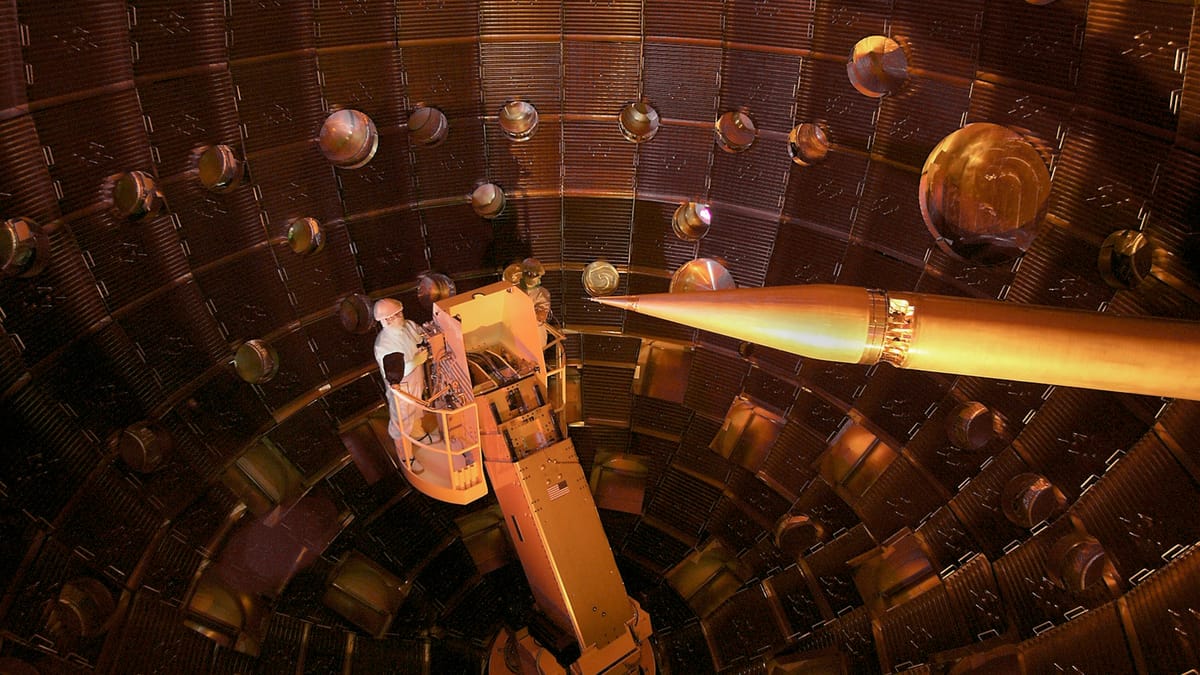
The National Ignition Facility was never just a giant science toy. It was built to answer a post-Cold War weapons problem with one of the most complicated machines ever assembled.
After the United States stopped underground nuclear explosive testing in 1992, the nuclear stockpile still had to be certified as safe, secure, and reliable. Warheads age. Materials change. Designers retire. If full-scale tests were no longer available, the country needed laboratory experiments and supercomputer models that could recreate parts of the physics inside a thermonuclear weapon without detonating one.
That is the sober mission behind the huge laser at Lawrence Livermore National Laboratory. NIF uses 192 laser beams, a building roughly the size of three football fields, and a target smaller than a peppercorn to create temperatures and pressures normally associated with stars, giant planets, and nuclear explosions.
Then, on December 5, 2022, it did something fusion scientists had been chasing for decades. The facility delivered 2.05 megajoules of ultraviolet laser energy to a tiny target and measured 3.15 megajoules of fusion energy coming out. For the first time in a laboratory fusion experiment, the target produced more fusion energy than the laser energy delivered to start the reaction.
That did not make NIF a power plant. It did not put electricity on the grid. It did prove that laser-driven fusion ignition could happen in a controlled laboratory target, and that was enough to turn a troubled megaproject into one of the most important scientific instruments in the nuclear enterprise.
Why NIF Had to Exist
The logic of NIF begins with stockpile stewardship.
During the Cold War, the United States could test nuclear weapons underground and compare theory with explosive results. When that era ended, the National Nuclear Security Administration and the national laboratories had to maintain confidence in the arsenal through science-based methods instead.
NIF sits at the extreme end of that replacement tool kit. Its job is to create tiny, contained versions of the temperatures, pressures, radiation flows, and material behavior that matter to nuclear weapons physics. The work is also useful for high-energy-density science, laboratory astrophysics, and fusion energy research, but the core reason Congress paid for the facility was national security.
That explains the scale. NIF is the world’s highest-energy laser system. It can direct more than 2 million joules of ultraviolet laser energy onto a target about the size of a pencil eraser in a pulse lasting billionths of a second. At the center of the facility is a 10-meter-diameter target chamber surrounded by diagnostics, shielding, final optics assemblies, and systems that position cryogenic targets with extraordinary precision.
The machine was approved in an era when scientists believed ignition could be reached by scaling up the laser technology Livermore had developed through earlier systems such as Shiva and Nova. The result was not a normal laboratory upgrade. It was a stadium-scale laser facility with thousands of optics, thousands of replaceable modules, huge capacitor banks, and an automated control system coordinating tens of thousands of points.
The total cost, including development, vendors, capital, installation, and commissioning, was about $3.5 billion. For that money, the United States received a machine designed to compress a fuel capsule to conditions that ordinary instruments cannot touch.
How the Shot Works
A NIF ignition shot starts small.
The pulse begins as weak infrared light and is split into 192 beamlines. Those beams pass through amplifiers and are boosted enormously before final optics convert them into ultraviolet light. In the target bay, they converge on a small cylinder called a hohlraum, usually made of gold or a similar high-Z material.
The lasers do not directly hit the fusion fuel. Instead, they enter the hohlraum and strike its inner walls. That blast of laser energy creates an intense bath of X-rays. The X-rays then crush a tiny capsule containing deuterium and tritium, two heavy isotopes of hydrogen.
The capsule surface blows outward. The rest of the capsule implodes inward. At its center, the fuel is squeezed and heated until nuclei fuse, releasing neutrons and alpha particles. Those alpha particles are the critical feedback mechanism. If enough of their energy is deposited back into the compressed fuel, the fuel heats itself and a burn wave can propagate before the target flies apart.
That self-heating is what makes ignition different from merely producing fusion reactions. Fusion had been produced in laboratories for decades. Ignition means the target has crossed into a regime where the reaction reinforces itself for a few billionths of a second and the fusion yield exceeds the laser energy delivered to the target.
The tolerances are punishing. The implosion has to stay symmetrical. The fuel layer has to be uniform. The laser pulse has to arrive with the right timing and balance. A tiny defect in a capsule, a small asymmetry in the X-ray drive, or unwanted mixing between capsule material and fuel can spoil the shot.
That is why NIF’s target is not just ammunition for a laser. It is a precision machine in miniature.
The Megaproject Nearly Broke First
NIF’s later success can make the construction story look inevitable. It was not.
The facility was planned in the 1990s, but by 2000 the Government Accountability Office was investigating major cost overruns and schedule delays. GAO’s report focused on management and oversight failures, and the project became a public example of a technically ambitious facility whose original estimates had not survived contact with reality.
The problem was not that the physics was uninteresting. The problem was that the machine was too complex to build on the early schedule and budget claims. NIF needed deep foundations, a massive target bay, long laser bays, precision optics, vibration control, power conditioning, final optics, diagnostic systems, cryogenic target handling, shielding, and enough integration discipline to make all of it behave as one instrument.
The 10-meter target chamber alone was a megaproject symbol. In June 1999, a 287,000-pound sphere was hoisted by a crane previously used at the Nevada Test Site and lowered into the target bay so the building could be completed around it.
The main building was finished in 2001. All 192 laser support structures and clean enclosures were complete in 2003. Special equipment installation and commissioning stretched into 2008 and 2009. By March 2009, NNSA had certified completion of the world’s largest laser.
Building the machine was only the first hard part. Making it live up to its name took another decade.
The Long Road to Ignition
NIF began integrated experiments in 2009 and 2010 with a clear target: reach ignition. Early campaigns proved the laser could deliver enormous energy, but the fuel would not burn the way models had promised.
That mismatch mattered. The laser could hit its design targets while the implosion still failed. The capsule might not compress evenly. The hohlraum might not drive the target symmetrically enough. Laser-plasma interactions could steal energy. Capsule defects and support structures could seed instabilities that mixed cold material into the hot spot.
The facility entered a long period of incremental work. Scientists changed pulse shapes. They adjusted hohlraum geometry. They improved capsules, fill tubes, diagnostics, and models. Every shot was expensive, slow, and instrumented in detail. Every failure left a trail of data.
In August 2021, NIF produced a 1.35 megajoule shot that put it on the doorstep of ignition. It was a huge leap, but it was still short of the clean threshold that would settle the question. Follow-up shots showed how narrow the window was. The same facility, aimed at the same broad goal, could produce very different yields depending on small changes in target quality and implosion behavior.
Then came December 5, 2022. Shot N221204 delivered 2.05 megajoules to the target and produced 3.15 megajoules of fusion energy. The result was checked, announced by the Department of Energy, and treated as a landmark because it crossed the most famous line in inertial confinement fusion: more fusion energy from the target than laser energy into it.
Since then, NIF has repeated ignition multiple times. LLNL’s public ignition record lists later shots in 2023, 2024, and 2025, including an April 7, 2025 experiment that produced an 8.6 megajoule yield from 2.08 megajoules delivered to the target. That matters because a single extraordinary shot can be dismissed as fragile. Repeated ignition shows that the facility is learning how to operate in that regime.
Why It Still Is Not a Power Plant
The easy headline is that NIF made more energy than it used. The more accurate version is narrower: the fusion target produced more energy than the laser energy delivered to it.
That distinction is everything.
Before laser light reaches the target, the facility must draw much more electrical energy to charge flashlamps, run amplifiers, operate cooling systems, prepare optics, position targets, and support diagnostics. NIF’s own description of a shot notes that the capacitor bays deliver 400 megajoules of stored electrical energy to the main laser’s flashlamps. A commercial plant would need to produce more useful energy than the entire facility consumes, not just more than the ultraviolet light arriving at the target.
The repetition rate is also wrong for electricity. NIF is a research facility. A fusion power plant would need cheap targets, efficient lasers, reliable chamber clearing, heat capture, tritium handling, and rapid shots, potentially many times per second. NIF is not built for that. Its targets are intricate and specialized. Its shot cycle is measured like a major experiment, not an industrial engine.
That does not make ignition meaningless. It means the achievement is a physics proof, not an energy product. NIF answered a question that had remained open for decades: can laser-driven inertial confinement fusion reach a self-sustaining burn in the laboratory? The answer is yes. The engineering question of whether that can become practical electricity is still open.
What NIF Changed
For stockpile stewardship, ignition made NIF more valuable. Burning plasma experiments give weapons physicists access to conditions closer to those inside thermonuclear systems, without underground nuclear explosive testing. That improves experimental data for the models used to assess the stockpile.
For basic science, NIF remains a rare tool for creating matter under extreme pressure and temperature. Researchers use those conditions to study planetary interiors, astrophysical phenomena, material strength, radiation transport, and plasma behavior that cannot be reproduced in ordinary laboratories.
For fusion energy, the facility changed the argument. Before December 2022, critics could reasonably ask whether inertial confinement fusion would ever reach ignition at all. After repeated ignition, the uncertainty has moved. The core physics has been demonstrated, but the next machine would have to be designed around efficiency, repetition rate, manufacturable targets, and heat extraction from the start.
That is the real legacy of NIF so far. It is a weapons-science facility that became a fusion milestone machine. It was too expensive, too late, and too complicated to be a simple triumph. But after decades of engineering, management trouble, and near misses, it finally did what its name promised.
It ignited.
Key Takeaways
-
The National Ignition Facility is a $3.5 billion, 192-beam laser facility at Lawrence Livermore National Laboratory.
-
NIF was built primarily for stockpile stewardship after the United States ended underground nuclear explosive testing.
-
On December 5, 2022, NIF delivered 2.05 megajoules of laser energy to a target and produced 3.15 megajoules of fusion energy.
-
Later ignition shots showed that the achievement could be repeated, including a public LLNL record of 8.6 megajoules from an April 7, 2025 experiment.
-
NIF proved laboratory laser fusion ignition, but it is not a power plant because facility-wide energy input, shot rate, target cost, and heat capture remain unsolved engineering problems.

Simon Whistler
Simon Whistler hosts MegaProjects, bringing engineering, infrastructure, and military-machine stories into clear narrative focus for viewers who want the systems, tradeoffs, and human decisions behind the build.
Frequently Asked Questions
What is the National Ignition Facility?
The National Ignition Facility, or NIF, is the world’s highest-energy laser system. It is located at Lawrence Livermore National Laboratory in California and uses 192 laser beams to create extreme temperatures and pressures in tiny experimental targets.
Why was NIF built?
NIF was built mainly for the National Nuclear Security Administration’s stockpile stewardship mission. It helps scientists study weapons-relevant physics without returning to underground nuclear explosive testing.
What happened on December 5, 2022?
NIF delivered 2.05 megajoules of laser energy to a fusion target and measured 3.15 megajoules of fusion energy output. That crossed the laboratory ignition threshold for the first time.
Did NIF create usable electricity?
No. NIF demonstrated target-level fusion ignition, not electricity generation. A power plant would need far more efficient lasers, rapid repeated shots, low-cost targets, and a system for turning fusion energy into usable power.
How much did NIF cost?
NIF’s public FAQ gives a total cost of about $3.5 billion, including development, vendors, capital, installation, and commissioning.
How many lasers does NIF use?
NIF uses 192 laser beams. They are amplified, converted to ultraviolet light, and directed into a small hohlraum that drives the implosion of a deuterium-tritium fuel capsule.
Why is NIF important if it is not a power plant?
It gives the United States a unique tool for stockpile stewardship and high-energy-density science. It also proved that laser-driven inertial confinement fusion can ignite in the laboratory, which is a necessary physics milestone for any future inertial fusion energy program.
Sources
-
Original MegaProjects video: The $3.5 Billion Laser That Might Change Energy Forever
-
LLNL: Lawrence Livermore National Laboratory achieves fusion ignition
-
U.S. Government Accountability Office: National Ignition Facility cost and schedule report
-
Hero image source, Lawrence Livermore National Laboratory / DOE, public domain.
Related Projects
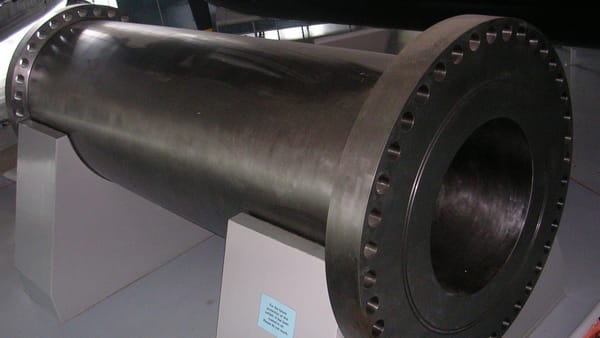
Project Babylon
The true story of Gerald Bull, the Canadian artillery genius who helped Saddam Hussein build a gun capable of firing satellites into space.
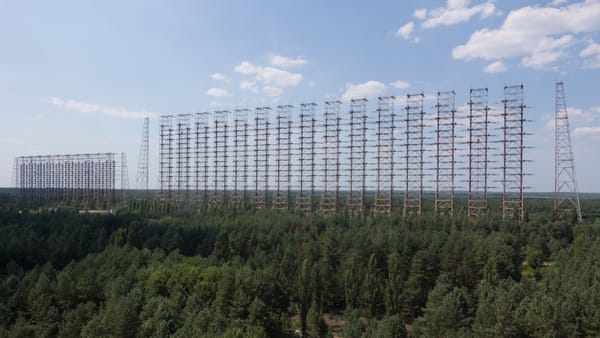
The Duga Radar
The story of the Duga over-the-horizon radar, the mysterious "Russian Woodpecker" signal that haunted radio operators worldwide during the Cold War.
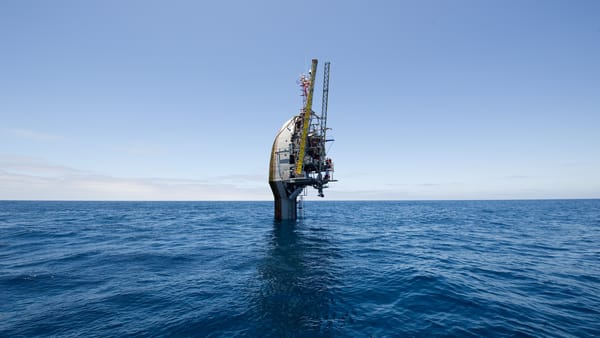
RP FLIP
How R/P FLIP, the 355-foot floating instrument platform, rotates from ship-like hull to stable spar buoy for ocean science.
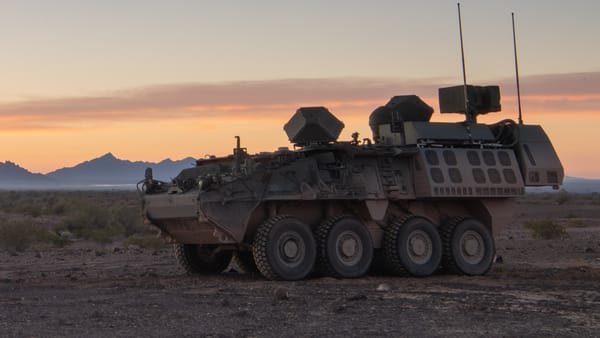
LOCUST X3
How AeroVironment's LOCUST X3 uses a 20-35+ kW laser to attack the cost problem behind modern drone defense.