
A cheap drone has become one of the most expensive problems in air defense.
A quadcopter built from commercial parts can cost a few thousand dollars. A larger one-way attack drone might cost tens of thousands. The missile fired to stop it can cost hundreds of thousands or several million. Win enough of those individual engagements and the defender can still lose the economics of the campaign.
That is the problem AeroVironment’s LOCUST X3 is trying to solve. It is a third-generation directed-energy counter-drone system descended from BlueHalo’s LOCUST laser work, now folded into AeroVironment after its BlueHalo acquisition. The basic promise is simple: instead of firing a missile, put enough laser energy on a drone for long enough to break it.
AeroVironment describes LOCUST X3 as a 20-35+ kilowatt high-energy laser designed for Group 1 through Group 3 unmanned aircraft systems. In plain English, that means the small and mid-sized drones that are now everywhere from trenches to ships to remote logistics bases.
The important question is not whether laser weapons are futuristic. The important question is whether they have finally become ordinary enough to be useful.
The Drone Defense Cost Trap
Modern drone attacks create an ugly arithmetic problem.
Ukraine has shown how quickly small drones can become artillery spotters, bomb trucks, anti-armor weapons, and one-way strike aircraft. The Red Sea has shown the same problem at sea, where warships can spend high-end missiles against drones and missiles launched by Houthi forces. U.S. bases in Iraq, Syria, and Jordan have faced repeated drone and rocket attacks, including the January 2024 Tower 22 attack that killed three American soldiers.
The drones behind this shift are not all exquisite weapons. Many are built around commercial airframes, hobby-grade electronics, cheap cameras, and simple navigation. Even the larger Shahed-style systems are cheap compared with the interceptors that might be used against them.
That creates a defender’s trap. A Patriot interceptor, a naval SM-series missile, an AIM-9X, or even a Stinger can destroy the target, but each shot also consumes a scarce weapon from a magazine that may take months or years to refill. A base commander may be forced to spend a very expensive interceptor on a target that costs a small fraction of the missile.
Guns, jammers, and short-range interceptors all have a place, but they bring limits of their own. Guns need ammunition and range. Jammers depend on the target’s control links and navigation. Kinetic interceptors still need reloads. The appeal of a high-energy laser is that the shot is powered by electricity rather than a missile inventory.
That does not make the system cheap. It does change the marginal cost of the engagement. AeroVironment has marketed LOCUST X3 around engagements below five dollars of electricity per shot. The full system still needs generators, cooling, maintenance, optics, trained operators, spare parts, and a command network. But the cost exchange is no longer a million-dollar missile against a cheap drone.
How LOCUST Reached the Field
The U.S. military has been chasing laser weapons for decades. Earlier systems proved lasers could damage targets, but many were too bulky, chemically messy, or expensive to become routine battlefield tools.
The practical shift came with solid-state and fiber lasers. They use electricity instead of chemical fuel and can be packaged into smaller modules. By the 2010s, those modules were moving from laboratory demonstrations toward truck, pallet, and shipboard installations.
BlueHalo’s LOCUST work emerged from that environment. In 2022, BlueHalo announced delivery of a LOCUST Laser Weapon System for the Army’s Palletized High Energy Laser program, or P-HEL. The goal was not to wait for a perfect future laser. It was to give soldiers a working counter-drone system that could be deployed, tested, and improved from field feedback.
The P-HEL idea was deliberately practical. Put a laser system on a pallet, connect it to power, tie it into sensors, and protect a fixed site. AeroVironment later said LOCUST-equipped P-HEL systems informed the newer mobile versions, and its 2026 shipboard announcement described the system as having already moved across fixed-site, land-mobile, and maritime use cases.
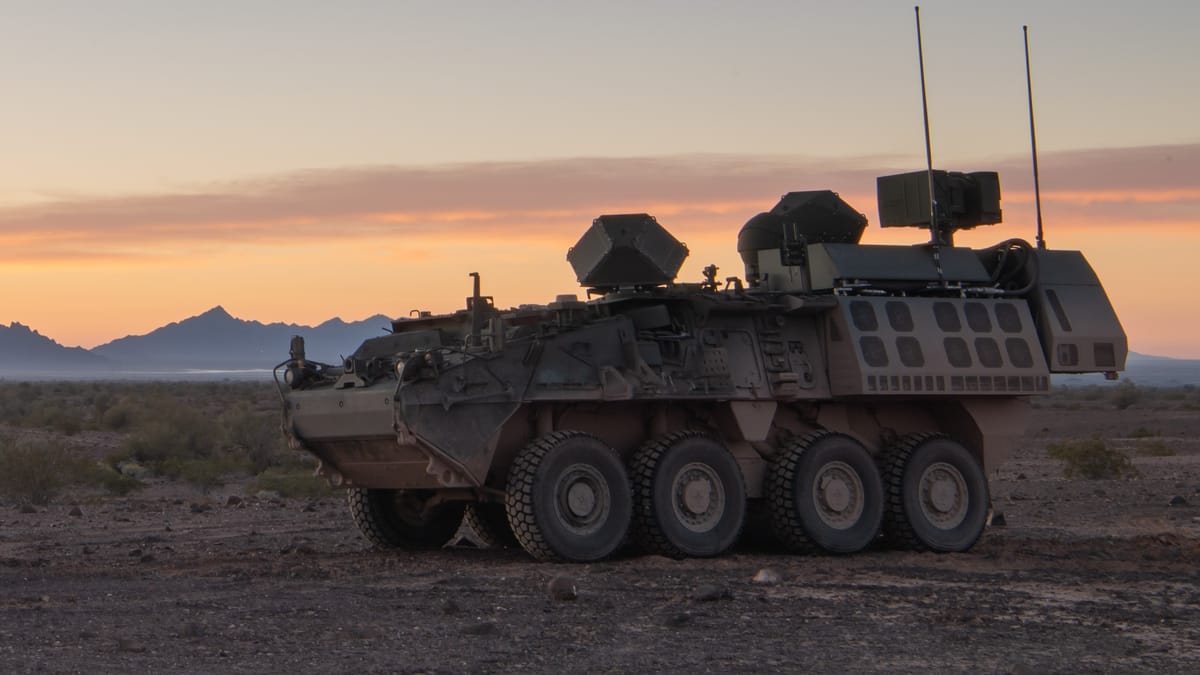
In 2025, AeroVironment announced mobile LOCUST prototype deliveries to the U.S. Army. The first pair mounted LOCUST on General Motors Defense Infantry Squad Vehicle platforms. The next pair mounted LOCUST on Joint Light Tactical Vehicles. Those deliveries mattered because a base-defense pallet and a vehicle riding with a maneuver force are different engineering problems.
The common theme is modularity. LOCUST is not being sold as one single vehicle. It is being sold as a laser weapon architecture that can move between platforms with the right power, cooling, sensors, and controls.
What LOCUST X3 Adds
AeroVironment unveiled LOCUST X3 in March 2026 as the third-generation version of the family. The company describes it as production ready, built around a 20-35+ kilowatt high-energy laser, and intended to defeat Group 1 through Group 3 drones.
The kill mechanism is thermal. The beam is invisible, but the effect is not magic. The system has to hold energy on a vulnerable part of the drone until heat damages a motor, battery, control surface, airframe, sensor, or other critical component. AeroVironment’s product materials emphasize precise aim-point control, not just raw laser power, because the beam has to stay on target while the drone moves and the platform vibrates.
LOCUST X3 also depends on software. AV_Halo Pinpoint is the targeting and tracking layer that AeroVironment says maintains energy placement on maneuvering targets. In practice, the laser is only the final effector. The full system needs detection, classification, tracking, prioritization, fire control, and operator oversight before the beam ever fires.
That is why the system is pitched as part of a counter-UAS network rather than a standalone science-fiction cannon. External radars or other sensors can cue the laser. Electro-optical and infrared systems then help identify and track the target. The operator supervises or controls the engagement through the fire-control interface.
The X3 also inherits lessons from the earlier LOCUST line. AeroVironment’s 2025 Army delivery announcements point to Infantry Squad Vehicle and JLTV prototypes. Its 2026 product materials point to scalable power, open interfaces, and upgrade paths. The message is that X3 is not a clean-sheet lab experiment. It is an iteration of a system family already being pushed into real operational contexts.
The Platform-Agnostic Promise
The most revealing LOCUST demonstration may not have involved X3 specifically.
In April 2026, AeroVironment announced that a palletized LOCUST Laser Weapon System had been demonstrated aboard the aircraft carrier USS George H.W. Bush during an October 2025 live-fire event with the U.S. Navy and the Army Rapid Capabilities and Critical Technologies Office. According to AeroVironment, the P-HEL system tracked, engaged, and neutralized multiple target drones.
That matters because ships are hard places for lasers. A carrier moves. The deck environment is harsh. Power and integration are different from a fixed Army site. If the same broad weapon family can move from a base-defense pallet to Army vehicles to a carrier flight deck, it becomes easier to imagine production and training at scale.
It also explains why the word “modular” appears so often in AeroVironment’s LOCUST materials. A laser that only works as a bespoke installation on one platform is useful but narrow. A laser architecture that can be palletized, mounted on a vehicle, or adapted for shipboard trials gives commanders more ways to build a layered defense.
That does not mean every platform can simply bolt one on. Power supply, cooling, stabilization, sight lines, electromagnetic safety, operator training, and rules for firing a high-energy beam through shared airspace all matter. The practical achievement is not zero integration. It is reducing the amount of reinvention required each time the laser changes host.
Why a Laser Is Not a Magic Shield
The phrase “unlimited magazine” needs careful reading.
LOCUST does not run out of missiles because it does not fire missiles. But each shot still consumes electrical power and produces heat. The beam director can engage one target at a time. A drone may need several seconds of dwell time before it fails. If a large swarm arrives together, a single laser has to work through the targets sequentially.
Weather is another hard limit. Dust, smoke, fog, rain, and salt haze can scatter or absorb laser energy. A shot that works at one range in clear air may be much less effective in bad atmospheric conditions. The laser also needs line of sight. Terrain, buildings, vegetation, low approach angles, and the curvature of the earth all create places where a target can hide from the beam.
Target design can also matter. Reflective surfaces, protective skins, faster maneuvering, tumbling flight, smoke, or attacks timed to overwhelm the engagement queue can all reduce effectiveness. Laser defense is a fight between energy on target and everything that prevents that energy from staying there long enough.
That is why LOCUST X3 is best understood as one layer in a stack. Lasers can be excellent for low-cost precision engagements against visible drones. Guns and missiles still matter when weather is bad, the target is too fast, the range is wrong, or the threat is more than a small or mid-sized UAV. High-power microwave systems may be better against dense swarms at short range. Electronic warfare remains important where links and navigation can be disrupted.
The breakthrough is not replacing air defense. It is making the lowest tier of air defense cheaper to use.
What Comes Next
As of June 2026, the public record supports a clear but bounded conclusion. LOCUST X3 has been unveiled by AeroVironment as the next-generation product. Earlier LOCUST systems have been delivered in Army mobile prototypes, used in the P-HEL family, and demonstrated at sea aboard USS George H.W. Bush. What has not been publicly confirmed is a large full-rate Army production award for X3.
That distinction matters. Defense technology is full of impressive demonstrations that never become common equipment. LOCUST has more behind it than a trade-show mockup, but the next step is still procurement, scaling, training, sustainment, and integration into real air-defense networks.
If AeroVironment can turn the X3 into something units can buy, move, maintain, and trust, the payoff is obvious. A base, convoy, or ship could reserve expensive missiles for threats that truly need them while using laser shots against drones that would otherwise bleed the defender’s inventory.
The drone problem is not going away. The cost problem is not going away either. LOCUST X3 matters because it attacks both at the same time.
Key Takeaways
-
LOCUST X3 is AeroVironment’s third-generation directed-energy counter-drone laser, described by the company as a 20-35+ kW system for Group 1 through Group 3 unmanned aircraft.
-
Its central promise is economic: use a laser engagement, powered by electricity, instead of spending scarce high-cost missiles on low-cost drones.
-
Earlier LOCUST systems have been tied to the Army’s P-HEL work, mobile Army prototypes on ISV and JLTV platforms, and a shipboard demonstration aboard USS George H.W. Bush.
-
The system still has laser limits: weather, line of sight, dwell time, heat, power, and one-target-at-a-time throughput.
-
LOCUST X3 should be read as one layer in a broader counter-UAS defense, not a replacement for missiles, guns, sensors, electronic warfare, or command networks.

Simon Whistler
Simon Whistler hosts MegaProjects, bringing engineering, infrastructure, and military-machine stories into clear narrative focus for viewers who want the systems, tradeoffs, and human decisions behind the build.
Frequently Asked Questions
What is LOCUST X3?
LOCUST X3 is AeroVironment’s third-generation high-energy laser weapon system for countering small and mid-sized unmanned aircraft. AeroVironment describes it as a 20-35+ kW directed-energy system.
What kind of drones is LOCUST X3 meant to stop?
AeroVironment says LOCUST X3 is designed for Group 1 through Group 3 unmanned aircraft systems. That range covers small quadcopters through larger tactical and one-way attack drones.
Does LOCUST X3 fire a visible laser beam?
No. The beam is not a visible science-fiction ray. The effect comes from holding enough energy on part of the target long enough to overheat or damage critical components.
Why is the cost per shot important?
Drone defense often uses expensive missiles against cheap drones. LOCUST’s claimed low electricity cost per engagement changes that cost exchange, although the full system still has procurement, maintenance, power, cooling, and training costs.
Can LOCUST X3 stop a swarm by itself?
Not by itself. A single laser beam engages one target at a time and needs dwell time. Swarms still require layered defenses, including sensors, electronic warfare, guns, missiles, and possibly high-power microwave systems.
Has LOCUST been used outside a test range?
AeroVironment and BlueHalo materials describe LOCUST/P-HEL systems moving beyond laboratory work into Army deliveries, operationally informed prototypes, and a shipboard live-fire demonstration. Public sources do not provide a detailed combat engagement log.
Is LOCUST X3 already in full-rate production?
As of June 2026, AeroVironment describes LOCUST X3 as production ready, but public sources do not confirm a large full-rate Army production award for X3.
Sources
-
Original MegaProjects video: America Has Unveiled a New UAV-Catching Energy Cannon
-
AeroVironment: LOCUST demonstrated aboard USS George H.W. Bush
-
AeroVironment: First two AMP-HEL systems delivered to the U.S. Army
-
AeroVironment: JLTV-mounted LOCUST systems delivered to the U.S. Army
-
Hero image source by Venetia Gonzales / U.S. Army, public domain.
Related Projects
SMASH 2000L
How SMARTSHOOTER's Smash 2000L fire-control optic helps infantry engage small drones, and why smart rifle scopes still face hard battlefield limits.
LRASM
How LRASM restored America's long-range anti-ship strike capability with stealth, autonomy, and a missile built from the JASSM-ER family.