
In July 1976, radio operators around the world — both amateur and professional — found themselves confronting a bizarre anomaly. Without warning, their broadcasts were assaulted by a haunting sound: a sharp, repetitive tapping, often likened to an electronic woodpecker. Everyone from radio hobbyists to aviation control towers, and even legitimate nationwide radio broadcasters, heard the signal at 10 hertz. None were able to prevent it from rudely interrupting their broadcasts seemingly at random, and no explanations as to where the woodpecker was coming from were forthcoming, whether from the US government or otherwise.
This was a time when Cold War tensions were peaking and nerves were already frayed. So, of course, it wasn’t long before concerned speculation gave rise to an avalanche of conspiracy theories.
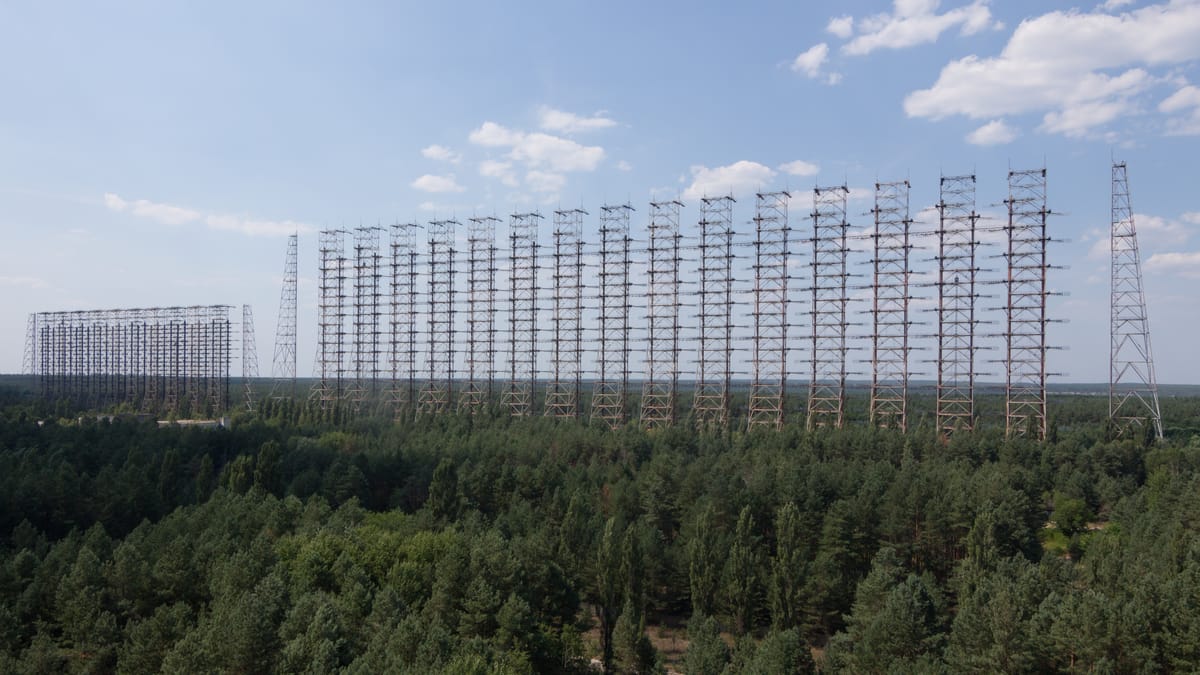
What the radio hobbyists of the world — and specifically those in America, where the woodpecker was most commonly heard — didn’t know was that they were hearing the over-the-horizon (OTH) Duga-1 radar array, otherwise known as the Russian Woodpecker. NATO military intelligence referred to it as Steel Yard or Steel Work, a name derived from the fact that the Duga radar receivers were absolutely enormous structures measuring 700 meters (2,300 feet) in length and 150 meters (490 feet) tall, making them among the most expansive ever built. More to the point, the radars were allegedly capable of outputting a staggering 10 megawatts — a very impressive number at the time.
As a point of comparison, the cutting-edge AMES Type 80 radars used by the UK’s Royal Air Force between the mid-1950s and early 1990s had an output of between 1 and 2.5 megawatts. The American AN/FPS-85, on the other hand, had a peak output of 30 megawatts, though it was intended to track objects in outer space. Power output doesn’t necessarily translate to a radar being accurate or reliable, however, as subsequent events would demonstrate.
Civilians at the time didn’t know the signal was the Duga Radar, and some insisted that the Woodpecker signal was part of a Soviet brainwashing operation, threatening to either turn Americans slowly Soviet or perhaps simply reduce anyone within earshot to a mindless zombie. Others pushed a conspiracy theory that persists to this day, linking the mysterious radar signals to weather anomalies. The signal was, the theorists insisted, a by-product of weather modification experiments that would ultimately destroy America through drought or devastating storms.
Russian Woodpecker interference was an unintended side effect of the backscattering techniques used by Duga radars and remained an international problem until the end of the 1980s. The interference was such a problem that radio broadcast equipment was eventually designed with a built-in dampener to counter the signal, referred to as a Woodpecker Blanker. But although the interference itself could be dealt with, the much more pressing issue was understanding whether there was any real, credible threat to concerned American citizens.
Thankfully, it didn’t take long for motivated radio hobbyists and amateur investigators to collaborate using signal triangulation techniques, quickly confirming that the signal was indeed originating from Ukraine, near Chernobyl. The Duga radar receiver at this location is the one most commonly mentioned and referenced in popular media today, though an often-overlooked second Duga radar system also existed in eastern Siberia, built soon after the first.
Once 1970s investigators confirmed that the Woodpecker signal was coming from Soviet Russia, Americans weren’t exactly comforted. The paranoia dial was turned up to eleven, and legitimate tinfoil hats were a hot fashion accessory. Though in these circumstances, who can blame anyone for trying to protect their brain from an unidentified Soviet radio signal?
The Russian Woodpecker Hunting Club
While some chose tinfoil hats, others were more proactive. A group of radio hobbyists banded together and called themselves the Russian Woodpecker Hunting Club. They set about attempting to jam the radar by broadcasting a directly opposing signal of their own.
The group would perhaps have told you that they were “transmitting synchronised unmodulated continuous wave signals on the same pulse as the Woodpecker,” but what this really came down to was tapping a HAM radio microphone in synchronicity with the Woodpecker. It may sound a little silly, but the hobbyist group was actually using a sound principle, and at least in theory may have even been somewhat successful. Similar techniques were almost certainly used by the US military, though of course with powerful, high-grade equipment.
As the Russian Woodpecker Hunting Club was tapping microphones, other, more skilled investigators were unravelling mysteries and drawing conclusions. A Binary Phase-Shifting Key — the same BPSK used in the local area networks of modern computers and in wireless Bluetooth devices — was identified in the Woodpecker signal. Investigators likewise noted that the pulse exhibited clear signs of uninterpretable communication Barker Codes, thus all but confirming that the signal was an over-the-horizon radar system, one located in Ukraine and pointed towards the United States.
OTH radar systems were a cutting-edge technology at that time, with the US, UK, Russia, and various other countries all actively developing their own versions. The political climate of the Cold War had, above all else, put countries into a mad scramble for the ability to identify rocket launches at extreme long range. Satellites would ultimately come to serve that purpose, but prior to that technological leap, OTH radar was the best solution for seeing incoming nuclear war before it happened — even if just by a few minutes.
The Cold War Early Warning Arms Race
At the time Duga-1 went online, America already had an expansive early warning radar system of its own, including the 5-megawatt RCA 474L Ballistic Missile Early Warning System (BMEWS) and the already-mentioned 30-megawatt AN/FPS-85. The FPS-85 was widely publicised as being capable of tracking a basketball-sized object at 40,000 kilometres in outer space, and the military partially hijacked its tracking capabilities to scan for ballistic missile launches — specifically from submarines.
In the spirit of the frequent military posturing that characterised the Cold War, Russia was quick to claim that the US’s early warning detection system wasn’t as impenetrable as it appeared. Soviet Premier Nikita Khrushchev proclaimed in 1961:
“You [the Americans] do not have 50- or 100-megaton bombs; we have bombs more powerful than 100 megatons. We placed [cosmonauts] in space, and we can replace them with other loads that can be directed to any place on Earth.”
Khrushchev was referring to terrifying Fractional Orbital Bombardment Systems (FOBS), which effectively made all US early warning systems useless. Given the orbital trajectory of FOBS missiles, a warhead could theoretically approach from any direction, skirting around radars and striking with little to no warning. Khrushchev repeated this declaration during the Cuban Missile Crisis in 1962:
“We can launch nuclear missiles not only over the North Pole, but in the opposite direction too. Global rockets can fly from the oceans or other directions where warning facilities cannot be installed. Given global missiles, the warning system has lost its importance. Global missiles cannot be spotted in time to prepare any measures against them.”
Soviet Russia, meanwhile, was itself surrounded by threats on all sides, with the West having intercontinental ballistic missiles (ICBMs) in Turkey, Europe, Asia, and of course America.
Whoever did or didn’t have the upper hand is an endless topic of speculation, but either way both countries had serious need for improved early warning systems given the frankly insane Cold War political situation. More to the point, these systems certainly had to be well beyond World War II-era line-of-sight (LOS) radar systems.
LOS Versus OTH
World War II LOS systems had been strictly short range, only effective for aircraft detection up to a few hundred kilometres at their peak. This short-range detection had been extremely useful, doing wonders in providing military units with an essential but brief warning on approaching bombers. But as WWII came to an end and technology advanced, the biggest threats were obviously no longer incoming aircraft but rather incoming long-range missiles. The infamous German V-2 rocket had demonstrated beyond a shadow of a doubt just how devastating long-range attacks could be, with the then-revolutionary weapon capable of hitting targets at a distance of 320 kilometres.
Thus Russia, along with the US and many other countries, focused on radar systems that could detect a missile launch at thousands of kilometres, thereby providing enough time for a considered response. The goal was that with long-range radar detection, a window of between 12 and 15 minutes could be granted, depending on where the missile launch originated. A number of experimental OTH research projects took place during this era, including the Multiple Storage, Integration, and Correlation project (MUSIC), developed at the United States Naval Research Laboratory in 1955, and the Magnetic-Drum Radar Equipment project (MADRE) at Chesapeake Bay in 1961.
But naturally, going from short-range to long-range detection was about far more than simply increasing the power of a radar. The problem was, simply put, that the earth curves.
There is no detailed development history of the Duga radar system, with virtually all of the information lost forever behind the Soviet Iron Curtain. Much of the information that does exist, at least as far as the construction and operation of the radar goes, comes from Volodymyr Musiyets, a former commander of the Duga-1 complex. But even the information he provides is vague at best, giving only a glimpse into how Duga was developed and deployed.
Some spotty information available beyond ex-commander Musiyets alleges that a working OTH radar was built by the Soviets as early as 1949, referred to as Veyer. Assumptions are that although the Soviets could see the potential of OTH with Veyer, they also understood that further technological advancements were necessary for OTH to be practical. That is probably why there is no further information of Soviet OTH research and development until the 1960s and 1970s.
A working, experimental version of Duga was then built at Mykolaiv in Ukraine during the early 1960s, with the system reportedly able to detect rocket launches 2,500 kilometres away. A follow-up, equally successful prototype was built at the same location, again demonstrating the potential of OTH and prompting the full-scale construction of the famous Duga-1 receiver — the structure still standing today. The separate transmitter was located around 60 kilometres away at the military town of Liubech-1.
The transmitter has since been entirely dismantled and removed, which is probably why that half of the Duga-1 radar is often overlooked. Only the Liubech-1 military town now remains where the transmitter once stood, which is itself part of a conspiracy explored later.
Understanding Radio Frequencies
To help put the technical Duga radar information into a sensible framework, it is worth understanding the differences between low and high radio frequencies. Low frequencies, between 30 and 300 kilohertz, tend to travel great distances, are much less likely to suffer interference from weather, and can penetrate buildings and other structures with relative ease. On the other hand, low frequencies also have limited bandwidth, making the potential transfer of information modest at best. A standard voice call on a mobile phone uses low frequencies.
High frequencies, between 3 and 30 megahertz, are what you find in WiFi routers and on 5G towers. High frequencies have a much broader bandwidth and are capable of transmitting dramatically more information very quickly. But high frequencies travel far shorter distances and are easily disrupted by physical structures or bad weather.
These inherent limitations are why 5G towers require so many relays to be effective, given that the signal must be repeated constantly to provide reliable coverage. Another very important property of high frequencies not seen in low frequencies is that they bounce off the Earth’s ionosphere.
The Duga system used broad-bandwidth high frequencies, and given the limitations of such waves — not travelling very far and being easily disrupted — the challenge of getting the radar to work as intended must have been immense. That is also probably why the radar had a higher-than-average output of up to 10 megawatts, assuming the information about output is indeed accurate. More importantly, the Soviets needed to take advantage of the ionosphere-bouncing properties of high frequencies. It is worth noting that the word “Duga” translates to “arc,” referring to the route taken by the radar beam over the horizon.
Radars use microwave beams broadcast in a focused, straight line, with any waves sent back — reflected off a solid object such as an aircraft — received as readable information. In the case of WWII LOS systems, the range of the beam could be extended in various ways, such as by elevating the radar to compensate for ground scattering. Generally speaking, an elevated 200-kilowatt WWII LOS radar could detect an object above ground at a reasonable distance assuming clear line of sight — up to around 160 kilometres depending on circumstances.
Watch the Video
Open VideoHowever, the key is that no matter how much you increase output or elevate a radar, the beam is still limited to functioning in a straight, unbroken line. At a certain point, your beam is simply going to be shooting off the planet and into space, not serving much purpose other than sending your electricity bill into the stratosphere.
Hence, if you want your radar to detect something on the other side of the world, what you need to do is intentionally bounce your radar beam back down onto the surface of the Earth. The beam will then reflect along the same route it arrived and be accepted and analysed by a receiver.
There are other workable solutions to OTH radar detection, such as using longer-travelling low-frequency waves and essentially scattering them along the ground to eventually refract around the Earth’s surface. But this solution, referred to as using “ground waves,” is less accurate than the alternative and works best when used over the ocean where refraction is most reliable. The ground wave solution is therefore useful for tracking ships, but less so for detecting missile launches.
“Skywave” or “skip” communication refers to the use of the ionosphere — the charged layer in our atmosphere that exists between 48 and 965 kilometres above sea level — to bounce low-frequency signals back onto the surface of the Earth. The method has been used frequently throughout history, though primarily as a means to extend the reach of radio and TV broadcasts. The technique is even still used fairly commonly today, though much less so since the widespread adoption of satellite technology.
With all that being said, skywave OTH radar comes with serious drawbacks. The most prominent is that the system is, as one can imagine given the logistics involved, still incredibly imprecise and difficult to use, even if it is technically more precise than the ground wave alternative. There is even speculation that the Duga radars barely worked, if they worked at all.
The Many Problems With OTH Duga
The Duga radar receiver was 700 meters in width not because Soviet Russia enjoyed enormous metal structures, but because a receiver of this size was necessary. It is not easy finding concrete information on the dismantled transmitter, but given that radar resolution depends entirely on the width of the beam, assumptions are that the transmitter must have been just as enormous as the receiver.
For perspective, a radar beam with a 1-degree width, assuming the target is 120 kilometres away, will receive a signal back showing a 2-kilometre-wide target area. This is workable in principle, but the Duga system was attempting to detect targets thousands of kilometres away using a messy refraction process. Based on the physics involved, available information, and using other more modern OTH radars as reference, the Duga radars potentially had an accuracy of around 2 to 4 kilometres — keeping in mind that most modern commercial GPS has an accuracy of 1 metre. Even still, since Soviet Russia wasn’t trying to detect missile launches to the metre but was rather attempting to detect them at all, the radar system would have had enormously important potential.
Furthermore, skywave radar is, essentially due to the angles required, not only limited to around 2 to 4 degrees off the horizon but also only works well if the ground along the path of the beam is very reflective. Modern OTH radars have wire mesh extending some 3 kilometres out from the arrays, and there are some hints that this may have been planned or implemented at the Duga radars. Many rolls of wire mesh are still present at the Duga-1 receiver today, and there is a possibility they once served this purpose as well as being part of the receiver itself.
This brings us to one of the more interesting aspects of the Duga radar system. The refracted signal gathered by the Duga receivers — the part of the signal that was actually informative and could be used to detect missile launches — was essentially nothing more than a barely perceptible drop in a cacophony of deafening noise. In order for operators to actually harvest usable information, extremely powerful low-noise amplification technology advancements, along with then cutting-edge computers, were necessary.
The process would have required specialist operators to constantly tune and adjust the frequencies, with a separate group using an additional transmitter aimed directly at the ionosphere to gauge atmospheric fluctuations. This must have been extremely challenging given the available technology at the time, especially since it is often suggested that Soviet scientists didn’t fully understand the ionosphere during the radar’s construction.
All of this was made significantly more difficult by the previously mentioned Russian Woodpecker Hunting Club, plus the near certainty that the US military was attempting to jam the signal themselves. The Duga radar was reportedly very susceptible to jamming, and in conjunction with all the other challenges, it does raise questions as to just how effective the system really was.
Either way, whether the radars worked well or not, it is generally accepted that the system fell out of use in the late 1980s. Woodpecker radio interference declined throughout the decade — partially due to Duga-1 being abandoned after the Chernobyl disaster — until ceasing entirely in 1989. The most obvious reason for the second Duga radar being taken offline is the success of the Upravlyaemy Sputnik Kontinentalny Statsionarny (US-KS) operation, which saw seven Russian satellites launched between 1975 and 1997. Each of the 2,400-kilogram satellites was fitted with 50-centimetre infrared telescopes, each specifically tuned to detect the heat produced by missile exhaust systems.
Today, the most famous of the radar receivers, Duga-1, is the only large-scale remnant of the two arrays left standing. The receiver has been left to gradually degrade and decompose in the Chernobyl exclusion zone, serving as a relic of the Cold War era and, more recently, acting as a hotspot for adventure tourists. The receiver has also become something of a media celebrity in recent years, mentioned constantly in TV series, films, video games, and in various ongoing conspiracy theories.
The Duga Conspiracies
The Russian Woodpecker , a documentary released in 2015 at the Sundance Film Festival, won the World Cinema Documentary Grand Jury Prize. The film follows Fedor Alexandrovich as he investigates the Chernobyl disaster and Duga radar, ultimately suggesting that the two are linked. He proposes that the radar was a $10 billion failure that never worked, and that efforts were subsequently made to cover up the unmitigated disaster.
This theory does seem to hold some water given everything discussed above, plus taking into account that a very confirmed failure happened nearby at the Chernobyl nuclear power plant. The Chernobyl disaster demonstrated just how precarious Soviet-era projects were and made clear the extent the government would go to in keeping failures a secret from the rest of the world. However, the film also suggests that the Chernobyl disaster was, in fact, triggered purposefully as a means to cover up the failure of Duga.
Mike D’Angelo of The AV Club summed up this particular conspiracy theory best, saying it was:
“In terms of plausibility, roughly on a par with ‘George W. Bush allowed 3,000 Americans to be murdered by Al Qaeda … so he could justify invading Iraq.’”
D’Angelo also commented on the film’s inclusion of the Euromaidan protests that occurred during the production period:
“It’s almost as if Alexandrovich and director Chad Gracia use this real-world conflict to distract viewers from the lack of concrete evidence, in the same way that Alexandrovich claims the Chernobyl disaster was meant as a diversion.”
The most commonly cited conspiracy theories regarding the Duga radars are the already-mentioned notions that the arrays were intended for mind control or weather control. There is, needless to say, not a single shred of evidence to back any of this up. Duga commander Volodymyr Musiyets told Ukrainian newspaper Fakty that:
“The Chernobyl-2 object, as a part of the anti-missile and anti-space defense of the Soviet military, was created with a sole purpose; to detect the nuclear attack on the USSR in the first two-three minutes after the launch of the ballistic missiles.”
Similar mind and weather control claims have been made about the High-frequency Active Auroral Research Program, or HAARP, radar array at the University of Alaska Fairbanks. The HAARP radar array is, interestingly enough, tasked with studying the ionosphere.
The Real Conspiracies of Duga
With the less believable conspiracy theories out of the way, it is worth noting that we don’t actually need to turn to questionable speculation when there are perfectly good real conspiracies surrounding the radars.
The construction of Duga-1 and its transmitter were a fiercely guarded secret, even from the Russian people. Both the receiver and transmitter were carefully built as far away from nearby roads as possible, making the military sites undetectable from passing vehicles within a 30-kilometre radius. Pripyat at the Chernobyl power plant was the only populated area within this radius, though the dense forest would have concealed the construction process and the facilities almost entirely from residents.
Duga engineering personnel and their families lived in dedicated on-site mini-towns: Chernobyl-2 near the Duga receiver, and the already-mentioned Liubech-1 at the transmitter. All engineers involved were sworn to secrecy under threat of execution.
The receiver site was marked as a children’s summer camp on Soviet maps, and the 8-kilometre road leading into the facility was carefully blockaded and disguised with fake signs. Perhaps most famous in this deception is the inclusion of an entirely artificial bus stop on the approaching road, masquerading as the drop-off point for the non-existent children who would have gone to camp. It is often noted that during the 1980 Moscow Summer Olympics, the bus stop was even decorated with a Misha the Bear Olympics mascot, further solidifying the illusion that children used the road.
Famously, when US journalist Phil Donahue was allowed into Chernobyl in 1989, following the Chernobyl disaster, he caught a glimpse of Duga-1 and, upon asking about it, was told by his guide that the array was an unfinished hotel under construction. Donahue, one can assume, knew better than to press the issue in a country where executions were still common.
The Enduring Duga Radar Mythos
The Duga radar is almost as recognisable as Chernobyl itself, appearing in numerous forms of media and continuing to captivate audiences decades after it went silent.
Perhaps the most provocative mention and depiction of the radar is in the STALKER series of video games, each set in the Chernobyl exclusion zone. The franchise incorporates Duga-1 into the semi-fantastical setting, allowing players to not only visit the sites first-hand but even using the array as part of the decidedly tongue-in-cheek plot. In STALKER: Shadow of Chernobyl , the Brain Scorcher plot device takes direct inspiration from Duga mind control conspiracy theories.
The player is forced to confront various zombie enemies as they make their way towards a dangerous Brain Scorcher radar. The radar is due to appear again in the sequel, STALKER 2 .
The highly praised 2015 book Stalking the Atomic City: Life Among the Decadent and the Depraved of Chornobyl by Markiyan Kamysh details the author’s trips into the Chernobyl exclusion zone, including investigations he made at the Duga-1 receiver. The book explores the abandoned facilities themselves while also discussing the political situation that led up to the disaster and the thriving tourism industry that has sprung up around the exclusion zone.
The Duga radar has regularly featured in the Call of Duty games, including in Black Ops and prominently in Cold War . In Cold War , the Outbreak map titled “Duga” allows players to completely explore a fairly accurate recreation of the radar, though with the added complication of having to shoot zombies. The radar again appears in the more recent Call of Duty: Warzone .
The radar has also appeared as a map in the drone racing game Liftoff , as a location in PUBG , as a DLC map in Spintires , and more prominently as a central plot mechanic in Chernobylite and Proze: Enlightenment , both of which focus on the mind control conspiracy theory.
The Duga-1 receiver can also be seen in the Divergent series of films, where the radar is depicted being used as a protective wall. Most of the shots including the radar are CGI, but according to production notes, some footage was shot on location at the radar itself.
A Relic of Cold War Paranoia
Clearly, the Duga radars are still a big part of popular culture, even if they are remembered today far more as a conspiracy theory than as the terrifying statement of political tension they really were. The massive steel structures near Chernobyl stand as monuments to an era when two superpowers poured billions into systems designed to give themselves just a few extra minutes of warning before nuclear annihilation — and when civilians caught the signal bleed of those systems, the resulting paranoia spawned conspiracy theories that endure to this day.
As a closing thought, historian Serhii Plokhy, author of the lauded Chernobyl: History of a Tragedy , gave his own review of The Russian Woodpecker conspiracy theory film. He said, rather succinctly, that the film is an:
“Example of the ease with which conspiracy vitiates meaningful debate about Chernobyl.”
It is a sentiment that applies equally well to the Duga radar itself — a genuinely remarkable and secretive piece of Cold War engineering that deserves to be understood on its own terms, rather than through the distorting lens of conspiracy.
Key Takeaways
-
The mysterious Russian Woodpecker was actually a massive Soviet over-the-horizon radar system named Duga-1, designed to detect long-range missile launches.
-
This powerful radar array caused severe global radio interference throughout the 1970s and 1980s, spawning wild conspiracy theories about mind control and weather manipulation.
-
The Duga system attempted to bounce high-frequency microwave beams off the ionosphere, an incredibly imprecise method plagued by deafening noise and technical limitations.
-
Construction of the colossal radar facilities was a fiercely guarded Soviet secret, disguised on maps and hidden deep within the forests near Chernobyl.

Simon Whistler
Simon Whistler hosts MegaProjects, bringing engineering, infrastructure, and military-machine stories into clear narrative focus for viewers who want the systems, tradeoffs, and human decisions behind the build.
Frequently Asked Questions
What was the Soviet “Russian Woodpecker” signal that disrupted radio broadcasts in 1976?
In July 1976, radio operators around the world began hearing a sharp, repetitive tapping at 10 hertz that interrupted broadcasts seemingly at random. The signal was the over-the-horizon Duga-1 radar array, later identified as originating from Ukraine near Chernobyl.
Why did the Duga radar trigger so many conspiracy theories during the Cold War?
The signal appeared without warning at a time when Cold War tensions were peaking, and no explanation was immediately forthcoming from the US government or elsewhere. That vacuum produced theories ranging from Soviet brain washing to weather modification experiments meant to cause drought or devastating storms in America.
How large and powerful was the Duga radar system near Chernobyl?
NATO military intelligence referred to the Duga receivers as Steel Yard or Steel Work because the structures measured 700 meters in length and 150 meters tall. The radars were allegedly capable of outputting 10 megawatts, an impressive figure for the time.
How did civilians and radio hobbyists respond to the Russian Woodpecker signal?
Radio hobbyists quickly used signal triangulation to confirm that the transmissions were coming from Ukraine near Chernobyl. A group calling itself the Russian Woodpecker Hunting Club then tried to jam the radar by transmitting synchronized continuous wave signals, which in practice meant tapping a HAM radio microphone in sync with the Woodpecker pulses.
What evidence led investigators to conclude the Woodpecker was an over-the-horizon radar aimed toward the United States?
Investigators identified a Binary Phase-Shifting Key in the signal and also found clear signs of uninterpretable communication Barker Codes. Those features all but confirmed that the transmission was an over-the-horizon radar system located in Ukraine and pointed toward the US.
Why were over-the-horizon radars such an important Cold War technology?
Countries including the US, UK, and Russia were racing to develop over-the-horizon radar because it offered a way to detect rocket launches at extreme range. Before satellites took over that role, it was the best available method for seeing incoming nuclear war even if only by a few minutes.
How did Soviet leaders describe the threat posed by fractional orbital bombardment systems?
Nikita Khrushchev argued in 1961 and again during the Cuban Missile Crisis in 1962 that global rockets could approach from directions where warning facilities could not be installed. He said that with such missiles, existing warning systems had lost their importance because they could not be spotted in time to prepare countermeasures.
Sources
-
Original MegaProjects video: The Duga Radar The Secret Spying Soviet Radar Next To Chernobyl
-
Hero image source by Ingmar Runge, licensed under by.
Related Projects
Lockheed U-2 Spy Plane
How Lockheed's U-2 spy plane flew to 70,000 feet to photograph Soviet secrets, survived being shot down, and outlasted every replacement for seven decades

Kelvedon Hatch Secret Bunker
Inside Kelvedon Hatch, the Cold War bunker built to keep the British government alive 38 meters underground through nuclear war.
The Nuclear Triad
Explore the three pillars of nuclear deterrence—strategic bombers, ICBMs, and submarine-launched ballistic missiles—and how the nuclear triad ensures mutually assured destruction.