

This is the Wartime Broadcasting Service. This country has been attacked with nuclear weapons. Communications have been severely disrupted, and the number of casualties and the extent of the damage are not yet known. We shall bring you further information as soon as possible. Meanwhile, stay tuned to this wavelength, stay calm and stay in your own homes. Remember there is nothing to be gained by trying to get away. By leaving your homes you could be exposing yourselves to greater danger.
That is part of the official BBC broadcast you would have heard if a nuclear attack had occurred in the United Kingdom during the Cold War. The broadcast would have gone on to explain that you should ration water, keep a food supply of at least 14 days, and stay in your home until the “all clear” was given.
Of course, while British civilians would have had to make do with their own shelter arrangements, government officials would have headed to their nearest designated underground bunker. The Prime Minister would likely have been whisked away to the cutting-edge facility at Kelvedon Hatch, in the Borough of Brentwood, Essex. Although today this bunker is nothing more than a Cold War tourist attraction, at the time Kelvedon Hatch was the Regional Government Headquarters, or RGHQ — essentially the centre of all wartime efforts after an attack. Had the bunker not withstood nuclear war, and had its inhabitants not survived, the UK would have been thrown into chaos, perhaps even collapsing entirely.
- Depth below ground
- 38m (125 ft)
- Capacity
- Up to 600 personnel for ~3months
- Wall thickness
- 10 ft reinforcedconcrete
- Entrance tunnel
- 91 m L-shaped blasttunnel
- Annual upkeep as RGHQ
- £3 million /year
- Visitors today
- ~60,000 peryear
So just how durable was a fallout shelter built in the 1950s, and would it really have survived an all-out attack from Soviet powers?
A Real-Life Fallout Vault
Even over half a century later, Kelvedon Hatch is still one of the safest places you could be if the bombs ever did start falling. The bunker may even seem somewhat familiar if you’ve watched the Fallout series or played any of the Fallout games — the interior has a similar appearance to the franchise’s Vaults. Those Vaults are entirely fictional, but the game designers clearly took inspiration from real Cold War bunkers such as this.
The Hatch was, and probably still is, capable of resisting just about anything, including a nuclear detonation in the near vicinity and probably even a detonation directly overhead. For context, according to a recently uncovered account from Eizō Nomura, he survived being within 200 meters of the Hiroshima blast epicentre because he happened to be in the reinforced cement basement of the Fuel Rationing Control Union. If that is the capability of a basement, Kelvedon Hatch would be many times more durable.
The Hatch’s cement-and-tungsten structure sits 38 meters (125 feet) below ground, is capable of housing up to 600 essential personnel for a period of up to three months, and would likely have been where the Prime Minister was sent in a time of crisis. Inside, the Prime Minister and essential staff would have enjoyed relative luxury: a dedicated sewage treatment facility, air conditioning, a self-sustaining borehole water supply, and a full array of telecommunications equipment.
Direct access to military networks was provided via MOULD, a VHF radio system that allowed direct communications between the Regular Army, TA Battalions and Regional Headquarters, and via CONRAD, a simple printed messaging service able to quickly send and receive printable information. Crucially, none of these systems relied on existing landline infrastructure, so they would have remained operational even after other forms of communication were devastated.
Built to R4 Spec — Blunt Practicality, Brutal Effectiveness
Kelvedon Hatch is a military-grade R4 Sector Operations Control (SOC) structure, with R1–R3 bunkers being smaller and less elaborate. R4 bunkers are primarily three-storey and include expanded living spaces, the idea being that a significant number of personnel could be housed on a semi-permanent basis. Interestingly, R4 bunkers weren’t necessarily intended as fallout shelters when originally constructed, though this particular one came to serve that purpose after a few modifications — its original role was part of the ROTOR early-warning system.
In terms of construction, R4 bunkers are about as simple as you could ask for, reflecting a Cold War military philosophy that prioritised blunt practicality above all else. Being simple in design, however, didn’t mean the bunkers weren’t incredibly effective.
The first step of construction involved excavating an enormous hole, then laying down a shock-absorbing gravel foundation. The three-storey bunker was erected on top of the foundation, with the goal of keeping the entire structure below ground level. Each bunker wall is 10 feet of concrete reinforced with tungsten rods every 6 inches — tungsten being the chosen metal because of its extremely high melting temperature.
Around the concrete core is a simple wire-mesh cocoon. The mesh acts as an EMP-resistant Faraday cage, protecting against electromagnetic pulses that would otherwise damage the interior electronics. The final layers are brick and pitch waterproofing, after which the excavated earth was used to create an artificial earthen hill over the bunker. Once completed, as simple as it all is, the bunker became a virtually impenetrable shelter.
Air, Water, and a Hidden Front Door
If you’re an astute bunker observer, you’ve probably realised there must be some chinks in the armour — at least where the exchange of fresh air is concerned.
The solution for air intake at Kelvedon Hatch is an entirely separate side-shaft that plays a double role as an emergency exit and air-exchange system. The shaft runs the vertical length of the shelter from the surface to the bottom floor, carefully integrated so that no air can pass into the shelter without first being processed through a filtration system. The filtration room, housed adjacent to the bunker on the bottom floor, is also where a sewage pump handles the interior plumbing.
As mentioned, the bunker is directly linked to a sustainable borehole system, meaning fresh water is available almost indefinitely — likely for multiple years at the very least. Inhabitants need not have exited for any reason, so long as food and fuel supplies held out. It’s an impressively durable, self-contained system, though we can only guess how long inhabitants could have held out, given that Kelvedon Hatch was, of course, never actually used as a shelter.
Gaining access to the bunker is perhaps the most fascinating aspect of the end result. With the earthen hill in place and nature gradually reclaiming all signs of construction, there is virtually no evidence of the vast bunker beneath your feet. The only tell-tale sign is the radio tower — a 150-foot-tall protrusion that facilitates communication — and even that isn’t a dead giveaway, since it’s strategically located some distance away.
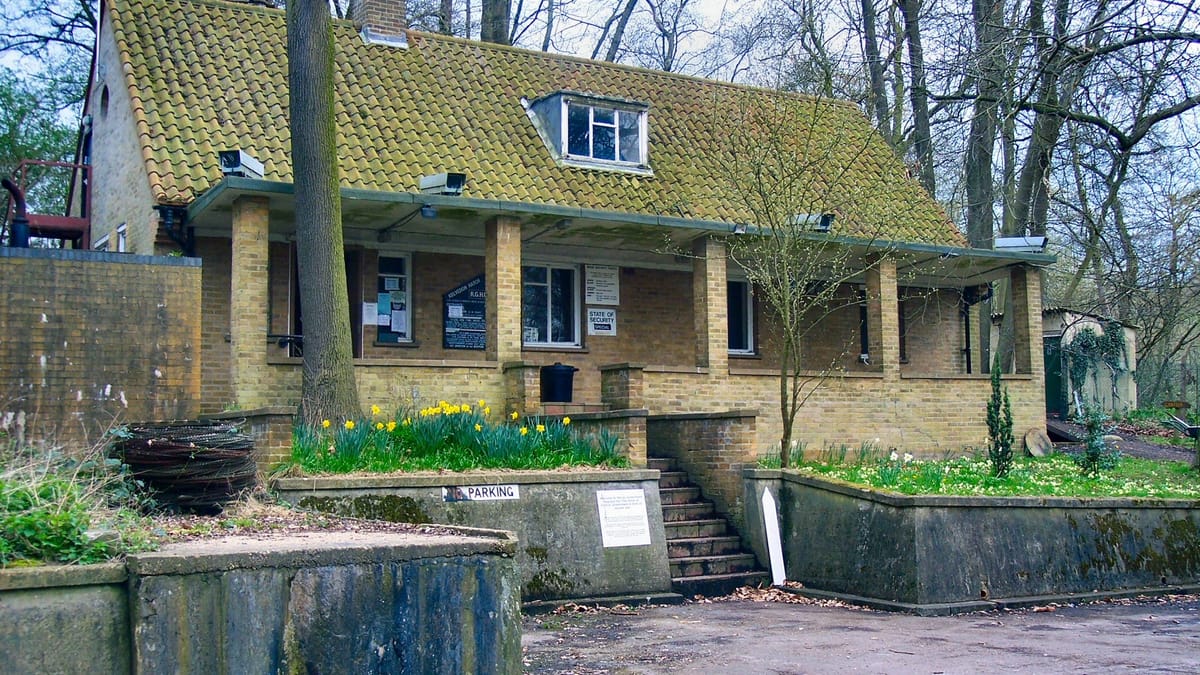
The entrance is hidden beneath a quaint, unimposing bungalow, not unlike hundreds of others scattered across the English countryside. At a glance the bungalow is nothing more than a simple one-storey home, but step inside and you’ll find a blast-absorbing, L-shaped, 91-meter tunnel that terminates at a massive set of blast doors. Once those doors had closed, nothing would have got in — including the majority of standard explosive weapons available at the time.
The Mad Scramble to Update Britain’s Early-Warning Systems
During World War II, the Royal Air Force (RAF) relied on the Chain Home early-warning radar system. Chain Home was built before and during the war, combining Air Ministry Experimental Stations (AMES) — including Type 1 and Type 2 radars, with the later addition of improved Type 7 radars. Stationed on the coasts, the towers were collectively capable of detecting incoming aircraft at a range of about 160 km, with varying accuracy across the system’s life.
The revolutionary network allowed the RAF to respond quickly and efficiently to any sign of the incoming Luftwaffe, giving the UK an enormous advantage in many key battles. By the end of the war, 40 Chain Home stations were in use, and as Luftwaffe attacks waned the system was repurposed to detect V2 rocket launches.
But the war ended, and the 1950s ushered in a new era of dangers — the most prominent being the threat of Soviet bombers. This made the 1950s a decade defined by the UK scrambling to upgrade its early-warning radar network, hopefully before a better one became necessary. A big part of the new United Kingdom Warning and Monitoring Organisation (UKWMO) project was referred to as ROTOR, and its key new technology was codenamed Green Garlic.
Green Garlic leveraged a new type of radar using microwave frequencies, the effect of which was dramatically better than anything previously seen. Detection range instantly went from a mere 160 km to a massive 390 km, all but revolutionising the UKWMO overnight. The new radars — AMES Type 80s — were to be built and put into use as quickly as possible, replacing the AMES Type 1, 2 and 7 Chain Home system over the course of a few years.
The race to transition Chain Home into ROTOR began in the early 1950s, with the original plan ambitiously intending to construct a total of 66 new radar stations. The combined network would provide full coverage of the entire United Kingdom, introducing the best early-warning system the country had ever seen. As part of ROTOR, the construction of multiple blast-resistant bunkers began — including small R1 and R2 bunkers, plus a handful of bigger R4 bunkers such as the one now known as Kelvedon Hatch.
Obsolete Before It Was Finished
Things didn’t go as planned. As new technology emerged and the nature of warfare evolved, the ROTOR radar system became not only less necessary but largely obsolete before it was even finished — at least in its intended form. The carcinotron radar jammer, which appeared in the mid-1950s, was the first serious blow: a single aircraft carrying such a jammer could, in one fell swoop, render all ROTOR radar systems useless. The hydrogen bomb and the ballistic missile then changed the game entirely, ushering in a new era of warfare that benefited little from having full radar coverage of an entire country.
So, just as quickly as the R-type bunkers were built, many became irrelevant. Most were sold off, but others were repurposed. The R4 bunker in Essex transitioned from a Sector Operations Control into a Regional Seat of Government (RSG), and finally into a Regional Government Headquarters (RGHQ).
Kelvedon Hatch was maintained as an RGHQ until the early 1990s at a cost of £3 million a year. Finally, once the risk of nuclear war was no longer seen as credible, the land and the R4 bunker were sold back to the original owners of the land, the Parrish family.
The Beckhams Are Welcome (Everyone Else, Make Your Own Plan)
Today Kelvedon Hatch is a popular Cold War tourist attraction, seeing around 60,000 visitors a year. The owning Parrish family is happy to welcome guests, provide tours, and let children enjoy the various obstacle courses and outdoor activities. As a rather cutting, ironic joke, the company that handles the outdoor activities is called Nuclear Races.
Given the current political climate, you may be wondering whether you could get access to such a bunker should nuclear war once again become a realistic possibility. The good news is that current owner Mike Parrish is willing to cut you a deal — but only if you’re willing to fork out £500,000 to cover your long-term stay. He’s jokingly stated that he’d consider accepting such an offer if the Beckhams were to pitch up, so he clearly doesn’t believe nuclear war is happening any time soon.
Less jokingly, he’s confident that everything inside the bunker still works as intended, would still offer effective communication in case of a disaster, and adds that it is far better equipped for modern nuclear war than you might think. He stresses that none of the antique equipment relies on modern cell towers or other fragile infrastructure, meaning it’ll keep working in virtually any worst-case scenario.
On the other hand, you’d probably have a bidding war on your hands long before you got anywhere near the bunker. Parrish explains that interest in renting it spiked after the 9/11 attacks, with wealthy locals insisting they were ready to pay any sum. Those offers eventually died down, only to pick up again in more recent times: the war in Ukraine reignited paranoid interest in bunkers, and Parrish has again fielded dozens of calls from wealthy locals. He’s turned them all down — though he still maintains that he might consider an offer from the Beckhams.
Is Britain Actually Prepared?
Would you even have to bid against the Beckhams for a place in a bunker? Surely the UK is much better equipped to handle a nuclear attack today than in the 1950s? Not exactly. Switzerland has nearly 400,000 bunkers available, including 9,000 public ones — enough to house everyone in the country. Virtually the entire rest of the world has no such infrastructure in place.
The vast majority of the UK’s once-elaborate series of fallout bunkers have been almost entirely sold off. They simply weren’t needed and were costing the government a fortune, so they’ve passed on to become farms, museums, cannabis factories, wine cellars and the like. As recently as 2015, one bunker was converted into a five-bedroom eco-home and put on the market for £700,000. Another, in 2022, was sold for a quarter of a million pounds, with no word on what it would be used for.
The reality is that these days there are just a few dozen active bunkers in the UK — barely enough to house essential government personnel, and certainly nowhere near enough to offer space to the average citizen. The majority of Cold War preparations have long since been scrapped, meaning the country is almost entirely unprepared for nuclear war. In fact, according to experts, the plans for a leak at a power station are much more clearly thought out, with plans for nuclear war coming a distant second. To put it another way: were nuclear war to break out today, the most you’d probably get is an SMS giving a 20-minute warning, at best.
Pindar, Candid, and Python
There are, of course, definite plans in place for the Prime Minister, Royal Family and other essential personnel — including a new Defence Crisis Management Centre located below the Ministry of Defence building. As a heads-up, much of what follows is based on rumour and speculation. Details on emergency plans for UK government officials aren’t open to the public, for obvious reasons.
The bunker said to be located below the Ministry of Defence building — codenamed Pindar, after the ancient Greek poet whose house reportedly remained standing after all others were destroyed — is much more elaborate and dramatically more expansive than anything at Kelvedon Hatch. It’s rumoured that the bunker is connected to a much broader series of below-ground military facilities, as well as to Buckingham Palace, with hundreds of hidden tunnels crisscrossing beneath the United Kingdom. Other hidden entrances are allegedly scattered at various locations, though these are a well-kept secret and you aren’t likely to stumble on any by accident.
As for the most essential British individuals, a number of alleged protocols have reportedly been put in place to keep the monarch and Prime Minister alive at all costs — namely Operation Candid, which dates to the Cold War, and Python, which was supposedly hashed out in more detail during the most heated moments of the Brexit period. At their core, the protocols aim to secure the monarch and Prime Minister separately, given the key role each plays in a functional British government. The loss of one might be endured; the loss of both would be far more devastating. It’s also been speculated that the broader Royal Family would be split up across different locations to protect succession lines and ensure at least one royal survived in a worst-case scenario.
Python, in more detail, is rumoured to involve multiple cells established around the country, each having its own royal and Minister of State. Should any single cell be wiped out, the country could still continue as a fully functional organism.
With all of that said, let’s be upfront. Some say the world is closer to nuclear war than it’s been since the 1970s, and that may be true, relatively speaking. But the policy of Mutually Assured Destruction is still in place — and if you believed that policy safeguarded against nuclear war before, you’ll be confident it remains effective today. It is, naturally, impossible to ever say that the threat of nuclear war is zero.
But then the same is true of asteroid impacts, alien invasion, and any number of other potential disasters.
Key Takeaways
- Kelvedon Hatch is an R4-spec Cold War bunker in Essex, built 38 meters underground with 10-foot tungsten-reinforced concrete walls and a wire-mesh Faraday cage, designed to house up to 600 people for around three months.
- It was originally built as part of the ROTOR early-warning radar program, then repurposed as a Regional Seat of Government and finally a Regional Government Headquarters where the Prime Minister could have been sent during nuclear war.
- The ROTOR network — powered by the long-range AMES Type 80 “Green Garlic” radar — was rendered largely obsolete by the carcinotron jammer, the hydrogen bomb and ballistic missiles before it was even completed.
- The bunker’s communications (MOULD VHF radio and the CONRAD printed messaging service) deliberately avoided landline infrastructure so they would survive an attack.
- Maintained until the early 1990s at £3 million a year, the bunker was sold back to the Parrish family and is now a tourist attraction drawing about 60,000 visitors a year.
- Today the UK has only a few dozen active bunkers; unlike Switzerland’s roughly 400,000, there is nowhere near enough shelter capacity for the general public.

Simon Whistler
Simon Whistler hosts MegaProjects, bringing engineering, infrastructure, and military-machine stories into clear narrative focus for viewers who want the systems, tradeoffs, and human decisions behind the build.
Frequently Asked Questions
How deep and how strong is the Kelvedon Hatch bunker?
The structure sits 38 meters (125 feet) below ground. Each wall is 10 feet of concrete reinforced with tungsten rods every 6 inches, surrounded by a wire-mesh Faraday cage for EMP protection, then brick, pitch waterproofing and an artificial earthen hill. The design is described as capable of resisting a nearby — and probably even an overhead — nuclear detonation.
What was Kelvedon Hatch originally built for?
It was constructed as part of the ROTOR early-warning radar program of the 1950s as a military-grade R4 Sector Operations Control. It was only later modified and reclassified, becoming a Regional Seat of Government and eventually a Regional Government Headquarters intended to keep the government functioning after a nuclear attack.
Why did the ROTOR radar system become obsolete?
Three developments undercut it. The carcinotron radar jammer, introduced in the mid-1950s, meant a single aircraft could neutralise ROTOR’s radars. The arrival of the hydrogen bomb and ballistic missiles then shifted warfare toward threats that full radar coverage did little to counter, so the system was largely obsolete before it was even finished.
Can the public visit or rent Kelvedon Hatch today?
Yes. The Parrish family runs it as a Cold War tourist attraction drawing around 60,000 visitors a year, with tours and outdoor activities. Owner Mike Parrish has jokingly said he’d rent it out for a long-term stay for about £500,000 — and has quipped he’d consider an offer from the Beckhams — but has turned down the wealthy locals who called after 9/11 and again after the war in Ukraine.
How would the bunker’s communications survive a nuclear attack?
Its systems were designed not to rely on civilian infrastructure. MOULD, a VHF radio system, linked the Regular Army, TA Battalions and Regional Headquarters, while CONRAD was a printed messaging service. Because neither depended on existing landlines, they would have kept working even after other communications were destroyed — and the current owner says the equipment still functions.
Is the UK prepared for nuclear war today?
Largely not. Most of Britain’s Cold War bunkers have been sold off and converted into homes, farms, museums and wine cellars, leaving only a few dozen active bunkers — barely enough for essential government personnel. By contrast, Switzerland has nearly 400,000 bunkers. Experts cited in the script suggest the public might receive only an SMS giving roughly a 20-minute warning at best.
What are Pindar, Operation Candid and Python?
Pindar is the codename for a more modern, far larger bunker rumoured to sit beneath the Ministry of Defence building. Operation Candid (from the Cold War) and Python (reportedly detailed further during the Brexit period) are alleged protocols to protect the monarch and Prime Minister separately, with Python said to involve multiple cells around the country, each with its own royal and Minister of State. Note that much of this is rumour and speculation, as such plans aren’t public.
Sources
-
Original MegaProjects video: Kelvedon Hatch: The UK’s Secret Nuclear Bunker
-
Hero image source by Genesisman26 / Wikimedia Commons, public domain.
Related Projects

The Convair B-36 Peacemaker: The Absolute Unit That Carried America Into the Cold War
The Convair B-36 Peacemaker was the largest combat aircraft ever built — a six-engine nuclear behemoth whose real mission was to never be used at all.

The Convair Pogo: The US Navy’s Weirdest Prototype Ever
The Convair XFY-1 Pogo was the US Navy's tail-sitting VTOL fighter that took off straight up, flew at 300+ mph, and very nearly worked

The Lockheed U-2: Spying Before Satellites
How Lockheed's U-2 spy plane flew to 70,000 feet to photograph Soviet secrets, survived being shot down, and outlasted every replacement for seven decades