
The 21st century has not been kind to Iraq. From a large-scale invasion and years-long occupation by a global superpower, to the crosshairs of an exceptionally ruthless jihadist organization, to being the centerpoint of a long tug-of-war between the more powerful nations of the world, Iraq is a nation that has had more than its share of hardship. But even with everything it has survived, the worst of all may still be yet to come.
The worst ticking time bomb in all of Iraq has little to do with ideology, geopolitics, or history — at least, all only indirectly. That time bomb is the Mosul Dam, a monolith in Iraq’s northern deserts with the potential to bring death and destruction to the millions living downriver. From crisis to crisis, from war to war, the collapse of the Mosul Dam has been the threat held over Iraq’s head for generations — and by all accounts, it’s a miracle the thing has survived this long.
This is the story of that massive threat: how it was built in the first place, why it has brought Iraq so close to the brink, and how it was finally fixed — if, that is, you trust that it was fixed at all.
- Dam height
- 113m (371 ft)
- Dam length
- 3.4km (2.1 miles)
- Reservoir capacity
- 11.1km³ (~3 cubic miles)
- Main power station
- 750MW
- Estimated fatalities if it fails
- 500,000–1million
- Refurbishment cost
- ~$4billion
How It Was Built
To trace the history of the Mosul Dam, you first have to focus on a single person around whom the entire modern history of Iraq has revolved for decades: Saddam Hussein. Born in 1937 and officially claiming Iraq’s presidency in 1979, Hussein would do a great many things over the course of his three-decade authoritarian rule. One of them was to build a big dam.
Iraq had been looking at building a dam north of Mosul for a few years before Saddam took over, and the potential project became a sort of revolving door for international experts who weren’t inclined to tell Iraq what it wanted to hear. First a British firm was asked to evaluate the site, then the Americans, then the Soviets, then the Finns, then the Yugoslavs, then the French, and finally the Swiss. The first five teams all agreed: there were better places to build a massive dam than this particular, relatively unstable spot in Iraq.
Even the French and the Swiss wouldn’t ultimately take the reins. But the eighth time was the charm for the Iraqi government, and by 1981 the process was underway.
Most of the builders at the site would be Chinese nationals, while the Iraqi administrators and ministers in charge reportedly feared they’d be hanged if the project failed. Nineteen Chinese laborers would die in the process — including many who fell into wet cement and could have been fished out, except that delaying the project long enough to save them would have risked the cement hardening too soon.
As for why there needed to be a dam here at all, 1970s Iraq deserves some credit. Far from a simple vanity project, a dam north of Mosul was a pretty good idea. It was built on the Tigris River, which had a tendency to flood downstream, including in the capital. A dam would also give Iraq better control of its water resources — enabling more complex irrigation networks, a more stable water supply for crops, and thus a more successful agriculture industry.
The construction wasn’t seamless: the area set to be flooded for the reservoir contained several important archaeological sites. After a several-year mad dash in which Iraqi and foreign expeditions dug out as many artifacts as they could, the water level eventually rose to swallow most of the landscape. The dam began generating electricity in July 1986, and it has been in near-continuous operation since.
A Monolith in the Desert
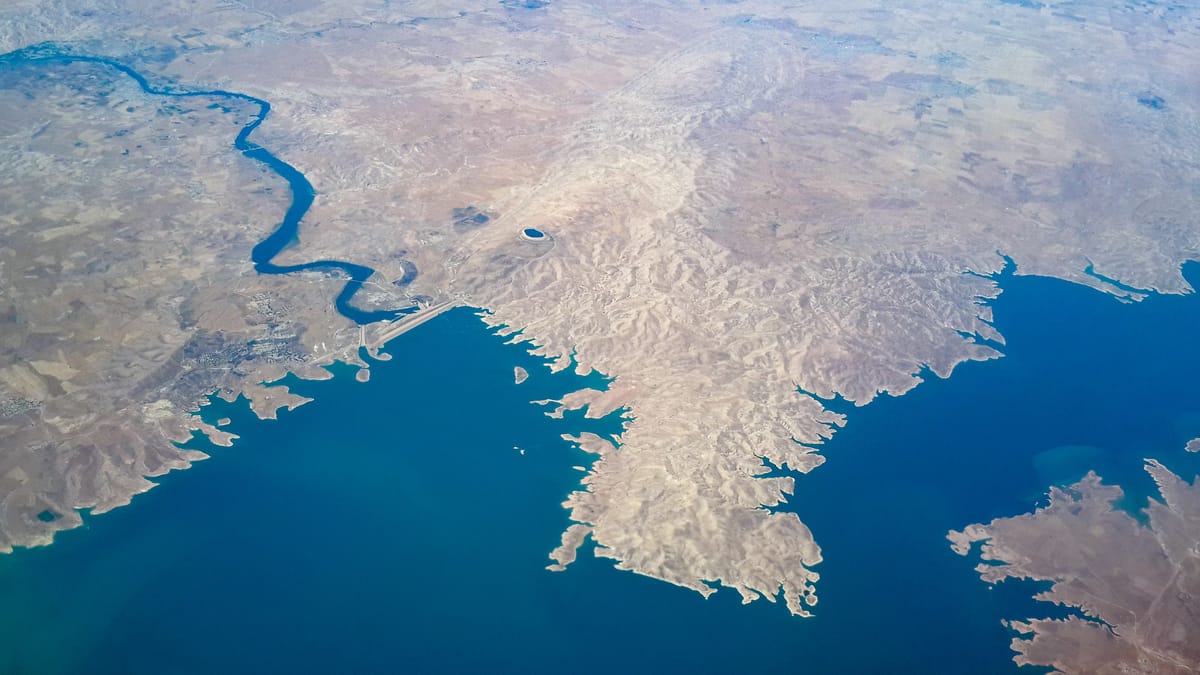
Before getting into the reasons this dam poses such a danger, it’s worth describing exactly what was built. Formerly known as Saddam Dam, in honor of Saddam Hussein, and today referred to as the Mosul Dam after the city it primarily serves, it’s a hydroelectric structure whose main power station generates 750 megawatts — just over a million horsepower’s worth of energy. That power station includes four individual turbine-generators. The dam also has a secondary power plant with an additional 250 megawatts of capacity, and a secondary run-of-the-river dam downstream responsible for another 62 megawatts.
When the dam is at full capacity, its reservoir holds nearly three cubic miles of water — 11.1 cubic kilometers. To collect that reservoir, the dam relies mostly on the flow of the Tigris but also captures snowmelt flowing southward from Turkey.
The dam itself rises 113 meters from the ground below — 371 feet — with a total length of 3.4 kilometers, or 2.1 miles. At its cresting point, it’s ten meters, or thirty-three feet, thick. It features two spillways, including a large concrete chute that siphons off any water rising above the safe level, and something called a fuse plug, which will allow floodwaters to spill over the top safely if they rise too high. It’s overseen by the Ministry of Water Resources, which also manages the unfinished Badush Dam — which, when completed, should be able to catch a gigantic wave caused by a flood from the Mosul Dam upstream.
All in all, the Mosul Dam ranks as the fourth-largest in the Middle East. It generates well over 3,000 gigawatt-hours annually, enough to power the city of Mosul downstream, with its population of 1.7 million.
The Problems
When it comes to the myriad problems with this particular dam, you have to start with one final element of its construction. The Mosul Dam is an embankment structure — built by compacting layers upon layers of earth, plus a layer of crushed stone to prevent erosion, to sit in the way of a river and literally prevent it from flowing further. That technique involves trade-offs.
The benefits: embankment dams are relatively cheap to build, and they should adapt over time and hold water pressure better than more rigid structures like concrete ones. The drawbacks: they’re much more vulnerable to deterioration, especially from flowing water; they’re relatively weak for their size; and they’re permeable, making it more likely that small leaks occur and lead to a much larger catastrophe.
In the case of the Mosul Dam, that on its own might not be so bad — except for the additional issue of what the dam is built on. It lies on a foundation of gypsum, a soft mineral used in things like plaster, drywall, and sidewalk chalk. The trouble with gypsum is that it’s soluble. It can dissolve in water, which is really not what you want in a dam.
To be clear, this was something Iraq was well aware of before they built the thing. That’s why the country went through five sets of advisers who didn’t tell them what they wanted to hear, before finally getting a few teams who understood their warnings would fall on deaf ears anyway. Nor did Iraq follow the recommendations given by the consortium of engineers who did agree to build it. Instead, they cut corners to speed up the project, using a barrier called a grout curtain to protect the area directly below the dam and around the foundation — but not nearly to the extent they’d been advised to. A consulting engineer who’d inspected the project, and who would speak to The New Yorker about his experience decades later, described sinkholes popping up all around the dam and water bubbling up from the ground downstream, even just a few months after the dam was completed.
The Badush Problem
So the dam isn’t great. But there might be a saving grace downstream: the Badush Dam, which Iraq went to the trouble of building just in case something goes wrong with the Mosul Dam upstream. If catastrophe strikes, the Badush Dam will catch the flood before it kills millions — right?
Unfortunately, two key problems bear pointing out. First, it’s always a tough day when you’re asking whether the seemingly inevitable collapse of your massive dam can be stopped by another dam you haven’t tested — because to test it, you’d have to either collapse the dam you’re worried about, or put so much water in the Badush Dam’s reservoir that, if the Mosul Dam did collapse while you were testing, you’d have just doubled the size of the resulting flood. Second — well, you’d probably want the Badush Dam to be complete, which it isn’t. Started thirty-six years ago, the dam is at present only forty percent complete, and it hasn’t been worked on in decades.
War Comes to the Dam
And if that weren’t all bad enough, there’s one more factor that makes a dam collapse north of Mosul seem like one hell of a dodged bullet so far. That factor is war.
War became an immediate concern around the Mosul Dam during the Gulf War, when the US actually bombed the power generator attached to the dam during its air offensive — but the dam remained intact. In 2003 it was put in the crossfire again, during the invasion of Iraq by a US-led coalition. At that time, the dam became a primary point of concern among military intelligence personnel.
Chief among their worries was that Saddam Hussein — who wouldn’t be captured for several months after the invasion began — might intend to use the dam as a bargaining chip. Wire it with explosives, and Saddam could hold the entire city of Mosul hostage; blow it, and the city would be washed away, potentially with mass numbers of coalition troops in the water’s path. It’s worth noting here that the dam is widely understood to be survivable under aerial bombardment — but the same can’t be said for a sabotage attempt using explosives placed on specific stress points.
Luckily, the dam survived the 2003 invasion unscathed. But an even worse crisis would befall it some eleven years later, starting in June 2014, when a new force surged into Mosul for the first time: the Islamic State of Iraq and Syria, better known as ISIS. Over the next several weeks, ISIS worked its way northward from Mosul, tracing a path up the Tigris toward the dam.
On August 7, despite a bitter and valiant stand by Kurdish Peshmerga forces, ISIS claimed the structure, evicting most of the roughly fifteen hundred workers who had been trying to keep it in operation despite the war. Within hours, ISIS had posted one of its trademark propaganda videos, depicting a fighter carrying their black flag across the dam itself.
Immediately, liberating the dam became the top priority for every force fighting ISIS — the Western coalition, and Kurdish and Iraqi forces as well. In a best-case scenario, the world reasoned, the jihadists would use the dam to restrict the flow of water and electricity downstream, giving themselves complete leverage over Mosul and exerting significant pressure on Baghdad. In the worst case — well, one of the many reasons ISIS worried the rest of the world so much was the way its messaging often drifted toward the apocalyptic. The group could take an incredible number of lives if it so wished, doing in a few days with explosives at the dam and roadblocks obstructing the way out of Mosul what would otherwise have taken years of concerted warfighting.
After ten very tense days of ISIS control, the dam was liberated by a combined Peshmerga and Iraqi Army offensive, assisted by US air power. Despite the intense fighting, the dam never ruptured — perhaps a sign that ISIS hadn’t intended to blow it, or perhaps simply because they hadn’t been allowed the time to. But with Western officials now traveling to the dam to scope it out, the world became acutely aware of what had been going on there for years.
Because of that water-soluble rock the dam is built on, teams of hundreds of laborers and engineers had worked around the clock for years, pumping a mixture primarily of cement into the parts of the foundation that were washing away. Fail to do so, and the whole thing might collapse — and it was hard to gauge how fast that might happen. Even if ISIS hadn’t meant to blow the dam, it risked destroying it anyway simply by halting the concrete-pumping operations.
Warnings Ignored
The US Embassy in Baghdad issued stark warnings in 2015, stating in part that the “Mosul Dam faces a serious and unprecedented risk of catastrophic failure without warning.” The UN echoed the claims, as did Iraqi engineers who’d had a chance to inspect it. But the Iraqi government has remained very hesitant to take action, likely for fear that acknowledging the vulnerability would trigger a crushing public backlash.
In the years since, occasional updates have emerged. A brief few months of repairs alongside an Italian firm was enough for the Iraqi government to declare victory — but those repairs only fixed the imminent signs of structural failure. When it comes to the dam’s much more fundamental issues, the updates are always the same: lack of progress, lack of progress, lack of progress.
If the Dam Breaks
If we’re being generous, we can at least say the ticking time bomb that is the Mosul Dam has had a bit of time put back on the clock. But the dam is still one unexpected earthquake, one material shortage, or one upstream flood away from collapse — so it’s worth examining what it would be like if the worst does happen. The result would be nothing short of biblical.
In the event of catastrophic failure, the resulting tsunami wave would be staggering to behold: a wall of water 45 meters — nearly 150 feet — high, with well over fifteen cubic kilometers of reservoir following immediately behind. In a best-case scenario, the city of Mosul would have four hours from the moment of collapse before most of the city is underwater — to say nothing of the time it takes for word to spread and an alert to go out. If some of the most troubling estimates are correct, Mosul wouldn’t have four hours at all; it would have two. Because of Iraq’s difficulties taking an accurate census, it’s unclear how many people would be in the water’s path upstream of Mosul, but within the city the estimate is more dependable: somewhere around 1.7 million, many living or working in the downtown areas directly in the water’s path.
With the better part of a city consumed and rubble and shrapnel thundering across the landscape alongside the water, the wave would only continue. Downstream are towns that would likely be nearly or totally wiped out: Hamam al-Alil, population 25,000; Tikrit, pre-war population 160,000; and Samarra, pre-war population 350,000, along with numerous smaller villages and settlements. Within sixty to seventy hours, as the flood follows the rough outline of the Tigris, it would reach Baghdad — estimated population at least six million. There, floodwaters are still expected to rise to a standing depth of at least eight meters, filling the Tigris floodplain and carrying on even further.
In an absolute best-case scenario, the hearts of Iraq’s two largest cities would be gutted, washing away some of the nation’s most critical establishments, destroying hundreds of thousands of homes at a minimum, and setting off a cascading humanitarian crisis with mass shortages of electricity, safe drinking water, food, and medical care for many millions. In every scenario worse than that, all of the above still happens — but not everybody gets out of the water’s path in time. Estimates for fatalities caused by a complete failure of the Mosul Dam range from 500,000 on the low end to one million on the high.
There Is Still Time
At this point, we have got to stress — not just for the regular audience but for any policymaker who might be listening — that there is still time. The Mosul Dam has not yet collapsed, and if the word of the Iraqi government is to be trusted (which we’re not confident recommending anyone does), the long-term, band-aid solutions that have kept the dam standing thus far are still in effect. There is a critical window to fix the dam’s issues, and that window is happening now. It is very difficult to estimate a cost for which it would not be worth saving anywhere from 500,000 to a million lives in the mid-to-near future — and the estimated price tag of a refurbishment, some four billion US dollars adjusted for inflation, is nowhere near steep enough to justify inaction.
As for what’s needed, there are a few key measures that would go a long way. As the Iraqi environmentalist Azzam Alwash wrote for the Wilson Center in 2016, some companies have proposed forming a 200-meter — 600-foot — slurry wall underneath the dam, a costly process on a scale that’s never been done before. Other organizations have advocated the approach Iraq took decades ago with the Badush Dam, meant to catch a wall of floodwaters before the worst destruction could occur.
But finishing the Badush Dam, or building something new, will take years either way — and during that time the dam’s seepage issues will only get worse. Alwash’s own proposal, nearly a decade ago, was to have Iraq pay Turkey to dam the Tigris further upstream and send water downstream to Iraq. Unfortunately, the window to enact that proposal has since closed.
In recent years, new proposals have centered around building a protection dam downstream, but as of now there has been no tangible effort to bring such a project to life.
In a nation where the current administration seems unlikely at best to undertake such a massive investment, it’s always going to be difficult to find anybody else to foot the bill — especially in a country as geopolitically fraught as Iraq, where both Western and non-Western nations seek to gain influence. But if there’s any time to put diplomatic finger-wagging, geopolitical pride, and questions of regional alignment aside, this is it. Iraq needs a solution to the Mosul Dam issue, and it needs one fast.
Whether it’s America, the European Union, Russia, China, Iran, India, Brazil, Saudi Arabia, or somebody else who fixes the dam hardly matters. Incredible human potential, and the risk of incredible human suffering, hang in the balance.
Key Takeaways
- The Mosul Dam was built starting in 1981 on a foundation of soluble gypsum, after seven of eight consulted engineering firms warned the site was unsuitable.
- As an embankment dam, it is cheap and flexible but permeable — and its gypsum foundation keeps dissolving, requiring constant cement grouting to stay standing.
- A downstream backstop, the Badush Dam, was meant to catch a catastrophic flood, but it remains only 40 percent complete and hasn’t been worked on in decades.
- War has repeatedly threatened the dam: US bombing in the Gulf War, sabotage fears in 2003, and a ten-day ISIS occupation in August 2014.
- If the dam fails, a 45-meter wave could submerge Mosul within hours and reach Baghdad in 60 to 70 hours, with estimated fatalities of 500,000 to one million.
- A full refurbishment is estimated at roughly $4 billion — a sum the script argues is far too small to justify continued inaction.
Priya Menon
Priya Menon covers tunneling, ports, rail corridors, and the procurement choices that determine whether large public works become durable assets or permanent disputes.
Frequently Asked Questions
Why is the Mosul Dam considered so dangerous?
The dam sits on a foundation of gypsum, a soft mineral that dissolves in water. As the gypsum dissolves, the foundation washes away, requiring crews to continuously pump cement into it to prevent collapse. Combined with its permeable embankment construction, this makes the dam vulnerable to a sudden, catastrophic failure.
Why was the dam built on such unstable ground?
Iraq had wanted a dam north of Mosul to control Tigris flooding and improve irrigation and water supply. Seven of the eight engineering firms consulted advised against the site, but the Iraqi government under Saddam Hussein proceeded anyway, beginning construction in 1981 and cutting corners — such as installing a smaller grout curtain than advised — to speed the project along.
What happened when ISIS captured the dam?
In August 2014, ISIS seized the Mosul Dam after a stand by Kurdish Peshmerga forces, evicting roughly 1,500 workers and posting a propaganda video on the structure. The world feared the group might blow the dam to take an enormous number of lives. After ten tense days, a combined Peshmerga and Iraqi Army offensive backed by US air power retook it, and the dam never ruptured.
What would happen if the Mosul Dam collapsed?
A failure would release a wall of water about 45 meters (nearly 150 feet) high. Mosul, with roughly 1.7 million people, could be largely underwater within two to four hours, and the flood would reach Baghdad — population at least six million — within 60 to 70 hours, with standing water at least eight meters deep. Estimated fatalities range from 500,000 to one million.
Can the dam be fixed, and how much would it cost?
The script argues there is still a critical window to act. A full refurbishment is estimated at roughly $4 billion (inflation-adjusted). Proposed measures include a 200-meter slurry wall beneath the dam, finishing the Badush Dam, or building a new protection dam downstream — but each takes years, and so far there has been no tangible effort to launch a permanent fix.
Sources
-
Original MegaProjects video: Failure of Iraq’s Mosul Dam: A Catastrophe Waiting to Happen
-
NASA Earth Observatory, “Reservoir Swells Upstream of Mosul”
-
Dexter Filkins, “A Bigger Problem Than ISIS?”, The New Yorker (January 2, 2017)
-
Hero image source by Ali Haidar Khan / Wikimedia Commons, CC BY-SA 3.0.
Related Projects
The Interoceanic Corridor: Mexico’s Attempt at a Panama Canal Rival
Inside Mexico's Interoceanic Corridor across the Isthmus of Tehuantepec, a centuries-old dream revived to rival the Panama Canal with rail, ports, industry
The Laerdal Tunnel: The Longest Road Tunnel in the World
Inside Norway's 24.5 km Laerdal Tunnel, the longest road tunnel on Earth, where psychologists helped engineers fight driver fatigue and fear