
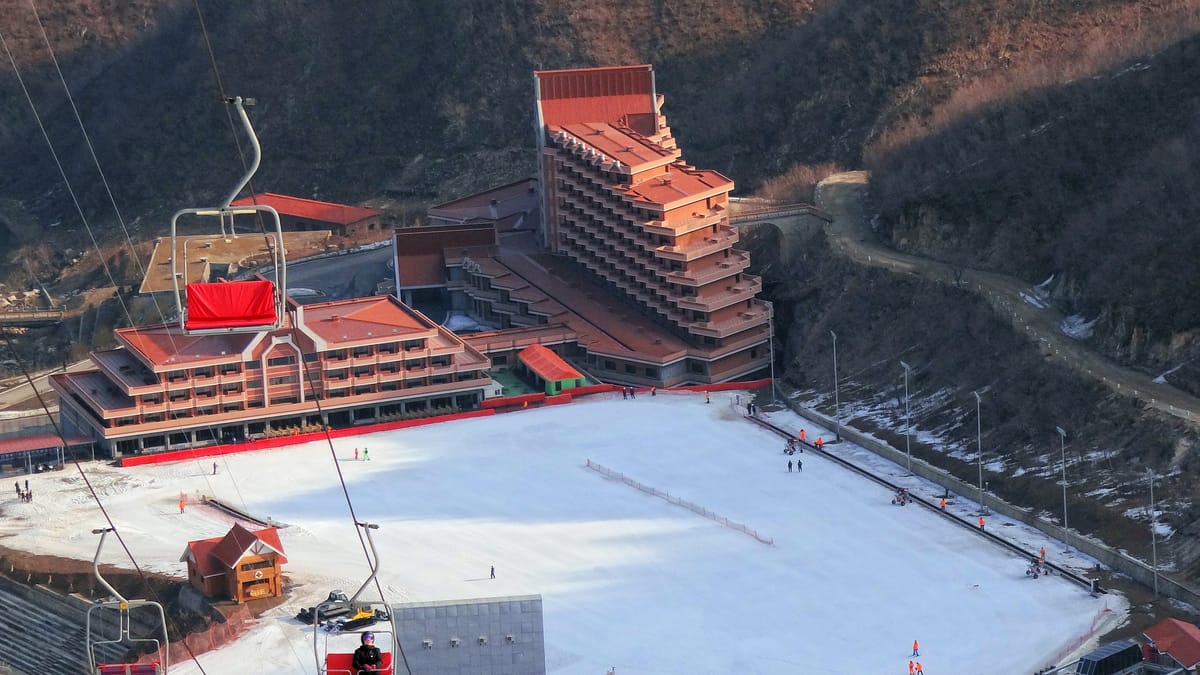
For winter sports aficionados, it sounds like a dream. A near-untouched luxury ski resort nestled in the mountains of an exotic nation. A resort characterized by virgin snow, 11 multi-level ski runs, ice rinks, saunas, and an exclusive hotel with rooms for just a fraction of what you’d spend in Aspen or the Alps.
Sound enticing? Well, there’s one catch. This dream destination isn’t in some emerging nation, or even in an adversary like China. It’s in North Korea, a country with a human rights record that might charitably be called “appalling.” Nor is it just some random getaway, cut off from the currents of the outside world.
Rather, Masikryong is central to Kim Jong-Un’s plan to make the DPRK great again. First conceived back in 2013, it was intended to open North Korea up to the international jet set, boosting the economy and supercharging investment. As part of a greater project known as the Wonsan Special Tourist Zone, it should have been the first step in turning the Hermit Kingdom into an economic tiger. Instead, it now stands as a haunting monument to hubris. A glamorous tombstone topping a dead dream.
- Ski runs (planned)
- 11 multi-levelslopes
- Construction time
- 10months
- Daily capacity (target)
- 5,000tourists
- Hotel 1 rooms
- 120
- Tourist zone area
- 400 sqkm
- Blocked Swiss lift deal
- $7.7million
Tourist Dollars
When Kim Jong-Un first came to power in North Korea in 2012, foreign media was transfixed by both his age and his sheer bloodthirstiness. Over the following years, the tyrant launched a series of brutal purges that included the killing of his own uncle. He had his half-brother assassinated with a nerve agent at an airport in Malaysia. To top it off, he oversaw four separate nuclear tests, twice as many as his father had achieved, and that’s before he got into a slanging match with the President of the United States.
So you’d be forgiven for remembering Kim’s first years in office as nothing but a non-stop horror show. A carnival of cruelty and saber-rattling. But for observers of the Hermit Kingdom, there was also something else that typified the 2010s, something as unlike the executions and warmongering rhetoric as it’s possible to get. These were the years when Kim tried to turn North Korea into a tourist destination.
On the face of it, this seems absurd. Leave aside the fact that no tourist in their right mind would spend money propping up a genocidal dictatorship; what would even the North Koreans get out of this? But dig a little deeper, and a twisted kind of logic starts to become visible.
At the time Kim announced his plans, the DPRK was, and still is, under strict sanctions. Normal ways to make money, like exporting textiles or selling coal and iron ore, were illegal. Yet the UN sanctions didn’t forbid foreigners from traveling to North Korea, nor did they forbid the North Koreans from making money off of them. In short, tourism was one of the few legitimate means Kim had left to earn hard currency, something his impoverished state desperately needed.
When he took over from his dad in 2012, one of Kim’s first promises was that his people would never have to tighten their belts again. That meant economic development. That meant attracting foreign investment, even as the human rights abuses continued.
Not that it was only about money. Kim Jong-Un is said to be a passionate believer in physical competition. Across his tenure, Pyongyang has seen an explosion of sports halls, skating rinks, outdoor gyms, and basketball courts. Getting his subjects playing sport together, in Kim’s view, means more social cohesion.
Hence the plan the dictator unveiled in early 2013, the one that would combine his love of sport with his love of foreign money: the plan to build a glamorous ski resort known as Masikryong. Located in the mountains overlooking the country’s eastern coast, it would be a North Korean destination unlike any other, one with “world class” facilities capable of hosting 5,000 tourists a day.
Since officials at the time estimated that only 5,500 North Koreans even knew how to ski, out of a total population of 25 million, this necessarily meant attracting foreigners. Lots of them. One method for achieving this was offering Masikryong as a venue for the 2018 Winter Olympics, scheduled to be held in South Korea. The idea, presumably, was that the average American would see the place on TV and think the socialist paradise looked perfect for their next vacation.
Perhaps unsurprisingly, Seoul turned down Kim’s offer. Yet this didn’t put the tyrant off his pet project. Following the “if you build it, they will come” logic of Field of Dreams, Kim decided he wouldn’t stop with a single ski resort. Rather than a standalone destination, Masikryong would soon be part of the greatest tourist region in the world.
Wonsan Blues
At the same time that he began pushing for the creation of Masikryong, Kim was also ordering work to begin on other special tourist zones. Samjiyon was to be another ski resort, one less glamorous than Masikryong but located right up in the north where Chinese visitors could easily access it. The Mt. Kumgang tourist area, meanwhile, was right down in the south, perfect for day-trippers from Seoul.
But the jewel in the tourism crown wouldn’t be up in the mountains. Rather, it would be based around a strip of golden sand on the coast a few kilometers east of Masikryong, adjacent to a city known as Wonsan. It was here that the hub of the Wonsan Special Tourist Zone would be built.
Officially announced in 2014, the zone actually began life the year before, when Kim suddenly ordered the reconstruction of Wonsan Airport to accommodate 1.2 million fliers annually. Given that Wonsan at this time was a grimy industrial city with a population of just 350,000, it was obvious the Dear Leader was up to something. But it was only 12 months later that the scope of his plans became clear.
From a car manufacturing hub, Wonsan was to be transformed into a resort town, one focused around spas, swimming pools, and beach activities. More than that, it was to become the center of a gigantic tourist area spreading over 400 square kilometers, from Masikryong up in the mountains to the great waterfall at Ullim. In this year-round wonderland, foreign tourists would enjoy everything from long walks by the sea, to hikes in the forests, to skiing in the winter.
Imagine Aspen combined with Miami Beach, then sprinkled with Soviet-era surveillance and filled with images of Kim Jong-Un beaming down at you. That bizarre concoction is what the Wonsan Special Tourist Zone was meant to be.
Yet just because it was undoubtedly a strange idea doesn’t mean Kim was crazy to try and push it. Throughout the long march of the 2010s, through nuclear tests, political crises, and a near-war with the USA, tourism to the DPRK continued to steadily grow. Even at the height of the 2017-18 crisis, when it looked like conflict might be imminent, Pyongyang welcomed hundreds of thousands of foreigners. The source of most of these dark tourists? China.
Although Kim conceived of Masikryong and Wonsan as a place elites from Japan, Europe, and the Middle East would flock to, the backbone of his plan was the mass of Chinese visitors already coming to his nation each year. In 2019 alone, a bare minimum of 350,000 Chinese vacationed in North Korea, with some estimates putting the total figure at over 1 million. And this was before most of the tourist zones were even finished.
Aside from Masikryong, those Chinese citizens were stuck pootling around places like Pyongyang. Perhaps it’s no wonder Kim began the second decade of the 21st century feeling confident in his tourist vision.
But, of course, we all know what happened next. In early January 2020, news started leaking out of China of a virulent form of pneumonia linked to the city of Wuhan. On the 21st of that month, when COVID had officially only killed nine people, Kim Jong-Un ordered his nation’s borders slammed shut. The tourist revenues vanished as the world plunged into lockdown. Fast-forward to the time of recording, in March 2023, and the DPRK still wasn’t accepting foreigners back.
Before we get into the impact of COVID, though, we first need to turn the clock back a little. Back to 2014. Back to the grand opening of Kim’s winter wonderland.
The Crisp Mountain Air
In terms of strange parties, it’s hard to imagine one stranger than the gathering that took place 175 km east of Pyongyang on January 1, 2014. Set against a spectacular mountain backdrop under a blanket of fresh snow, the party wasn’t just strange because of who attended, although the sight of an intoxicated Dennis Rodman zooming around on a snowmobile and hollering would certainly have been odd.
Nor was it weird because of the skiing display put on by Kim Jong-Un who, as a band played and women cheered, zipped up and down the mountains with surprising nimbleness. For once this wasn’t a propaganda trick, but a reminder that the tyrant spent his formative years at an expensive school in the Swiss Alps, with talented ski instructors on hand.
No, what must have been weirdest about Masikryong’s opening party was the juxtaposition of this drunken glamor with the world that surrounded it. Just over the horizon, for example, lay the Kyohwaso No. 8 prison camp, part of the DPRK’s vast gulag, where 3,000 detainees lived in conditions of unbearable misery. Between it and Pyongyang back west, a stretch of typical North Korean countryside unfurled. A place of shacks, malnutrition, starvation, and disease, running for miles and miles.
Yet up here on this mountaintop, guests could have almost imagined the entire world was trouble-free. That everyone was able to drink champagne and nibble on canapes as easily as they were. And that, presumably, is exactly how Kim wanted it.
A Place of Luxury
Now, there aren’t many descriptions of Masikryong out there, as only a handful of Westerners ever visited, and only a fraction of those then went on to write about it. But from the accounts we’ve read, it seems like it really was a place of luxury.
People talk of sparkling tiles and beautiful woodwork in the hotel designed for foreigners. Of flatscreen TVs and comfy linen, and other things you wouldn’t associate with the DPRK. The official tourist board likewise paints a picture of luxury. Hotel 1, the one for non-Koreans, is said to have 120 rooms, with communal spaces turned over to saunas, swimming pools, cafes, and restaurants. There’s even a karaoke bar.
For anyone used to Alpine resorts, this probably doesn’t sound so special. But then you remember that this is a country where most citizens outside Pyongyang don’t even have electricity, and it all becomes so much more surreal.
The ski facilities, too, are at an international level, with the 11 north-facing slopes ranging from two beginner runs to a hardcore piste angled at almost 40 degrees. Admittedly, only five of these had been opened by the time COVID hit. But you can’t deny Kim was thinking big, and that’s not even including the ice rinks.
Perhaps most amazing of all is that everything was built at warp speed. From start to finish, construction on Masikryong is said to have taken only ten months. So pleased were Pyongyang’s propagandists that new slogans were forged, urging workers in other sectors to complete their tasks at “Masikryong speed.”
The Cracks in the Facade
Yet for all the resort has impressed most outsiders who venture there, there are still signs that this is not a normal vacation spot. One particularly noticeable one is the propaganda screens at the bottom of the slopes. Automatically switched on, they blast out a steady stream of anti-Western and pro-Kim slogans, loud enough for everyone to hear.
Another is the evidence of corners cut to avoid falling foul of sanctions. Take the six ski lifts designed to ferry visitors to the top of the peaks. When Outside magazine visited back in 2014, their reporter described them as “slow and rickety” and prone to shuddering, as if they might collapse at any moment. That’s because Kim had originally contracted a Swiss company to provide state-of-the-art lifts and cable cars for $7.7 million. But UN sanctions blocked the deal, leading North Korea to memorably accuse the body of a “serious human rights abuse.”
Still, sanctions or no sanctions, Masikryong has been running for almost a decade now without any major incident. Even during the depths of the pandemic, satellite imagery detected artificial snow being spread on the slopes, suggesting Pyongyang elites were still visiting. Nearby, too, more construction work seems to be underway. The North Korean monitoring group 38 North reported in early 2023 that new ski chalets were being built, speculating that this meant foreign tourists would soon be returning.
If they do come back, though, the vacationers might be in for a disappointment. Because while Masikryong does indeed seem to be open, the rest of Kim’s planned resorts all conversely seem to be in various stages of catastrophic failure.
A Haunted Wreck
If Masikryong was to be the glamorous, jet-setting diamond in Kim Jong-Un’s crown, then Wonsan-Kalma beach was to be its mass-market counterpart. A dazzling seaside utopia that would see up to 100,000 guests at any given time.
Announced in 2014, with construction starting four years later, this slice of North Korean coast was intended to be the first thing foreign arrivals saw of the Special Tourist Zone. A place to unwind and relax after a long flight. Stretching along 5 km of shore, Wonsan-Kalma is a place of densely packed hotels, the sort of vista of high-rises you might see on Spain’s southern coast.
There are stadiums and international conference centers. Outdoor Olympic-sized pools for either lane swimming or diving. A large water park for younger visitors. Along the front, a meandering promenade appeared, dotted with gardens, benches, and bike paths.
Floating piers were set up, as was a vast marina for luxury yachts. There was to be a tram system. A path for riding electric scooters. Cinemas and entertainment venues, dotted alongside restaurants and food stalls.
And, beside it all, the natural attraction meant to draw people from far and wide: the gleaming North Korean sand, overlooked by dozens of pastel-hued hotels.
So what happened? How come this second part of Kim’s tourist dream didn’t come to pass? To guess, all you probably need to do is look at the projected opening date: April 2020.
Yep, the Wonsan beach resort seems to have been yet another victim of COVID and North Korea’s closed borders. As of March 2023, it was still unfinished. A spooky wonderland where everything was built but nobody came. A place of towering hotels without windows or guests.
Pools without water. A promenade untouched by human feet. Unlike Masikryong, construction also seems to have ground to a halt, meaning it’s possible that this pleasure city will now stand empty for all time: a desolate, windswept monument to a place that never was.
It’s a similar story in the northern mountains, at Samjiyon. Intended to be the other great ski resort, Samjiyon began its transformation from mountain town to glitzy destination back in 2013, under Kim Jong-Un’s watchful eye. There was no “Masikryong speed” here. Creating the ski slopes, fancy hotels, and luxury spas took time.
Six years, in all, only finally opening in December 2019. At the time, Kim called it the “epitome of modern civilization.” But within mere days of its inauguration, Samjiyon resort had likewise been closed due to COVID. Today, it remains unfinished.
The story goes like that all across Kim’s tourist zones. Once the cradle of North Korea’s hopes and dreams for an economic miracle, they now stand mostly abandoned. Looking less like destinations, and more like the set for some post-apocalyptic film.
A Monument to Hubris
The saddest part? There’s no reason to think the end of the pandemic will change this. While North Korea was expected to reopen to tourism in 2023, it was doing so at a time when it may have been physically incapable of supporting foreign visitors.
Monitoring site 38 North announced in January that the DPRK was facing its worst food crisis since the famine of the 1990s. In their words: “Food availability has likely fallen below the bare minimum with regard to human needs.” This has been reflected in official statements, too, with Kim recently halting talk of economic expansion and ordering officials to focus on agricultural production, a tall order given the devastated nature of the nation’s farmland.
Facing an impending subsistence disaster, what sort of country would focus more on keeping tourists happy than its own people fed? More to the point, what sort of tourist would be happy to relax on a beach knowing there were people starving just a few hundred meters away?
The tale of North Korea’s luxury resorts may be fascinating and comic. But we also shouldn’t forget that they’re symbols of tragedy: the tragedy of how a dictator who cares nothing for his people can waste millions of dollars on trinkets that will never be used.
Key Takeaways
- Masikryong is a luxury ski resort in North Korea, conceived in 2013 as the first step of Kim Jong-Un’s plan to turn the sanctioned DPRK into a tourism-driven “economic tiger.”
- With tourism one of the few legitimate ways to earn hard currency under UN sanctions, the resort was designed to host up to 5,000 visitors a day, even though officials estimated only 5,500 North Koreans knew how to ski.
- The resort was built in a remarkable ten months, spawning the propaganda slogan “Masikryong speed,” and offered 11 planned slopes, a 120-room foreigners’ hotel, saunas, pools, and a karaoke bar.
- Sanctions left their mark: a $7.7 million Swiss deal for modern ski lifts was blocked, leaving the resort with lifts a visiting reporter called “slow and rickety.”
- Masikryong was meant to anchor the 400-square-kilometer Wonsan Special Tourist Zone, alongside the Wonsan-Kalma beach resort and the Samjiyon ski resort.
- COVID-19 border closures in January 2020 froze the dream: Wonsan-Kalma (opening targeted for April 2020) and Samjiyon were left unfinished and abandoned, while a deepening food crisis cast doubt on any revival.
Simon Whistler
Simon Whistler hosts MegaProjects, bringing engineering, infrastructure, and military-machine stories into clear narrative focus for viewers who want the systems, tradeoffs, and human decisions behind the build.
Frequently Asked Questions
Where is Masikryong and what is it?
Masikryong is a luxury ski resort in North Korea, set in the mountains overlooking the country’s eastern coast, a few kilometers west of the city of Wonsan and about 175 km east of Pyongyang. It was conceived in 2013 as the centerpiece of Kim Jong-Un’s tourism ambitions, featuring 11 planned multi-level ski runs, ice rinks, saunas, and an exclusive hotel.
Why did North Korea build a luxury ski resort?
Under strict UN sanctions, North Korea was barred from many normal sources of income, such as exporting textiles, coal, and iron ore, but the sanctions did not forbid foreigners from visiting or the DPRK from profiting from them. Tourism was therefore one of the few legitimate ways for Kim to earn the hard currency his impoverished state needed. The resort also reflected Kim’s personal belief in sport and physical competition.
How quickly was Masikryong built?
According to the resort’s history, construction took only ten months from start to finish. Pyongyang’s propagandists were so pleased that they coined a new slogan, “Masikryong speed,” urging workers in other sectors to complete their own tasks just as fast.
How did UN sanctions affect the resort?
Sanctions forced corners to be cut. Kim had contracted a Swiss company to supply state-of-the-art ski lifts and cable cars for $7.7 million, but UN sanctions blocked the deal. North Korea even accused the sanctioning body of a “serious human rights abuse.” A reporter from Outside magazine who visited in 2014 described the resulting lifts as “slow and rickety.”
What was the Wonsan Special Tourist Zone?
It was a planned tourist region spanning roughly 400 square kilometers, stretching from Masikryong in the mountains down to the coast and the waterfall at Ullim. Its hub was to be the Wonsan-Kalma beach resort, a mass-market seaside complex meant to host up to 100,000 guests, complemented by the Samjiyon ski resort in the north and the Mt. Kumgang area in the south.
What happened to Kim’s tourism dream?
COVID-19 ended it. On January 21, 2020, Kim ordered the borders slammed shut, wiping out tourist revenues. The Wonsan-Kalma beach resort, due to open in April 2020, was left an unfinished ghost town, and the Samjiyon resort closed within days of opening. As of March 2023, North Korea still wasn’t accepting foreigners, and 38 North reported the country was facing its worst food crisis since the 1990s.
Is Masikryong still operating?
Of all Kim’s tourist projects, Masikryong appears to be the one that survived. The resort has run for nearly a decade without major incident, and satellite imagery during the pandemic detected artificial snow being spread on the slopes, suggesting Pyongyang elites were still visiting. In early 2023, 38 North reported new ski chalets were under construction, hinting that foreign tourists might eventually return.
Sources
-
Original MegaProjects video: Masikryong Revealed: Inside North Korea’s Enigmatic Luxury Ski Resort
-
38 North: North Korea’s Tourism Industry — A Grand Initiative in Limbo
-
38 North: Wonsan-Mt. Kumgang International Tourist Zone — Plans vs. Progress
-
Hero image source by Bjørn Christian Tørrissen / Wikimedia Commons, CC BY-SA 3.0.
Related Projects
Colossus of Prora
Discover the bizarre history of Prora, Nazi Germany's 4.5km holiday resort built for 20,000 workers through the Strength Through Joy program, and its transformation from abandoned ruin to modern destination.
Islamabad
Explore the ambitious creation of Islamabad, Pakistan's planned capital city. From its 1959 conception through modern-day inequality, discover how this metropolis became both an architectural achievement and a cautionary tale of urban division.
Shanghai Tower
Shanghai Tower solved soft soil, typhoon winds, elevators, and double-skin design at 632 meters. The harder problem was making a megatall icon work.