
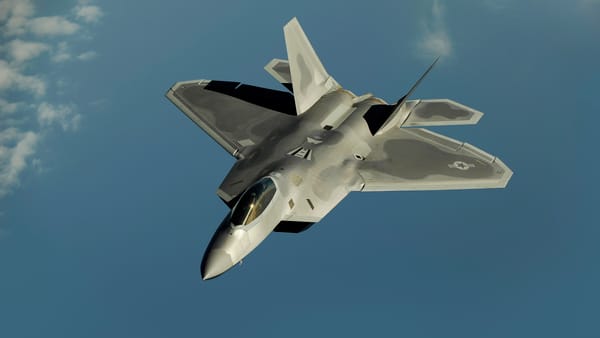
When the F-22 Raptor took to the skies for its first flight on September 7, 1997, it set a nearly impossible standard by which every fighter aircraft from that moment onward would be judged. Packed with some of the most sophisticated technology ever incorporated into an aircraft, all but invisible to radar, and capable of beating nearly any air superiority fighter in the world before its pilots even realize they’re being hunted, the Raptor is, as of the time of writing, the best air-to-air fighter jet ever made.
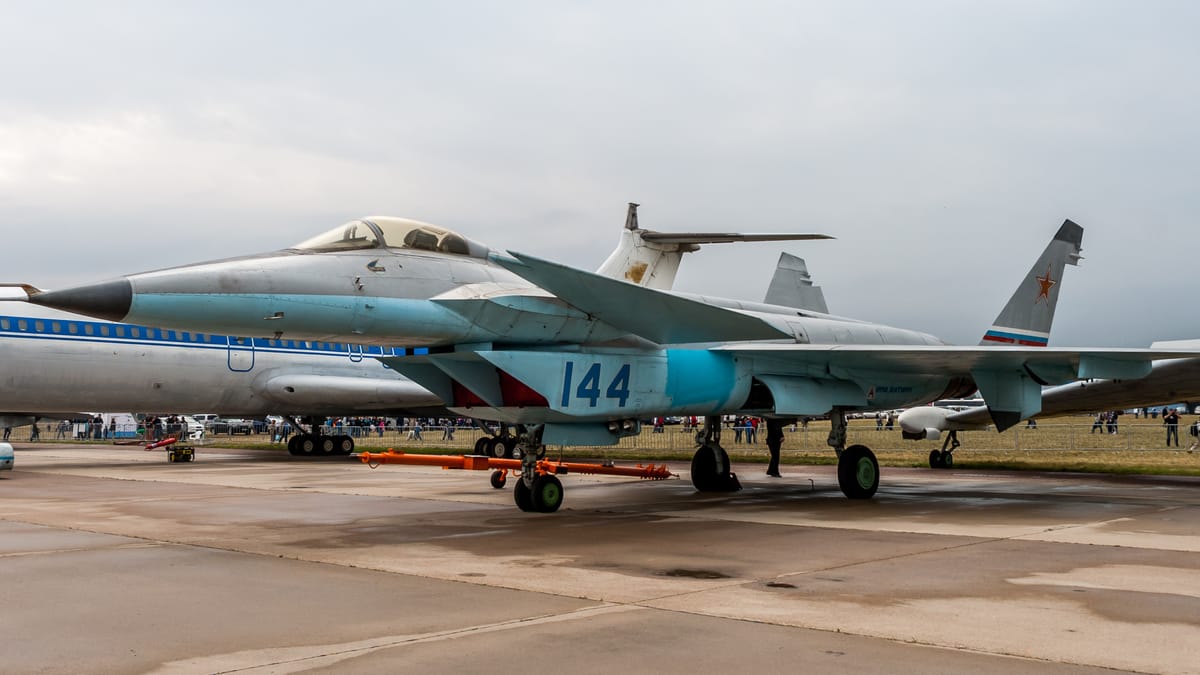
But long before it ever took flight, long before it ever proved its dominance against the best fighter jets in any global arsenal, the F-22 had a challenger hiding in secret. Designed deep in the heart of Moscow, in a crucible formed by the best aerospace minds the Soviet Union could provide, it was an air superiority fighter said to rival the F-22 in head-to-head combat. Its name was Mikoyan Project 1.44, and for the briefest moment, the MiG 1.44 might have done more than just stand up to the Raptor — it might have even beaten the Raptor into the sky.
This is the story of Mikoyan Project 1.44: what the Soviet super-plane was, what it was capable of, and why, when the race to a fifth-generation jet fighter concluded, it was the F-22 that made it over the finish line, while the MiG 1.44 was left shattered in the Raptor’s thunderous exhaust.
- Length
- 21.7m (71 ft 2 in)
- Top speed
- ~2,500km/h (1,540 mph)
- Supercruise
- Mach 1.5
- Range
- 4,000km (2,500 mi)
- Engine thrust
- 177 kNeach (2× AL-41F)
- First flight
- 29 February 2000
Conception and Design
The MiG 1.44 was a product of the Cold War, which meant that, like every other American and Soviet Cold War project, it was a response to a threat. Sometimes, in those long and difficult years, Washington and Moscow would build devices to get ahead of new capabilities they suspected the other might soon develop; sometimes they produced a design meant to cross a boundary or set a record before the other side could. And sometimes they were forced to design at high levels, very quickly, cutting as many corners as possible, because the other side had caught them with their pants down.
By the waning years of the Cold War in the 1980s, the Soviet Union was doing far less of the proactive sort of development — and spending a good bit more time getting caught flat-footed. The Soviets were losing their long battle of attrition, and a few more ambitious wonder-weapon projects could doom the whole thing.
In 1981, roughly a decade before the Soviet Union took its final tumble into the dust, Moscow was caught out yet again. This time the problem was a US Air Force program codenamed Senior Sky, soon announced as a procurement initiative for something called the Advanced Tactical Fighter. What the Advanced Tactical Fighter was probably seemed obvious to the Soviets, as it did to the Americans: the F-14, F-15, F-16, and F/A-18 the US relied on were all well and good, but technology was improving, and the Americans would surely want a better fighter before the Soviets built one first.
A more advanced fighter was on the Soviets’ radar too, but with Moscow strapped for cash, overstrained in a number of areas, and lacking the military-industrial might to truly embark on such a project, outside indicators suggested the Soviets were hoping the next-generation fighter race might hold off a little longer. The Advanced Tactical Fighter put them on a timeline anyway: match the new American aircraft, or get caught behind and hand the Americans exactly the kind of wonder-weapon the Soviets had wanted for so long.
The Kremlin reached out to its design bureaus, particularly Sukhoi — responsible for the Su-27 and its many derivatives — and Mikoyan, responsible for the iconic MiG-21, the super-fast MiG-25, and the modern MiG-29. Sukhoi would enter the contest with the strange-looking and ultimately unsuccessful Su-47 Berkut, a fighter primarily known for asking, “What if we put the wings on backward and scare the Americans with our fancy acrobatics?”
Meanwhile, the Mikoyan team got to work satisfying the requirements the Kremlin had laid out, plus a few others widely understood at the time. While America’s Advanced Tactical Fighter focused on a dedicated air superiority fighter with a strong emphasis on stealth, the Soviets wanted a multi-role fighter — somewhat like the F-35 that serves beside the F-22 today. Moscow wanted a plane that could excel at air-to-ground operations, perhaps taking over from or supporting aircraft like the Su-25 and the MiG-27.
In the open sky, the new Mikoyan plane was supposed to endure long supersonic flights, but it was also supposed to be supermaneuverable, executing tactical maneuvers that aren’t aerodynamically possible using only flaps, air brakes, rudders, and the other control surfaces most aircraft rely on. That most likely meant it would be capable of the Cobra short-stall maneuver, and would have required or benefited from thrust-vectoring engine nozzles — specialized nozzles that control the direction of thrust and enable much tighter turns.
At the start, Mikoyan had the option to develop two planes rather than one, and clearly wanted to: a heavy multirole aircraft and a light tactical fighter sharing many overlapping parts. For a very brief moment, it seemed Mikoyan might get something in the air before the Americans — and had history gone their way, they might even have reached production within a few years.
Rising costs forced a consolidation, with the smaller light tactical aircraft shelved and most of its attributes carried over to the larger multirole design as best the team could manage. The Soviet Union threw its support behind the new aircraft, even giving it a shout-out in the five-year economic plan of 1986. Design elements began to take shape on the airframe: it was given canards — small fore-wings underneath the cockpit — and was tweaked to reduce its radar cross-section, shrinking the size radar would perceive it to be.
(For reference, the F-22 is 62 feet long and 44.5 feet wide — 19 by 13.5 meters — but on radar it shows up as roughly the size of a single bumblebee.) The MiG was also given an internal weapons bay to reduce its radar cross-section further, though that feature wouldn’t make it onto the eventual flyable aircraft.
The program was beset by delay after delay, slowed down much like the F-22 was halfway around the world. First it took time to integrate the two airplane designs into one; then the Soviet Air Force took forever with its critical review; then the Soviet Union itself collapsed, pushing back long-awaited milestones like a first flight by several years. By 1994, Mikoyan produced a technology demonstrator ready for ground tests, and that year the demonstrator arrived at Moscow’s Zhukovsky Airfield to begin its trials.
Upheaval in Russia and within Mikoyan would push back deadlines and cancel production runs. But finally, in 1999, Russian military and government elites, foreign journalists, and international dignitaries got to see Russia’s secret project unveiled. It would fly for the first time about a year later, on February 29, 2000.
Specs and Capabilities
Before discussing the MiG 1.44’s capabilities in flight, a caveat is needed. According to publicly available information, the MiG 1.44 was never pushed to its limits in flight, either during tests or in actual deployment. Any estimation of the outer bounds of what it could do comes from a mix of Soviet and Russian records, public statements on the program, and independent analysis of the aircraft and what it should have been capable of. With that said, we can make some pretty good guesses.
The MiG 1.44 was envisioned as a single-seat fighter, measuring 21.7 meters tip to tail — 71 feet, 2 inches. It featured a wingspan of exactly 17 meters (55 feet, 9 inches) and sat at a height of 4.5 meters, just under 15 feet. Shaped with boxy engine inlets and a chunky fuselage reminiscent of the MiG-25 and MiG-31, it flew in a delta-wing configuration aided by canards set behind the cockpit.
Its twin vertical stabilizers leaned outward at a slight angle, leaving room for two Lyulka AL-41F afterburning turbofan engines, each producing 177 kilonewtons of thrust with afterburners engaged. The aircraft sat empty at 18 metric tons — just shy of 40,000 pounds — but could fly at slightly over twice its empty weight, maxing out at 37 metric tons, or 81,500 pounds.
Its performance specs are quite impressive. The MiG 1.44 was purportedly able to fly well in excess of twice the speed of sound, hitting a top speed just barely shy of 2,500 kilometers per hour — 1,540 miles per hour — and capable of supercruise at Mach 1.5: 1,580 kilometers per hour, or 990 miles per hour. It featured a range of 4,000 kilometers (2,500 miles), helped by its bulk and inherent fuel capacity, and would have flown at a maximum altitude of 17,000 meters, or 56,000 feet above sea level.
Onboard, it carried modern pulse-Doppler radar with target detection at 250 kilometers (160 miles), and the ability to track up to 40 targets and attack 20 simultaneously. It used a fly-by-wire system, and according to Russian aviation experts would have had a radar cross-section about the size of a household microwave heater, allegedly integrating radar-absorbent materials along with physical features to reduce its radar return. Whether that would have qualified it as a true fifth-generation fighter is a matter of some debate, but by any metric it would have been very impressive compared to most fighter jets of the time.
When it came to armament, the MiG 1.44 was well-equipped, capable of carrying several kinds of air-to-air missile along with a 30mm autocannon. Some sources indicate it would have been able to fire missiles backward to win dogfights with American fighters. While the exact number of hardpoints isn’t known, its lack of an internal weapons bay suggests externally mounted weapons.
The Su-35 is slightly smaller and isn’t a delta-wing design, but is a useful size analogue, carrying twelve hardpoints; the smaller but similar-profile Swedish JAS 39 Gripen features eight, and the also-smaller, similarly shaped Eurofighter Typhoon has up to thirteen — so a figure north of ten hardpoints for the MiG 1.44 would have been a good bet. As a multirole fighter, it would likely have carried air-to-surface missiles, anti-ship missiles, unguided and precision bombs, and drop tanks.
The Raptor Comparison
As impressive as those figures are, they really only matter against one key comparison: the F-22 Raptor. If the estimates hold, the MiG 1.44 would have beaten the Raptor in a few areas. It would have been a bit faster, a bit lighter, and used engines producing greater thrust — specifically a better thrust-to-weight ratio with afterburners engaged. It would have significantly outworked the Raptor on range, and because the Raptor relies on internal weapons bays to stay stealthy, the MiG 1.44 would have had it massively outgunned.
The F-22 had its own advantages, though, and arguably they were the ones that mattered more. It could fly a full 3,000 meters — 10,000 feet — above the MiG 1.44’s service ceiling, it hit a faster supercruise by several hundred miles or kilometers per hour, and most important of all, its combination of better avionics and better stealth meant that, more than likely, it would have been able to see the MiG 1.44 while the MiG couldn’t see it in return. So would the MiG 1.44 have beaten the Raptor in direct combat?
It’s unclear, and we’ll never know for certain, but the indicators are that it would probably take more losses than wins. That said, it still would have been an impressive aircraft — if only it had seen production.
Why It Came Up Short
For all its apparent potential, the MiG 1.44 would only fly once. Its February 29, 2000 excursion into the skies revealed engineering issues that needed fixing, and somewhere along the line while those tweaks were being made, someone in Moscow decided the MiG 1.44 would never see production. In hindsight it’s not too difficult to understand why.
The project was a relic of Soviet competition with the West, reflecting decisions made by Moscow’s leaders a full generation prior. It had been intended to go head-to-head with the Advanced Tactical Fighter, but there were two problems. First, the Advanced Tactical Fighter was now the F-22 Raptor, a real aircraft about to enter full service on a timeline Russia simply couldn’t match.
Second, if the rumors about the F-22’s capabilities were true, it would take substantial design overhauls for the MiG 1.44 to do anything other than humbly accept a beatdown if they ever faced off. The MiG 1.44 had once had real promise, but the window had closed, and Moscow knew it. The lone prototype was shelved and eventually refurbished in the mid-2010s for display.
In the years since, Russia most likely took many of the design elements and principles behind the MiG 1.44 and leveraged them into a range of later products. One direct derivative was to be the Mikoyan LMFS — the Light Multi-Function Frontline Aircraft — a proposed single-seat, all-weather multirole stealth aircraft discussed during the 2010s. By 2021 it was no longer in development, and as far as the world knows, no flyable airframe was ever built. The Su-57 Felon had considerably more success, in that it did at least enter main-line production and become a proper fighter jet, although that design has had a wide range of problems and is, at best, a questionable entry into the fifth-generation club.
The MiG 1.44’s legacy also lives on in the allegedly soon-to-arrive Sukhoi Su-75 Checkmate, a single-engine fighter Russia claims is in pre-production and will be introduced in 2027 — though as of now its maiden flight is not yet believed to have taken place. There’s also another Mikoyan design, the PAK DP, slated for a first flight in 2025 and introduction in 2028. The PAK DP is purportedly a sixth-generation fighter, promised to feature cruising speeds above Mach 3, fly well into the stratosphere, integrate stealth, and potentially carry anti-missile lasers.
But at the time of writing, the PAK DP, like the Su-75, is nowhere to be found as an actual flyable aircraft. The idea that the Su-57 will one day fill Russia’s air fleet with several hundred copies is already somewhat unbelievable, and given the Felon’s troubles, the PAK DP and Su-75 are unlikely to carry on the MiG 1.44’s legacy anytime soon.
A Chinese Successor?
To say the MiG 1.44 has no successor at all might not be true. Russia has raised allegations against China around design elements of the MiG 1.44, which it claims have shown up in China’s flagship fifth-generation stealth fighter, the Chengdu J-20 Mighty Dragon. Unlike the MiG 1.44 or the Su-57, the J-20 is very much a functional combat aircraft, with an estimated 300 or so in service at the time of writing.
China is long understood to have stolen US military secrets — particularly elements from the F-22 and F-35 — to build its own stealth fighters, and high-profile criminal cases in the US have found that large-scale data theft, including theft perpetrated by a spy named Su Bin starting in the late 2000s, did occur. But while the stealth elements of the J-20 seem mostly based on American state secrets, its overall design, its delta wings, and its canards make it a dead ringer for the MiG 1.44. As some experts have pointed out, there aren’t that many ways to build a stealth aircraft, and it’s not inconceivable that Russia and China arrived at similar profiles independently. Even so, most experts agreed at the time of the J-20’s unveiling that its resemblance to the Russian design was probably a bit more than pure coincidence.
Was It Vaporware?
It’s worth asking, in a 21st-century environment grown used to big but ultimately empty Russian threats and copying allegations against China, how the MiG 1.44 would have fared if it really had been put into production. We can refine that into one question: Was the MiG 1.44 vaporware all along — just another piece of technology that was mostly smoke, mirrors, and a compelling story people of the time wanted to believe?
There are certainly elements that point toward yes. As noted earlier, all those performance, stealth, and weaponry specs were basically made up — drawn from available sources by very knowledgeable experts who can create and validate rough estimates, but made up all the same. Perhaps the MiG 1.44’s airframe would have disintegrated once it hit the speed of sound; it’s not likely, but we don’t know for sure, since it literally never went past the speed of sound.
Perhaps the model unveiled to the global press in 1999 was nicely painted cardboard, and the alleged first flight never happened at all. At the end of the day, we simply don’t know.
But what we do know is that the MiG 1.44, regardless of how it ended up, was born of a very different type of strategic thinking in Moscow than what exists today. There’s always been an element of showmanship behind Russian and old Soviet warplane designs, but the ultra-confident smoke-and-mirrors show that today’s Russia under Vladimir Putin seems to favor was not characteristic of the old Soviet military. Where Russia today engages in bluster around its purported new aircraft to intimidate adversaries and challenge the Western order, the Soviets back then were still very much engaged in an active Cold War — and the way they went about their designs, successful or not, still reflected that fact.
Whether the MiG 1.44 would have been a genuinely useful aircraft is tough to say. Whether it would have evolved into a true fifth-generation jet fighter, we’ll never know for sure. But regardless of how badly it would have lost the race with the Raptor, it was designed with the clear intent to win — not just by getting the better of a war of words, but by actually fielding a technology that could be, to America, what the prospect of the Raptor became to the Soviet Union.
Whatever advanced stealth technology Russia does have, whatever aerodynamic features and fifth-gen design elements it can leverage into its aircraft today, were most likely born out of this promising but failed little program, an entire generation ago. The MiG 1.44 didn’t work, crippled by all the shortages, funding troubles, and internal strife of a dying empire that perished before the MiG 1.44 could ever be born. But could it have worked?
The answer is a resounding yes.
Key Takeaways
- The MiG 1.44 was Mikoyan’s secret Cold War answer to the US Advanced Tactical Fighter program, which ultimately produced the F-22 Raptor.
- Originally conceived as two aircraft — a heavy multirole fighter and a light tactical fighter — the program was consolidated into one design as costs rose, with canards, a delta wing, and twin AL-41F engines.
- On paper it could have beaten the F-22 on speed, weight, thrust-to-weight ratio, range, and external weapons load, but the Raptor’s higher ceiling, faster supercruise, and superior stealth and avionics likely mattered more.
- After delays compounded by the Soviet collapse, the aircraft was unveiled in 1999 and flew for the first time on February 29, 2000 — then flew only that once before being cancelled.
- Its design DNA may live on in later Russian projects (Su-57, the abandoned LMFS, the Su-75 Checkmate, the PAK DP) and, by Russia’s allegations, in China’s Chengdu J-20.
- Because the MiG 1.44 never exceeded the speed of sound in flight, nearly all of its quoted capabilities are expert estimates rather than verified performance.

Simon Whistler
Simon Whistler hosts MegaProjects, bringing engineering, infrastructure, and military-machine stories into clear narrative focus for viewers who want the systems, tradeoffs, and human decisions behind the build.
Frequently Asked Questions
What was the MiG 1.44?
The MiG 1.44 — Mikoyan Project 1.44 — was a Soviet, later Russian, air superiority and multirole fighter developed to counter the US Advanced Tactical Fighter program. It was meant to rival the F-22 Raptor in head-to-head combat. Only a single technology demonstrator was ever built.
How does the MiG 1.44 compare to the F-22 Raptor?
On the available estimates, the MiG 1.44 would have been a bit faster and lighter, with greater engine thrust, a better afterburning thrust-to-weight ratio, longer range, and more external weapons. The F-22, however, flew about 10,000 feet higher, supercruised faster, and had superior stealth and avionics — likely letting it detect the MiG first. In a direct fight, the indicators suggest the MiG would take more losses than wins.
When did the MiG 1.44 first fly?
A technology demonstrator was ready for ground tests by 1994 and arrived at Zhukovsky Airfield that year. The aircraft was publicly unveiled in 1999 and flew for the first time on February 29, 2000. It would only ever fly once.
Why was the MiG 1.44 cancelled?
Its single flight revealed engineering issues, and Moscow concluded the project was a relic of Soviet-era competition that couldn’t keep pace. The F-22 was about to enter full service on a timeline Russia couldn’t match, and matching the Raptor’s rumored capabilities would have required substantial redesign. The lone prototype was shelved and later refurbished for display.
Did China’s J-20 copy the MiG 1.44?
Russia has alleged that design elements of the MiG 1.44 appear in China’s Chengdu J-20, whose delta wings and canards make it a visual dead ringer for the Russian design. Most experts at the J-20’s unveiling thought the resemblance was more than coincidence, though some note there are only so many ways to build a stealth aircraft. The J-20’s stealth elements appear mostly based on stolen American secrets rather than Russian ones.
Was the MiG 1.44 just vaporware?
There’s a real case for it: the aircraft never exceeded the speed of sound, so virtually all its quoted specs are expert estimates rather than tested figures. It’s possible the airframe could have failed at supersonic speed, or that aspects of the program were more showmanship than substance. Ultimately, because it was never pushed to its limits, we simply can’t know for certain.
Sources
Related Projects
F-22 Raptor: The Ultimate King of Air Supremacy
How the F-22 Raptor became the most lethal fighter jet ever built — from its origins in Cold War competition to its uncertain future.
The Convair B-36 Peacemaker: The Absolute Unit That Carried America Into the Cold War
The Convair B-36 Peacemaker was the largest combat aircraft ever built — a six-engine nuclear behemoth whose real mission was to never be used at all.
Boeing E-4: America’s Advanced Airborne Command Post
How the E-4 Nightwatch became America's airborne command center, built to keep national command authority alive through nuclear war, disasters, and crises.