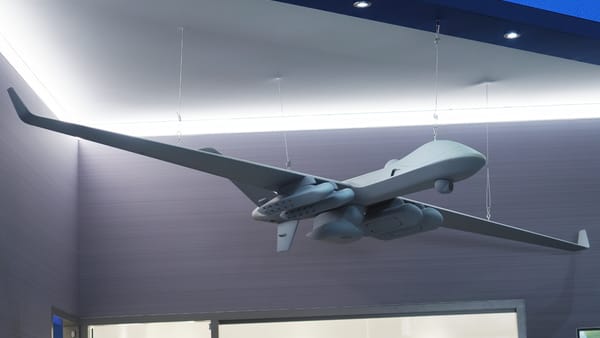

In March 2013, a US MQ-1 Predator drone was flying a reconnaissance mission over international waters near the coast of Iran. When Iranian radar picked it up — flying alone — they scrambled two F-4 Phantoms to intercept it, a reliable aircraft that had every reason to succeed where a pair of Su-25s had failed months earlier. But the Iranian pilots were in for a very different kind of surprise.
As they closed on the drone, the lead pilot glanced left and found his worst nightmare: an American stealth fighter cruising silently alongside them, completely undetected on their radar, flying right underneath their noses. The American pilot had already checked out their weapons. He climbed to make himself visible, and — not keen on engaging two enemy aircraft — switched on his radio.
“You really ought to go home.”
- Maximum Speed
- Mach 2.2
- Supercruise Speed
- Mach 1.5 at 50,000ft
- Radar Cross Section
- ~0.0001m² (bumblebee-sized)
- Total Program Cost (est. 2011)
- $70billion
- Aircraft Produced
- 187
- Jobs Supported
- ~95,000 across 46states
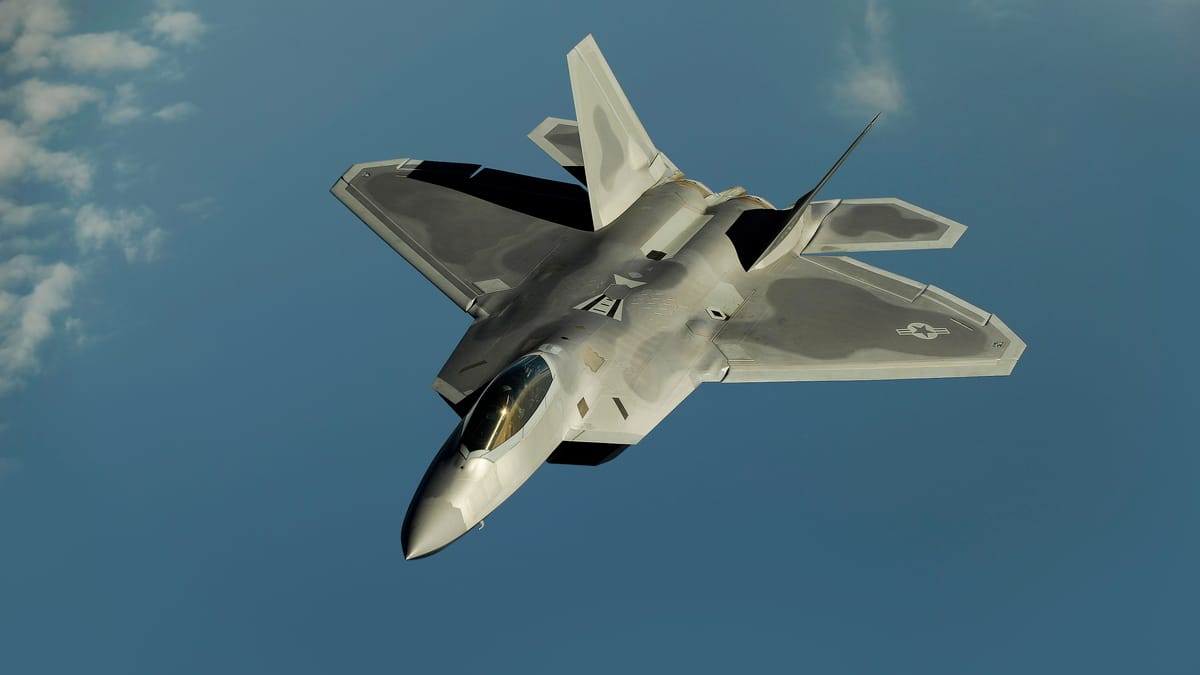
The Phantoms promptly obliged. Few aircraft in history have commanded that kind of instant respect, but then, few aircraft are the Lockheed Martin F-22 Raptor.
Making the Cut
The F-22’s origins trace back to the 1980s, when the United States Air Force launched a program called the Advanced Tactical Fighter, or ATF. The goal was to build on the success of the F-15 and F-16 and create something new — a platform that could counter advancing Soviet aviation using state-of-the-art stealth, speed, and maneuverability.
Seven companies bid for the contract, but two were selected to compete: Lockheed, with its prototype YF-22, and Northrop, with the YF-23. The two designs were broadly similar in concept but diverged in meaningful ways. The YF-23 was larger, featured a dramatic V-shaped tail optimized for high maneuverability, and was considered by some analysts to be stealthier and potentially faster — a genuinely innovative design that turned heads. Yet that very distinctiveness may have worked against it.
The Air Force selected the YF-22. The reasoning has been debated ever since, but the prevailing consensus is that Lockheed’s design was seen as cheaper and a less risky investment. Salesmanship played a role too: Lockheed’s test pilots put on a bolder show during trials, pulling maneuvers exceeding 9Gs, firing missiles from internal weapons bays, and demonstrating their thrust-vectoring capability — something Northrop’s design lacked.
To this day, devoted YF-23 advocates insist the Air Force made the wrong call, arguing that the decision was more bureaucratic than technical. Regardless, Lockheed walked away with the ATF contract, and the F-22 moved toward full-scale production.
King of the Skies
The Air Force had chosen the YF-22 partly because it was supposed to be cheaper. They were wrong. The technologies being developed proved far more expensive than anyone had anticipated. But when the Raptor finally entered service in 2005, there was no argument about what had been built.
At 62 feet long with a 44-foot wingspan, the F-22 is broadly comparable in size to the F-15 Eagle, but its performance characteristics are in a different class entirely. The aircraft’s diamond-shaped wings provide a very high wing area that, combined with large tail fins, gives the Raptor exceptional maneuverability. A pair of Pratt & Whitney F119 turbofan engines — each producing a maximum thrust of 35,000 lbs — incorporate thrust vectoring, allowing the aircraft to redirect its exhaust for superb handling in all flight regimes. Computer-assisted flight control ties it all together, enabling the F-22 to perform maneuvers that border on the physics-defying: its signature falling-leaf maneuver, near-vertical climbs after takeoff, and other demonstrations that have repeatedly stunned observers.
Speed is equally formidable. Those engines push the Raptor to a maximum of Mach 2.2, and the aircraft can supercruise — sustaining supersonic speeds without afterburners — at Mach 1.5 while flying at 50,000 feet. That altitude advantage meaningfully extends the effective range of its air-to-air missiles compared to aircraft operating lower and slower.
Then there is the stealth. The F-22 was engineered from the outset for low observability. Its airframe relies on what designers call “continuous curves” — surfaces that deliberately avoid flat edges, scattering radar waves rather than bouncing them back toward the sender. The attention to detail extends to landing gear doors and weapons bay panels, which feature carefully designed sawtooth edges for the same reason.
According to Lockheed Martin, the jet’s radar cross section from certain angles measures approximately 0.0001 square meters — roughly the size of a bumblebee.
Armament is stored entirely within three internal compartments to preserve that stealth profile: a main weapons bay at the center housing six launchers for beyond-visual-range missiles, and a smaller bay on each side capable of holding one short-range air-to-air missile each. To avoid compromising stealth during an engagement, hydraulic systems ensure the bay doors are open for less than a second — the missile is pushed clear and launched before the door slams shut behind it. The 20mm M61 Vulcan autocannon is similarly concealed behind a retractable door that only opens when needed.
Radar-absorbent materials coat those areas of the airframe where they matter most. The selective application is deliberate: the materials are expensive, heavy, and maintenance-intensive. By limiting their use, engineers reduced the maintenance burden considerably. Unlike the B-2 stealth bomber, which requires climate-controlled hangars to preserve its delicate stealth properties, the F-22 can be serviced in any standard hangar.
The avionics package matched the airframe’s ambition. The aircraft’s baseline software comprises 1.7 million lines of code, handling everything from missile approach warning to onboard radar and electronic warfare. Six sensors distributed around the jet provide complete spherical infrared coverage in all weather conditions. Data gathered by one Raptor transfers seamlessly to friendly aircraft — particularly other F-22s — giving the entire formation exceptional situational awareness and battlefield integration.
By 2011, the United States had spent an estimated $70 billion on the F-22 program, across roughly 95,000 jobs spanning 46 states. What they had purchased was one of the fastest, most maneuverable, and stealthiest aircraft ever built — and much of what the jet can actually do remains classified to this day. Its true capabilities are not even permitted to be demonstrated in training exercises with US allies.
From ISIS to Balloons
The F-22’s entry into service attracted immediate attention — much of it focused on its cost overruns and uncertain future. Australia, Israel, Japan, and others expressed interest in acquiring Raptors for their own air forces, but the United States refused to lift its export ban, with Congress citing the volume of classified technology embedded in the platform.
The aircraft’s early operational history was relatively quiet. In 2007, a pair of F-22s was dispatched to intercept Russian Tu-95 bombers off the Alaskan coast — the first of many such escort missions that have continued since. A reluctant deployment to the Middle East eventually followed, producing the now-famous Iranian Phantom intercept.
Real combat operations began in September 2014 with Operation Inherent Resolve, the US-led military campaign against ISIS. In the opening days of the campaign, F-22s dropped 1,000-pound guided bombs on ISIS positions near the Euphrates River in Syria. Over the following year, the aircraft flew more than 200 sorties and struck more than 60 ISIS positions. They also provided close air support for ground forces and, though they never engaged them directly, deterred Russian aircraft from attacking American-allied Kurdish fighters on the ground.
The one instance where F-22s were involved in direct combat against a Russian-linked force came in February 2018 at the Battle of Khasham. The adversaries were not the Russian military proper, but Wagner Group — the Russian private military company that has since become notorious for its operations across the Middle East, Africa, and Ukraine. On February 7th, Wagner forces, alongside Shia militants and local fighters, launched a coordinated assault on a US-allied base near Khasham, backed by T-72 and T-55 tanks and supported by rockets, artillery, and mortar fire directed at the headquarters inside.
After contacting Russian officials and confirming that no official Russian military personnel were present, the US authorized a large-scale response. F-22 Raptors were among the aircraft that arrived. In the battle that followed, as many as 200 Wagner contractors and several hundred additional enemy fighters were killed. Not a single US soldier or ally lost their life.
Shortly after, F-22s flew alongside B-52 bombers over Afghanistan, striking Taliban opium production facilities.
The most widely covered F-22 mission, however, came in February 2023. A suspected Chinese spy balloon was spotted over Montana and tracked as it drifted eastward across US airspace. The Air Force held off on engaging it while there was any risk of wreckage falling on populated areas. Once the balloon reached the Atlantic Ocean off the South Carolina coast, a single F-22 intercepted it at 60,000 feet and destroyed it with a short-range air-to-air missile.
The wreckage was recovered by the US Coast Guard. Within the following week, F-22s shot down two more unidentified objects — one over Alaska, one over Canada, both described as silver and cylindrical — though the remains of those were never recovered.
An Endangered Species
Not one F-22 has been shot down in combat. In training exercises with allied air forces, the Raptor’s losses are rare enough that they make news when they occur. By any operational measure, the aircraft has delivered on its promise.
And yet the F-22 has struggled to secure its own future almost from the beginning. The cost overruns that accumulated during development eroded the Air Force’s appetite for the platform long before it reached its potential. The original plan called for purchasing 750 aircraft, with the Navy monitoring the program for a potential carrier variant.
As deadlines slipped and the price climbed, the Navy withdrew, and the Air Force’s target fell to 339. As the US military’s focus shifted from conventional conflict toward counter-insurgency and asymmetric warfare in the Middle East, the number dropped again — what use is an air superiority platform when no one is seriously contesting your airspace? Production ended at 187 aircraft, with much of the production infrastructure cannibalized for the F-35 program.
The F-35 offered something the F-22 never could: versatility and export potential. Military planners and investors gravitated toward it, and the Raptor was repeatedly passed over when upgrade funding was distributed.
Retirement discussions have already begun, with 2030 cited as a possible end date. The reasons are real. Despite remaining the most capable pure air superiority fighter on the planet, the F-22’s avionics were designed in the 1990s, and the gap between its systems and modern standards widens every year. Upgrades have been added over time, but the aircraft was not designed with modularity in mind, making comprehensive avionics modernization prohibitively expensive — a lesson that was deliberately incorporated into the F-35’s architecture.
The deeper issue, though, is that the F-22’s replacement is already in development. The Next Generation Air Dominance program, or NGAD, is a sixth-generation air superiority platform designed around deep integration with drone systems and the most advanced avionics yet conceived. If the program hits its target — which, given the Air Force’s track record with deadlines, is far from guaranteed — NGAD could enter service around 2030.
The F-22 Raptor may have arrived in the wrong era, carrying too large a price tag to build in the numbers its capabilities warranted, and facing adversaries that never required it to demonstrate what it was truly capable of. Whatever its eventual fate — early retirement, airshows, aerospace museums — the engineering achievement it represents is unambiguous. Few machines built by human hands have combined stealth, speed, and lethality so completely, and fewer still have commanded the respect of an adversary with nothing more than a calm radio transmission.
Key Takeaways
- The F-22 Raptor emerged from the 1980s Advanced Tactical Fighter program, beating out Northrop’s competing YF-23 design primarily on cost and perceived investment risk.
- Its combination of Mach 2.2 top speed, Mach 1.5 supercruise at 50,000 feet, and a radar cross section the size of a bumblebee makes it the premier fifth-generation air superiority platform ever built.
- Internal weapons bays with hydraulic doors that open for less than one second preserve the aircraft’s stealth profile even during combat engagements.
- Despite a $70 billion program cost, only 187 F-22s were ever built — far fewer than the 750 originally planned — as budget overruns and shifting military priorities eroded support for the program.
- The Raptor’s combat record includes strikes on ISIS targets in Syria, involvement in the 2018 Battle of Khasham against Wagner Group forces, and the February 2023 shoot-down of a suspected Chinese spy balloon over the Atlantic.
- The F-22 faces potential retirement around 2030, driven not by any rival aircraft but by aging avionics and the development of its sixth-generation replacement, the Next Generation Air Dominance (NGAD) program.

Simon Whistler
Simon Whistler hosts MegaProjects, bringing engineering, infrastructure, and military-machine stories into clear narrative focus for viewers who want the systems, tradeoffs, and human decisions behind the build.
Frequently Asked Questions
Why was the F-22 chosen over the YF-23?
The Air Force selected Lockheed’s YF-22 over Northrop’s YF-23 primarily because it was seen as cheaper and a lower-risk investment. Lockheed’s test pilots also made a stronger impression during trials, demonstrating thrust vectoring, internal missile launches, and maneuvers exceeding 9Gs — capabilities the YF-23 demonstration did not match.
Can the F-22 Raptor be exported to allied nations?
No. The United States has maintained a strict export ban on the F-22 since it entered service. When Australia, Israel, and Japan expressed interest in purchasing Raptors, Congress refused, citing the volume of classified technology embedded in the platform.
What makes the F-22 so difficult to detect on radar?
The Raptor uses a combination of airframe shaping and radar-absorbent materials to minimize its radar cross section. Its “continuous curves” scatter radar waves rather than reflecting them back to the sender, and even details like landing gear doors and weapons bay edges are given sawtooth profiles for the same purpose. Lockheed Martin stated in 2009 that from some angles the aircraft’s radar cross section is approximately 0.0001 square meters — comparable in size to a bumblebee.
What combat missions has the F-22 actually flown?
The F-22 first saw combat during Operation Inherent Resolve in September 2014, striking ISIS positions in Syria. It flew more than 200 sorties and struck over 60 targets in the following year. In 2018, F-22s participated in the defense of a US-allied base at Khasham against Wagner Group forces. In 2023, an F-22 shot down a suspected Chinese spy balloon over the Atlantic, followed shortly by two unidentified objects over Alaska and Canada.
Why is the F-22 likely to be retired so early?
The F-22’s avionics were designed in the 1990s and, despite incremental upgrades, are increasingly dated. A full modernization would be prohibitively expensive because the aircraft was not built with modularity in mind. More fundamentally, the US is already developing the sixth-generation Next Generation Air Dominance (NGAD) platform to replace it, with a target service entry around 2030.
How many F-22 Raptors were built?
Only 187 F-22s entered service — a fraction of the 750 originally planned and even fewer than the revised target of 339. As costs escalated and military priorities shifted toward counter-insurgency operations in the Middle East, demand for a pure air superiority fighter declined, and production ended with much of the manufacturing infrastructure repurposed for the F-35 program.
Sources
-
Original MegaProjects video: F-22 Raptor: The Ultimate King of Air Supremacy
-
Hero image source by Master Sgt. Andy Dunaway / U.S. Air Force, public domain.
Related Projects
The Dassault Rafale
How France walked away from NATO's joint fighter program and went it alone — producing one of the world's most capable fourth-generation combat aircraft.
Su-75 Checkmate
Russia's Su-75 Checkmate was pitched as a cheap fifth-generation export fighter. Its real test is whether UAC can turn a mockup into a flying aircraft.