
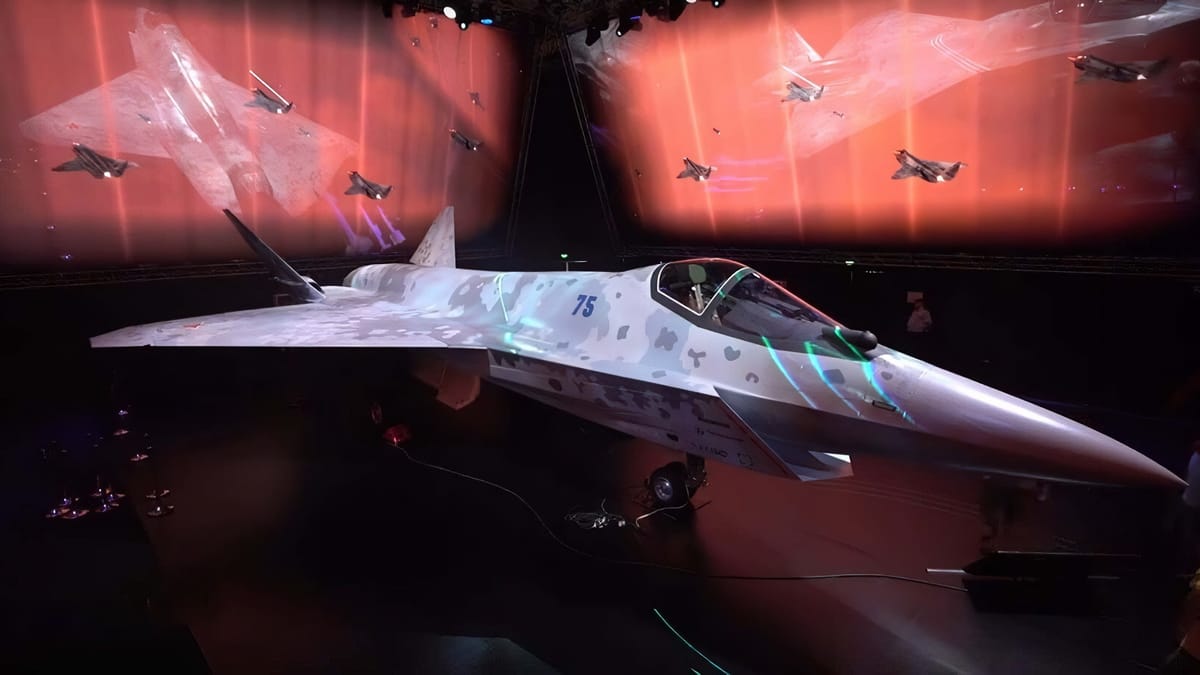
The Su-75 Checkmate was introduced as the fighter Russia wanted foreign buyers to imagine: single engine, low observable, cheaper than an F-35, and modern enough to replace aging fourth-generation fleets. It was supposed to give Sukhoi and United Aircraft Corporation a lighter export product beneath the heavier Su-57.
The problem is that a fighter is not proven by a name, a mockup, or a brochure. It is proven by flying, testing, production, training, maintenance, and buyers willing to bet their air forces on the result.
As of June 2026, the Checkmate remains in that uncomfortable space between pitch and aircraft. UAC says the project is still being developed for both Russia’s Defense Ministry and foreign customers, while Russian officials have continued to point toward bench tests and a future first flight. That keeps the program alive. It is also a reminder that the jet first appeared publicly in 2021 and still has no confirmed first flight, no confirmed production line, and no publicly confirmed customer.
That makes the Su-75 a useful megaproject story. The most important question is not whether the Checkmate can beat the F-35 in a brochure comparison. The real question is whether Russia can still turn an ambitious new combat aircraft into a reliable export product while its aerospace sector is under wartime pressure.
Why Russia Wanted Checkmate
Russia already had a fifth-generation fighter program in the Su-57, but the Su-57 is a heavy twin-engine aircraft. It is expensive by Russian standards, slow to build, and oriented around the needs of Russia’s own Aerospace Forces as much as export customers.
The Checkmate was aimed at a different gap. Many countries still operate older MiG-21, MiG-29, F-16, Mirage, or other fourth-generation fleets. Some of those governments cannot buy the F-35 for political reasons. Others cannot afford enough Western aircraft, weapons, simulators, spares, and support infrastructure to make the purchase practical.
That was the opening Sukhoi wanted. A single-engine aircraft should be cheaper to buy and operate than a twin-engine fighter. A design that borrows technologies from the Su-57 should be faster to develop than a clean-sheet program. A fighter with internal weapon bays, a modern sensor suite, and reduced radar signature could be marketed as a fifth-generation option for air forces outside the U.S.-led procurement system.
The timing looked plausible in 2021. UAC unveiled the aircraft at MAKS that year and then presented it internationally at the Dubai Airshow. Rostec described it as Russia’s first fifth-generation single-engine aircraft and emphasized low visibility, open architecture, low flight-hour cost, and export appeal.
Then Russia invaded Ukraine in February 2022, and the whole business case became harder.
What UAC Says the Su-75 Can Do
UAC’s official Su-75 page presents the Checkmate as a fifth-generation light single-engine fighter designed by the Sukhoi Design Bureau. The claimed design features are exactly what an export pitch needs: low visibility, high performance, artificial-intelligence support for the pilot, and heavy use of supercomputer design tools.
The headline numbers are ambitious. UAC says the aircraft is intended to carry a maximum combat load of 7,400 kilograms, fly up to 2,900 kilometers without external fuel tanks, and reach speeds up to Mach 1.8. In a low-visibility configuration, it is supposed to carry up to five air-to-air missiles internally. UAC has also promoted the aircraft as adaptable to customer needs rather than a single fixed configuration.
Those claims matter, but they are still claims. The Su-75 shown publicly has been a mockup or model, not a flight-test aircraft with a public record. Until it flies, the numbers are marketing targets rather than demonstrated performance.
That distinction is especially important because modern fighter capability is not just speed and payload. A fifth-generation aircraft is a system: radar, infrared sensors, electronic warfare, mission computers, datalinks, weapons integration, software updates, maintainability, training, and the ability to survive in contested airspace. The F-35 is powerful because of that whole ecosystem, not because of any single specification line.
The F-35 Comparison Problem
The Checkmate was marketed in the shadow of the F-35 because that is the aircraft every new multirole fighter gets compared with. The comparison is useful only if it stays honest.
On paper, the Su-75 pitch overlaps with the F-35A in obvious ways. Both are single-engine combat aircraft. Both are built around reduced radar signature. Both are meant to carry weapons internally when stealth matters and externally when payload matters more. UAC claims a top speed above the F-35A’s public Mach 1.6 figure, and it sells the Checkmate as cheaper and easier to operate.
But the F-35 is not a concept. It is a mature multinational program with operational squadrons, combat use, a large supplier base, an upgrade roadmap, and a training and sustainment structure. That does not make it cheap or problem-free, but it does make it real.
The Su-75 has not yet crossed that line. It may eventually become a capable lower-cost fighter, but until a prototype flies and a test campaign produces public evidence, “F-35 rival” is mostly a sales frame. The more careful description is that Checkmate is Russia’s attempt to build a cheaper fifth-generation-style export fighter for customers who cannot or will not buy Western alternatives.
Why the Program Slowed Down
The Su-75’s biggest enemy is not the F-35. It is time.
When the aircraft appeared in 2021, Russia’s pitch depended on speed: bring a cheaper modern fighter to market before the replacement window closed for older fleets. UAC and Rostec could argue that demand existed if the product arrived quickly enough.
That schedule collided with war and sanctions. Advanced aircraft production depends on precision machine tools, electronics, engines, sensors, materials, software, finance, and supplier relationships. Sanctions do not make production impossible, but they make it slower, more expensive, and more fragile. They also make export customers nervous because buying a new Russian aircraft means buying into its support chain.
Design changes added another uncertainty. Models and renderings shown after 2021 have differed from the original display aircraft. Changes in the wing roots, rear fuselage, intake area, and canopy shape may reflect normal development, but they also show that the design has been moving while the public flight schedule has slipped.
In November 2025, Russian officials again said the aircraft was approaching bench testing and flight work. In June 2026, UAC chief Vadim Badekha told TASS that Checkmate was still being developed for the Russian Defense Ministry and foreign customers. Those statements keep the program alive, but they also underline the same point: nearly five years after the reveal, the decisive public milestone is still ahead.
The Export Trap
The Checkmate makes most sense as an export fighter, but exports are where the problem gets harder.
A country does not just buy the airframe. It buys engines, spares, software support, munitions, diagnostics, manuals, ground equipment, simulators, pilot training, maintainer training, and years of political trust. For a new aircraft with no service record, that support network matters as much as the purchase price.
Russia’s traditional fighter customers have more options than they did during the Cold War. Some can buy Western aircraft. Some can buy Chinese aircraft. Some can modernize existing fleets while investing heavily in drones, missiles, and air defenses. The war in Ukraine has also changed how governments think about cost. A cheap fighter is still expensive compared with drones and long-range weapons.
There is probably a market for a lower-cost modern fighter below the F-35. The question is whether Russia is the supplier that can deliver it. Publicly, the Checkmate has no confirmed orders. Without a launch customer, every delay becomes more damaging, because buyers prefer to wait for someone else to absorb the early risk.
What Would Prove It Is Real
The Su-75 does not need to beat the F-35 to matter. It needs to become a flyable, testable, producible aircraft with credible support behind it.
The first proof point is a public first flight. The second is a sustained test campaign that shows the prototype is more than a brief demonstrator. The third is a production plan with funding, tooling, suppliers, and an actual customer. The fourth is a support package that makes buyers believe the aircraft can be kept flying for decades.
That is the distance between a mockup and a weapon system.
Checkmate is not dead. UAC’s 2026 comments show the program still has institutional support. But it is not yet the cheap F-35 alternative Russia advertised either. For now, the Su-75 is a sales idea trying to become an aircraft in one of the hardest industrial environments Russia has faced in decades.
If it flies, the conversation changes. If it sells, the conversation changes again. Until then, the Checkmate is still waiting for its first real move.
Key Takeaways
-
The Su-75 Checkmate is UAC and Sukhoi’s proposed single-engine fifth-generation-style fighter aimed at Russia and export customers.
-
UAC claims a 7,400 kilogram combat load, a 2,900 kilometer range without external fuel tanks, and speeds up to Mach 1.8.
-
The aircraft was revealed in 2021, but as of June 2026 there is still no public confirmed first flight.
-
UAC says the project is still being developed for Russian and foreign customers, but the program still lacks publicly confirmed orders.
-
The F-35 comparison is mostly a marketing frame until the Su-75 completes flight testing and proves its sensors, software, weapons integration, and sustainment model.

Simon Whistler
Simon Whistler hosts MegaProjects, bringing engineering, infrastructure, and military-machine stories into clear narrative focus for viewers who want the systems, tradeoffs, and human decisions behind the build.
Frequently Asked Questions
What is the Su-75 Checkmate?
The Su-75 Checkmate is a proposed Russian single-engine light tactical fighter developed by Sukhoi under United Aircraft Corporation. It is marketed as a fifth-generation-style aircraft with reduced visibility and lower operating costs than heavier twin-engine fighters.
Has the Su-75 Checkmate flown?
No public first flight had been confirmed as of June 6, 2026. Russian officials have said the aircraft is moving toward bench tests and flight work, but public evidence of a completed flight-test aircraft has not yet settled the question.
Is the Su-75 meant to replace the F-35?
No. The Su-75 is better understood as Russia’s attempt to offer a cheaper export alternative for customers that cannot or will not buy the F-35. The F-35 is already operational at scale, while the Su-75 still has to prove itself in flight testing.
What are the Su-75’s claimed specifications?
UAC says the Checkmate is intended to carry up to 7,400 kilograms of combat load, fly up to 2,900 kilometers without external tanks, and reach speeds up to Mach 1.8. Those figures remain manufacturer claims until demonstrated by testing.
Why has the Checkmate program been delayed?
The program has been affected by the normal difficulty of developing a modern fighter, design changes after the first public reveal, Russia’s war economy, and sanctions pressure on aerospace supply chains.
Does Russia have buyers for the Su-75?
There have been reports and speculation about possible interest from foreign customers, but no publicly confirmed Su-75 orders had been established as of this article’s publication.
Why does the Su-75 matter if it is still a prototype?
It matters because it tests whether Russia can still create and export a new lightweight combat aircraft under sanctions and wartime pressure. A successful Su-75 would signal industrial resilience; continued delays would point to the limits of Russia’s aerospace base.
Sources
-
Original MegaProjects video: The SU-75 Checkmate - Can it Defeat the F-35?
-
Rostec: The first international presentation of the Checkmate fighter jet starts in Dubai
-
TASS: Su-75 Checkmate fighter developed for Russian Defense Ministry and foreign customers
-
The War Zone: Russia insists Su-75 Checkmate fighter will fly next year
-
Hero image source, KF-21A / Wikimedia Commons, CC BY-SA 4.0.
Related Projects
National Ignition Facility
How Lawrence Livermore's National Ignition Facility turned 192 lasers, Cold War stockpile science, and decades of failed shots into laboratory fusion ignition.
LRASM
How LRASM restored America's long-range anti-ship strike capability with stealth, autonomy, and a missile built from the JASSM-ER family.
SMASH 2000L
How SMARTSHOOTER's Smash 2000L fire-control optic helps infantry engage small drones, and why smart rifle scopes still face hard battlefield limits.
Boeing E-4
How the E-4 Nightwatch became America's airborne command center, built to keep national command authority alive through nuclear war, disasters, and crises.