

It’s December 17, 1998, the second night of the United States airstrike campaign known as Operation Desert Fox. Imagine you’re a guard at one of Saddam Hussein’s many palaces, and you’ve got a sneaking suspicion this palace might not last the night. You’ve heard about the wreckage and destruction that took place elsewhere in your country the night before, and since Saddam has decided not to back down, tonight is almost sure to be worse. As you wait, you can’t help but wonder what sort of American jets will be flying overhead soon, perhaps a supersonic bomber, or one of what seems like a thousand sorts of fancy fighter jet.
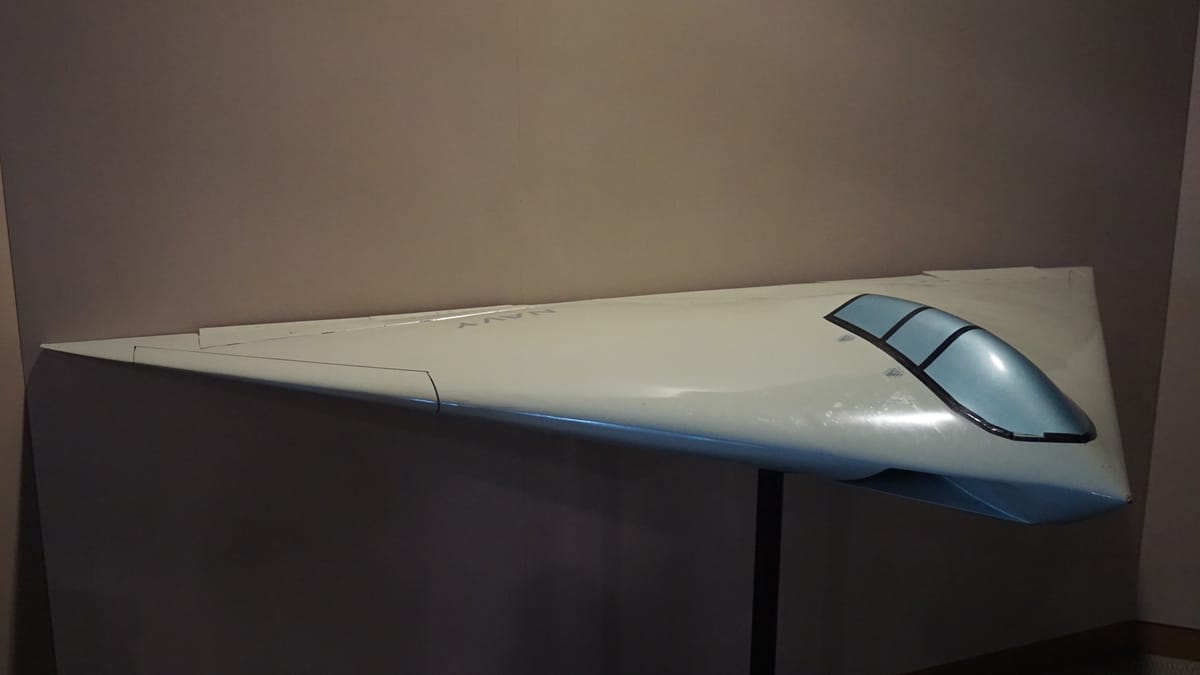
But when you finally see the plane that’s coming for you, you’re barely able to believe your eyes. On the one hand, it’s got all the eerie contours and otherworldly design of an alien spacecraft. On the other, it looks for all the world like a corn chip. As the A-12 Avenger II puts an absolute beating on your boss’s palace, and your friend over in the radar-operations office bemoans the fact that his faulty radar never saw these planes coming, you get a sinking feeling that you’ve entered an age where this new, strange jet will rule the skies.
That, of course, is only what might have been. As innovative and as wild-looking as the A-12 Avenger II was, it never made it to that night, or any other. Here we’ll explore the one-of-a-kind plane in all its detail, and really go deep on the A-12 Avenger: the futuristic, flying Dorito of death that never made it to the big time.
- Wingspan
- 70ft (21.5 m)
- Top speed
- ~580mph (930 km/h)
- Combat range
- 920miles
- Initial Navy order
- 620aircraft
- Cost overrun reported
- $2billion
- Cancelled
- January 7, 1991
Why the Navy Needed a New Attack Aircraft
A good attack aircraft can be a game-changer, flying low over a warzone and unleashing instant destruction on entrenched enemy forces that might otherwise take hours to defeat by land. But a great attack aircraft is much more than that: versatile, easy to maintain in austere conditions, and extremely durable. Planes like the American A-10 and the Soviet Su-25 are a critical force multiplier in a long-term military engagement, helping armies and navies surge through enemy lines and turn a protracted, bloody war into one-way traffic.
By the early 1980s, the US Navy had a problem: it no longer had a great attack aircraft, and to hear some Navy officials tell it, it didn’t even have a good one. Its main attack aircraft at the time, the Grumman-made A-6 Intruder, was distinguished for its long range and payload capacity. But with an introduction to service in 1963, the plane had become outmoded some twenty years later.
The Navy needed a replacement, but the obvious candidates didn’t fit. Fairchild Republic’s A-10 Warthog was already in service with the Air Force, but it would have been a nightmare to redesign into a carrier-capable variant. The F-14 Tomcat was in service too, but high-speed fighters aren’t really appropriate for a ground-attack role. The simplest way to understand why: if you’re going to fire a plane’s cannons or rockets at the ground, the plane has to be pointed at the ground, and that’s a massive problem, and probably terrifying for the pilot, if the aircraft has to go bloody fast just to stay airborne.
The Advanced Tactical Aircraft Program
Rather than jury-rig an existing plane into the attack role, the Navy kicked off its Advanced Tactical Aircraft program, which opened in 1983 to solicit design proposals. The Navy’s wish list was demanding: the winning design would operate at long range, carry high payloads, and do so from an aircraft carrier in a medium-attack role, carrying big and effective weapons, but not so big that you’d need a strategic-bomber-size aircraft to lift them.
The really interesting demand was for stealth capability, which at the time was still an emerging, early technology. The Air Force’s only real stealth aircraft were the SR-71 Blackbird, which had been outpaced by Soviet radar advances, and the F-117 Nighthawk, which had been secretly introduced that year. The Navy’s contractors could draw on that technology, but they’d have to be on the cutting edge to make stealth work at scale.
A project this hard scared off the usual suspects from going it alone. Two teams received concept-design contracts. One paired McDonnell Douglas, known for the F-4 and F-15, with General Dynamics, known for the F-16. The other brought together Northrop, Grumman, and Vought, all with long histories of putting planes onto US carriers.
On paper the second team should have had the edge: Grumman built the A-6 that this contract was meant to replace, and Vought had produced the carrier-capable A-7 Corsair. Both teams won follow-on contracts in 1986, but the Grumman-Vought-Northrop team never submitted a final design. McDonnell Douglas and General Dynamics did, and by default they were selected as the winner.
A Flying Triangle: Specs and Expected Capabilities
It wouldn’t be fair to say the winning design got picked only for lack of alternatives. Uncontested as it was, it was also a fascinating piece of conceptual work with the potential to redefine attack-aircraft doctrine.
Named the A-12 Avenger II, in homage to the Grumman-made torpedo bomber of World War II, the plane bore little resemblance to its namesake or, for that matter, anything else in the sky. Today we recognize the design as a “flying wing,” the same family as the B-2 stealth bomber. But a flying wing was a fairly unproven concept in the late 1980s, and the Avenger was unlike any flying wing before or since. Put simply, it was a triangle: a sharply pointed nose, two sharp-tipped wings, and an almost completely smooth exterior, distinguished by an alien-looking bubble cockpit sticking out the front and not much else.
At a total length of just under 38 feet (11.5 meters) but a wingspan of 70 feet (21.5 meters), the A-12 was designed to be maneuverable, with plenty of room for munitions and fuel. Powered by two General Electric turbofan engines nested mostly inside the airframe, with intake ports just under the cockpit and exhaust vents on the underbelly, the Avenger had an empty weight of 39,000 pounds and a maximum takeoff weight of 80,000 pounds, including 5,160 pounds of munitions.
The plane carried its weapons in an internal bay, with the capacity for two AIM-120 air-to-air missiles, two AGM-88 air-to-ground missiles, or any number of guided or unguided bombs. Some experts have claimed it was designed to carry nuclear payloads, too. Early versions had no cannon, and between that and the lack of any external weapons hardpoints, the plane had a low-observable radar profile, with only minimal ridges and edges to bounce radar back to its source. For perspective on how much that matters: the B-2 bomber is a pretty massive plane, yet its radar cross-section viewed from the front is between 0.1 and 0.5 square meters, at worst about the same as a fairly fat crow.
The rest of its expected capabilities were impressive too:
- Speed. A top speed of about 580 mph (930 km/h), not fast for a fighter, but comparable to the Su-25 and about 140 mph faster than the Warthog.
- Low stall speed. Thanks to the flying-wing design, the Avenger could loiter menacingly over a battlefield and drop its payload with a high degree of accuracy.
- Service ceiling. 40,000 feet, more than enough to stay above most enemy anti-air weapons, especially combined with its low-observable shape.
- Range. Perhaps most impressive of all. Against a measly 288 miles for the A-10 and a somewhat better 470 for the Su-25, the A-12 would have boasted a combat range of 920 miles, enough to strike deep inland and return to its carrier.
Its short, triangular shape was a carrier deck’s friend. With wings folded and a group parked nose-to-nose, the Navy could fit roughly five A-12s in the space needed for two F-14s (rough math, so take it with a grain of salt). The plane was meant to be easy to maintain and not too hard to fly, and it was even considered for tanker and dedicated anti-ship variants.
Unorthodox, innovative, and seemingly destined to be bloody effective, the A-12 was a hit with the US military. The Navy’s initial order, lacking the skeptical conservatism it showed toward other planes of the era, was for 620 aircraft. The Marines made public their desire for 238 more.
Even the Air Force, which really should have been set between the A-10 and the F-117, entertained picking up 400 Avenger IIs if a suitable variant could be designed. For its strange, eerie, but somewhat silly-looking shape, it earned the nickname “Flying Dorito,” and with a first flight planned for December 1990, the program looked as if it might take off in record time.
Death of a Dorito
So how did a plane this promising fall apart? Picture the A-12 like a drunk uncle picking a street fight: it went from swaggering out into the open with all the confidence in the world to being face-down on the sidewalk in about five seconds.
As prodigious as the A-12 might have been against insurgencies or enemy regimes, it was no match for the US military’s budget office, which can control the rise and fall of empires with a slash of its red pen. It wasn’t for lack of trying. High-profile naval officials, including Deputy Chief of Naval Air Operations Vice Admiral Richard Dunleavy, backed the project, and the cancellation of upgrades to the existing A-6 fleet seemed to all but ensure the A-12 was needed. But it simply wasn’t to be.
Within a few months, the A-12 proved its ambition had outrun what was possible. Its structure was meant to use composite materials to save weight, but the composites didn’t deliver any savings, and some structural elements simply couldn’t be built from composites the way the contractors had hoped. They had to be swapped for standard metal components, pushing the empty weight to over 30 tons, a full 30% past the intended figure and close to the absolute maximum an aircraft carrier could accommodate.
The avionics were slow to develop and the radar was underwhelming at best. Together, these problems blew the budget so badly the plane was estimated to consume up to 70% of the Navy’s annual aircraft budget.
When the issues reached the desk of Secretary of Defense Dick Cheney, they were not met with enthusiasm. The 238 aircraft earmarked for the Marine Corps were slashed to zero, and production-rate expectations were dramatically lowered. The Air Force’s potential 400-aircraft buy was postponed to 1998 at the earliest and written out of the development plan. The Navy could keep its 620 potential aircraft, but they were on thin ice.
And thin ice was exactly where the Navy didn’t want to be. McDonnell Douglas and General Dynamics were forced to report more serious engineering issues and a cost overrun to the tune of $2 billion, or about $4.5 billion in today’s money. First flight slipped to at least the fall of 1991, and the price per plane had to go way up.
These weren’t necessarily game-ending problems; they would later look like playtime next to what the F-35 Lightning would face. But rather than pivot to address them, the Navy and both contractors leaned on faulty, overly optimistic assumptions about how quickly they could get back on track. They also played fast and loose with the truth toward their own government superiors.
In the words of reporter David Montgomery, “Officials assigned to Secretaries Cheney and Garrett were kept away, standard reporting procedures were abandoned, and information was transmitted verbally rather than in writing.” When the government investigated, it was the team’s lack of objectivity and its disregard for the warnings of financial analysts that became the death knell.
On January 7, 1991, the US Navy notified McDonnell Douglas and General Dynamics that the A-12 contract was terminated. There would be no prototype, no production run, and all the money the Navy had handed over would have to be returned. It was a solemn admission: the Navy was $2 billion in the hole and hadn’t received a single airplane. But the contractors hadn’t helped themselves.
Rather than hurry up and deliver, they’d asked for more money and refused to commit to a concrete price or timeline. In the aftermath, the two companies fought a decade-long legal battle with the government over reparations, even as they delivered other weapon and aircraft designs. Two Navy admirals, an undersecretary of defense, and a Navy captain all lost their jobs, and the affair was a black eye for the Navy and for Secretary Cheney alike.
What Came After
With the A-12 gone, the Navy had no successor to its A-6, which was retired anyway by 1997. Instead, the F/A-18 Hornet and its successor, the Super Hornet, had to fill the attack role. To its credit, the Hornet has kept up with the Navy’s needs despite the shortcomings of using a fighter in a strike role; by all accounts it’s a highly effective strike fighter. But the Navy’s vision of a stealthy, dedicated attack aircraft went entirely unfulfilled, and even the modern F-35 multirole fighter hasn’t quite stepped into the role the A-12 might have occupied.
The Avenger II may have been a feat of aviation design, but it would never lead the way into battle as the Navy once hoped. What could have been a world-changing aircraft was kept out of service forever by a design and engineering team that faced significant, but conquerable, obstacles, and chose hubris over dogged persistence. With that decision came the premature end of the A-12: the spooky, stealthy, and very, very formidable Flying Dorito that might well have changed the world.
Key Takeaways
- The A-12 Avenger II was the US Navy’s Advanced Tactical Aircraft program winner, intended as a stealthy, carrier-capable replacement for the aging A-6 Intruder.
- Its triangular flying-wing shape, internal weapons bay, and low-observable profile earned it the nickname “Flying Dorito” and orders or interest totaling well over 1,000 aircraft across the Navy, Marines, and Air Force.
- On paper it promised a 920-mile combat range, a 40,000-foot ceiling, and a deck footprint so compact that five could park in the space of two F-14s.
- Composite-structure failures forced a switch to metal, pushing empty weight 30% over target, while avionics and radar lagged and costs ballooned toward 70% of the Navy’s annual aircraft budget.
- Secretary of Defense Dick Cheney canceled the contract on January 7, 1991, after a $2 billion overrun and a pattern of the contractors concealing the program’s true state.
- The F/A-18 Hornet and Super Hornet absorbed the attack role, but a dedicated stealthy naval attack aircraft never materialized.

Simon Whistler
Simon Whistler hosts MegaProjects, bringing engineering, infrastructure, and military-machine stories into clear narrative focus for viewers who want the systems, tradeoffs, and human decisions behind the build.
Frequently Asked Questions
Why was the A-12 Avenger II nicknamed the “Flying Dorito”?
The aircraft was a flying wing shaped like a sharp triangle, with a pointed nose, sharp-tipped wings, and an almost completely smooth surface broken only by a bubble cockpit. That strange, eerie, but somewhat silly-looking corn-chip silhouette earned it the informal moniker “Flying Dorito.”
What was the A-12 designed to replace?
It was meant to replace the Grumman A-6 Intruder, the Navy’s main attack aircraft, which had entered service in 1963 and was considered outmoded by the early 1980s. Existing alternatives didn’t fit: the A-10 would have been hard to make carrier-capable, and the fast F-14 Tomcat wasn’t suited to the ground-attack role.
Why was the A-12 program canceled?
The aircraft ran badly over budget and behind schedule. Composite materials failed to deliver expected weight savings and had to be replaced with metal, pushing empty weight 30% past target, while the avionics and radar lagged. Combined with a $2 billion overrun and the contractors concealing the program’s real status, Secretary of Defense Dick Cheney terminated the contract on January 7, 1991.
How capable would the A-12 have been compared to other attack aircraft?
It promised a combat range of 920 miles, far beyond the A-10’s 288 miles or the Su-25’s 470, plus a 40,000-foot service ceiling and a top speed near 580 mph. Its low-observable shape and low stall speed would have let it loiter over a battlefield and strike accurately while staying hard to detect.
How many A-12s were ordered or considered?
The Navy’s initial order was for 620 aircraft. The Marine Corps publicly sought 238 more, and the Air Force entertained picking up as many as 400 if a suitable variant could be designed, adding up to interest in well over 1,000 planes before the program collapsed.
What filled the role the A-12 was meant to play?
With the A-12 canceled and the A-6 retired by 1997, the F/A-18 Hornet and later the Super Hornet took over the Navy’s strike duties. They have proven highly effective, but the Navy’s vision of a dedicated, stealthy attack aircraft went unfulfilled, and even the F-35 hasn’t fully stepped into that role.
Sources
-
Hero image source by Michael Barera / Wikimedia Commons, CC BY-SA 4.0.
Related Projects
Arleigh Burke: The U.S. Navy’s Guided-Missile Destroyer Workhorse
The Arleigh Burke destroyer survives because it keeps absorbing radar, missile-defense, and fleet-escort jobs while the Navy waits for DDG(X).
The Most Expensive Plane Crash in History
In 2008, a $1.2 billion B-2 Spirit stealth bomber crashed on takeoff in Guam after moisture corrupted its sensors — the costliest aviation accident ever.
RAT 55: Why the US Military Built the Weirdest Boeing Ever Made
Inside RAT 55, the one-of-a-kind modified Boeing 737 with bulbous radomes that may be the secret linchpin of US stealth airpower


.jpg)