

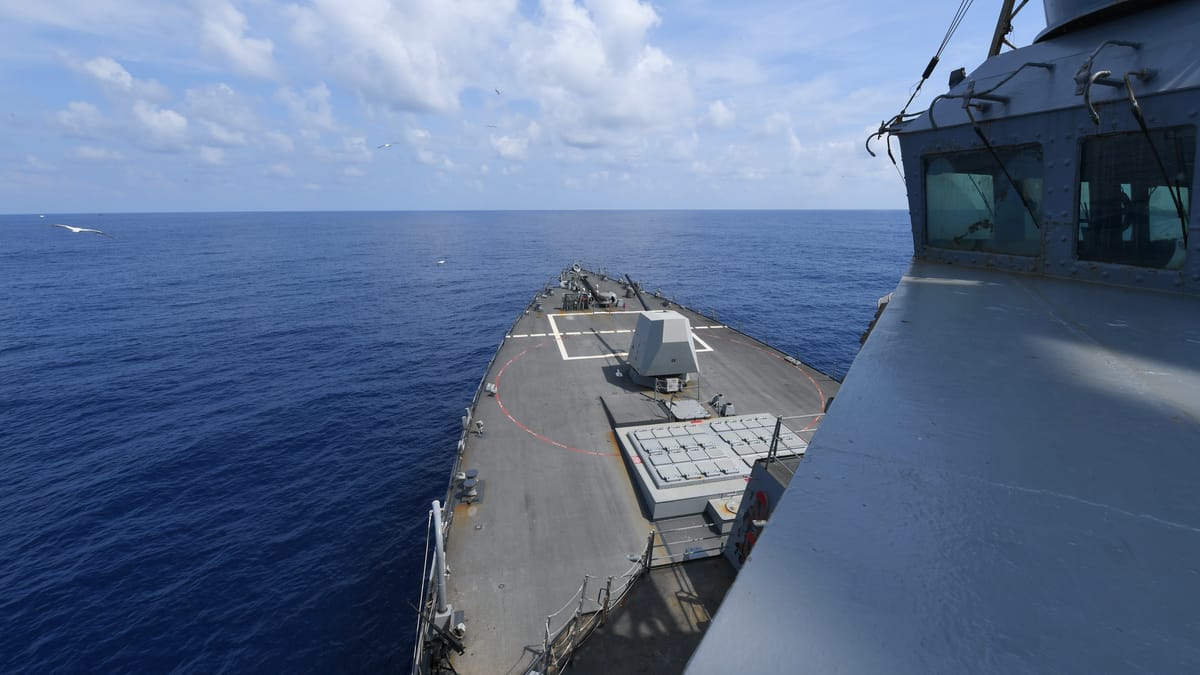
If the U.S. Navy had to explain its surface fleet with one ship class, it would probably point at the Arleigh Burke destroyer.
That is not because the Burke is the biggest ship in the fleet. It is not. It is not because the design is new. The lead ship, USS Arleigh Burke, was commissioned on July 4, 1991. It is not even because every ship in the class is identical. After more than three decades of production, modernization, and flight-by-flight changes, an early Flight I destroyer and a new Flight III destroyer are not the same animal.
The reason the class matters is simpler: the Navy keeps finding new jobs for it.
Arleigh Burke-class guided-missile destroyers escort aircraft carriers, hunt submarines, launch Tomahawk cruise missiles, defend ships against aircraft and missiles, support ballistic-missile defense, and show the flag in waters where showing the flag is the whole point. They are the Navy’s armed multitool, and they have lasted because the basic hull, propulsion plant, combat system, and upgrade path have been good enough to keep taking on new sensors and weapons.
That does not make the Burke untouchable. No surface warship is. A destroyer is still a ship that has to survive mines, submarines, anti-ship missiles, drones, electronic attack, maintenance delays, crew strain, and the brutal arithmetic of magazine depth. But the class has become the U.S. Navy’s default answer to a remarkable number of problems.
This is how a Cold War destroyer became the ship the Navy is still building while it waits for whatever comes after.
What a Destroyer Does Now
The word “destroyer” sounds wonderfully blunt.
Historically, destroyers grew out of the need to counter torpedo boats and later submarines. Modern guided-missile destroyers are much broader machines. The Navy’s public DDG 51 fact file describes them as multi-mission surface combatants built for anti-air warfare, anti-submarine warfare, anti-surface warfare, strike warfare through the Mk 41 vertical launching system, and ballistic-missile defense on ships equipped with the right Aegis baseline.
That is a lot to put on one hull.
In practical terms, a Burke is often the hard-working escort around more glamorous ships. Aircraft carriers get the headlines, but carriers need protection. Amphibious ships need protection. Supply ships need protection. A destroyer can push sensors and weapons outward from the group, add air-defense coverage, watch for submarines, and carry land-attack missiles of its own.
The Burke can also operate independently. It can patrol contested waters, conduct presence missions, join freedom-of-navigation operations, launch strikes, support missile-defense tasking, or plug into a larger coalition network. That flexibility is why the class has not aged out in the way many late-Cold-War programs did.
The ship is old enough to have been designed with the Soviet Navy in mind. It is still current enough that two Arleigh Burke-class destroyers, USS Cole and USS Bulkeley, fired interceptors during the U.S. defense of Israel against Iran’s October 1, 2024 ballistic-missile attack. Whatever else one thinks about destroyer design, that is not museum work.
From Spruance to Aegis
The Burke class began as the Navy thought about what should follow the Spruance-class destroyers and how to spread Aegis capability beyond the Ticonderoga-class cruisers.
The formula was ambitious but not mysterious. Take a new destroyer hull. Use much of the Spruance propulsion and machinery experience. Put the integrated Aegis Weapon System at the center of the ship. Give it vertical launch cells instead of older, more limited launch arrangements. Build it from steel, improve survivability, and design the superstructure with reduced radar signature in mind.
That produced DDG 51.
The Navy’s fact file says the Arleigh Burke class uses an all-new hull form, incorporates much of the Spruance machinery plant, and carries the integrated Aegis Weapon System that had already been proven on earlier ships. It also notes one of the reasons the class has endured: it has been continuously upgraded with advanced sensors, weapons, and support systems.
That word “continuously” is doing a lot of work.
The first ships, DDGs 51 through 71, are Flight I. DDGs 72 through 78 are Flight II. DDGs 79 through 124 plus DDG 127 are Flight IIA. Flight III begins with DDG 125 and DDG 126, then continues with DDG 128 and later ships. Those flight lines are not trivia. They decide everything from aviation facilities to radar, power, cooling, combat-system baseline, and modernization potential.
The original script said the first Flight III ship was commissioned in 2019. That is not right. USS Jack H. Lucas, DDG 125, was the first Flight III Arleigh Burke-class destroyer. The Navy says Jack H. Lucas was commissioned on October 7, 2023, after being launched in 2021 and delivered in 2022.
That correction matters because Flight III is the current answer to the question “how much more can the Burke design absorb?”
The Ship Itself
Arleigh Burke destroyers are large ships for the destroyer label.
The Navy lists Flight I and II ships at about 505 feet long, and Flight IIA and III ships at about 509.5 feet. The beam is listed at 59 feet. Displacement ranges from about 8,230 to 9,700 long tons depending on flight and configuration. Public top speed is given as more than 30 knots, which is the Navy’s polite way of saying enough without telling everyone exactly how much.
Power comes from four General Electric LM2500 gas turbines driving two shafts. The fact file lists 100,000 total shaft horsepower. The class is not built around nuclear endurance or exotic propulsion. It is built around a proven gas-turbine plant, a global logistics system, and a design the Navy and its shipbuilders know how to keep producing.
Crew size has grown with capability. The Navy lists a Flight IIA crew at 329 and a Flight III crew at 359. That is a reminder that modernization is not just a matter of bolting on better electronics. More capability can mean more watchstanding, more maintenance, more training, more cooling, more power, more network integration, and more people.
The Burke’s survivability story is equally pragmatic. The class uses all-steel construction. Its vital areas include Kevlar armor protection. It has collective protection against nuclear, biological, and chemical contamination. Later flights have helicopter hangars and facilities for two MH-60R helicopters, giving the ship much more reach in anti-submarine work, surveillance, logistics, and search-and-rescue tasks.
None of that makes a destroyer invulnerable. It does make the Burke a serious ocean-going combat platform rather than a missile box with a crew.
Aegis: The Brain of the Ship
The core of the Arleigh Burke story is Aegis.
Lockheed Martin calls Aegis the U.S. Navy’s and six international allies’ surface combat system, and describes it as a multi-mission system that integrates sensors and weapons for simultaneous integrated air and missile defense. Contractor language aside, that is the heart of the matter. Aegis is the ship’s way of seeing, sorting, assigning, and engaging threats fast enough for modern naval combat.
The old idea of one rotating radar giving the ship a slow sweep of the sky is not enough when anti-ship missiles, aircraft, ballistic missiles, drones, and electronic warfare are all part of the same fight. Aegis combines radar data, command-and-control, weapons control, and human decision-making into one combat system.
The Flight III upgrade is centered on the AN/SPY-6(V)1 Air and Missile Defense Radar. The Navy says that radar gives Flight III ships greatly increased capability over Flight IIA ships and enables simultaneous anti-air warfare and ballistic-missile defense. RTX describes SPY-6 as a family of radars designed to defend against ballistic missiles, cruise missiles, hypersonic missiles, hostile aircraft, and surface ships, with better range, sensitivity, and discrimination than legacy radars.
The SPY-6(V)1 version for Flight III has four fixed array faces with 37 radar modular assemblies per face. The important part is not the box count. It is what the box count means: more radar aperture, better sensitivity, more power and cooling demand, and a more demanding ship-integration problem.
That is why Flight III is not just a better radar. It is a test of how far the Burke hull can be pushed.
The Missile Battery
The “guided-missile” part of guided-missile destroyer is not decorative.
Burkes carry Mk 41 vertical launch cells, and those cells can be loaded with different mixes depending on mission. Public descriptions often reduce the ship to a single missile count, but that is too neat. A VLS loadout is a planning choice. A destroyer assigned to air defense, ballistic-missile defense, land attack, anti-submarine work, and maritime strike will not necessarily carry the same mix.
The public family of weapons includes Standard Missiles for air and missile defense, Evolved Sea Sparrow Missiles for shorter-range self-defense, Tomahawk cruise missiles for land attack and newer maritime strike roles, and Vertical Launch ASROC for anti-submarine work. The Navy also lists six Mk 46 torpedoes from two triple tube mounts, the 5-inch Mk 45 gun, Close-In Weapon System mounts where fitted, and embarked helicopters on Flight IIA and III ships.
This is why the Burke is valuable. It is not merely that it has missiles. It has cells that can be turned into different answers.
A ballistic-missile-defense patrol puts one kind of demand on the ship. A carrier escort puts another. A land-attack strike package puts another. A destroyer operating in the Red Sea, Eastern Mediterranean, Western Pacific, or North Atlantic may need a different balance of anti-air, anti-submarine, strike, and self-defense weapons.
That flexibility is also a constraint. A VLS cell can only hold one thing at a time. Once a missile is fired, it cannot be reloaded at sea in the way a gun magazine can be topped off. In a high-end missile fight, even a very heavily armed destroyer can become a magazine-depth problem.
Decoys, Jammers, Guns, and Lasers
The missile battery gets the attention, but a Burke survives through layers.
Electronic warfare systems warn, jam, and complicate enemy targeting. Chaff and decoys try to seduce incoming missiles away from the ship. Nulka active decoys, SRBOC chaff launchers, Nixie torpedo decoys, close-in weapons, small guns, and the ship’s own maneuvering all sit behind the glamorous long-range interceptors.
This is where the original script’s “almost untouchable” claim needs tightening. The Burke is layered. It is not untouchable. Modern anti-ship weapons are fast, numerous, networked, and increasingly cheap at the low end. A destroyer may be asked to defend itself against cruise missiles, ballistic missiles, one-way attack drones, small boats, submarines, mines, and electronic attack in the same theater.
The class is also part of the Navy’s directed-energy experiment. Lockheed Martin’s HELIOS program was built to put a high-energy laser with optical dazzler and surveillance functions onto an operational West Coast-based Arleigh Burke Flight IIA destroyer with Aegis. That does not mean every Burke has a laser cannon, or that lasers have replaced missiles. It means the class is one of the places the Navy is trying to add cheaper-per-shot defenses against drones, small craft, and sensor threats.
That is the pattern again: the Burke remains relevant by taking on another layer.
Why It Keeps Being Built
The Navy is not still buying Burkes because it has no imagination.
It is buying them because the class works, the shipyards know how to build them, the combat system keeps evolving, and the alternative is not ready in sufficient numbers. The Navy’s public fact file says 74 DDG 51-class ships had been delivered to the fleet, with 25 more on contract and 12 in various stages of construction at the time of that update. The exact count will keep changing as ships commission, retire, and move through construction, but the broad point is stable: this is not a boutique class.
Modernization is the second half of the story. The Navy says a second phase of DDG modernization is underway for Flight IIA ships to preserve mission relevance, increase capability, reduce workload, and lower ownership cost. In plain English: the Navy needs older Burkes to keep carrying the fleet while new Burkes arrive and the future destroyer takes shape.
That future destroyer is DDG(X), or the next-generation destroyer program.
Congressional Research Service describes DDG(X) as the planned successor for Ticonderoga-class cruisers and older DDG 51 destroyers. The Navy’s DDG(X) concept keeps DDG 51 Flight III combat-system elements but seeks more margin: more space, weight, power, and cooling for future weapons and sensors, an integrated power system, reduced signatures, increased range and time on station, and greater payload flexibility.
The reason is blunt. The Burke has been stretched hard. CRS quotes Navy language saying DDG 51 remains highly capable, but after decades of production and upgrades, the hull form lacks enough margin for some future capabilities. That is not an insult. It is what happens when a good design gets asked to carry the fleet for 40 years.
The China Question
Any article about modern U.S. destroyers eventually runs into China.
The People’s Liberation Army Navy has been building large, modern surface combatants at speed, including Type 052D destroyers and Type 055 large destroyers. A straight ship-to-ship comparison is tempting, but it is usually less useful than it looks. Combat power is not just hull size, VLS count, radar panels, or missile brochures.
Training matters. Logistics matter. Battle-network integration matters. Submarines, aircraft, satellites, cyber systems, tankers, bases, repair yards, munitions production, and alliance access all matter. A destroyer fights as part of a system.
That is where the Burke class has an advantage that is hard to see on a spec sheet. It is embedded in a U.S. Navy that has decades of experience operating Aegis ships globally, integrating with carriers and allies, conducting air and missile defense, and sustaining ships forward. China is not standing still, and the U.S. Navy cannot treat past experience as a shield against future missiles. But the Burke’s value is not just the ship. It is the ship plus the system around it.
That is also why the class is still politically and militarily important. The U.S. Navy needs enough large surface combatants to be present in several theaters at once. Until DDG(X) is ready and affordable, the Burke is the bridge.
The Legacy
The Arleigh Burke class is not exciting because it is new.
It is exciting because it refuses to leave.
It began as a Cold War destroyer built around Aegis, vertical launch cells, gas turbines, steel construction, and a hard lesson about survivability. It then became a post-Cold-War strike platform, a carrier escort, a ballistic-missile-defense ship, a forward-presence tool, a Flight III radar host, and a test bed for the systems the Navy wants to carry into the next generation.
That kind of longevity is not glamorous. It is better than glamorous. It is useful.
The Burke’s eventual replacement will need more power, more cooling, more space, more payload flexibility, and probably a larger margin for directed energy, hypersonics, uncrewed systems, and sensors that do not fit comfortably into a 1980s hull philosophy. CRS is right to frame DDG(X) as a margin problem as much as a combat-system problem.
But until that ship exists in numbers, the Navy’s answer remains the same grey shape it has trusted since 1991.
An Arleigh Burke destroyer is not the future of naval warfare by itself. It is the workhorse carrying the Navy from one future to the next.
Key Takeaways
-
Arleigh Burke-class destroyers remain central to the U.S. Navy because they combine Aegis, vertical launch cells, anti-air, anti-submarine, strike, and ballistic-missile-defense roles on one proven hull.
-
The first DDG 51 entered service in 1991, but the class has evolved through Flight I, II, IIA, and III variants rather than staying frozen in its original Cold War configuration.
-
Flight III begins with USS Jack H. Lucas, commissioned in 2023, and centers on the AN/SPY-6(V)1 Air and Missile Defense Radar.
-
The class is powerful but not invulnerable; modern missile, drone, submarine, mine, and electronic-warfare threats make magazine depth and layered defense central to survival.
-
DDG(X) exists because the Burke design is still useful but running out of growth margin for future power, cooling, payload, and sensor demands.

Simon Whistler
Simon Whistler hosts MegaProjects, bringing engineering, infrastructure, and military-machine stories into clear narrative focus for viewers who want the systems, tradeoffs, and human decisions behind the build.
Frequently Asked Questions
What is an Arleigh Burke-class destroyer?
It is a U.S. Navy guided-missile destroyer class centered on the Aegis combat system and Mk 41 vertical launch cells. The ships conduct air defense, anti-submarine warfare, anti-surface warfare, strike missions, escort work, and, on equipped ships, ballistic-missile defense.
When did the Arleigh Burke class enter service?
USS Arleigh Burke, DDG 51, was commissioned on July 4, 1991. The class remains in production and has been repeatedly upgraded through later flights and modernization programs.
What is different about Flight III Arleigh Burke destroyers?
Flight III centers on the AN/SPY-6(V)1 Air and Missile Defense Radar, along with associated power, cooling, and combat-system changes. USS Jack H. Lucas, DDG 125, is the first Flight III ship and was commissioned in 2023.
How many missiles does an Arleigh Burke carry?
The exact operational loadout varies by flight and mission. Burkes use Mk 41 vertical launch cells that can carry different mixes of Standard Missiles, Evolved Sea Sparrow Missiles, Tomahawks, Vertical Launch ASROC, and other compatible weapons.
Does every Arleigh Burke have lasers?
No. Directed-energy systems such as HELIOS are part of selected integration and testing work, not a classwide replacement for missiles and guns. They are best understood as another layer the Navy is exploring for drones, small craft, and sensor threats.
Why is the Navy still building Arleigh Burke destroyers?
The design is proven, the shipyards know how to build it, the combat system keeps evolving, and the next-generation DDG(X) is not yet available in fleet numbers. New Burkes and modernized older ships help maintain large-surface-combatant capacity.
What will replace the Arleigh Burke?
The Navy’s planned next-generation destroyer is DDG(X). Public CRS reporting describes it as a future large surface combatant that would carry DDG 51 Flight III combat-system elements on a hull with more space, weight, power, cooling, range, and future payload margin.
Sources
-
Original MegaProjects video: Arleigh-Burke: The Mother of all Naval Destroyers
-
U.S. Navy: USS Jack H. Lucas (DDG 125) Arrives at Homeport in San Diego
-
Lockheed Martin: More Than a Laser, HELIOS is an Integrated Weapon System
-
Congressional Research Service: Navy DDG(X) Next-Generation Destroyer Program
-
Hero image source: USS Halsey underway in the South China Sea by Petty Officer 2nd Class Ismael Martinez / U.S. Navy, public domain.
Related Projects
USS Constellation
The USS Constellation began as a safer frigate bet built on the FREMM parent design. By 2026, delays and redesigns had shrunk the program to two ships.
Sea Hunter
How Sea Hunter grew from a DARPA submarine-tracking prototype into a fleet-controlled unmanned surface vessel for the U.S. Navy.
LRASM
How LRASM restored America's long-range anti-ship strike capability with stealth, autonomy, and a missile built from the JASSM-ER family.


.jpg)