

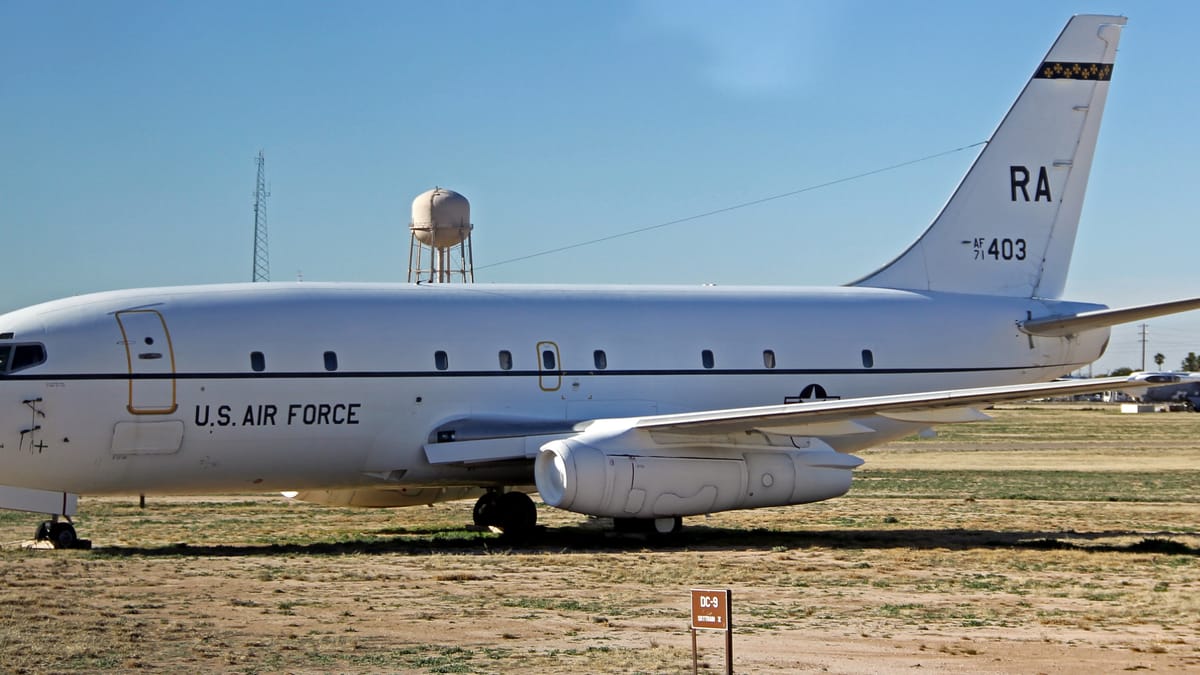
When it comes to weird and wonderful aircraft, the United States does it better than anybody else in the world. From the World War II-era Flying Pancake, to vertical take-off and landing propeller planes, to the Pregnant Guppy, the Flying Chainsaw, the diagonal-wing AD-1, and even that very first wood-and-cloth contraption that paved the way for all the rest, America has put some positively wacky stuff in the sky. In the modern day, it has flown everything from the tailless X-36 and MANTA, to the winged Speedhawk helicopter, to the needle-thin Quesst and more.
But there’s one exceptionally strange aircraft flying above the United States that has somehow escaped the world’s notice, despite being the kind of invention that can never be un-seen once you’ve gazed upon its strange glory. Its name is the RAT — more precisely, RAT 55 — and it’s an enigma even within the arsenal of the United States Air Force. Nobody knows where it’s based, nobody knows quite what it does, and nobody has ever shared what it looks like on the inside.
But we know it’s in active service, we know it’s one-of-a-kind, and judging by both when and where it shows up, we can take a reasonable guess that it’s involved in some of the most important projects of the US military. So let’s confront RAT 55 with one simple question: why are you the way that you are?
- Base airframe
- Boeing 737-200
- Air Force serial
- 73-1155
- Estimated length
- ~123ft (37.5 m)
- Top speed
- ~586mph (943 km/h)
- Return to service
- 21 March 2001
- Aircraft of its kind
- One (NT-43A)
An International Plane of Mystery
RAT 55 is about as elusive a beast as one could hope to track down in the great, big world that is the US defense industry — but there are a few key things we know for certain. The base aircraft is a Boeing 737-200, a variant of the 737 jetliner that first entered commercial service under the dash-two-hundred marker in 1968. It flies under the auspices of the United States Air Force, with serial number 73-1155, and it has been observed operating at or around both Area 51, the highly classified Air Force facility in the Mojave Desert, and the Tonopah Test Range — otherwise designated Area 52 — about seventy miles, or 110 kilometers, away.
We know that RAT 55 can fly, we’re reasonably confident it has people onboard when it does, and sometimes it flies accompanying America’s vaunted B-2 Spirit stealth bomber. Officially, it’s classed within the Air Force’s registry as the NT-43A, the only aircraft of its kind.
Thanks to a small handful of clear images circulating in the public domain, we also know this extensively modified jetliner’s unforgettable appearance. Affixed to the front is a gigantic, bulbous radome, sticking out like an extra-long nose well ahead of the cockpit. Large air data sensors stretch backward from the radome past the cockpit, nearly to the aircraft door.
At the very rear of the plane is another radome, this one seemingly even longer, stretching out behind it like the bushy tail of an animal. The aircraft also features infrared above its radar, a number of other unexplained antennas, and an area along the top that can be removed and replaced to make room for extra sensors or a satellite communications system.
From Navigator Trainer to One-of-a-Kind
While the aircraft’s current purpose is not clearly established, its history is known well. RAT 55 was one of nineteen 737-200 aircraft acquired by the US Air Force starting in 1973, collectively flying under the name T-43 and nicknamed “Gator” — short for “navigator.” The aircraft that would become RAT 55 served, like the rest of the T-43s, as a navigational training aircraft, working with Air Force trainee technicians from 1974 through 1997.
It was eventually retired, shipped off to America’s great aircraft cemetery — the Boneyard — and there it languished in the hot desert sun for about two years. Then it was dragged out of storage, taken off to whatever organization was responsible for its one-of-a-kind refit, and returned to service, taking its first flight in its new iteration on the twenty-first of March, 2001.
Basic Specs and Suspected Purpose
That’s what we know about RAT 55 — but it doesn’t tell us much about what the aircraft actually does, or why it’s important. To answer that, we start with the three words the acronym RAT is believed, albeit not confirmed, to stand for: Radar Airborne Testbed.
That first word, “radar,” isn’t a terribly big surprise for experts who know what they’re looking at. The great, big bulges out the front and back are radomes, each housing a radar apparatus, presumably to cast a radar field of view out in front of and behind the aircraft. It’s not known for sure, but either or both of those radar systems might feature a so-called agile sensor — one that can be steered to point its field of view in certain directions, over a much wider “field of regard.”
As for why RAT 55 would have such an unusual radar setup, the origins of the aircraft are thought to trace back to Lockheed Martin’s Advanced Prototype Center. According to GlobalSecurity, in the year 2000 the Advanced Prototype Center sent a “flight-worthy composite structure” to a company called Denmar, based in Lawton, Oklahoma. That company works primarily with stealth technology, and it’s led by a former engineer of Lockheed Skunk Works, Denys Overholser.
The apparatus that Lockheed Martin sent to Denmar was a fairing and bulkhead assembly — a streamlined outer structure with internal compartments — measuring nineteen feet long and about six feet three inches in diameter, meant to fit into the rear fuselage of a modified Boeing 737-200. Denmar would build a total of four radomes, each at least six and a half feet in diameter and at least nine feet long, all seemingly intended to work as part of RAT 55.
What these radar fixtures are thought to allow RAT 55 to do is to take very, very detailed images of their targets using so-called synthetic aperture radar — a kind of radar-mapping that provides three-dimensional reconstructions of objects at high resolution. RAT 55 appears to feature infrared detection devices of similar power, and if functioning properly, both tools should be able to work together and provide a clear picture of whatever the aircraft’s beams are pointed at.
Reading the numbers
For those well-accustomed to aircraft episodes here on MegaProjects, this is about the time we’d typically deliver a run-down of an aircraft’s specs, so we’ll at least try to do the same in the areas we’re able. Given the documented, tip-to-tail length of the modified line of Boeing 737-200s from which RAT 55 was adapted — plus an estimated protrusion past the tail of about fifteen feet, and a shorter protrusion up front we’ll estimate at about eight feet — we’d expect RAT 55 measures roughly 123 feet, or thirty-seven and a half meters, tip to tail.
Its wingspan is probably about the same as any other T-43, at ninety-three feet or twenty-eight meters, although it’s not inconceivable that the wings could have been lengthened a bit, or had their profile changed, to add lift and compensate for the added weight of the front and aft radomes. The aircraft can hit top speeds of around 586 miles per hour, or 943 kilometers per hour — more than able to keep up with supersonic jet fighters like the F-22 and F-35, and to fly alongside the B-2 Spirit and other delta-wing stealth aircraft in America’s current and future arsenal.
The T-43, and probably RAT 55, featured an endurance of six hours in flight, powered by a pair of Pratt & Whitney JT8D-9A turbofans, with recent imagery indicating RAT 55 either kept those engines or replaced them with something similar. As for what goes on inside the aircraft, we couldn’t tell you — but the standard T-43 flew with a pilot and copilot, and had seats for nineteen people, mostly trainees using equipment housed inside.
The Stealth Connection
It’s not an accident that RAT 55 is so frequently spotted alongside one of America’s most critical stealth aircraft, the B-2 Spirit. RAT 55’s job is almost certainly to take pictures of those stealth aircraft — and to do it with such precision, at such a high resolution, that it can capture details no other radar installation would be able to see.
Because it can fly in front of or behind these stealth aircraft, it can beam them with radar from angles that ground sensors would never be able to achieve. It can use its radomes and other sensors on both the front and rear to take detailed imagery of both the front and back of these stealth aircraft while flying alongside them — instead of trying to grab as much data as possible during a rushed, head-to-head fly-by.
And when it comes to the final image that RAT 55 is probably trying to get, the Air Force would likely prefer that the plane and its operators can see nothing at all. For RAT 55 to fly so close to these aircraft, with such powerful onboard imaging technology, means the people onboard have the ability to take a closer, more detailed look at these stealth aircraft — using radar and infrared — than any person or nation on Earth ever should. So if those aircraft can fly before or behind RAT 55, have their picture taken innumerable times, and have very little, if anything, show up for the operators, then it’s highly unlikely that anything else on Earth would be able to get a clearer picture.
Why Does It Matter?
So, that’s the secretive, ill-defined, and still poorly-understood aircraft known as RAT 55. But why is it so important? Why must its capabilities be kept so secret, and why is it so important to keep around when America’s stealth aircraft have each flown for decades now?
At its most basic, RAT 55’s strengths are in that up-close, in-flight imaging capability. While America’s stealth aircraft can be seen with the naked eye, they should be nearly invisible to radar and infrared detection systems. That’s the entire point of having them — so they can skate past enemy aircraft and air defenses and start causing chaos in areas where American planes aren’t supposed to be. What RAT 55 does is achieve a level of imaging clarity that should be basically unmatched.
Even if, say, China were able to successfully intercept an American F-22 with its own stealth fighter, the J-20 Mighty Dragon, and get very close to it, that J-20’s onboard radar likely wouldn’t hold a candle to RAT 55’s ability to image that airplane. Extend that difference to less advanced adversary aircraft with less advanced radar, or to ground-based air-defense systems, and RAT 55’s abilities are even more superior. To put it simply: if RAT 55 can’t see your stealth aircraft, nothing can.
The degree to which RAT 55 can see stealth aircraft is anyone’s guess, but at such close range, with such powerful equipment, it can likely see those aircraft a whole lot more clearly than most radar and infrared systems could. That may be especially true when it examines aircraft from angles other than their head-on profile, where they’re meant to be at their very stealthiest. Side or rear-view attempts to use radar imaging on stealth aircraft have a significantly better chance of success than front-facing views, so it’s likely that, at least from those angles, the data RAT 55’s operators receive doesn’t just indicate that the sky is empty.
Two key advantages
That level of imaging capability provides two key advantages. First, it offers a lot of peace of mind when evaluating the performance of stealth aircraft. If certain profiles or details show up hazily, or not at all, for RAT 55, then it’s extremely unlikely that any other nation will get a clear view. And since RAT 55 is probably carrying very powerful tools, the highest-quality data it captures can be scaled and adjusted down to match what other aircraft or radar installations are capable of.
For that reason, RAT 55’s primary task seems to be to conduct full evaluations of stealth aircraft from all possible angles — pointing out problem areas, clearing the most effective stealth profiles, and giving the sort of data that lets the US Air Force extrapolate. Once the Air Force has RAT 55’s data, it can conduct much more accurate evaluations of what a friendly or adversarial system will be able to see: the Russian S-300 air defense system, for example, or a modern airborne early warning and control aircraft like the E-7 Wedgetail or Beriev A-100.
Taking into account the expected strength of those systems, the Air Force can evaluate what they’ll be able to see, drawing on the comparison case of RAT 55 — about as close to a perfect view as any global radar system is likely to get. Once American planners have a clear idea of what an adversary can see, they gain a major upper hand in strategic and tactical planning. If they know that a nation using S-300s can detect an incoming stealth aircraft only once it gets within, say, fifteen kilometers, then once the US can pinpoint those S-300s, it can thread the needle and plot a flight path that keeps its stealth aircraft away from danger.
They can also plan for pilots to stay hidden when something goes wrong mid-mission. If people on the ground hear an unexplained plane overhead at night and an adversary scrambles a fighter to intercept, RAT 55’s data informs the plan for the stealth aircraft to deal with that fighter’s radar and infrared. If those fighters only have front-facing radar — which most rely on, to a fault — but RAT 55 has shown the American stealth plane is all but undetectable from the front, then its pilots know to fly a straight shot at the hunters and slip by unseen. If RAT 55’s data shows the stealth aircraft can’t handle what those fighters carry head-on, it gives pilots and commanders plenty of time to work out escape methods in advance.
Maintenance checks and the future
The continual use of RAT 55, including with aircraft like the B-2 Spirit whose contours and stealth profiles are almost certainly well understood by now, suggests another key function: checking and sweeping over these aircraft after repairs or work, to make sure everything’s in the right place. If a screw wasn’t covered up properly and risks pinging radar back to its source, that screw should show up as an impossible-to-miss point of radar return for instruments as sensitive as RAT 55’s. When it’s not verifying maintenance, RAT 55 may participate in experiments on new technologies, like an experimental radar-absorbent coating or a new sensor bubble meant to blend seamlessly with the rest of an aircraft’s profile.
And RAT 55’s most important mission of all, in an era of rapid air-power development, might have little or nothing to do with the stealth aircraft already in service. RAT 55 is the perfect tool to test America’s future stealth aircraft, of which there are a wide range thought to be in active development. Almost certainly, it has had a close look at the B-21 Raider, the eventual replacement for the B-2 Spirit.
It has probably had encounters with the flying prototypes of the NGAD — the Next Generation Air Dominance program — meant to give the United States an ultra-advanced fighter jet; a full-scale technology demonstrator and three separate prototypes are known to have flown. RAT 55 will likely have worked with stealth drones like the RQ-180, an aircraft the US government still has never acknowledged. The US Navy’s F/A-XX may have been evaluated as well, and RAT 55 could have gotten a look at prototypes for America’s Loyal Wingman program.
Its operating locations, at Area 51 and Area 52, suggest it’s in close proximity to all sorts of experimental aircraft — and we can only imagine what other advanced designs its pilots have seen.
As far as we in the public domain can tell, there is only one RAT 55, although it’s not impossible the Air Force is hiding multiple copies under the same callsign. But regardless of whether it’s a unique aircraft or a small line of them, the thing RAT 55 is, is truly one of a kind. It’s not a stealth aircraft, and it’ll never garner the acclaim of the B-2 or the F-22.
But it’s the key to America’s stealth aircraft programs — and those programs are, themselves, the key to American air dominance around the world. Whatever that elusive, mysterious RAT 55 really does, it is the linchpin that holds together America’s entire stealth airfleet.
Key Takeaways
- RAT 55 is a one-of-a-kind, extensively modified Boeing 737-200 (serial 73-1155), officially registered as the NT-43A, in active US Air Force service.
- It began life as a T-43 “Gator” navigation trainer (1974–1997), was retired to the Boneyard, then refitted and returned to service with its first flight on 21 March 2001.
- Its signature feature is a pair of huge radomes — one ahead of the cockpit and a longer one trailing the tail — believed to house powerful radar, alongside infrared sensors and a removable upper bay.
- “RAT” is believed (not confirmed) to stand for Radar Airborne Testbed; it likely uses synthetic aperture radar to image stealth aircraft in extreme detail from angles ground sensors can’t reach.
- It is regularly spotted alongside the B-2 Spirit, and its data helps the Air Force evaluate stealth profiles, verify post-maintenance work, and plan flight paths around adversary radar like the S-300.
- It may also be testing America’s future stealth aircraft, including the B-21 Raider, NGAD prototypes, the RQ-180, the Navy’s F/A-XX, and Loyal Wingman drones.

Simon Whistler
Simon Whistler hosts MegaProjects, bringing engineering, infrastructure, and military-machine stories into clear narrative focus for viewers who want the systems, tradeoffs, and human decisions behind the build.
Frequently Asked Questions
What exactly is RAT 55?
RAT 55 is a heavily modified Boeing 737-200 in active US Air Force service, officially designated the NT-43A and the only aircraft of its kind. It carries the serial number 73-1155 and is distinguished by two enormous radomes mounted at its nose and tail. Its precise mission is classified, but the callsign “RAT” is believed to stand for Radar Airborne Testbed.
Why does RAT 55 have those giant bulges on its nose and tail?
Those bulges are radomes, each housing a radar apparatus that casts a field of view out in front of and behind the aircraft. They are thought to enable synthetic aperture radar imaging — high-resolution, three-dimensional reconstructions of targets. The aircraft also carries infrared sensors and a removable upper section for extra equipment or satellite communications.
What is RAT 55 used for?
Its primary task appears to be imaging America’s stealth aircraft in extraordinary detail, from front, side, and rear angles that ground-based sensors can’t achieve. This lets the Air Force evaluate stealth profiles, verify that repairs and coatings are correctly applied, and extrapolate what adversary radar systems would be able to detect. It may also be testing next-generation stealth aircraft and drones.
How does RAT 55 help the US military plan missions?
By revealing how visible a stealth aircraft is to radar and infrared, RAT 55’s data lets planners model what adversary systems — like the Russian S-300 — can actually see. With that knowledge, they can route stealth aircraft around danger zones and prepare evasion tactics in advance. In short, if RAT 55 can’t see a stealth aircraft, it’s very unlikely anything else can either.
Why is it so often seen flying with the B-2 Spirit?
RAT 55 can fly directly in front of or behind the B-2, beaming it with radar from angles unavailable to ground stations and imaging both ends of the aircraft while cruising alongside it. Beyond evaluating the B-2’s stealth, it also likely sweeps the bomber after maintenance to confirm that every panel and fastener is correctly in place. A loose or exposed screw would show up as an obvious point of radar return.
Is there only one RAT 55?
As far as anyone in the public domain can tell, there is just one RAT 55. It’s not impossible that the Air Force is concealing additional copies under the same callsign, but no second aircraft has been confirmed. Either way, the type itself is genuinely one of a kind.
Sources
-
Original MegaProjects video: RAT-55: Why the US Military Built the Weirdest Boeing Ever Made
-
The War Zone — These Are The Best Images Yet Of ‘RAT 55’, The World’s Most Secretive 737
-
Hero image source by Clemens Vasters / Wikimedia Commons, CC BY 2.0.
Related Projects
Boeing E-3 Sentry: The Story of America’s Ultimate Eye in the Sky
Inside the Boeing E-3 Sentry AWACS, the modified 707 that became America's ultimate airborne radar and the eye in the sky for nearly 50 years
The Most Expensive Plane Crash in History
In 2008, a $1.2 billion B-2 Spirit stealth bomber crashed on takeoff in Guam after moisture corrupted its sensors — the costliest aviation accident ever.
The A-12 Avenger II: The Stealth Bomber That Could Have Changed Everything
How the A-12 Avenger II, the US Navy's triangular stealth attack jet nicknamed the Flying Dorito, collapsed before its first flight


.jpg)