
MAKO is not the biggest hypersonic missile Lockheed Martin could talk about.
That is the point.
Modern hypersonic weapons are often sold to the public as enormous national prestige machines: giant boosters, exotic engines, eye-watering budgets, and claims about Mach numbers so high they almost stop meaning anything. MAKO is different. It is still a hypersonic weapon. It is still meant to reach time-sensitive, heavily defended targets at extreme speed.
But its sales pitch is not simply “faster” or “bigger.” It is small enough to fit into the aircraft mix the United States and its allies already fly, and cheap enough, at least in theory, to buy in more useful numbers.
That makes MAKO one of the more interesting hypersonic designs in public view.
It is also a missile that needs cautious language. As of June 6, 2026, MAKO is not a publicly fielded operational weapon with disclosed squadrons, inventory counts, or combat use. Lockheed Martin says the weapon has been in development for years, has been fit-checked on multiple aircraft, and is mature enough to pitch to customers. That is not the same thing as a procurement program of record.
The real story is therefore not that MAKO has already changed warfare. It is that Lockheed is trying to solve one of the least glamorous problems in the hypersonic race: how to make a weapon fast enough to matter, small enough to carry, and affordable enough not to become a boutique science project.
The Missile of 13s
MAKO is compact by hypersonic standards.
Lockheed Martin describes it as a multi-mission hypersonic missile with a 1,300-pound airframe, a 13-inch diameter, and a 13-foot length. The War Zone reported from the 2024 Sea Air Space exposition that Lockheed’s Rob Osterhoudt called it “the missile of 13s,” adding that the weapon includes a 130-pound warhead.
Those numbers matter because carriage is the central design feature. A huge hypersonic missile can be impressive and still be awkward if only a few aircraft or ships can launch it. MAKO is being pitched as a weapon that can go on a much broader set of platforms.
Lockheed says MAKO has been physically fit-checked externally on the F-35, F/A-18, F-16, F-15, and P-8, and internally on the F-22 and F-35C. The company also says any aircraft with 30-inch lugs can carry it, including bombers. Defense reporting has described the same broad idea: a small hypersonic weapon that can exploit fifth-generation fighters without forcing the United States to reserve hypersonic strike only for large bombers or ship-launched systems.
The distinction is important. A bomber can carry large weapons, but it is not always the aircraft closest to the problem. A stealth fighter can get nearer to defended airspace, find or receive target data, and launch from a geometry that changes the defender’s timing. If that fighter can carry a hypersonic missile without losing the whole point of stealth, the weapon becomes more than a fast projectile. It becomes part of an operational tactic.
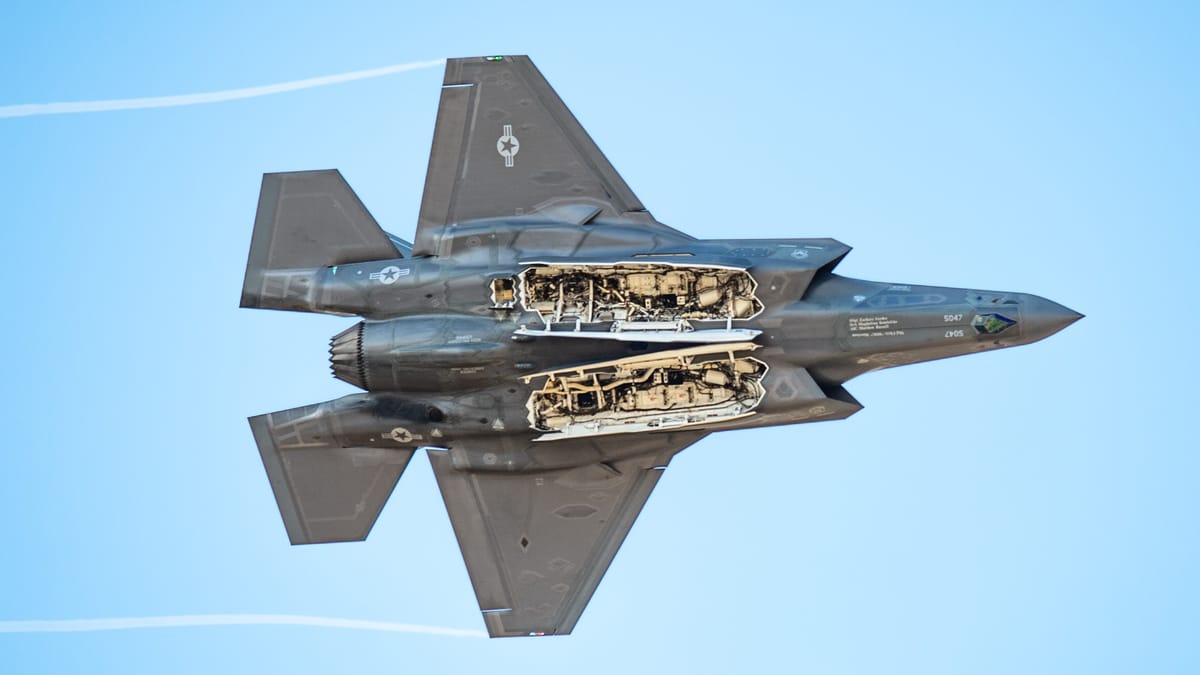
The hero image for this article shows an F-35A with its weapons bays open. It does not show MAKO. It shows the aircraft-design problem MAKO is trying to exploit.
Why Small Can Be More Dangerous
The script for the original video compares MAKO with larger weapons such as Russia’s Zircon and other hypersonic systems. The comparison is useful, but only if it is framed carefully.
A smaller missile usually means less room for fuel, less room for a large warhead, and less room for exotic propulsion. MAKO is not being publicly sold as the longest-ranged or heaviest hypersonic weapon in the world. The public range remains undisclosed, and The War Zone reported that Lockheed would not put it in the same range class as larger systems such as the Navy’s HALO concept or the Air Force’s AGM-183A ARRW.
That sounds like a weakness. It can also be a trade.
If MAKO can be carried by more aircraft, bought in larger numbers, and integrated faster, then it may be useful even if it does not outrange every rival. In a real campaign, a commander may not need one exquisite missile that can fly the farthest possible route. They may need enough missiles to hit air-defense nodes, launchers, ships, radars, jammers, and command facilities before those systems can move or recover.
This is the attraction of a compact hypersonic missile. It turns hypersonics from a strategic trophy into something closer to a magazine-depth problem. The question becomes less “can one weapon reach Mach 5?” and more “can enough aircraft carry enough rounds to make the opening strike matter?”
That is why MAKO’s affordability claims are central to the pitch.
Solid Rocket, Digital Design
MAKO is not a scramjet cruise missile in the way many people imagine when they hear “hypersonic.”
The War Zone reported that MAKO uses a solid-fuel rocket motor. Lockheed’s own public page emphasizes a digitally engineered, open, producible missile that uses existing components and proven supply chains. The company also says MAKO was among its first missiles designed entirely in a digital engineering ecosystem, with manufacturing engineers involved from the start.
That is a very contractor-ish way of saying the missile is supposed to be buildable.
For hypersonic weapons, buildability matters. Scramjets, thermal protection, guidance, seekers, and high-speed flight controls are all difficult. A weapon that can demonstrate once but cannot be manufactured, maintained, upgraded, or bought in volume is not much of a military answer. Lockheed is trying to make MAKO sound less like a laboratory trophy and more like an industrial product.
The company points to additive manufacturing as one cost-reduction path. Its public MAKO feature says engineers used additive manufacturing for the guidance section and fins, and says the additive guidance section met requirements while reducing cost and schedule compared with conventional subtractive methods.
Those are company claims, not independent cost audits. They should be read as part of Lockheed’s sales case. But they also identify the right problem. The United States does not only need hypersonic prototypes. It needs weapons that can survive the budget process and be built in quantities that matter.
The SiAW Backstory
MAKO’s path runs through the Air Force’s Stand-in Attack Weapon, or SiAW.
SiAW is the Air Force’s effort to give stand-in platforms a fast air-to-surface weapon for high-value targets inside an enemy’s anti-access network. Public descriptions of the award frame the weapon as part of a digital acquisition effort built around open architecture and rapid modernization.
Lockheed offered MAKO for SiAW, but it did not continue into Phase 2. The Air Force awarded Northrop Grumman a roughly $705 million contract in September 2023 to continue SiAW work. That means MAKO lost the most obvious U.S. Air Force path it had.
Losing SiAW did not make the missile irrelevant.
Lockheed is now pitching MAKO more broadly: to the U.S. Navy and Air Force, and potentially to allies such as the United Kingdom and Australia. The War Zone also reported that Lockheed and CoAspire have explored whether the missile could be adapted for vertical-launch systems on surface ships or submarines. The UK-focused hypersonics paper from the Council on Geostrategy similarly treats MAKO as a possible small, solid-rocket-powered hypersonic weapon relevant to aircraft with 30-inch lugs, while noting that public details such as range and speed remain limited.
That is the second life of MAKO: not the winner of SiAW, but a mature-looking design looking for a buyer.
What “Hypersonic” Actually Adds
Hypersonic does not simply mean “fast missile.”
Congressional Research Service defines hypersonic weapons as weapons that fly at least Mach 5, and it distinguishes between hypersonic glide vehicles and hypersonic cruise missiles. The tactical problem is speed plus maneuverability plus flight profile. A ballistic missile can also travel at hypersonic speed, but a predictable ballistic arc gives defenders a different kind of tracking problem. A maneuvering hypersonic weapon can compress detection and decision timelines.
That is the useful military promise. A defender sees less, later. The target may have only a small window to move, jam, shoot, hide, or hand off the track. A missile that can arrive very quickly and maneuver on the way in is a serious problem for air defenses, ships, and mobile launchers.
It is not magic.
Hypersonic weapons still have to navigate, survive heat and stress, receive or process target information, and hit what they were sent to hit. A compact missile with a smaller warhead may need high accuracy to be useful against hardened or large targets. A missile launched from a stealth fighter also inherits the risk of the aircraft’s mission: tanker support, basing, enemy sensors, weather, communications, and rules of engagement.
This is where MAKO’s smaller size cuts both ways. It helps with carriage and cost. It may limit range, payload, or endurance. The whole design is a tradeoff.
The Target Set
The original SiAW target set explains why MAKO exists.
The targets are not random bunkers. They are the systems that make modern anti-access networks work: air-defense radars, missile launchers, cruise-missile platforms, GPS jammers, anti-satellite systems, command nodes, and other high-value pieces that are hard to reach with slower weapons once the war has started.
MAKO’s public mission list has widened beyond that. Lockheed describes strike, maritime strike, counter-air-defense, and other missions. The War Zone reported Osterhoudt describing the missile as useful against surface combatants, though he would not disclose range. That maritime angle matters because a fast, fighter-carried missile could create a different threat geometry for ships, especially if launched from stealth aircraft or maritime patrol aircraft.
Still, a 130-pound warhead shapes expectations. MAKO is not a battleship shell wearing a hypersonic costume. It is more plausibly a precision weapon for valuable nodes, ships vulnerable to mission-kill damage, radars, launchers, and other targets where speed and accuracy are more important than blast mass.
That may be enough. Modern military systems are full of fragile, expensive, high-value parts. You do not always have to obliterate the entire base if the real target is the radar, the launcher, the command van, the fuel point, or the sensor suite.
Defenses Are Catching Up Too
Hypersonic weapons are hard to stop, but the defense side is moving.
Congressional Research Service notes that hypersonic weapons challenge detection and defense because of speed, maneuverability, and lower-altitude flight compared with traditional ballistic trajectories. That compressed timeline is the real danger. But it also notes that space-based sensors, fire-control systems, and interceptors are being explored as part of the future defense architecture.
Northrop Grumman’s Glide Phase Interceptor page describes GPI as a system meant to detect, track, control, and engage hypersonic threats during the glide phase, integrating into the Missile Defense Agency ecosystem. That is a company product page, but it shows where the counter-hypersonic market is going: better tracking, better seekers, and interceptors designed for the part of flight where hypersonic threats are currently hardest to handle.
This matters for MAKO because hypersonics are not a permanent cheat code. If small hypersonic missiles proliferate, defenses will adapt. The advantage may be strongest before defenders have enough sensors, interceptors, doctrine, and magazine depth to respond.
That makes affordability a two-sided question. If the defender must fire a very expensive interceptor at each incoming missile, a cheaper hypersonic attacker has leverage. If the attacker can only afford a handful of rounds, the defender can plan around rarity. MAKO is trying to sit on the favorable side of that exchange.
The Export Pitch
MAKO is not only about the U.S. inventory.
Lockheed has publicized the missile as a multi-mission weapon, and defense reporting has tied the design to allied interest. The UK and Australia are obvious names because both work closely with the United States on advanced weapons, both operate or plan around aircraft that could be relevant to the carriage problem, and both are thinking about long-range strike in increasingly dangerous regions.
The UK angle is especially interesting. Britain wants more conventional long-range strike options, but it does not have the same bomber force the United States has. A compact missile that can be carried by tactical aircraft is therefore more attractive than a weapon that assumes a large bomber fleet. The Council on Geostrategy paper notes MAKO’s compatibility with aircraft using 30-inch lugs and frames it as one of the hypersonic options relevant to Britain’s future choices.
There is a gap between “relevant” and “procured.” No public evidence shows MAKO has secured a major production order. But the export logic is clear. If hypersonic weapons become a normal part of high-end air forces, a smaller and cheaper design may be easier for allies to adopt than the largest U.S.-only weapons.
The Real Question
The easy story is that MAKO is Lockheed’s new hypersonic monster.
The better story is that MAKO is a test of whether hypersonic weapons can become ordinary enough to be useful.
That sounds strange, because nothing about Mach 5 flight is ordinary. But military value often comes from boring repeatability. Can the missile be carried by common platforms? Can it be produced without heroic manufacturing? Can it be upgraded without a proprietary trap? Can it be bought in numbers? Can pilots and planners treat it as a real option rather than a once-a-year demonstration round?
MAKO is built around those questions.
It may never become the missile Lockheed wants it to become. It may find a customer, or it may remain a polished pitch after losing SiAW. It may prove affordable, or the classified details may complicate that claim. It may be excellent against some target sets and wrong for others.
But as a concept, it is important because it points toward a different hypersonic future. Not just a few enormous national showpieces, but smaller, more numerous, fighter-carried weapons that make speed a tactical problem.
If MAKO succeeds, its biggest achievement may not be the top speed. It may be making hypersonics small enough, practical enough, and cheap enough to leave the showroom.
Key Takeaways
-
MAKO is Lockheed Martin’s compact multi-mission hypersonic missile, publicly pitched as a smaller and more affordable way to put hypersonic strike on existing aircraft.
-
Lockheed says the missile is 13 feet long, 13 inches in diameter, and 1,300 pounds, with fit checks on multiple tactical aircraft and internal checks on the F-22 and F-35C.
-
MAKO was offered for the Air Force’s Stand-in Attack Weapon program, but Northrop Grumman won the Phase 2 SiAW contract in 2023.
-
The missile is not publicly fielded as an operational weapon; the public record supports a mature pitch and development history, not a deployed inventory.
-
Its strategic importance is the tradeoff: less range and payload than larger hypersonic systems may be acceptable if the weapon is cheaper, easier to carry, and available in useful numbers.

Simon Whistler
Simon Whistler hosts MegaProjects, bringing engineering, infrastructure, and military-machine stories into clear narrative focus for viewers who want the systems, tradeoffs, and human decisions behind the build.
Frequently Asked Questions
What is the MAKO missile?
MAKO is a Lockheed Martin multi-mission hypersonic missile designed to be compact enough for carriage by several tactical aircraft. It is pitched for strike, maritime strike, counter-air-defense, and related high-value target missions.
Is MAKO already in service?
No public evidence shows MAKO as an operationally fielded missile with disclosed units or inventories. Lockheed presents it as a mature, customer-ready design, but that is not the same as a fielded program.
How fast is MAKO?
Lockheed and defense reporting describe MAKO as hypersonic, meaning at least Mach 5. Specific speed, range, and flight-profile details remain undisclosed.
How large is the missile?
Lockheed says MAKO is 13 feet long, 13 inches in diameter, and weighs 1,300 pounds. The War Zone reported that Lockheed described a 130-pound warhead.
Which aircraft can carry MAKO?
Lockheed says MAKO has been fit-checked externally on the F-35, F/A-18, F-16, F-15, and P-8, and internally on the F-22 and F-35C. The exact operational loadout would depend on the customer, aircraft variant, integration work, and release testing.
Why did MAKO not become SiAW?
Lockheed offered MAKO for the Air Force’s Stand-in Attack Weapon program, but Lockheed did not continue into Phase 2. The Air Force awarded the Phase 2 SiAW contract to Northrop Grumman in 2023.
Why does MAKO matter if it is smaller than other hypersonic missiles?
Size is the selling point. A smaller hypersonic missile may have less range or warhead mass than larger systems, but it could fit more aircraft, cost less, and be bought in larger numbers.
Sources
-
Lockheed Martin: Mako, A Hypersonic Missile That’s More Than Ready
-
The War Zone: The Lowdown On Lockheed’s Newly Revealed Mako Hypersonic Missile
-
EveryCRSReport: Hypersonic Weapons - Background and Issues for Congress
-
Council on Geostrategy: Britain’s Hypersonic Challenge - Strategic Opportunities and Risks
-
GovConWire: Northrop Secures $705M Air Force Contract for Stand-in Attack Weapon Delivery
-
Hero image source: F-35A weapon bay by Senior Airman Alexander Cook / U.S. Air Force, public domain. The image is representative and does not show the MAKO missile.
Related Projects
AGM-183A ARRW
The AGM-183A ARRW survived failed tests and a procurement pause. Air Force budgets now put the hypersonic weapon back into production planning.
Talon-A2
Talon-A2 is not a fielded missile yet. It is a reusable Mach 5-plus test vehicle that could change how fast the Pentagon learns hypersonics.
LRASM
How LRASM restored America's long-range anti-ship strike capability with stealth, autonomy, and a missile built from the JASSM-ER family.
Su-75 Checkmate
Russia's Su-75 Checkmate was pitched as a cheap fifth-generation export fighter. Its real test is whether UAC can turn a mockup into a flying aircraft.