
The AGM-183A Air-Launched Rapid Response Weapon has had one of the stranger lives in modern American missile development.
It began as the Air Force’s fast-track answer to the hypersonic arms race: an air-launched boost-glide weapon, carried by a bomber, accelerated by a rocket, and intended to release a maneuvering hypersonic glide vehicle toward high-value targets from standoff range. It was supposed to give the United States a weapon that could compress an enemy’s warning time and complicate even advanced air defenses.
Then the tests went badly.
ARRW, pronounced “arrow,” failed several early flight events, lost congressional confidence, and appeared to be sliding toward the shelf. By 2024, the Air Force had completed the rapid prototyping test series and requested no ARRW research or procurement funding in its fiscal 2025 budget. The safer bet seemed to be HACM, the Hypersonic Attack Cruise Missile, a different air-launched hypersonic program built around air-breathing cruise-missile technology rather than a boost-glide vehicle.
Yet ARRW did not stay dead. In 2025 and 2026 budget documents, the Air Force brought the program back into procurement planning. That does not mean ARRW is already fielded, or that its test record has magically become spotless. It means the service has decided that a large, long-range, air-launched hypersonic weapon is still useful enough to fund.
The interesting question is not whether ARRW is fast. It is why the Air Force would revive a weapon with this much baggage.
What ARRW Actually Is
ARRW is not a ballistic missile in the ordinary Cold War sense, and it is not a scramjet cruise missile like HACM.
It is an air-launched hypersonic boost-glide weapon. The carrier aircraft releases the weapon. A solid rocket booster accelerates it to hypersonic speed and lofts it toward the upper atmosphere. The payload then separates as an unpowered glide vehicle, using lift and maneuvering rather than a simple ballistic arc to approach the target.
That distinction matters. Ballistic missiles have flown at hypersonic speeds for decades. What makes modern boost-glide weapons so difficult is the mix of speed, maneuvering, altitude, and uncertainty. A predictable arc can be tracked and modeled. A glide vehicle that can maneuver while traveling at Mach 5-plus forces defenders to maintain track, predict a changing path, and make launch decisions under brutal time pressure.
Congressional Research Service describes ARRW as leveraging DARPA’s Tactical Boost Glide work, with an air-launched prototype capable of average speeds between Mach 6.5 and Mach 8 and an approximate 1,000-mile range. The public record does not prove every performance claim attached to the program. It does show why the Air Force kept caring about it: an aircraft-launched hypersonic glide weapon could let bombers strike defended, time-sensitive targets without flying directly into the teeth of an integrated air-defense network.
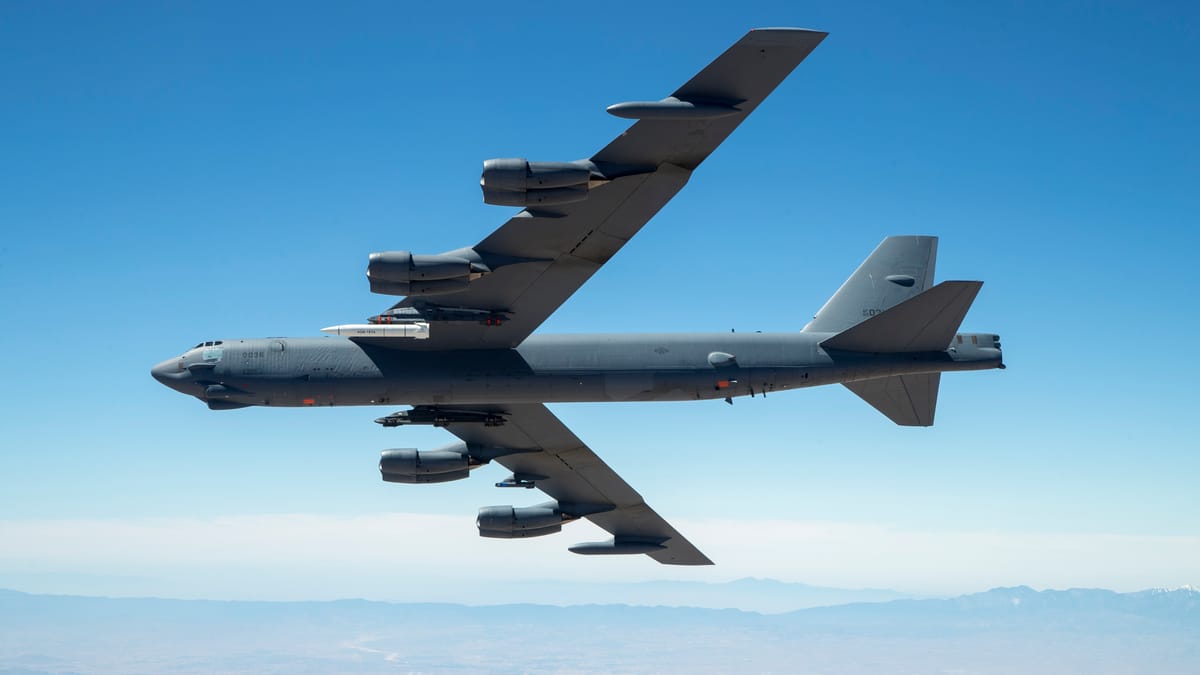
The test platform has been the B-52H Stratofortress. The B-1B Lancer has also appeared in Air Force discussions as a potential future external-carriage platform for large weapons, including hypersonics. But the operational carriage plan remains less settled than the basic concept: ARRW is a bomber-launched standoff weapon, not a deployed missile fleet with public squadron inventories.
Why Hypersonic Glide Weapons Are So Hard
Hypersonic flight is easy to describe and hard to engineer.
At Mach 5 and above, the vehicle is not simply going “very fast.” It is flying in an environment of extreme heating, violent aerodynamic loads, navigation problems, communications limits, and material stress. A glide vehicle has to survive that environment, maneuver predictably enough for its own guidance system, and still arrive accurately enough to justify the mission.
That last part is especially important for the United States. CRS has repeatedly noted that most U.S. hypersonic weapons are not being designed as nuclear weapons. That makes accuracy more important, not less. A nuclear warhead can compensate for a larger miss distance. A conventional hypersonic weapon has to be precise enough to destroy the intended target without that margin.
This is one reason the public “unstoppable missile” framing can be misleading. Hypersonic weapons are difficult to defend against, but they are not magic. They still have to be detected by their own sensors, guided through plasma and heat, survive the flight, communicate where possible, and hit a real target. Mobile targets are harder than fixed ones. Weather, countermeasures, jamming, intelligence quality, and mission planning still matter.
The more useful way to think about ARRW is as a high-end strike option for fixed or time-sensitive targets in a heavily defended theater. That is already an ambitious job.
The Early Promise
Lockheed Martin received the ARRW contract in 2018, and the first captive-carry flight followed in June 2019 with a B-52 over Edwards Air Force Base. The Air Force was trying to move quickly. ARRW was part of the Middle Tier of Acquisition rapid-prototyping world, where the point was to get from concept to a usable prototype faster than a conventional major acquisition program.
For a while, the schedule looked aggressive enough that the Pentagon hoped ARRW might become the first U.S. operational hypersonic weapon.
The appeal was obvious. China had demonstrated serious interest in hypersonic glide systems. Russia was loudly advertising its own hypersonic weapons. American officials did not want the United States to be seen as late to a prestige technology with real military implications.
ARRW also fit a familiar Air Force instinct: use bombers as flexible missile trucks. A bomber with long range and standoff weapons can create launch geometry that a ground launcher cannot. It can move, be retasked, and bring weapons closer to the fight before launch. If the weapon itself can then sprint and maneuver at hypersonic speed, the defender’s timeline shrinks dramatically.
That was the theory. The hardware took longer to cooperate.
The Test Record Became the Story
ARRW’s public test record was rough enough to define the program.
The first captive-carry and integration work showed that the weapon could be carried by a B-52, but the powered flight campaign stumbled. Early booster tests included failures to separate from the aircraft and failures of the booster to ignite after release. Those are not small problems. If a missile cannot leave the aircraft cleanly and light its motor reliably, nothing else in the concept matters.
The program later recovered some momentum. In May 2022, the Air Force reported a successful booster test in which ARRW separated from the B-52, its booster ignited, and the weapon exceeded Mach 5. In December 2022, the Air Force conducted the first all-up-round operational prototype test off Southern California, again from a B-52.
But the full prototype campaign did not settle the argument. CRS describes ARRW’s post-2022 flight record as mixed, with at least one 2023 failure and Air Force statements that sometimes emphasized “valuable insights” rather than clean success. A March 2024 final planned test from a B-52 that took off from Andersen Air Force Base in Guam produced more data, but the Air Force again declined to discuss specific results publicly.
That is why the program looked finished. The Air Force had completed the rapid-prototyping test series. Senior officials were openly more enthusiastic about HACM. The fiscal 2025 request included no ARRW procurement or research-and-development funding. GAO later noted that, in February 2025, DOD told GAO the ARRW effort was complete and that there were no plans for further development.
Then the budget changed.
The Revival in the Budget
In June 2025, Air Force Chief of Staff Gen. David Allvin told lawmakers the service was looking at two hypersonic programs: ARRW, the larger long-range form factor tested several times, and HACM. He framed both as programs the Air Force wanted to move toward procurement.
The fiscal 2026 Air Force missile-procurement justification then put numbers behind that shift. ARRW procurement appeared as a new start with $387.055 million in FY2026 funding. FY2027 budget material, published in 2026, showed the FY2026 line at $362.155 million after a congressional reduction and requested $452.035 million for FY2027. The same FY2027 document described FY2027 funds as procuring ARRW weapon systems and associated support costs, while noting that quantities are controlled unclassified information.
That is a real comeback. It is also not the same thing as saying ARRW has entered broad operational service.
The cautious reading is this: the Air Force completed the prototype phase, paused public procurement momentum, analyzed the test data, and then decided ARRW still had enough value to restart production planning. The budget documents suggest a move into procurement. They do not disclose how many weapons will be bought, how quickly they will be delivered, or what exact configuration changes may be made after the test program.
For a weapon with ARRW’s history, that distinction matters.
Why Bring It Back?
The simplest answer is China.
The United States is not developing hypersonic weapons in a vacuum. Chinese and Russian investments have made hypersonics a high-visibility measure of advanced strike capability. Whether every foreign claim is credible is a separate question. The strategic effect is already real: U.S. planners do not want rivals to hold targets at risk with systems the United States cannot match or defend against.
ARRW also occupies a different space from HACM. HACM is a smaller air-breathing hypersonic cruise missile. ARRW is a larger boost-glide weapon. A rational Air Force might want both, because they imply different ranges, payloads, carrier options, costs, and target sets.
There is also an acquisition logic to reviving a wounded program instead of starting over. ARRW has already consumed years of design work, flight testing, integration effort, and data collection. Even failed tests can be valuable if they expose the failure modes engineers need to fix. If the final test campaign gave the Air Force enough confidence that the hardest problems were understood, restarting procurement could be cheaper and faster than inventing a replacement from scratch.
That is the optimistic view.
The skeptical view is that budget revival does not erase technical risk. GAO’s hypersonic-weapons work has warned about cost and schedule risk across the portfolio, and ARRW’s own public record gives lawmakers obvious reasons to ask what changed. If the answer is “we learned enough from the tests,” Congress will still want evidence that the production version can be reliable, affordable, and useful.
Both views can be true at once. ARRW can be strategically useful and technically bruised. It can be worth funding and still deserve hard oversight.
The OpFires Side Story
ARRW’s story also overlaps with DARPA’s Operational Fires, or OpFires, a ground-launched hypersonic boost-glide effort.
In 2022, DARPA announced that OpFires had completed its first flight test at White Sands Missile Range. The demonstration used a Marine Corps logistics truck as a medium-range missile launcher and showed canister egress, stable flight capture, and Army fire-control integration. That test did not make OpFires an operational Army or Marine Corps weapon, but it showed how the same broad hypersonic technology base could migrate into different launch concepts.
This is the part of hypersonics that often gets missed. The United States is not only building individual missiles. It is building a body of test data, materials knowledge, guidance work, boosters, launch concepts, and manufacturing lessons. A canceled or paused program can still feed another program. A failed test can still improve a later design.
ARRW’s revival makes more sense in that ecosystem. The Air Force may not be buying the exact dream version imagined in 2018. It may be buying a weapon shaped by years of bruising tests.
What ARRW Would Give the Air Force
If ARRW works, it gives the Air Force a long-range conventional strike weapon for the opening hours of a hard fight.
The target set would likely be high-value, fixed, or time-sensitive assets: air-defense nodes, command-and-control facilities, missile-support infrastructure, hardened logistics points, and other targets where speed and compressed warning time matter. A B-52 or future bomber carrying a standoff hypersonic weapon could launch from outside some threat rings while still threatening targets deep inside a defended area.
That does not make the bomber invulnerable. It does not make every target easy. It does not make missile defense obsolete. It does give commanders another option where subsonic cruise missiles may be too slow and ballistic missiles may be too predictable or politically complicated.
It also creates an industrial and doctrinal question. Can the Air Force buy enough of these weapons to matter? Can it test them enough to trust them? Can it integrate them into real plans without treating each round as an exotic showpiece?
Those questions explain why affordability keeps appearing in leadership comments. A weapon that is too expensive to buy in useful numbers becomes a signal, not a force.
The Real Meaning of the Comeback
ARRW’s revival is not a clean redemption story. It is more interesting than that.
The program failed enough times to lose momentum. It produced enough data to remain relevant. It was overtaken publicly by HACM, then returned in Air Force procurement documents because the strategic demand for air-launched hypersonic strike did not disappear.
That is the reality of many advanced weapons programs. They are not born fully formed. They stumble through failures, budget fights, redesigns, competing priorities, and changes in threat perception. Sometimes they die. Sometimes they come back because the requirement outlives the embarrassment.
ARRW is now in that second category.
The Air Force appears to believe that a large, long-range, bomber-launched hypersonic boost-glide weapon is still worth pursuing. The budget documents support that. The test record demands caution. The hypersonic race explains the urgency.
So the right question is not whether ARRW is America’s latest unstoppable missile. It is whether the Air Force can turn a troubled prototype into a weapon reliable enough, affordable enough, and available enough to matter.
That is a much harder achievement than Mach 5. It is also the one that decides whether ARRW becomes a real weapon or just another expensive lesson.
Key Takeaways
-
AGM-183A ARRW is an air-launched hypersonic boost-glide weapon, not a fielded ballistic missile fleet.
-
The program suffered several early test failures, then completed later booster and all-up-round tests that produced mixed public signals.
-
The Air Force appeared to pause ARRW after the rapid-prototyping phase, while shifting more attention to HACM.
-
FY2026 and FY2027 budget documents show ARRW back in procurement planning, including a FY2026 new-start procurement line and a FY2027 request.
-
ARRW’s comeback is best understood as a strategic and acquisition bet: the Air Force still wants a large bomber-launched hypersonic strike option, but the program remains an oversight risk.

Simon Whistler
Simon Whistler hosts MegaProjects, bringing engineering, infrastructure, and military-machine stories into clear narrative focus for viewers who want the systems, tradeoffs, and human decisions behind the build.
Frequently Asked Questions
What does ARRW stand for?
ARRW stands for Air-Launched Rapid Response Weapon. The designation is AGM-183A, and the acronym is usually pronounced “arrow.”
Is ARRW already in service?
Public budget documents show ARRW moving back into procurement planning, but they do not prove that ARRW is broadly fielded in operational units. Quantities are not publicly disclosed.
Is ARRW a ballistic missile?
ARRW is better described as an air-launched hypersonic boost-glide weapon. A rocket booster accelerates the system, then a glide vehicle separates and maneuvers toward the target.
Why did the Air Force almost drop ARRW?
ARRW suffered a series of test problems, including failed launches and mixed all-up-round results. By fiscal 2025, the Air Force requested no ARRW procurement or research funding and seemed more committed to HACM.
Why revive ARRW now?
The Air Force still wants hypersonic strike options that can threaten defended, time-sensitive targets. ARRW offers a larger boost-glide path than HACM, and the service may believe the test data made the program mature enough to restart procurement planning.
How is ARRW different from HACM?
ARRW is a larger boost-glide weapon. HACM is an air-breathing hypersonic cruise missile. They are both hypersonic air-launched weapons, but they use different flight concepts and likely fit different mission and platform mixes.
Sources
-
Original MegaProjects video: AGM-183A: America’s Latest Mach-5 Ballistic Missile
-
U.S. Air Force FY2026 Missile Procurement justification book
-
U.S. Air Force FY2027 Aircraft and Missile Procurement justification book
-
Congressional Research Service: Hypersonic Weapons - Background and Issues for Congress
-
U.S. Air Force: Air Force conducts first ARRW operational prototype missile test
-
Defense News: Air Force may revive shelved ARRW hypersonic program
-
GAO: Hypersonic Weapons - DOD Could Reduce Cost and Schedule Risks by Following Leading Practices
-
DARPA: Operational Fires Program successfully completes first flight test
-
Hero image source by Christopher Okula / U.S. Air Force, public domain.
Related Projects
Talon-A2
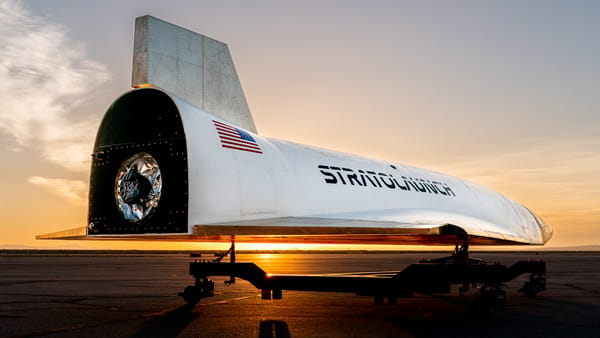
Talon-A2 is not a fielded missile yet. It is a reusable Mach 5-plus test vehicle that could change how fast the Pentagon learns hypersonics.
LRASM
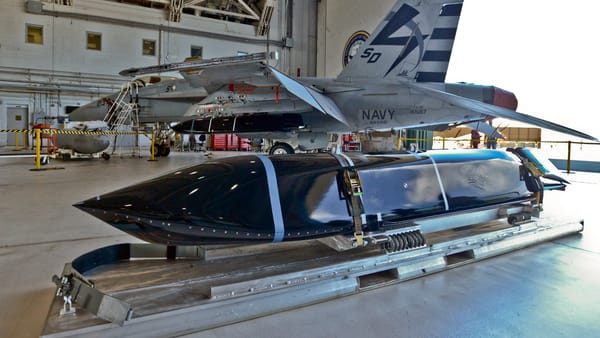
How LRASM restored America's long-range anti-ship strike capability with stealth, autonomy, and a missile built from the JASSM-ER family.
A-10 Warthog
The A-10 Thunderbolt II survived decades of retirement fights, but 2026 divestments show why the Air Force is finally moving past the Warthog.
SMASH 2000L
How SMARTSHOOTER's Smash 2000L fire-control optic helps infantry engage small drones, and why smart rifle scopes still face hard battlefield limits.