

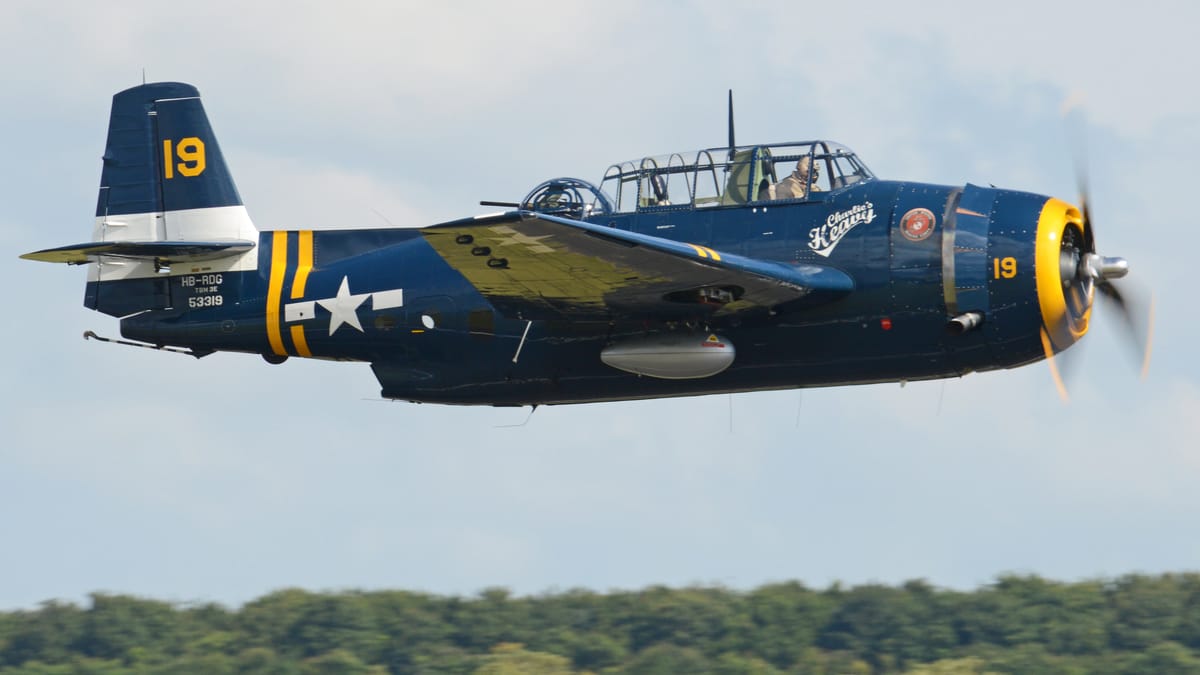
In the 1940s, the United States Army Air Forces took over a conceptual project from the Canadian Navy and developed an active camouflage technology that turned bomber planes almost completely invisible. The technique was reportedly so effective that, in the right conditions, it enabled bombers to get within just 30 seconds of flight time to surfaced submarines. Previously, enemy subs would simply have fled underwater and disappeared, but now depth charges could be dropped long before a submarine had time for evasive maneuvers. The system was called Project Yehudi Lights, and it was hoped to be a game changer — potentially shifting the balance of the battlefield.
You’ve probably never heard of it. And you’ve already guessed it didn’t alter the course of the war.
Invisibility, it turns out, is less a single invention than a moving target. Every time a camouflage system matures, some new sensor technology renders it obsolete. That dynamic is as old as warfare itself — and it’s still playing out today, with several serious programs pushing closer to what most people would recognize as true active camouflage. Whether any of them will actually deliver something Predator-like is another question entirely.
- Project Yehudi Lights detection window
- 30 seconds of flighttime
- Adaptiv hexagonal panels per vehicle
- ~1,000
- Adaptiv panel size
- 5.5inches (hexagonal)
- Effective disguise range (Adaptiv)
- 500 meters orbeyond
- ACAMSII project cost
- €2million
- ACAMSII development duration
- 43months
Hiding in Plain Sight: Project Yehudi Lights
The Canadian Navy originally built the Yehudi prototype with the goal of making ships harder to spot with the naked eye — a technique known as counter-illumination. They achieved a notable degree of success, and the project was passed to the US Army Air Forces, who recognized it was better suited to airborne bombers.
The core idea was elegantly simple: sets of lights were placed strategically on the nose and wings of an aircraft. When illuminated, those lights washed out the plane’s silhouette, making the dark shape against the sky disappear. What made the project genuinely revolutionary was automation — the brightness of the lamps was controlled by a pair of photocells that continuously matched projected light to ambient light conditions. The result was that ground observers no longer saw a dark bomber against the sky.
In ideal conditions, test subjects weren’t even aware of a plane until they heard its engine.
Had Yehudi Lights arrived just a few years earlier, it might be a household name. Instead, advanced radar was being developed in parallel, and spotting aircraft with the naked eye became largely irrelevant. One breakthrough made the other redundant almost overnight.
This pattern has repeated throughout military history. In World War I, camouflage meant paint schemes on uniforms and hiding bases in inconspicuous locations — until aerial reconnaissance changed what detection even meant. The same disruption happened again when multi-spectral sensors entered the picture.
The Infrared Problem
Infrared has been a factor in warfare since World War II. Germany tested tank-mounted night vision during the conflict; the US attached infrared “snooperscopes” to long-range rifles. Today, Forward Looking Infrared sensors — FLIR — are standard equipment on reconnaissance aircraft, capable of detecting the thermal signatures of hardware and soldiers at enormous distances.
As IR became ubiquitous, so did the need to defeat it. Since the early 21st century, multi-spectral camouflage has become a serious research area, with the goal of hiding military assets not just in the visible light spectrum, but simultaneously across relevant portions of the electromagnetic spectrum. A 2004 NATO research paper noted that “the multi-spectral signatures of most military equipment can be significantly reduced by combinations of various camouflage materials.” That framing — combinations, reduction, not elimination — is worth keeping in mind.
Adaptiv: The Most Promising System That Already Works
The most tangible active camouflage technology available today is called Adaptiv, and in a neat reversal of Project Yehudi Lights, it is designed specifically with infrared sensors in mind rather than the naked eye.
Adaptiv has been in development since around 2011, commissioned by the Swedish Defence Material Administration, which enlisted the Swedish branch of UK company BAE Systems. The resulting system can produce both crypsis — hiding from detection — and mimesis — disguising a target as something else entirely. No prior counter-IR system had managed both.
The mechanism covers every surface of a vehicle with roughly 1,000 hexagonal Peltier panels, each measuring 5.5 inches and each functioning as an individually controllable thermal pixel. The panels are heated or cooled electronically as needed, making the vehicle’s IR signature match whatever pattern is stored in memory. An armored tank can be made to look, thermally, like a civilian vehicle. Or something else entirely — any stored configuration the panel array can reproduce.
The limitations are real: the disguise is most effective at 500 meters or beyond, and the vehicle remains fully visible to the naked eye. Adaptiv is not a complete camouflage solution. But it is a complete disruption of IR-based detection, which is currently one of the primary tools modern militaries rely on.
BAE Systems has indicated the system may be ready for full production within a few years, with plans to extend it to ships and helicopters in addition to armored vehicles. The company describes the possibility of turning “a helicopter into a cloud, or a warship into a wave” — creative phrasing, but the underlying technology is real and already demonstrated.
The Science Fiction Tech of the Future
Beyond Adaptiv, a number of other projects are at various stages of development — some promising, some deeply speculative, and at least one that is difficult to assess at all.
Quantum Stealth
Canadian company Hyperstealth Biotechnology has developed a system called Quantum Stealth that bends light using a lenticular lens configuration — the same basic principle behind novelty trading cards that show different images at different viewing angles. Objects placed behind a Quantum Stealth panel appear to vanish, though with a visible distortion effect that limits its effectiveness at close range.
What makes Quantum Stealth notable is that, unlike Adaptiv, it conceals targets both from the naked eye and in the IR spectrum simultaneously — and it does so passively, with no power requirements. Hyperstealth has filed a patent for the design and is reportedly refining the panels for military application.
Golden Veil
In late 2023, details emerged regarding a Chinese system called Golden Veil, reportedly under development at Northwestern Polytechnical University. Researcher Zong Yali and her team published work in the Chinese Journal of Radio Science describing an intricate web of gold-plated, reflective threads woven around a cruise missile to create radar cross-sections that can appear as a civilian passenger aircraft from certain angles.
Radar reflectors of this general type are not new — the US has used similar technology on the ADM-160 Miniature Air-Launched Decoy (MALD) for some time. The claimed advantage of Golden Veil is cost reduction. More intriguing is the reported ability to switch between stealth configurations, which would put it in genuine active camouflage territory. However, available information is limited, and the system is reportedly still far from operational.
Invisibility Cloak
Professor Susumu Tachi at the University of Tokyo developed a retro-reflective projection system that produces a genuinely striking visual effect — a cloak that appears to make the wearer partially transparent. The cloak is lined with thousands of glass beads with retro-reflective properties. For the effect to work, a viewer must stand behind a glass sheet, and an image of the background behind the wearer must be projected onto that sheet. At the correct angle, the projection bounces off the beads back to the viewer, making the cloak appear to vanish.
The technology is real; the setup is wildly impractical. The prototype was showcased over two decades ago, and no meaningful development has followed — only vague rumors of military interest that have not been substantiated.
Phased Array Optics
Phased array optics allows light beams to be directed without moving parts, opening the possibility of projected imagery that appears convincing from any angle. If the technology matures, it could theoretically produce holographic disguises capable of imitating stored visual profiles — or generating new ones from a live feed.
The concept remains in early development. A volumetric display recently went viral showing Doom running on what amounts to a rudimentary hologram, and while unimpressive in execution, it represents a first step toward something that has previously existed only in science fiction. Whether phased array optics can be adapted into functional active camouflage, and on what timeline, remains entirely speculative.
ACAMSII
The EU-backed ACAMSII project — Adaptive Camouflage for the Soldier — was showcased at a Safran campus event outside Paris in 2022 after 43 months of development at a cost of €2 million. The promotional materials featured phrases like thermochromic pigments, radar absorbing layers, and phase change materials. What they did not feature was any demonstration of the suit actually doing anything.
The fact sheet states that the suit integrates active and passive adaptation for visual, near-infrared, short-wave infrared, thermal infrared, and radar camouflage — which sounds comprehensive. How any of it functions was not explained, and the showcase video showed nothing more than what looked like a Ghillie suit. The top comment on that video reads: “that wasn’t very impressive.”
OLED Skins
Organic light-emitting diodes can be fabricated on flexible substrates, meaning an OLED display could theoretically be shaped to conform to irregular surfaces — a vehicle, or a soldier’s body — and display a live image of the surrounding environment. The result would be a genuine chameleon-skin camouflage visible to the naked eye.
Of all the technologies discussed here, OLED skins are the furthest from reality. No significant development program has been identified; the concept exists largely as speculation in a handful of reports.
Key Takeaways
- Project Yehudi Lights demonstrated functional active camouflage in the 1940s by using photocell-controlled lights to eliminate a bomber’s visible silhouette — then became obsolete when radar superseded visual detection.
- Modern camouflage challenges are multi-spectral: hiding from the naked eye is no longer sufficient when IR sensors, FLIR systems, and radar are all in standard military use.
- Adaptiv, developed by BAE Systems for the Swedish military, is the most advanced active camouflage system currently in existence — it uses ~1,000 individually controlled thermal panels to defeat IR detection and can disguise an armored vehicle as a different thermal profile at ranges of 500 meters or more.
- Quantum Stealth from Hyperstealth Biotechnology offers passive, low-cost camouflage in both the visible and IR spectrum using lenticular lens technology, though with noticeable close-range distortion.
- Technologies like phased array optics and OLED skins represent plausible long-range paths to Predator-style invisibility but remain firmly in early or conceptual stages.
- The pattern throughout camouflage history is consistent: each solution is eventually rendered obsolete by advances in detection technology, making the field a permanent arms race rather than a solved problem.

Simon Whistler
Simon Whistler hosts MegaProjects, bringing engineering, infrastructure, and military-machine stories into clear narrative focus for viewers who want the systems, tradeoffs, and human decisions behind the build.
Frequently Asked Questions
What was Project Yehudi Lights and why did it fail?
Project Yehudi Lights was a World War II active camouflage program that mounted photocell-controlled lights on bomber aircraft to wash out their visible silhouette, making them nearly undetectable to the naked eye in optimal conditions. It was rendered obsolete not because the technology failed, but because advanced radar made visual detection of aircraft largely irrelevant — removing the need it was designed to fill.
What is Adaptiv and how does it work?
Adaptiv is an active camouflage system developed by BAE Systems for the Swedish Defence Material Administration, designed to defeat infrared detection rather than visual observation. It covers a vehicle’s surface with approximately 1,000 hexagonal Peltier panels that can be individually heated or cooled to match any stored thermal profile, making the vehicle appear as a different object — or nothing at all — on IR sensors. It is most effective at distances of 500 meters or beyond.
Can any current technology hide an object from both the naked eye and infrared sensors simultaneously?
Quantum Stealth from Hyperstealth Biotechnology is the most notable example: it uses passive lenticular lens panels to bend light in a way that conceals objects in both the visible and infrared spectrums. The trade-off is a visible distortion effect that limits its effectiveness at close range. Adaptiv addresses IR only; OLED skin concepts address visible only.
How does Golden Veil differ from existing radar decoy technology?
Radar reflectors designed to make one object appear as another on radar are not new — the US ADM-160 MALD has used similar technology for years. Golden Veil’s claimed distinction is cost reduction and, more significantly, the ability to switch between stealth configurations actively, which would qualify it as genuine active camouflage. However, information is limited and the system is reported to be far from operational.
Why is OLED considered the most futuristic active camouflage option?
OLED can be produced on flexible substrates, meaning it could theoretically wrap around irregular shapes like a vehicle or a person and display a real-time image of the background — creating a true chameleon effect visible to the naked eye. It is the technology that most closely matches popular depictions of invisibility. It is also the least developed of the options discussed, existing primarily as a theoretical concept with no identified significant development program.
Is true “Predator-style” invisibility achievable with current or near-term technology?
Not in the immediate term. Adaptiv provides effective IR camouflage but does nothing for the naked eye. Quantum Stealth addresses both spectra passively but with distortion limitations. OLED skins and phased array optics represent longer-horizon paths to something resembling Predator-style invisibility but remain early-stage or conceptual.
The additional challenge is that any purely visible-spectrum solution would still be detectable by standard IR optics, meaning a complete solution must address multiple spectra simultaneously.
Sources
-
Original MegaProjects video: How Close is “Active Camouflage”?
-
BAE Systems Adaptiv camouflage system
-
Hyperstealth Biotechnology Quantum Stealth patent filing
-
Zong Yali et al., Chinese Journal of Radio Science (Golden Veil)
-
University of Tokyo, Professor Susumu Tachi — Retro-Reflective Projection Technology
-
NATO Research Paper on multi-spectral camouflage (2004)
-
ACAMSII project showcase, Safran campus, Paris (2022)
-
Hero image source by Alan Wilson / Wikimedia Commons, CC BY-SA 2.0.
Related Projects
Aurora: The Black Aircraft Myth
The Aurora legend began with a black-budget line item, sonic booms, and triangular sightings. The evidence points to something murkier than one spy plane.

H-20: China’s Stealth Bomber
China's H-20 stealth bomber has been promised for years. The public record still shows a program wrapped in secrecy, delay, and unproven claims.


_(35984378711).jpg)