
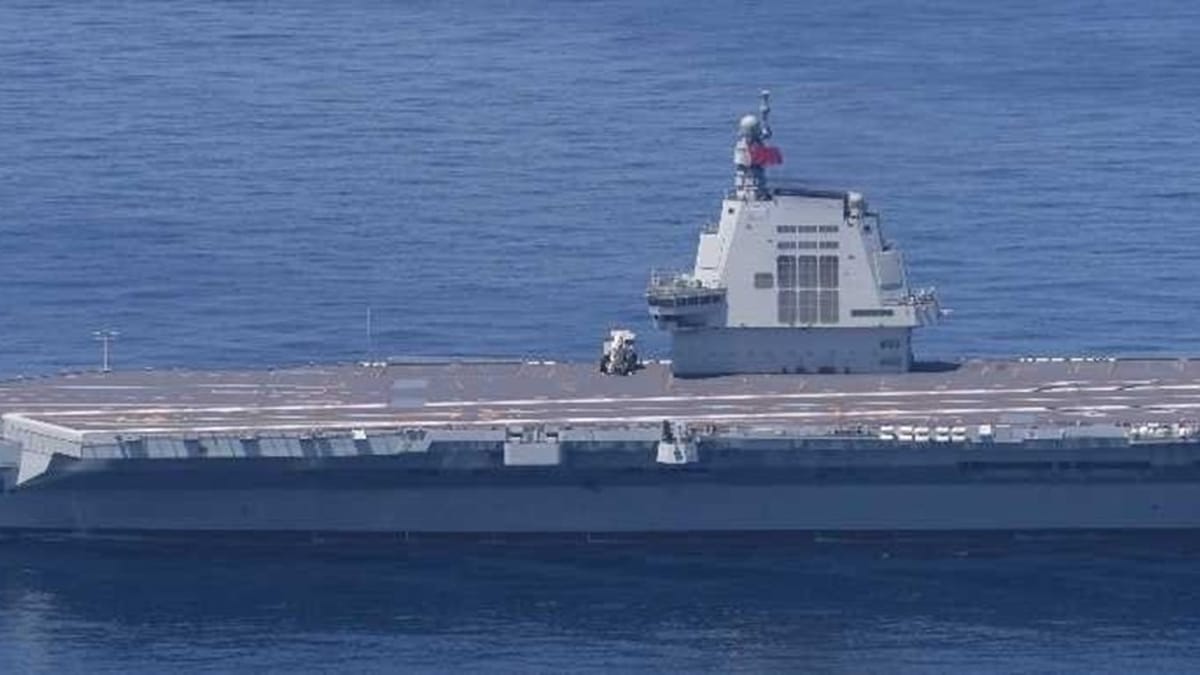
Aircraft carriers aren’t just ships—they’re floating fortresses, symbols of power that let nations project their influence across oceans. For decades, only a few countries have had the resources, technology, and expertise to build true supercarriers. The United States has long been the gold standard. But now there’s a new player in the game: the Fujian Type 003, China’s first domestically built supercarrier.
Launched in June 2022, the Fujian is a massive leap forward for China’s navy—a stunning show of ambition and innovation. It’s not just another warship. It’s a statement. A declaration that China’s military is no longer content to play defence. It wants to compete, dominate, and maybe even surpass the traditional powers of the sea.
The First Built From Scratch
The Fujian Type 003 is a game-changer. This ship stands toe-to-toe with the world’s largest and most advanced carriers, like the U.S. Navy’s Gerald R. Ford-class. It’s also the first Chinese carrier to be built entirely from scratch. China has two other carriers—the Liaoning and the Shandong—but both are heavily based on older Soviet designs. They’re smaller, less capable, and rely on outdated technology. The Fujian is all new: sleek, modern, and packed with cutting-edge systems.
- Length
- Over 300m (1,000 ft)
- Displacement
- ~85,000tons
- Top speed
- 30knots (56 km/h)
- Crew
- ~3,000
- Air wing
- 40-50aircraft
- Launched
- 17 June 2022
It’s named after a coastal province in China, one that’s strategically significant given its proximity to Taiwan. If that’s not a statement, I don’t know what is.
The carrier was constructed at the Jiangnan Shipyard on Changxing Island near Shanghai, one of China’s most advanced naval shipbuilding facilities. Construction began in 2015, though the project remained shrouded in secrecy during its early stages. Initial work focused on laying the keel and developing modular sections—a technique that allowed different parts of the carrier to be built simultaneously before being assembled. By 2018, satellite imagery revealed significant progress as the ship’s hull began to take shape.
The Fujian was officially launched in a highly publicised ceremony on June 17, 2022. The event marked the transition from construction to outfitting, during which advanced systems such as the Electromagnetic Aircraft Launch System and radar equipment were installed. Sea trials were expected to conclude sometime in 2024, with the ship entering active service shortly after that.
It’s not immediately clear how far along the process the carrier is. China doesn’t exactly post many updates about its cutting-edge floating titan, but with two sea trials now under its belt, it will likely begin roaming the oceans for real in 2025 or 2026 at the latest.
Groundbreaking Technology
First, a caveat: there’s a lot we don’t know about the Fujian. According to some reports, many of its components are still being fitted even as the ship completes its sea trials. There’s practically no information out yet regarding armaments, so let’s begin with the nuts and bolts.
Size matters when it comes to carriers. The Fujian is a behemoth, stretching over 300 metres (1,000 feet) in length—roughly the height of the Eiffel Tower laid on its side. It displaces around 85,000 tons, putting it on par with some of the largest carriers in the U.S. fleet. This sheer size isn’t just for show: it means more aircraft, more firepower, and more muscle in the middle of the ocean.
The Fujian has a top speed of 30 knots (56 km/h or 35 mph) and requires a crew of approximately 3,000 sailors and aircrew.
What truly sets the Fujian apart from its predecessors is its Catapult-Assisted Take-Off But Arrested Recovery system—CATOBAR for short. An absolute mouthful, but a piece of technology that allows China to join an exclusive club. Only the U.S. uses the same take-off system, with its Nimitz-class and Gerald R. Ford-class carriers, and France with the Charles de Gaulle.
CATOBAR uses electromagnetic catapults to launch aircraft into the sky. It allows the Fujian to launch heavier, more advanced planes with bigger payloads. Forget the ski-jump ramps of older carriers—with CATOBAR, the Fujian can easily handle next-generation fighters, surveillance planes, and even drones.
Inside, the Fujian boasts state-of-the-art radar systems. Rumour has it the ship is equipped with dual-band phased-array radars, capable of tracking multiple targets over vast distances. This means the Fujian isn’t just a platform for planes—it’s a high-tech command centre capable of detecting threats and coordinating strikes in real time.
The carrier’s enormous hangar deck is capable of carrying between 40 and 50 aircraft. That includes China’s cutting-edge J-15 fighters and likely the J-35, which is still in development but could rival America’s F-35 in the future.
Another critical feature is propulsion. Unlike U.S. supercarriers, which rely on nuclear power, the Fujian uses conventional propulsion. While this limits its range compared to nuclear-powered ships, it’s still designed for long-term operations. The ship is equipped with high-efficiency engines that allow it to stay at sea for extended periods without refuelling.
And let’s not forget defence. While the Fujian is primarily an offensive platform, it’s not without its own teeth. The ship is rumoured to carry close-in weapon systems (CIWS), anti-missile defences, and other protective measures designed to intercept incoming threats—exactly what you’d expect on such a carrier. Put it all together, and the Fujian is a technological marvel: a ship designed to survive on the modern battlefield and dominate it.
It’s fast, it’s powerful, and it’s brimming with the latest in naval technology.
But all of this doesn’t come cheap. The exact construction cost has not been publicly disclosed. Estimates suggest the expense is substantial, given the ship’s advanced features and size. For context, the U.S. Navy’s Gerald R. Ford-class carriers share similar technological advancements and have construction costs exceeding $13 billion per unit. Considering the Fujian’s comparable capabilities, we could likely apply a similar figure—plus a few billion more for technological development.
Toe to Toe With the Gerald R. Ford
When discussing the Fujian Type 003, it’s impossible to ignore its inevitable comparison to the U.S. Navy’s Gerald R. Ford-class, the pinnacle of American carrier innovation. Both represent their nations’ ambition to dominate naval power, but their differences highlight distinct approaches to military engineering and strategy.
The Gerald R. Ford-class is the U.S. Navy’s most advanced carrier, boasting groundbreaking technology such as the Electromagnetic Aircraft Launch System, which replaces traditional steam catapults for smoother, more efficient aircraft launches. The Ford also features advanced radar systems, a redesigned flight deck for increased sortie rates, and nuclear propulsion, allowing it to operate for 20-plus years without refuelling.
While not nuclear-powered, the Fujian Type 003 mirrors the Ford in many ways. It’s China’s first carrier to feature EMALS, marking a leap forward from its earlier designs. The EMALS catapults are estimated to be around 90 metres (295 ft) long, similar to U.S. systems. This puts the Fujian on par with the Ford’s aircraft-launching capabilities, enabling it to deploy similar-style aircraft.
Where the Ford outshines the Fujian is endurance and experience. Nuclear propulsion grants the Ford unmatched operational range, while the U.S. Navy’s decades of carrier warfare expertise far exceed China’s emerging carrier strategy. However, the Fujian signals China’s rapid technological advancement, narrowing the gap dramatically.
While the Gerald R. Ford-class still leads in raw capability, the Type 003 is a bold and brash statement that China is ready to challenge that dominance on the high seas. This race is now closer than ever.
The Fujian’s Role in China’s Military Strategy
First and foremost, the Fujian is about power projection. As we said at the beginning, aircraft carriers aren’t just warships—they’re floating bases capable of carrying dozens of aircraft thousands of miles from home. For China, this means the ability to extend its reach far beyond its shores. With the Fujian, China can operate deep into the South China Sea, the Indian Ocean, and even the Pacific, supporting its territorial claims, protecting shipping lanes, and intimidating rival nations.
The South China Sea is a particularly hot zone. It’s one of the most contested regions in the world, with overlapping territorial claims from countries like the Philippines, Vietnam, and Malaysia. China has already built artificial islands, equipped them with military bases, and asserted its dominance. The Fujian adds another layer to this strategy—a visible, mobile presence that can enforce China’s claims, deter opposition, and challenge the U.S. Navy, which has traditionally dominated these waters.
But it’s not just about the South China Sea. The Fujian also plays a key role in the Taiwan saga. Taiwan, regarded by China as a breakaway province, is a central focus of Beijing’s military strategy. The Fujian casts an ominous shadow across the Taiwan Strait, bolstering China’s ability to blockade, intimidate, or launch an offensive if tensions ever escalate. With its advanced capabilities, the Fujian provides air support, reconnaissance, and strategic dominance in a potential conflict zone.
Beyond Taiwan, the Fujian is about global influence. China has been expanding its footprint worldwide, from building ports in Africa to signing trade agreements in Latin America. The Fujian enables China to support these efforts militarily, protecting its interests and showing the world it has arrived as a major naval power.
Challenges and Limitations
For all its strengths, the Fujian Type 003 is not invincible. It’s a remarkable achievement, but like any ambitious project, it comes with significant challenges and limitations.
First, there’s the issue of operational readiness. Building a carrier is one thing; learning how to use it effectively is another. The Fujian is still in its testing phase, and while it looks impressive on paper, it will take years before it’s fully operational. Training pilots to use the CATOBAR system, coordinating complex carrier strike groups, and mastering the nuances of blue-water operations are monumental tasks. The U.S. Navy has had decades to perfect these skills. For China, this is new territory.
Then there’s the lack of combat experience. China’s navy has grown rapidly but hasn’t faced the same real-world conflict as its Western counterparts. The U.S. Navy, for example, has a long history of deploying carriers in combat zones, from World War II to modern-day conflicts in the Middle East. The Fujian, on the other hand, is untested in battle. While a powerful deterrent, its capabilities in a high-stakes conflict remain uncertain.
Another challenge is that conventional propulsion system. With conventional engines, the Fujian is limited in range and endurance, requiring it to return to port or rely on resupply ships for fuel. This could be a significant disadvantage in a prolonged conflict or far-flung operation, especially if supply lines are disrupted.
The technological gap is also worth mentioning. While the Fujian is packed with advanced systems, it’s still playing catch-up in some areas. Its air wing, while formidable, doesn’t yet include a proven fifth-generation stealth fighter. The J-35 is promising but still under development. Meanwhile, the U.S. Navy already has the F-35C, a battle-tested stealth fighter widely regarded as the most advanced in the world. That gives the U.S. a significant edge in air superiority.
Ripples Across the Global Naval Landscape
The launch of the Fujian Type 003 sent ripples across the global naval landscape. The Indo-Pacific has become the centre of modern naval competition, with the South China Sea as a major flashpoint. This region is critical for global trade—an estimated 30% of the world’s shipping passes through it—and it’s rich in resources.
The U.S. Navy has been the dominant force for years, conducting freedom of navigation operations to challenge China’s territorial claims. The Fujian changes the equation. With its advanced systems and larger air wing, it gives China a powerful tool to assert dominance.
Neighbouring countries aren’t taking this lightly. Japan, for example, has begun converting its Izumo-class destroyers into full-fledged aircraft carriers and investing in F-35B stealth fighters. India is ramping up its naval capabilities and launching its own domestically built carrier, the INS Vikrant. Even Australia, a traditionally quieter player, has strengthened its naval ties with the U.S. and the U.K. through the AUKUS alliance, which includes plans for advanced submarines.
On a global scale, the Fujian represents China’s push to challenge the United States as the preeminent naval power. While the U.S. Navy still holds a significant advantage in numbers, technology, and experience, the Fujian signals that China is closing the gap. And this isn’t just about numbers—it’s about strategy.
The question now is: what comes next? Will China build more carriers, possibly nuclear-powered ones, to expand its reach even further? According to vague reports—sorry, but that’s all we’ve got—China likely wants another three carriers deployed by 2035, which would significantly close the gap to the U.S. One thing is certain: the Fujian has set the stage for a new era of competition.
Where it used to be the U.S. and the Soviet Union slugging it out for oceanic supremacy, there’s a new kid on the block, and we might be about to enter an entirely new arms race.
Key Takeaways
- The Fujian Type 003 is China’s first domestically built supercarrier and the first not based on older Soviet designs—unlike the Liaoning and Shandong.
- It stretches over 300 metres, displaces around 85,000 tons, hits 30 knots, and carries a crew of roughly 3,000—putting it on par with the largest U.S. carriers.
- Its standout feature is EMALS-powered CATOBAR launch, joining an exclusive club of only the U.S. and France, and enabling heavier, more capable aircraft up to a 40-50 plane air wing.
- Unlike the nuclear-powered Gerald R. Ford-class, the Fujian uses conventional propulsion, limiting its range and endurance.
- China still trails the U.S. in combat experience, carrier-operations expertise, and a proven fifth-generation stealth fighter—the J-35 remains under development.
- Strategically, the Fujian is built for power projection across the South China Sea, the Taiwan Strait, and beyond, with reports suggesting China wants three more carriers by 2035.

Simon Whistler
Simon Whistler hosts MegaProjects, bringing engineering, infrastructure, and military-machine stories into clear narrative focus for viewers who want the systems, tradeoffs, and human decisions behind the build.
Frequently Asked Questions
What is the Fujian Type 003?
The Fujian Type 003 is China’s first domestically built supercarrier, launched on June 17, 2022, at the Jiangnan Shipyard near Shanghai. It is the first Chinese carrier built entirely from scratch rather than based on older Soviet designs, unlike the country’s earlier Liaoning and Shandong carriers. It stands toe-to-toe with the world’s largest and most advanced carriers.
How big is the Fujian and how many aircraft can it carry?
The Fujian stretches over 300 metres (1,000 feet)—roughly the Eiffel Tower laid on its side—and displaces around 85,000 tons. Its hangar deck can carry between 40 and 50 aircraft, including China’s J-15 fighters and likely the in-development J-35. It has a top speed of 30 knots and a crew of approximately 3,000.
What makes the Fujian’s launch system special?
The Fujian uses a Catapult-Assisted Take-Off But Arrested Recovery (CATOBAR) system powered by electromagnetic catapults (EMALS). This lets it launch heavier, more advanced aircraft with bigger payloads than the ski-jump ramps of older carriers. Only the U.S. and France field the same type of catapult-based take-off system, making the Fujian part of an exclusive club.
How does the Fujian compare to the U.S. Navy’s Gerald R. Ford-class?
The Fujian mirrors the Ford in many ways, including its EMALS catapults, estimated at around 90 metres long. However, the Ford is nuclear-powered, giving it far greater range and endurance, while the Fujian relies on conventional propulsion. The U.S. Navy also holds decades of carrier warfare experience that China’s emerging strategy can’t yet match.
What are the Fujian’s main limitations?
The Fujian is still in its testing phase and will take years to become fully operational, as China learns to run CATOBAR launches and complex carrier strike groups. It lacks combat experience, relies on conventional propulsion that limits its range, and does not yet field a proven fifth-generation stealth fighter—its J-35 is still in development. By contrast, the U.S. already operates the battle-tested F-35C.
Why does the Fujian matter to China’s military strategy?
The Fujian is built for power projection, letting China operate deep into the South China Sea, the Indian Ocean, and the Pacific. It strengthens Beijing’s hand in the contested South China Sea and casts an ominous shadow across the Taiwan Strait. It also supports China’s broader push for global influence as it expands its footprint worldwide.
Sources
-
Original MegaProjects video: Fujian Type 003: China’s First Aircraft Carrier
-
How Advanced Is China’s Third Aircraft Carrier? — CSIS ChinaPower Project
-
Hero image source by Japan Ministry of Defense, Joint Staff / Wikimedia Commons, CC BY 4.0.
Related Projects
China’s South China Sea Military Bases: The World’s Largest Island-Building Project
How China built seven artificial islands in the contested Spratlys, turning three into military bases to back its South China Sea claim
Explosive Reactive Armor: Fighting Explosions with Explosions
How explosive reactive armor saves tanks by meeting an incoming warhead with a smaller blast of its own, plus its drawbacks and what comes next
H-20: China’s Stealth Bomber Is Still a Mystery
China's H-20 stealth bomber has been promised for years. The public record still shows a program wrapped in secrecy, delay, and unproven claims.