
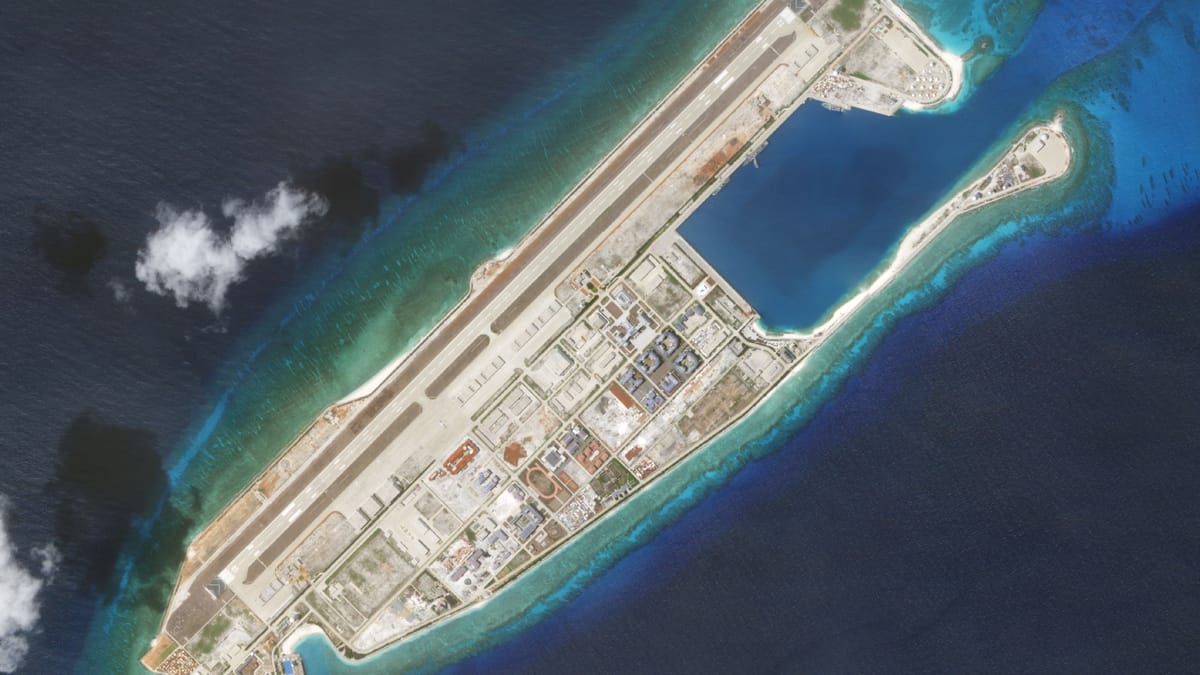
The South China Sea is one of the most disputed stretches of water on Earth, with seven different nations claiming ownership of some or all of it. Among the most contested areas are the Spratly Islands. In an attempt to solidify its claim, China has constructed seven artificial islands among them, complete with fully equipped military bases.
The South China Sea and its surrounding waters have been the focus of territorial disputes for over 100 years. Today, China, Brunei, Taiwan, Indonesia, Malaysia, Vietnam, and the Philippines all allege that they have the right to claim all or part of the sea and the islands located within it. This is the story of how one of those claimants decided to stop arguing on paper and start building land instead.
Why the South China Sea Is Worth Fighting Over
There are a few reasons the area is so heavily contested. The biggest is the South China Sea’s importance as a trade route. While it is often erroneously reported that $5.4 trillion worth of global trade passes through the sea each year, the actual figure is closer to $3.3 trillion. That is still an enormous amount, accounting for roughly 15% of all global trade annually and nearly 40% of all of China’s trade.
- Artificial islands China built
- 7
- Combined area of new islands
- ~3,000acres
- Original Spratly land area
- 440acres
- Construction period
- 2013–2016 (~2 years)
- Annual trade through the sea
- ~$3.3trillion (≈15% of global)
- Militarized reefs
- Subi, Mischief, FieryCross
Controlling the South China Sea would not only provide economic leverage over those trade routes to whoever successfully laid claim, it would also provide security. Sending trade vessels through an area where half a dozen hostile nations claim ownership — not to mention the pirates — is not necessarily the safest way to transport cargo. Having globally recognized dominion over those routes would improve the security of one’s ships, though there would still be pirates.
Then there is the matter of crude oil and natural gas. The seabed is believed to contain billions of barrels of oil and trillions of cubic feet of natural gas. Whoever controlled the region would have the rights to the exploration and exploitation of those resources. They would also have the rights to the fish, which is a non-negligible part of the equation: the fishing industry in the South China Sea officially employs 3.7 million people, and unofficially the number is much higher.
One of the most contested areas in the sea is the Spratly Islands. It was an archipelago of nearly 20 small islands totaling 440 acres — that is, until 2013, when China created seven artificial islands totaling nearly 3,000 acres.
The Dispute Over the Spratly Islands
The Spratly Islands have long been a disputed region, with the most recent chapter of the dispute beginning nearly 70 years ago. In the 1930s, the islands were recognized as having been acquired by France before Japan seized control of them. Following World War II, Japan signed the Treaty of San Francisco to establish peaceful relations with the Allied nations. One provision of this 1951 treaty was that Japan would relinquish control of the Spratly Islands — but the treaty did not name any beneficiary who would gain control over them.
This meant that, as far as the neighbouring nations were concerned, the islands were no longer owned by anyone and were fair game for annexation. Most of the claims for annexing all or some of the islands are rooted in the United Nations Convention on the Law of the Sea (UNCLOS). These claims relate either to a country’s continental shelf or to its 200-nautical-mile exclusive economic zone as defined by UNCLOS. While those claims are argued within the scope of the treaty, the result is overlapping areas that several nations could claim rights to.
China, however, had a different rationale for claiming ownership that worked outside the scope of UNCLOS. Beijing claimed that it had historic rights to the islands, as China had been using the area for fishing and taking refuge on the small islands since around 200 BC.
While arbitrators have made rulings on the matter, nothing has actually been agreed to. For decades, small-scale island building had been going on in the Spratlys as nations tried to bolster their claims to the area. These efforts were primarily carried out by Taiwan and the Philippines.
But China wasn’t interested in building islands on a small scale. Its efforts began in 2013, and by 2016 the seven islands it had constructed among the Spratlys not only totaled over six times the land mass of the original islands — they accounted for more land mass than every artificial island created by all other nations throughout history combined.
How China Built Its Artificial Islands
The process of creating an artificial island is actually very simple, and it dates back to Ancient Egypt, even though we tend to think of it as a modern practice. The first step is to build the base for the island. This is usually done by digging out a large, flat area on the seafloor, then filling it in with gravel before piling rocks or bags of sand on top. From there, a cofferdam is built around the base.
A cofferdam is a watertight enclosure built around the base of what will become the island. It is usually made of metal or concrete, and the water is pumped out of it so the island can be built. This structure prevents the materials used to create the island from falling away into the sea.
Rather than building a base through this method, China took a shortcut by building its islands on top of existing underwater structures — most notably coral reefs. Unrelated to the geopolitical implications, this decision has drawn a lot of international criticism for the damage it has done to the reefs and to the ecosystem of the South China Sea as a whole. But China had a lot of islands to build in a short period of time, so it was naturally going to employ the fastest methods possible.
Once the base is built, the next step is to fill it in with sand and dirt. When an artificial island is being built in a lake or off the coast of a continental mass, sand is often transported from the mainland to the water to build it up. That wasn’t an option for China’s endeavors in the Spratlys, however — trying to transport sand from mainland China to the construction site would take far too long.
Instead, China decided to use ships called cutter suction dredgers to dig up the seafloor for use as their new islands. These ships use large tubes to cut up material on the seafloor, grinding it into sand before sucking it through the tube into the ship. It is then blown out into the cofferdam through a different pipe. China’s largest of these cutter suction vessels, the Tianyu, can dredge the equivalent of three swimming pools every hour.
Unfortunately, because all of this soil came from the bottom of the sea, it had a much higher water content than sand imported to a site. A drainage pipe had to be inserted into the waterlogged soil so that the moisture could eventually seep out and escape through the pipe. This single step should have taken about five months — roughly 25% of the total construction time.
No other construction could take place during this process. Removing the moisture from the ground and giving it proper time to compress and set under gravity is extremely important for the stability of anything you would hope to build on these islands. Once the ground was properly set, China could begin paving roads and constructing buildings on its new land.
The Military Installations
China wasn’t interested in building some Airbnbs for fishermen to take shelter in during sudden severe weather. With ownership of the Spratly Islands and the entire South China Sea so heavily contested, China was trying to get a leg up on the competition. The newly constructed islands were clearly visible on satellite images, so China couldn’t claim it hadn’t created them. In 2017, however, it did claim that it was not militarizing the islands — a rather dubious assertion, given that it came over a year after photos of three of the islands showed what appeared to be fully armed and operational military bases.
Of all the claimants to the South China Sea, China had been the only one without an airfield in the Spratly Islands. This was seen as a huge tactical disadvantage, and it was the primary reason these artificial islands were created. China hasn’t been terribly forthcoming about the capabilities of these military installations, so for the most part we have to rely on photos of the islands.
The three islands that have been militarized are Subi Reef, Mischief Reef, and Fiery Cross Reef. The main thing we know for sure is that all three are equipped with airstrips capable of accommodating heavy aircraft. China publicly tested these airstrips using commercial airliners before conducting tests with military jets. Those airstrips are the only aspect of the bases China has spoken about publicly — but the images taken of the bases show a lot more.
All three islands appear to be equipped with anti-aircraft weapons and missile defense systems. Radomes — weatherproof structures that protect radar antennas — can be seen on the islands as well. Fuel depots are also visible, and at least one picture shows a plane refueling on a runway. When there aren’t planes on the runways, trucks are often parked along them to prevent anyone from attempting to forcibly land.
There also appear to be barracks, medical facilities with helipads, port facilities for docking vessels, and at least one basketball court to keep those on the isolated islands entertained. Despite all of these facilities and the speed with which they were constructed, none of the available images make the bases look like bustling hubs of activity. Many of the buildings have even been described as looking as though they have fallen into disrepair, despite having been built as recently as five years ago.
That’s not to say they are unmanned. One photo on Mischief Reef showed two Type 22 catamaran missile boats. Those boats — armed with stealth capabilities and anti-ship missiles — proceeded to chase away Filipino news crews who were trying to monitor China’s activities in the region.
Similarly, the Chinese bases have issued stern warnings to United States naval vessels conducting freedom of navigation operations in the area. The U.S. routinely conducts such operations around the world in places where one nation has attempted to lay a claim despite the waters being categorized as international. No action has been taken against the U.S. during these operations — just a series of warnings from the islands — though in the media the Chinese government has cited the incidents as provocations.
The Strategic Purpose
Thus far, the bases in the South China Sea seem to be running on skeleton crews and have done little more than issue idle threats and provide a refueling station for Chinese aircraft and naval vessels. This raises an obvious question: why did China embark on the world’s largest island-building project to create them in the first place?
Being the only contesting nation without an airstrip in the Spratlys was seen as a disadvantage, but in the event of an actual conflict the conventional wisdom is that these islands would be a liability. Their distance from mainland China would make them difficult to defend, and keeping them fully staffed and operational is a costly endeavor.
It is believed that the islands were built as part of two Chinese military strategies referred to as “cabbage wrapping” and “salami slicing.” Cabbage wrapping is a tactic used to gain control of an island by surrounding and overwhelming it with layers of different vessels, ranging from naval ships to fishing boats. Island bases that both harbor naval vessels and provide a resupply point for other ships could aid in employing this tactic on other islands in the region — encasing them in layers of Chinese ships that cut off all support from the outside world. It’s a straightforward and effective approach.
“Salami slicing” — or “nibbling like a silkworm,” as it is referred to in Chinese — is a much more nefarious tactic. It is based on making a large number of small provocations. Carried out one at a time, none of the actions would constitute or justify a declaration of war; but had they all been done simultaneously, they potentially could have. The end result is that China is able to slowly maneuver itself into a more advantageous position for the future without providing proper justification for military action against it.
These artificial islands are an extension of the salami-slicing tactics China has been performing in the South China Sea for decades. It would repeatedly take aggressive actions against the other claimant nations, then immediately back off any time it was met with meaningful resistance. This is similar to how it launched ships to chase Filipino news crews away — knowing there would be no resistance — while merely instructing the U.S. freedom-of-navigation operations to leave its “property” without actually trying to enforce the claim.
Key Takeaways
- Between 2013 and 2016, China built seven artificial islands in the Spratlys totaling nearly 3,000 acres — more land than every other artificial island created since Ancient Egypt combined.
- The South China Sea’s value lies in trade (roughly $3.3 trillion annually, about 15% of global trade), oil and gas reserves, and a fishing industry officially employing 3.7 million people.
- China based its claim on alleged historic use of the islands since around 200 BC, working outside the UNCLOS framework that underpins most other nations’ claims.
- China built its islands on top of existing coral reefs using cutter suction dredgers like the Tianyu, drawing heavy international criticism for ecological damage.
- Three reefs — Subi, Mischief, and Fiery Cross — have been militarized with airstrips, anti-aircraft and missile systems, radomes, fuel depots, and support facilities.
- The bases appear lightly manned and may serve “cabbage wrapping” and “salami slicing” strategies rather than conventional defense.

Simon Whistler
Simon Whistler hosts MegaProjects, bringing engineering, infrastructure, and military-machine stories into clear narrative focus for viewers who want the systems, tradeoffs, and human decisions behind the build.
Frequently Asked Questions
How many artificial islands did China build in the South China Sea?
China constructed seven artificial islands among the Spratly Islands between 2013 and 2016. Together they total nearly 3,000 acres, over six times the 440-acre land mass of the original natural islands and more than every artificial island built by all other nations throughout history combined.
Which of China’s islands have been militarized?
Three reefs have been turned into military bases: Subi Reef, Mischief Reef, and Fiery Cross Reef. All three are equipped with airstrips capable of handling heavy aircraft, and satellite images show anti-aircraft weapons, missile defense systems, radomes, fuel depots, barracks, medical facilities, and port facilities.
Why is the South China Sea so heavily disputed?
It is one of the world’s most important trade routes, carrying roughly $3.3 trillion in goods annually — about 15% of global trade and nearly 40% of China’s trade. The seabed is also believed to hold billions of barrels of oil and trillions of cubic feet of natural gas, and the fishing industry officially employs 3.7 million people.
How were the artificial islands actually built?
Rather than excavating new foundations, China built on top of existing coral reefs. It used cutter suction dredgers — including its largest vessel, the Tianyu, which can dredge the equivalent of three swimming pools per hour — to grind up the seafloor into sand and pump it into a cofferdam, then drained the waterlogged soil before paving and construction could begin.
What are “cabbage wrapping” and “salami slicing”?
They are two Chinese military strategies the bases are believed to support. Cabbage wrapping means surrounding a target island with overlapping layers of vessels — from warships to fishing boats — to cut it off, while salami slicing means making many small provocations that individually never justify war but collectively shift the balance over time.
On what basis does China claim the Spratly Islands?
China argues it has historic rights to the islands, citing use of the area for fishing and shelter since around 200 BC — a rationale that sits outside the UNCLOS framework. Other claimants base their claims on UNCLOS provisions covering their continental shelves and 200-nautical-mile exclusive economic zones, which produce overlapping disputed areas.
Sources
-
Asia Maritime Transparency Initiative (CSIS): China’s Spratly ISR and EW Upgrades
-
Hero image source by SkySat / Planet Labs / Wikimedia Commons (CC BY 2.0), CC BY 2.0.
Related Projects
Fujian Type 003: China’s First Aircraft Carrier
Inside the Fujian Type 003, China's first domestically built supercarrier: 85,000 tons, EMALS catapults, and a bold challenge to US naval dominance
H-20: China’s Stealth Bomber Is Still a Mystery
China's H-20 stealth bomber has been promised for years. The public record still shows a program wrapped in secrecy, delay, and unproven claims.