
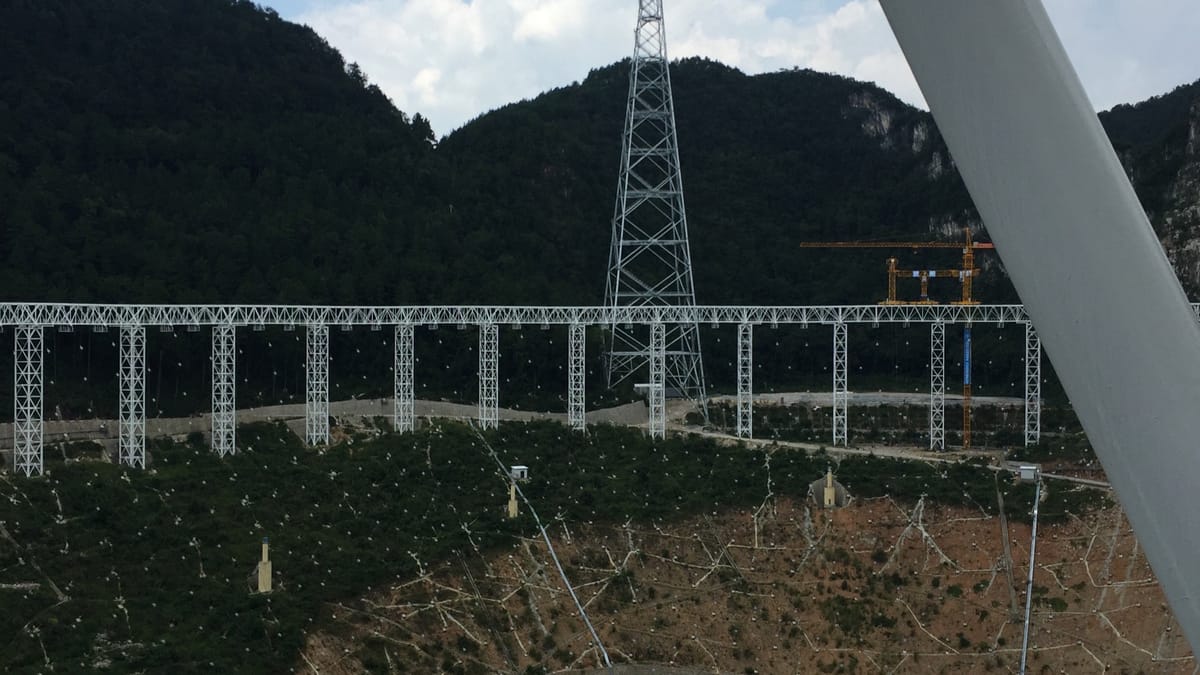
In a karst valley in Guizhou, China built a telescope that does not look like a telescope in the ordinary sense. There is no tube, no dome, and no mount turning through the night. FAST is a half-kilometer dish set into a limestone depression, a huge field of triangular panels suspended from a steel cable net and surrounded by hills.
Its full name is the Five-hundred-meter Aperture Spherical Telescope. Its public nickname is the Sky Eye. The engineering claim is simpler: FAST is the world’s largest single-dish radio telescope, built to collect radio signals so faint that ordinary electronics, vehicles, and phones can overwhelm them.
The scale is obvious from the rim. The trick is less obvious. FAST is not a rigid bowl. It is a shape-shifting instrument. Thousands of actuators pull part of the spherical reflector into a parabola, while a receiver cabin weighing about 30 tonnes hangs above the dish from cables and follows the moving focus. At any moment, a 300-meter section of the larger surface becomes the working telescope.
That combination made FAST more than a larger Arecibo. It gave China a uniquely sensitive listening instrument for pulsars, neutral hydrogen, fast radio bursts, and other radio sources. It also required a protected silence zone around the valley, meaning the megaproject changed the lives of thousands of people who had lived near Dawodang before the telescope arrived.
Why China Built a Sky Eye
Nan Rendong, an astronomer with the Chinese Academy of Sciences, began pushing the idea in the 1990s after international discussions about the next generation of large radio telescopes. Arecibo’s 305-meter reflector in Puerto Rico had dominated single-dish radio astronomy since the 1960s, but it was also a fixed spherical dish with limits in sky coverage and sensitivity.
Nan’s proposal was ambitious: use one of Guizhou’s natural limestone depressions as the cradle for a 500-meter reflector, then avoid Arecibo’s main limitation by making part of the surface actively deform into a parabolic shape. The terrain would reduce the amount of earthwork. The surrounding mountains would help shield the site from radio interference. The active reflector would turn the valley into a telescope that could track sources across a useful patch of sky.
Finding the right valley took years. The team surveyed hundreds of karst depressions before settling on Dawodang, near Pingtang County. The bowl was large, deep, naturally drained, and remote enough to give the telescope a fighting chance at radio quiet.
The project was approved as one of China’s major science and technology infrastructure efforts. Construction began in 2011, and FAST was inaugurated on September 25, 2016. Nan lived long enough to see the dish completed, but not long enough to see the facility reach full scientific operation. He died in 2017 after spending more than two decades trying to turn the idea into a working observatory.
Turning a Valley Into a Telescope
FAST started with civil engineering. Roads, utilities, worker access, and foundations had to be built into a wet, mountainous site before the observatory itself could take shape. The main fixed structure is the ring beam around the rim of the depression. From that rim hangs the cable net that carries the reflector.
The visible dish is made from about 4,450 triangular panels. Those panels sit on the cable net, and the cable net is connected to 2,225 actuators. The actuators are the machinery that gives FAST its defining ability. When astronomers choose a target, the control system pulls a 300-meter portion of the spherical surface into the parabola needed to focus incoming radio waves.
The rest of the dish remains spherical. The active section moves across the 500-meter surface as the target crosses the sky. It is a telescope that points by changing shape rather than by rotating a solid structure.
Above the reflector, a feed cabin hangs from six cables anchored to towers around the hills. The cables provide the large movement needed to put the cabin near the focus of the active dish. A fine-positioning system inside the cabin makes smaller corrections so the receiver sits where the radio waves converge. FAST’s workhorse L-band receiver uses 19 beams, allowing it to survey more sky per observation than a single-beam instrument.
The engineering is unforgiving because the signals are so weak. A phone, a router, or a vehicle ignition system near the site can be louder to the receivers than the distant object being studied. The reflector, cabin, receivers, and software only work as intended if the surrounding radio environment is controlled.
The Price of Radio Silence
FAST’s scientific value depends on silence. Chinese authorities created a protected radio environment around the telescope, including a core restriction zone close to the dish. Reports from the construction period describe roughly 9,000 residents being relocated from nearby villages before regular operations began.
That displacement is part of the megaproject, not a footnote to it. The telescope needed a region with few transmitters, few roads, and little modern electronic noise. The same isolation that made Dawodang attractive to astronomers also meant that the people living there were mostly rural communities with limited political power over the decision.
The official case was that relocation would protect the telescope and move residents into newer housing. The harder reality is that farmland, village networks, and inherited homes are not easily replaced by an apartment and a payment. FAST is a scientific instrument built to hear the universe, but its operating conditions were created through state power on the ground.
The tension did not end with construction. Pingtang County also built a tourism economy around the Sky Eye, with viewing areas and visitor infrastructure outside the most sensitive areas. Tourism helps the local economy and makes the project visible to the public. It also has to be managed carefully because every new road, hotel, bus, and device is a possible source of radio interference.
What FAST Has Already Found
FAST passed China’s national acceptance review in January 2020 and moved from commissioning into regular scientific operation. Its early results quickly matched the reason it had been built.
Pulsars were the obvious target. These rapidly rotating neutron stars produce regular radio pulses, and FAST’s sensitivity lets it find faint pulsars that smaller instruments miss. Chinese Academy of Sciences reporting said that by 2024 FAST had discovered more than 900 pulsars, making it one of the most productive pulsar discovery instruments ever built.
Fast radio bursts gave FAST an even more dramatic result. In observations of the repeating source FRB 121102, researchers reported 1,652 bursts across 47 days of observing. That kind of dense burst sample is exactly where a giant single dish matters: it can detect weak events in large numbers, giving researchers enough data to study timing and energy patterns rather than just individual flashes.
FAST also became more important after Arecibo collapsed on December 1, 2020. The National Science Foundation had already decided that the Puerto Rican telescope could not be safely repaired after cable failures. Its collapse ended more than half a century of Arecibo as the reference giant single dish. FAST was left as the only operating radio telescope at that scale.
In 2021, China opened FAST observing time to international proposals. That made the telescope a global facility in practice as well as scale, though it remains a Chinese Academy of Sciences instrument with its own access rules, logistics, and radio-quiet procedures.
The Unfinished Problem
FAST solved the hardest construction problem first: it turned a wet limestone valley into an enormous precision instrument. The problems that remain are more operational.
The telescope needs upgrades to stay ahead. Researchers have discussed new receiver systems and surrounding auxiliary dishes that could improve survey speed and angular resolution. The site has to keep attracting the engineers, technicians, and astronomers required to operate an instrument unlike any other. The local economy has to balance tourism against the radio silence the telescope was built to protect.
Those are not small details. FAST’s value comes from sensitivity, and sensitivity is fragile. A radio telescope can be defeated by the world around it as easily as by a failure inside the dish.
The Sky Eye is already a scientific success. It has found pulsars, dissected fast radio bursts, and given radio astronomy a giant single dish after Arecibo’s loss. But the long-term test is whether China can keep the valley quiet, keep the instrument upgraded, and keep the observatory open enough that the rest of the scientific world can use the machine Nan Rendong spent his life trying to build.
Key Takeaways
-
FAST is the Five-hundred-meter Aperture Spherical Telescope, a 500-meter single-dish radio telescope in Guizhou, China.
-
The dish uses about 4,450 reflector panels and 2,225 actuators to reshape a 300-meter active section into a parabola.
-
A receiver cabin weighing about 30 tonnes hangs over the dish from six cables and follows the moving focus.
-
FAST’s radio-quiet environment required major restrictions around the site and the relocation of roughly 9,000 nearby residents.
-
Since entering regular operation, FAST has become a leading instrument for pulsar discovery and fast radio burst research.

Simon Whistler
Simon Whistler hosts MegaProjects, bringing engineering, infrastructure, and military-machine stories into clear narrative focus for viewers who want the systems, tradeoffs, and human decisions behind the build.
Frequently Asked Questions
What does FAST stand for?
FAST stands for Five-hundred-meter Aperture Spherical Telescope. It is a giant radio telescope built into a natural karst depression in Guizhou, China.
Why is FAST called the Sky Eye?
Sky Eye is FAST’s public nickname in China. It reflects the idea of a huge instrument listening to signals from deep space, though radio telescopes detect radio waves rather than visible light.
Is FAST larger than Arecibo?
Yes. FAST has a 500-meter physical reflector, while Arecibo’s dish was 305 meters across. FAST also uses an active surface that reshapes part of the dish into a steerable parabolic reflector.
How does FAST point at objects if the dish does not move?
FAST points by reshaping part of its spherical reflector. Actuators pull a 300-meter section of the surface into a parabola, and the suspended receiver cabin moves to the focus of that active section.
What has FAST discovered?
FAST has discovered hundreds of pulsars, including more than 900 reported by 2024, and has produced major fast radio burst datasets, including 1,652 bursts from FRB 121102.
Why were people relocated near FAST?
Radio telescopes are extremely sensitive to interference from electronics and transmitters. Authorities established protected zones around FAST and relocated residents from nearby villages to reduce local radio noise.
Can visitors use phones near FAST?
Visitors to the most sensitive areas cannot use ordinary personal electronics. The radio-quiet rules are designed to prevent local transmissions from contaminating telescope observations.
Sources
-
Chinese Academy of Sciences: FAST opens to global scientists
-
Chinese Academy of Sciences: FAST has identified over 900 pulsars
-
Nature: A bimodal burst energy distribution of a repeating fast radio burst source
-
National Science Foundation: Arecibo Observatory media toolkit
-
The Guardian: China relocates villagers for world’s largest radio telescope
-
Hero image source, Luo Fang / Wikimedia Commons, CC BY-SA 4.0.
Related Projects
National Ignition Facility
How Lawrence Livermore's National Ignition Facility turned 192 lasers, Cold War stockpile science, and decades of failed shots into laboratory fusion ignition.
The Duga Radar
The story of the Duga over-the-horizon radar, the mysterious "Russian Woodpecker" signal that haunted radio operators worldwide during the Cold War.
RP FLIP
How R/P FLIP, the 355-foot floating instrument platform, rotates from ship-like hull to stable spar buoy for ocean science.