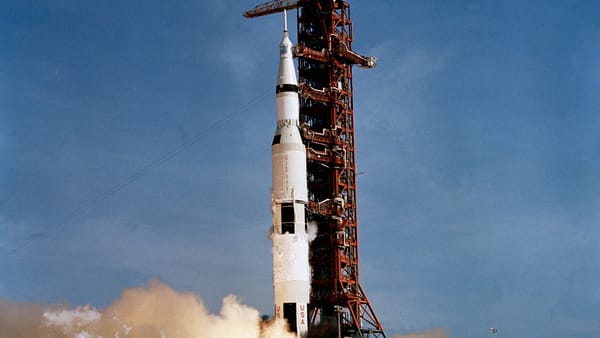

Without ambition, there can be no innovation. From the first days of the Cold War, human ambition has reached outward to the stars, as the most powerful nations on Earth sought to break our final terrestrial boundary. Today, 77 world governments have their own space agencies. Sixteen have the capability to launch spacecraft.
Five — plus the continental European Space Agency — can land on extraterrestrial bodies. But of every nation on this planet, only three have brought a living human being to space: the United States, Russia, and China.
Of those three, the USA and Russia’s predecessor, the Soviet Union, achieved that milestone during the Cold War as one piece of a much larger contest for global supremacy. China took a very different route. In the span of thirty years, its space program went from a handful of ballistic missiles to a pioneering organization at the leading edge of spacefaring technology. That journey is known as Project 921.
- Year Project 921 launched
- 1992
- First crewed spaceflight
- October 15, 2003
- Taikonaut who made first Chinese crewed flight
- YangLiwei
- Tiangong space station altitude
- 350 km aboveEarth
- First long-duration crew stay
- 6months (Shenzhou-13)
- Nations to achieve independent human spaceflight
- 3 (USA, Russia, China)
Predecessors and Formation
On April 24, 1970, China’s Dongfanghong-1 satellite reached orbit. Weighing 173 kilograms and launched on an indigenously produced Chinese rocket, it had two simple tasks: sing a patriotic song and announce the time. Despite that modest mission, the satellite was a major proof of concept. Made in China, launched with Chinese materials, and under sole Chinese control, Dongfanghong-1 placed its nation alongside the US, the Soviet Union, the United Kingdom, and France as the only five countries to have ever put anything into space.
China’s entry into that exclusive club had been a long time in the making. First proposed by Mao Zedong in 1958, the idea of placing an artificial satellite in orbit was a massive undertaking — made especially ambitious given its coincidence with the disastrous Great Leap Forward. For the next twelve years, a task force at the Chinese Academy of Sciences worked to make it happen.
Under Chinese scientist Qian Xuesen — educated in the United States before being expelled during the Red Scare of the 1940s and 1950s — China’s team of space scientists slowly grew. Closely linked with China’s nuclear weapons program, the space initiative developed the Long March series of rockets. As with the American and Soviet programs, China’s first launch vehicles were derived from ballistic missiles, though they would grow far more sophisticated over time. By 1970, China’s rocket scientists were already thinking about putting a human in space, and just a year later, nineteen astronaut candidates were selected to train for that honor.
But the Cultural Revolution intervened. In its campaign against China’s intellectual class, many of the program’s best scientists and engineers were dismissed from their posts. Astronaut trainees were sent home. By 1980, what remained of the space program had been abolished.
Twelve years later, China was in a very different position. A stable political environment had produced a stable and growing economy. The recent collapse of the Soviet Union had left something of a vacuum in the communist world, and China’s leadership recognized both the hunger for progress that its billion-plus citizens felt and the strategic value of a bold scientific program.
From this context emerged Project 921 — China’s reborn aspiration to reach space and, more importantly, to see it firsthand. Designated for the year of its founding, 1992, with a suffix of 1 to indicate it was that year’s first major national initiative, its long-term mission was divided into three phases.
In Phase 1, China would launch an unmanned spacecraft and master everything theoretically required to send a living human to space. In Phase 2, Chinese astronauts — referred to as taikonauts — would learn to travel to and from orbit, perform spacewalks, dock their modules, and prepare for a short-term space station. In Phase 3, China would construct its own space station capable of supporting a long-term crewed presence.
It was a bold plan, overseen by the newly founded China National Space Administration, and it required China to develop and manufacture its own technology to achieve it.
First Step: Launch and Return
To visit space, you have to leave Earth’s atmosphere, and China’s initial answer to that problem was the Long March 2F. A two-stage rocket 62 meters tall, fitted with four strap-on boosters and capable of lifting 8,400 kilograms of payload, the 2F was designed as a human-safe improvement over the Long March 2 family. Its predecessor, the Long March 2E, had been largely a failure of design, damaging several satellites on the way into space. The 2F had to be thoroughly overhauled before any rational person would consider boarding it.
Inside the Long March 2F, Chinese engineers developed the Shenzhou space capsule, based in large part on Russian Soyuz technology. In 1995, Russia provided significant support to the Chinese program, including actual modules for replication. The Shenzhou is visually similar to the Soyuz, though its larger size and range of internal modifications set it apart. The capsule consists of three modules: a forward orbital module with its own propulsion, an aft service module, and a re-entry capsule for return to Earth.
The launch escape system was developed entirely by Chinese engineers.
During this same period, China was selecting its first taikonauts. Two military pilots, Wu Jie and Li Qinglong, were sent to Russia for training in 1996, and two years later, fourteen pilots were identified as candidates. To support them, the Beijing Aerospace Flight Control Center opened in 1998.
China’s first test of the Shenzhou came on November 20, 1999, when the uncrewed Shenzhou-1 lifted off from a launch pad in Jiuquan. The objective was straightforward: reach orbit and return safely. It succeeded, with the return capsule touching down in Mongolia just one day later. Subsequent unmanned missions followed.
In early 2001, Shenzhou-2 spent seven days in orbit hosting microgravity experiments and a menagerie of animals — a monkey, a dog, a rabbit, and several mice — to test life support systems. All survived re-entry. The third and fourth missions in 2002 carried progressively more sophisticated dummy payloads, culminating in a full simulation of crewed conditions.
On October 15, 2003, the moment arrived. Taikonaut Yang Liwei was strapped into Shenzhou-5, and six minutes after launch, he and his capsule entered orbit. Twenty-one hours later, Yang landed safely in Mongolia. China had become only the third nation in history to place a human being in space and bring them home safely, entirely on its own — a historic achievement the world applauded for its scientific merit, and one that set off a cascade of Chinese advancements.
Second Step: Laboratory and Rendezvous
In the years following Yang Liwei’s flight, China launched two additional crewed missions using the Long March 2F. In October 2005, two taikonauts spent five days in space before returning safely. In September 2008, three taikonauts conducted China’s first-ever spacewalk. Each mission gave engineers the opportunity to refine procedures and improve the Shenzhou modules for safety, livability, and scientific capacity.
Meanwhile, China’s manned program was not operating in isolation. On November 5, 2007, China’s first lunar orbiter entered the moon’s gravity well, with a second launching less than three years later. The manned and unmanned programs fed off each other while also competing for the same limited pool of resources. But the real ambition during this period was to translate the lessons of the first seven Shenzhou missions into something more permanent: the groundwork for a short-term habitable space station.
This ambition produced the Tiangong-1. With a name translating as “Heavenly Palace,” it was designed as an experimental station to test docking systems and scientific tools. It also offered China the chance to become the world’s only country operating an actively inhabited national space station, since Russia’s Mir had been deorbited and the ISS, though continuously occupied, was a multinational endeavor.
Tiangong-1 weighed 8,500 kilograms, measured ten-and-a-half meters long by three-and-a-half meters wide, and was constrained in size by the dimensions of the rockets that would carry it to orbit. Its interior was divided between a pressurized forward module where taikonauts would live and an unpressurized aft module housing propulsion. The station was solar-powered and included ergonomic and safety features appropriate for its scale.
Tiangong-1 reached orbit in September 2011, establishing itself 350 kilometers above the surface. Within a month, the uncrewed Shenzhou-8 arrived for the station’s first docking test — conducted under ground control, during orbital darkness, maintained for twelve days, followed by a second rendezvous in sunlight. A biological sample provided by Germany and the European Space Agency survived the entire mission. The test was a complete success, and the Shenzhou-8 design became final; no subsequent craft in the Shenzhou line has been significantly modified from it.
With docking proven, two crewed missions followed before Tiangong-1’s scheduled decommission. Shenzhou-9 brought three taikonauts — including Liu Yang, the first Chinese woman in space, alongside Liu Wang and commander Jing Haipeng — to the station for a successful multi-day visit. Shenzhou-10 delivered another crew of three for a two-week stay. Among them was Wang Yaping, China’s second woman in space, who broadcast a live science lesson to sixty million Chinese students from orbit.
Tiangong-1 ended its crewed service after those missions and was monitored unmanned for several years before re-entering the atmosphere in April 2018, burning up on its descent.
Its successor, Tiangong-2, had already been in orbit since 2016 with the same design parameters. It was visited by humans once: a crew of two taikonauts who spent 33 days aboard Shenzhou-11. Their stay — the first month-long crewed mission in China’s program — demonstrated the station’s ability to sustain life over an extended period. In 2017, Tiangong-2 also hosted the uncrewed Tianzhou-1, a dedicated resupply vessel that successfully tested cargo docking procedures.
When Tiangong-2 reached the end of its service life in 2019, it, too, burned up in a quiet atmospheric descent.
It might seem that the two Tiangong prototypes — which between them hosted only seven taikonauts, completed five rendezvous missions, and spent fewer than two cumulative months inhabited — were modest returns on significant investment. But they were never designed to be destinations. They were a checklist. Station docking, rendezvous, life support, long-duration crew survival: every necessary box had now been checked. China was ready to build its permanent station.
Third Step: The Permanent Tiangong
Compared to its two predecessors, the permanent Tiangong — no number required — was a behemoth. First revealed in 2018, its design called for three modules. The Tianhe core module, roughly the size of a bus, would serve as the station’s spine, housing the crew’s main living quarters along with the power, propulsion, and life support systems, and a docking hub for visiting Shenzhou craft.
The Wentian module provided backup life support and propulsion redundancies, an independent spacewalk airlock, three additional short-term crew berths, and extensive laboratory space oriented toward life sciences. The Mengtian module expanded the station’s experimental capacity further — focusing on microgravity research — while adding communication features and a cargo airlock for unmanned supply vessels.
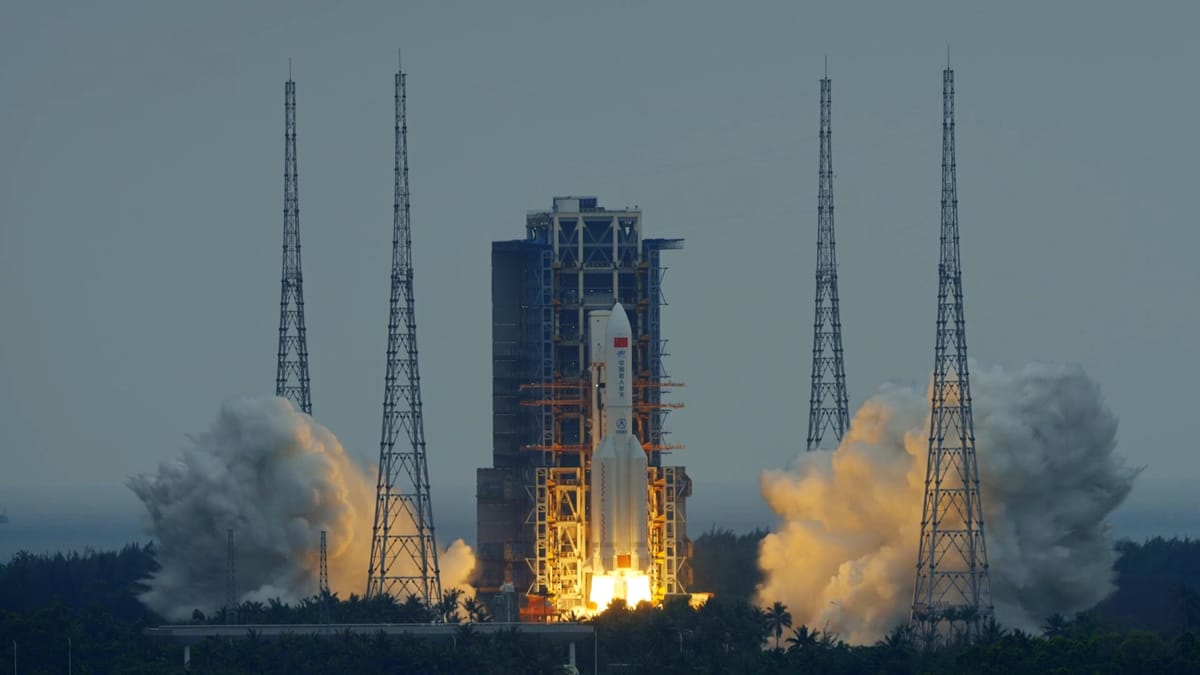
The Tianhe core was brought to orbit in 2021 on the Long March 5, a significantly more capable rocket designed to carry heavier payloads. An uncrewed Tianzhou cargo vessel delivered the supplies needed to support a live crew, and on June 17, 2021, Shenzhou-12 docked with the Tiangong, delivering three taikonauts for a 90-day stay. They performed two spacewalks, installed equipment, tested technology, and confirmed China’s understanding of long-term microgravity effects. Shenzhou-13 brought the next crew just a month after their departure.
The Shenzhou-13 mission was pivotal: its crew of three became the first to complete a full six-month stay aboard the Tiangong. From that point forward, six months became the standard mission duration — marking the transition from proof-of-concept testing to routine operations. The Shenzhou-14 crew that followed completed their own six-month stay, during which the station received its two laboratory modules. The Wentian docked on July 24, 2022, and the Mengtian followed on October 31, 2022.
The crew performed multiple spacewalks to complete both installations.
Shenzhou-15 arrived on November 29, 2022, carrying taikonauts Fei Junlong, Deng Qingming, and Zhang Lu to continue the station’s scientific mission.
Into the Future
The Tiangong’s operations are expected to continue without interruption, with a standing crew of at least three taikonauts at any given time, regular resupply from uncrewed Tianzhou cargo vessels, and ongoing scientific experiments broadcast to Chinese students and published for the global scientific community.
China’s ambitions extend well beyond the station’s current configuration. One design feature of the Tiangong is a spare docking port on the core module — a port that could receive a new module, which could in turn carry its own docking ports, enabling the station to expand outward in multiple dimensions. Planned additions may include expanded crew quarters, improved amenities, and additional life support and propulsion redundancies. No firm timeline for this expansion has been announced.
Looking further ahead, China has outlined an extraordinarily ambitious roadmap. By 2025, it hopes to collect samples from near-Earth asteroids, followed by a Mars sample-return mission in 2030. That same year, China claims it will land taikonauts on the Moon while also sending an unmanned probe to Jupiter. In 2033, Chinese taikonauts are slated to become the first humans to set foot on Mars.
By 2035, China aims to have a fleet of reusable carrier rockets replacing the Long March line, and by 2040, it intends to have developed a nuclear-powered space shuttle. The overarching goal, by 2045, is to stand as a leading space power — with further missions to Mars and the outer solar system to follow.
There is also a significant geopolitical dimension to China’s space future. The International Space Station is scheduled for decommission in 2031, and NASA is legally prohibited from sharing data with China, leaving Chinese taikonauts barred from the ISS by default. Should no ISS successor be operational by that date, the Tiangong could find itself the world’s only functioning space station — a scenario that may eventually test America’s data-sharing restrictions against its desire to maintain a continuous human presence in orbit. Whether China’s space program will incorporate military components, and how its growing capabilities will reshape great-power competition, remains to be seen.
Key Takeaways
- Project 921 was launched in 1992 as China’s three-phase national program to achieve crewed spaceflight, build toward a space station, and eventually establish a permanent orbital presence.
- On October 15, 2003, Yang Liwei became the first Chinese taikonaut in space aboard Shenzhou-5, making China only the third nation in history to independently send a human to space and return them safely.
- The Tiangong-1 and Tiangong-2 prototype stations served as operational test beds — validating docking, rendezvous, life support, and long-duration crew survival — rather than as long-term destinations.
- The permanent Tiangong space station consists of three modules: the Tianhe core, the Wentian life-sciences laboratory, and the Mengtian microgravity laboratory, assembled between 2021 and 2022.
- Six-month crew rotations became standard from Shenzhou-13 onward, marking China’s transition from experimental spaceflight to routine orbital operations.
- China’s stated goals include a lunar landing in 2030, a crewed Mars mission in 2033, and the ambition to be the world’s leading space power by 2045.
- The Shenzhou crewed transport and the Tiangong station have maintained a near-spotless safety record across fifteen Shenzhou launches, benefiting from the hindsight of earlier American and Soviet programs.
Eliot Harper
Eliot Harper writes about grids, launch infrastructure, complex fabrication, and the operational constraints that make modern megaprojects succeed or stall.
Frequently Asked Questions
What is Project 921?
Project 921 is China’s long-term national space program, formally launched in 1992 and named for the year and sequence of its founding. Its mission was divided into three phases: achieving crewed spaceflight, developing space station operations and rendezvous capabilities, and ultimately constructing a permanent crewed orbital station.
Who was the first Chinese person in space?
Yang Liwei became the first Chinese taikonaut to reach space, launching aboard Shenzhou-5 on October 15, 2003. He orbited Earth for twenty-one hours before landing safely in Mongolia, making China the third country to independently put a human in space and return them safely.
What is the Tiangong space station?
The Tiangong — Chinese for “Heavenly Palace” — is China’s permanent crewed space station, assembled in orbit between 2021 and 2022. It consists of three modules: the Tianhe core, the Wentian life-sciences laboratory, and the Mengtian microgravity laboratory, and operates at an altitude of approximately 350 kilometers.
How does the Shenzhou spacecraft relate to the Russian Soyuz?
The Shenzhou capsule was developed with significant reference to Russian Soyuz technology; in 1995, Russia provided actual modules for China to study and replicate. The Shenzhou is visually similar to the Soyuz but is larger and incorporates a range of internal modifications. Its launch escape system was designed entirely by Chinese engineers.
What happened to the early Tiangong prototype stations?
Both Tiangong-1 and Tiangong-2 were experimental stations rather than permanent facilities. Tiangong-1 was decommissioned after its crewed missions and burned up on atmospheric re-entry in April 2018. Tiangong-2, which hosted a 33-day crewed stay and an unmanned cargo docking test, ended its operational life in 2019 and similarly burned up during its re-entry.
What are China’s long-term ambitions in space?
China has publicly stated plans to collect asteroid samples by 2025, complete a Mars sample-return mission by 2030, land taikonauts on the Moon and send an unmanned probe to Jupiter in 2030, place the first humans on Mars in 2033, develop reusable carrier rockets by 2035, build a nuclear-powered space shuttle by 2040, and establish itself as the world’s leading space power by 2045.
Sources
-
Original MegaProjects video: A Closer Look at China’s Epic Space Mission: Project 921
-
Hero image source by China News Service / Wikimedia Commons, CC BY 4.0.
Related Projects
FAST: China’s Half-Kilometer Telescope
How China built FAST, the half-kilometer Sky Eye radio telescope, with an active dish, a suspended feed cabin, and a protected radio-quiet valley.
H-20: China’s Stealth Bomber
China's H-20 stealth bomber has been promised for years. The public record still shows a program wrapped in secrecy, delay, and unproven claims.