
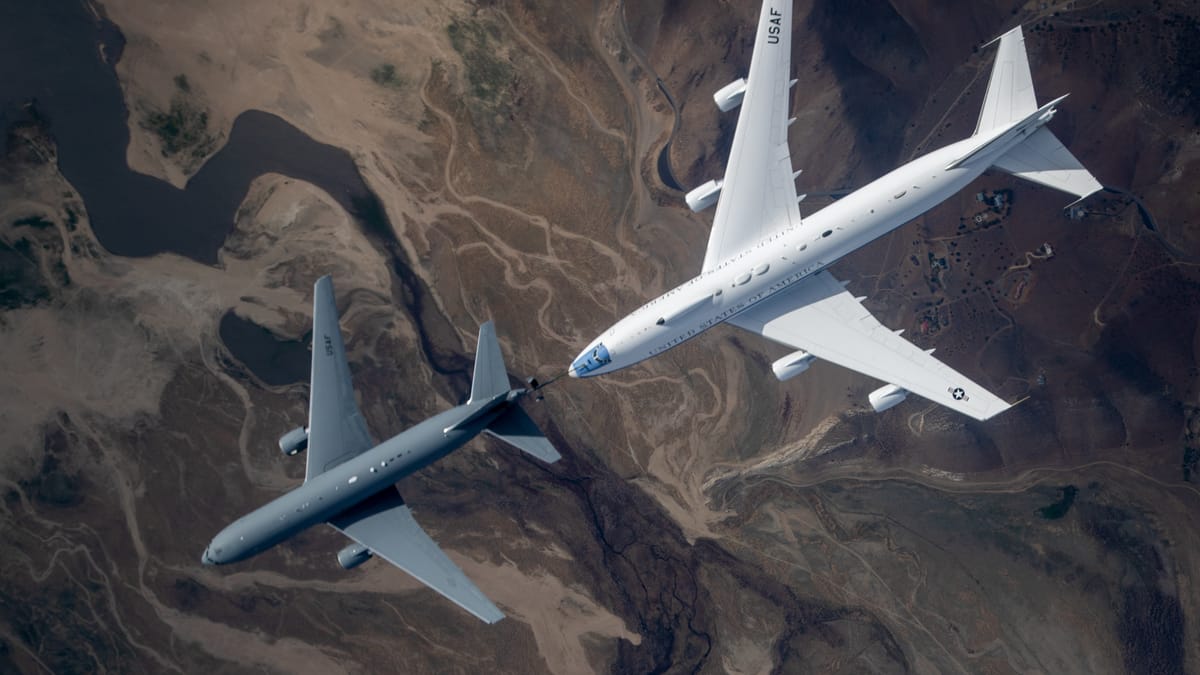
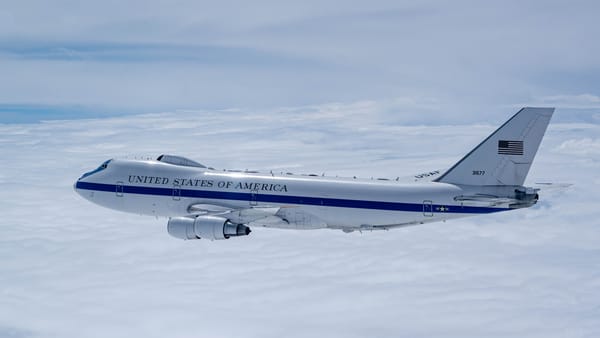
It’s the airplane designed for the end of the world. Kept deep in the American heartland and held ready twenty-four hours a day, 365 days a year, four specially designed aircraft lie in wait for the moment everything changes. They’re not meant to drop bombs, they’re not meant to ravage enemy bases, and they’re not meant to fly VIPs around the world, or at least, not usually. They’re a fleet with exactly one purpose: to provide a command post for the highest leaders of the American military in the event of nuclear war.
If everything goes wrong, if the klaxon sirens roar to life, it’s the Boeing-made, US Air Force-operated E-4 Nightwatch that takes control. From that moment onward, the decisions made inside its fuselage will change the course of global history.
Born From the Fear of an EMP
The E-4 Advanced Airborne Command Post, or AACP, was born of the same moment in American history that saw a range of iconic military aircraft take to the skies for the first time. Alongside the high-performance F-15 Eagle, the thundering B-1 Lancer, the tough-as-nails A-10 Warthog, and the gargantuan C-5 Galaxy, the AACP, better known today as the Nightwatch, was developed and first flown in the early 1970s. A combination of newly available American technologies and fears of highly advanced warplanes that might soon emerge from the Soviet Union prompted a fleet-wide set of evolutions that has really only been duplicated since with the advent of stealth-aircraft technology.
- Length
- 231 ft 4in (70.5 m)
- Wingspan
- 195 ft 8in (just under 60 m)
- Max speed
- ~600mph (970 km/h)
- Range
- 7,100miles (11,500 km)
- Max endurance
- Up to a full weekairborne
- Mission crew
- Up to 108people
But for the Nightwatch, the driving factor wasn’t simply beating some rival aircraft sent by Moscow. The issue at hand was a different threat: the nuclear electromagnetic pulse, or nuclear EMP. EMPs are massive bursts of electromagnetic radiation, and they can come from natural phenomena like lightning strikes, the breakup of a meteor falling through the atmosphere, and coronal mass ejections, the massive plasma bursts that erupt from the Sun and can sometimes wash over the Earth.
They cause electrical interference that can temporarily, or even permanently, damage electrical systems close enough to receive a blast of energy. Minor EMPs like lightning have largely been dealt with in modern hardware, but major EMPs can cause massive damage to electrical and electronic systems, buildings, airborne transportation, and more.
Since the early days of nuclear bomb testing in 1945, the United States already knew EMPs were a by-product of nuclear detonation. But while it understood the presence of EMP bursts and their effects, it badly underestimated their scale. The turning point came nearly two decades later. In July 1962, America carried out a test called Starfish Prime, detonating a bomb of about one and a half megatons’ yield over the Pacific, and the resulting EMP was way bigger than expected. In Hawaii, nearly a thousand miles from the test, hundreds of streetlights were disabled and other minor but real electrical damage was recorded. The damage was fixed relatively quickly, but as the test results were analyzed, they painted a more and more foreboding picture.
Luckily for America, Starfish Prime took place far from the continental US, in a zone where the Earth’s magnetic field exerted only moderate strength. The lower forty-eight states were another matter. The Earth’s magnetic field there is a good bit stronger, and if the same warhead had been detonated at a similar altitude over the northern US, the effects would have been orders of magnitude worse. Design a weapon specifically to create the largest high-altitude EMP burst it could, as the Soviets were almost certain to do once they ran the same math America had, and America was in serious trouble. According to a primer published by the Federation of American Scientists in the late 1990s, a large nuclear device detonated four to five hundred kilometers above Kansas would fry the electrical grid, destroy most forms of modern technology, and send most, if not all, of the continental United States back to the Industrial Age. Worse, such a strike could hand the Soviets a strategic victory very quickly, crippling America’s defense apparatus and preventing a nuclear retaliation without a single death on either side.
From the EC-135 to a Hardened 747
The Nightwatch wasn’t the first aircraft the United States built to provide an airborne strategic command post, but it was a significant improvement on the stopgap that came before. Its predecessor was the EC-135, based on Boeing’s C-135 Stratolifter. To its credit, the EC-135 was a capable platform for the time.
Through the sixties and seventies it flew so-called Looking Glass missions, with one aircraft airborne at all times, 24/7/365, to command nuclear bombers and ballistic-missile silos should ground command centers be destroyed or made inoperable. But its dated technology and lack of EMP resistance meant it needed replacing sooner rather than later.
To answer the call, the US Air Force went to Boeing looking for a few copies of its biggest and most sophisticated aircraft at the time, the 747-200. Boeing happened to have a couple on hand, built for a commercial customer who had ultimately decided not to complete the purchase. By the end of 1973, the order was doubled to four.
Because the Nightwatch uses the same frame as a commercial 747, its construction had less to do with an innovative airframe and more to do with the interior. That isn’t to say the planes underwent no exterior changes. The Nightwatch aircraft have a distinctive bulge a few dozen feet behind the cockpit. That’s where they house a radome featuring a steerable satellite communications antenna, with later updates enabling communications with a constellation of military satellites in orbit. But the bulk of the work was on the interior, enabling a massive crew of well over a hundred people to maintain constant contact with the outside world and manage incredibly important strategic assets.
The first aircraft took its inaugural flight in June 1973, and by the time the third was delivered to the Air Force in 1974, the planes already had new engines. In 1979, when the fourth aircraft was finally delivered, it was the first to include that radome on top, behind the upper deck. This kicked off the change from the early-model E-4A to the E-4B, and within a few more years all four planes were E-4Bs, outfitted with vastly improved communications and some serious hardening against electromagnetic pulses. Because of the rapidly evolving threat environment these aircraft face, they’ve never stayed internally stagnant for more than a couple of years at a time, but much of what goes on under the surface is classified and guarded behind closed doors. From the outside, the E-4B you might see in the skies today is almost totally unchanged from four decades ago. From what we do know about its internal systems, though, it has grown into a very impressive beast.
Specs and Survivability
When it comes to basic specs, the E-4B is similar for the most part to a classical Boeing 747. With a full length, tip to tail, of 231 feet 4 inches, or seventy and a half meters, it boasts a wingspan of 195 feet 8 inches, just under sixty meters. Sitting empty it weighs about 410,000 pounds, or 186 metric tons, and it’s powered by four General Electric F103 engines, each capable of pushing out about 52,000 pound-force of thrust.
At maximum speed it can crest just over 600 miles per hour, around 970 kilometers per hour, and it cruises at nearly the same pace, 556 miles per hour or about 900 kilometers per hour. On a single tank of fuel it has a range of 7,100 miles, or 11,500 kilometers, with a maximum in-flight altitude of 45,000 feet, around fourteen thousand meters. With a few small discrepancies here and there, that puts the E-4B on par with the 747-200 across the board, or at least that’s what it looks like from the outside.
As soon as we begin talking about the E-4B’s internal modifications, it becomes crystal clear that this is a far more sophisticated machine. The change at the heart of the aircraft is its hardening against EMP bursts. All onboard wiring is shielded from electrical disruption, all equipment is heavily insulated, and although, by public knowledge, this has never been tested, the aircraft should be able to withstand the kind of nuclear EMP burst that would cripple the rest of the United States. The cockpit, too, is built to be invulnerable to EMPs. As a result it has forgone the upgraded glass cockpits of modern aircraft, with their LCDs and digital bells and whistles, relying entirely on analog flight instruments the old-fashioned way, making its own controls functionally impervious to electrical interference.
Then there’s endurance. The Nightwatch is designed to receive in-flight aerial refueling, courtesy of the United States’ prodigious tanker fleet, and it’s not modest about its appetite. If it’s being refueled by America’s workhorse tanker, the KC-135, it takes two full KC-135s to replenish the E-4B’s internal fuel supplies just once.
But should the Nightwatch ever have to fulfill its primary function, the presence of refueling tankers becomes very important. The E-4B is designed to remain airborne for up to a full week at a time, with engines that can fire for weeks and only become inoperable when their stores of lubricant run out. As long as the fuel keeps coming, the E-4B can keep flying, potentially coordinating what would be the worst days in US history, up to and including the world’s first reciprocal nuclear exchange.
Speaking of nuclear exchange, the aircraft has other features to guard against the consequences of warhead detonation. Its windows, though few and far between, are covered in a mesh that prevents electromagnetic shockwaves from blowing them inward, and the flight crew has access to specialized masks that prevent the operators from being blinded if nuclear explosions occur within their field of vision.
The Largest Crew of Any Military Aircraft, Ever
Inside, the Nightwatch carries the largest crew complement of any military aircraft in the entire world, ever. The flight crew is a relatively modest bunch, including just a pilot, a copilot, a flight engineer, and a navigator, but the mission crew is a whole other story. The E-4B contains the space and stations to operate with a mission crew of up to 108 people, from maintenance crew to onboard analysts and technicians to senior members of the US military. At the helm is the battle staff, a team of planners, systems officers, administrative personnel, a handful of other experts, and the onboard chief. They’re supported by the operations team, which works to process and synthesize data from up to 29 onboard consoles at once. Also aboard is the Technical Control team, which handles the aircraft’s communication systems and keeps them connected, cooled, and reliable in flight.
The layout is specially optimized to ensure the full mission staff can function at its highest ability. The plane is organized into three decks. The uppermost includes the flight deck for the pilot, copilot, navigator, and flight engineer, plus a lounge area and sleeping quarters for the flight crew and maintenance personnel.
The middle deck is where the magic happens: it includes a nine-seat conference room, a projection room with EMP-insulated flatscreen displays, a briefing room where the battle staff does most of its work, an operations area housing those 29 consoles and their associated switchboards, phones, and data hubs, and a compartment near the aft of the aircraft where the Technical Control team works. Toward the front of the main deck, the E-4B has a galley with freezers, refrigerators, ovens, and microwaves, with onboard stewards able to serve many dozens of hot meals over an extended flight. Toward the aft, the crew has a rest area to sleep and recuperate, with additional food storage and the capacity for use in religious ceremonies.
Also squeezed onto the main deck is a zone called the National Command Authority area, or NCA. This basically amounts to an executive suite, a place to house the President of the United States, the Secretary of Defense, or, in times of severe crisis, an Acting or Presumptive Acting President. The suite contains a modest sleeping area, a lounge, an office, a dressing room, and a telecommunications suite for secure, high-quality communications from the plane to anywhere in the world.
If the Nightwatch does carry the highest executive of the United States, the onboard briefing room is fitted with a lectern and the ability to prepare and broadcast video. The E-4B can also link to America’s ground-based communications network, though that may be a less useful capability if much of that network is fried. In all, the Nightwatch features 42 different communication systems, all at the President’s fingertips in an emergency.
It can reach any landline or cell phone in the entire world, capture radio and television broadcasts, and communicate with any element of the US military at any time.
The lowermost deck is largely functional, equipped with water-supply tanks that store enough for a full flight crew across the length of a journey. Also on the lower deck are satellite communications equipment and a very-low-frequency, or VLF, radio transmitter. The aircraft has its own airstair to embark or disembark, enabling easy access when landing in potentially sub-optimal conditions.
Elsewhere are power panels to control and manage interior power, an avionics suite, storage space, spare parts, and liquid oxygen converters. The E-4B’s latest phased-array antenna systems let the aircraft stream high volumes of high-bandwidth voice, data, and video, linking with a range of military and commercial satellites under adverse conditions.
The Trailing Wire Antenna and TACAMO
Finally, there’s the Nightwatch’s TWA, its trailing wire antenna. This is a five-mile-long antenna, usually held on a spool, that unfurls behind the aircraft. The TWA is essential for a function called TACAMO, short for Take Charge And Move Out, which ensures the survival of critical communications links between the National Command Authority, usually meaning the President, and America’s triad of strategic nuclear weapons systems: its bomber fleet, its intercontinental ballistic missiles, and its nuclear-armed submarines.
While the trailing wire antenna on most TACAMO aircraft is especially vulnerable to EMPs, the TWA on the Nightwatch is hardened just like everything else on the plane. In use, it’s capable of penetrating salty seawater that renders most communications methods ineffective, sending signals to America’s ballistic-missile submarines: the fourteen of the Ohio class, and soon the planned twelve of the new Columbia class.
Nor is the Nightwatch intended to function on its own, and nor does it have to. In flight, the E-4B can work with other TACAMO aircraft, specifically the E-6 Mercury, sixteen of which are in service with the US Navy. The Mercury fleet acts essentially as relay stations, receiving orders from the National Command Authority wherever that highest executive may be, including from the Nightwatch, and transmitting them to ballistic-missile submarines at closer range.
The Mercury line will be phased out by a successor aircraft, currently designated the Lockheed E-XX, with a planned introduction late in this decade. The E-4B can also coordinate with America’s two VC-25s, each designated Air Force One whenever they carry the US President. And while the Nightwatch is not optimized for battle management and tactical command-and-control like an airborne early warning and control aircraft, it can collaborate with America’s aging E-3 Sentry and the incoming E-7 Wedgetail to unify both a strategic nuclear response and a potential parallel conventional engagement.
Five Decades of Service, and a Replacement on the Horizon
The Nightwatch was introduced to service for the first time in 1974. At that time, and through the 1990s, at least one of the four aircraft was continually stationed at Andrews Air Force Base in Maryland, with one Nightwatch always kept on alert. That practice continued after the four aircraft were transferred to Nebraska for full-time stationing by the Clinton administration.
An E-4B kept on alert is crewed twenty-four hours a day, seven days a week, with a watch crew always on board to guard its highly sensitive communications equipment. Other Nightwatch crew on call are expected to remain on-base and ready, summoned by a base-wide launch alarm. Even though the aircraft no longer stay at Andrews, a complete E-4B crew is always kept there on standby, with another at Wright-Patterson Air Force Base in Ohio.
Luckily, the Nightwatch has never had to fulfill its primary mission role, and we very much hope that remains the case. But it has gotten a good amount of work done over the years. One Nightwatch always flies backup with America’s President, trailing behind Air Force One whenever it travels abroad, and often when it moves to Alaska or Hawaii, far from the continental US where the fleet is based. There the E-4B joins an airborne convoy of cargo and support aircraft, maintaining a backup plane for the President if needed.
That way, even if something happens to Air Force One and the President is otherwise stranded abroad, they have a fully capable national-command aircraft at their disposal. To that end, the Nightwatch and Air Force One are never kept together when deployed. If Air Force One is at one airport, the Nightwatch stands by at another.
The decision to send the fleet to Nebraska full-time was made after the introduction of the current pair of Air Force One aircraft, the VC-25s, which include much of the executive functionality of the E-4B and probably a great deal else we don’t know about. Rather than carry the President most of the time, the Nightwatch aircraft are now the primary planes charged with transporting the US Secretary of Defense on overseas trips, their facilities expansive enough to let the Secretary’s staff stay in constant contact with the United States and keep coordinating on defense matters at all times. Once the VC-25s took over presidential transport, enough E-4Bs were freed up that one or two could be loaned to FEMA, America’s Federal Emergency Management Agency, serving as a mobile command post where ground facilities are nonexistent, damaged, or unsafe.
One E-4B was also spotted above Washington, D.C. on 9/11, following the attack on the Pentagon and prior to the attacks on the World Trade Center. As for presidential flight, only Jimmy Carter and Ronald Reagan are known to have flown on a Nightwatch aircraft, at least officially.
An Aging Beast and the SAOC
Despite the E-4B’s obvious utility, not just for nuclear catastrophe but as a broadly valuable national asset, it’s also an aging platform. The Nightwatch celebrated its fiftieth anniversary in active service this year, making it older than about two-thirds of Americans, and replacement has been on the government’s mind for some time. While its communications suite includes some very advanced kit, other systems have increasingly shown their age, and even the older-model 747 it’s based on now leaves something to be desired.
Talk of replacing the Nightwatch started all the way back in 2006, and although the first plane was slated for retirement in 2009, that retirement still hasn’t happened. A 2019 flood at Offutt Air Force Base didn’t help, severely damaging the E-4B’s primary runway and leading to years-long relocations of in-flight and ground-based personnel that have made the current aircraft harder to fly and maintain.
The anticipated replacement is currently referred to as the Survivable Airborne Operations Center, a program ongoing since 2019. Intended to use significant off-the-shelf components and a far more digitalized approach to systems construction, the new aircraft should go operational sometime in the early to mid 2030s. It will be built and developed with the help of the Sierra Nevada Corporation, SNC, an aerospace and electronics contractor that beat out Boeing for the role after Boeing refused to relinquish its data rights to the airplane intended for the new platform, the 747-8 Intercontinental.
Despite Boeing’s lack of involvement, the 747-8I will still be the aircraft used. Rather than acquire new copies, Sierra Nevada purchased five used models from Korean Air, an acquisition that might not make sense on paper when brand-new models could be custom-built, but actually carries more value than it first appears. Unlike made-to-order aircraft, used aircraft are highly unlikely to have tracking devices, monitoring equipment, bugs, or anything else installed in hard-to-access places, since the people working on them had no reason to spy on what they thought was a Korean Air jetliner.
The design of the new aircraft, especially the interior, is tightly controlled and buried under several layers of classification, but per the US Air Force it will fulfill largely the same broad task as, quote, “a command, control and communications center directing US forces, executing emergency war orders and coordinating the activities of civil authorities including national contingency plans.” Per the Department of Defense, the new aircraft may merge in some of the capabilities of the E-6 Mercury fleet to integrate ICBM command-and-control into a platform that can communicate with the entire nuclear triad.
In the coming years, the Nightwatch will attempt to pull off what has become the ultimate coup of a Cold War-era aircraft. Like the hyper-advanced F-22 Raptor, the formidable B-2 Spirit, and several other advanced warplanes meant to bring America victory against a fellow major power, the E-4B is just years away from ending its service life without ever serving the purpose it was made for. But far from a lack of accomplishment, this is the goal for any aircraft with stakes so high. Every day the Nightwatch goes by without having to assume control of a world-ending nuclear exchange is another day America’s defense apparatus, and indeed the governments of the entire world, have fulfilled their most fundamental duty. Give it a few more years, and, knock on wood, a general lack of mushroom clouds, and the E-4B Nightwatch will have finally fulfilled its mission.
Key Takeaways
- The Boeing E-4B Nightwatch is a fleet of four heavily modified 747-200s built to serve as an airborne command post for America’s top military leaders in a nuclear war.
- The fleet was conceived in response to the threat of high-altitude nuclear EMP, after the 1962 Starfish Prime test showed the United States had badly underestimated the scale of EMP damage.
- The aircraft is hardened against EMP throughout, uses an all-analog cockpit for survivability, can stay airborne for up to a week with aerial refueling, and carries a mission crew of up to 108.
- A five-mile trailing wire antenna enables the TACAMO function, communicating with the nuclear triad including ballistic-missile submarines, and the E-4B coordinates with aircraft like the E-6 Mercury.
- After fifty years of service, the E-4B is being replaced by the Survivable Airborne Operations Center, built by Sierra Nevada Corporation on used 747-8I airframes and expected operational in the early to mid 2030s.

Simon Whistler
Simon Whistler hosts MegaProjects, bringing engineering, infrastructure, and military-machine stories into clear narrative focus for viewers who want the systems, tradeoffs, and human decisions behind the build.
Frequently Asked Questions
Why is the E-4B called the “doomsday plane”?
The E-4B Nightwatch was built for a single purpose: to provide an airborne command post for America’s highest military leaders in the event of nuclear war. From inside its fuselage, leaders could coordinate the country’s nuclear forces even if ground command centers were destroyed. It has never had to fulfill that role.
How does the E-4B survive a nuclear electromagnetic pulse?
The aircraft is hardened against EMP throughout. All wiring is shielded, all equipment is heavily insulated, the windows are covered in a mesh that stops electromagnetic shockwaves from blowing them inward, and the cockpit uses all-analog flight instruments instead of digital glass displays, making its controls functionally impervious to electrical interference.
How long can the E-4B stay in the air?
The E-4B is designed to remain airborne for up to a full week at a time. Its engines can fire for weeks and only become inoperable once their lubricant runs out, so as long as aerial refueling keeps coming, the plane can keep flying. Refueling once requires two full KC-135 tankers.
How many people does the E-4B carry?
It carries the largest crew complement of any military aircraft ever. The flight crew is just four people, but the mission crew can number up to 108, including the battle staff, an operations team working up to 29 consoles, the Technical Control team, analysts, technicians, and senior military members.
What is TACAMO and the trailing wire antenna?
TACAMO stands for Take Charge And Move Out. It is enabled by the Nightwatch’s five-mile-long trailing wire antenna, which unfurls behind the aircraft to maintain communications between the National Command Authority and America’s nuclear triad. The antenna can even penetrate seawater to reach ballistic-missile submarines.
What aircraft will replace the E-4B?
The replacement is the Survivable Airborne Operations Center, or SAOC, a program ongoing since 2019. It is being built by Sierra Nevada Corporation on five used 747-8 Intercontinental airframes bought from Korean Air, and is expected to become operational in the early to mid 2030s.
Has a US President ever flown on the E-4B?
Only Jimmy Carter and Ronald Reagan are officially known to have flown on a Nightwatch aircraft. Today the fleet more often carries the Secretary of Defense on overseas trips and flies backup behind Air Force One when the President travels abroad, with the two planes never kept at the same airport.
Sources
-
Original MegaProjects video: The E-4B: America’s Doomsday Plane
-
The Aviationist: Air Force video provides an unprecedented look inside the E-4B Nightwatch
-
Hero image source by Christian Turner / U.S. Air Force (via Wikimedia Commons), public domain.
Related Projects
AGM-183A ARRW: Why the Air Force Revived a Troubled Hypersonic Missile
The AGM-183A ARRW survived failed tests and a procurement pause. Air Force budgets now put the hypersonic weapon back into production planning.
Boeing E-3 Sentry: The Story of America’s Ultimate Eye in the Sky
Inside the Boeing E-3 Sentry AWACS, the modified 707 that became America's ultimate airborne radar and the eye in the sky for nearly 50 years
Boeing E-4: America’s Advanced Airborne Command Post
How the E-4 Nightwatch became America's airborne command center, built to keep national command authority alive through nuclear war, disasters, and crises.