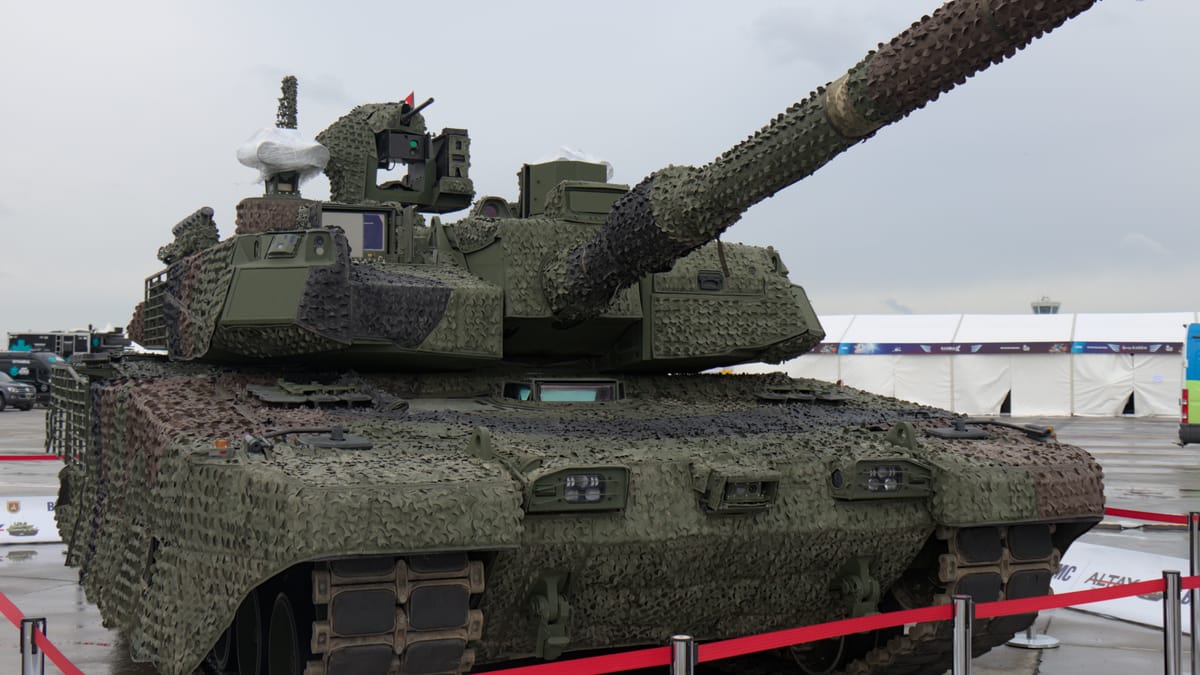
The Altay tank is easy to oversell and just as easy to dismiss.
On one side, it is Turkey’s first locally produced modern main battle tank, a 65-ton machine with a 120 mm gun, modern sights, active protection, digital command systems, and a production line meant to move Turkey away from dependence on imported armor.
On the other side, the program took far longer than planned, depended heavily on foreign technology at critical points, and has only recently moved from prototypes and test vehicles into serial production. A tank can look excellent on a spec sheet and still struggle if it cannot be produced, supported, upgraded, and trusted by its crews.
So the useful answer is not “good” or “bad.” The Altay is a credible modern tank on paper. It is also an unproven operational system whose real test is only beginning.
Why Turkey Wanted Its Own Tank
Turkey has a large army, a serious defense industry, and a long list of security problems on its borders. But for decades, its heavy armor fleet was built mostly from imported and upgraded designs.
That fleet included American M48 and M60 Pattons, German Leopard 1s, and German Leopard 2s. Some of those vehicles were modernized locally, and some remain useful for secondary roles, training, static defense, or lower-intensity missions. But none of them solved the core strategic problem: Turkey did not control the full design and production chain for its main tank force.
That matters because tanks are not just vehicles. They are ammunition, engines, transmissions, armor packages, fire-control systems, radios, optics, spares, factory tooling, test ranges, maintenance schools, and political export permissions. If a country imports the most important pieces, it can find itself constrained when allies disagree with how the equipment is used.
The Altay was meant to change that. The project gave Turkey a domestic heavy-armor anchor and gave companies such as BMC, Aselsan, Roketsan, MKE, Havelsan, and BMC Power a role in a high-end land-systems ecosystem.
That is why the tank is bigger than the tank. It is an industrial independence project with armor plate attached.
A Long Road to Production
The Altay program traces back to Turkey’s National Tank Production Project. Otokar developed the early design and prototypes, drawing on South Korean K2 Black Panther technology and assistance. BMC later became the mass-production contractor.
That transition was not smooth. The tank suffered from delays, redesign work, and a powerpack problem that became the program’s defining obstacle. Turkey had planned around foreign engine and transmission options, but politics and export restrictions complicated the supply chain.
By the mid-2020s, the answer was a staged approach. Early production tanks would use a South Korean powerpack, while later tanks were expected to move toward BMC Power’s domestic BATU engine and transmission group after testing and qualification.
That distinction is important. A tank is only truly sovereign when the powerpack can be produced, supported, and replaced without outside permission. Turkey has made real progress toward that goal, but the domestic powerpack still has to prove itself through endurance, production, and service use.
The program finally reached a more concrete stage in 2025. Anadolu Agency reported that BMC had begun mass production of the Altay at its Ankara plant, while Turkish defense officials described a delivery plan that starts with T1 tanks and then expands into later production.
Defense News reported that Turkey launched serial production in October 2025 and delivered the first units to the Turkish Armed Forces during the opening of BMC’s Ankara tank and armored vehicle facility. That is the line the Altay needed to cross. It is no longer just a prototype story.
But starting production is not the same as proving production.
What the Altay Is Supposed to Do
BMC’s published Altay specifications describe a four-person main battle tank with a commander, gunner, loader, and driver. The tank uses a 120 mm L55 smoothbore main gun, carries 40 rounds of ammunition, and is listed with laser-guided tank munition firing capability.
That puts it broadly in the same western tank family as the Leopard 2 and Abrams: a large, heavily protected vehicle built around a NATO-standard 120 mm gun rather than a smaller Soviet-style design with an autoloader.
The choice of a human loader is revealing. Autoloaders save space and crew, but Turkey appears to have preferred the flexibility and reliability of a four-person crew. A loader can help with maintenance, observation, radios, security, refueling, and emergency tasks. The tradeoff is a larger turret and one more crew member at risk.
The Altay’s fire-control package is also central to the claim that it belongs with modern tanks rather than upgraded Cold War machines. BMC lists a 360-degree panoramic stabilized commander’s periscope, hunter-killer capability, automatic target tracking, thermal sights, laser rangefinders for both commander and gunner, and electric gun and turret drives.
Those features matter because tank combat is increasingly about who sees first, identifies correctly, fires accurately, and survives the first exchange. Armor is still important, but sensors and fire-control systems decide whether the tank can use its gun effectively before the enemy does.
Protection Is the Real Question
The Altay’s survivability package is one of its strongest arguments.
BMC lists a nationally developed armor system, composite and reactive armor solutions, spall liner, active protection system, laser detection and warning, battlefield target identification, CBRN filtration, smoke grenade launchers, fire extinguishing, and explosion suppression.
That is the right shopping list for a modern tank. The war in Ukraine has made the point brutally clear: tanks face artillery, mines, anti-tank guided missiles, loitering munitions, cheap first-person-view drones, top-attack weapons, and constant surveillance. A tank that only relies on thick passive armor is no longer enough.
Active protection is especially important. A good active protection system can detect incoming threats and attempt to defeat them before impact. It does not make a tank invulnerable, and it can be overwhelmed, but it changes the survival equation.
The caution is that protection claims are hard to judge from outside. Public brochures can list impressive systems. What matters is how well those systems are integrated, how reliably they work, how often they false alarm, whether they can handle top-attack profiles and drone-era threats, and how crews maintain them in the field.
This is where the Altay is still unproven. It has the right architecture. It has not yet built the combat record that tells us how good that architecture is under stress.
Mobility and the Powerpack Problem
BMC lists the Altay with a 12-cylinder, 1,500 hp electronically controlled engine, a 6-forward and 3-reverse automatic transmission, electronically controlled in-arm suspension, automatic track-tension adjustment, 65 km/h on-road speed, 45 km/h off-road speed, 450 km range, and underwater fording capability up to 4 meters.
Those numbers are credible for a 65-ton western-style main battle tank. The Altay is heavy, but it is not outside the weight class of modern Abrams or Leopard variants. The question is not whether 1,500 horsepower is enough in theory. It is whether the chosen powerpack is reliable, maintainable, and available in the quantities Turkey needs.
That is why the engine story keeps returning. Turkey’s first mass-production phase is tied to foreign powerpack supply, while the longer-term sovereignty claim depends on domestic BATU maturity.
If the domestic powerpack performs well, the Altay becomes much more than a tank assembled in Turkey. It becomes a platform Turkey can build, maintain, and export with fewer political constraints.
If the powerpack struggles, the tank may still be good, but the program remains hostage to one of the hardest parts of armored-vehicle engineering.
Production Is the Hard Part
The Altay is not being judged against a single prototype. It is being judged against an ambition: hundreds of tanks, then potentially a thousand over the long term.
That ambition is difficult. Modern tanks are expensive, complex, slow to build, and supply-chain hungry. Armor plate, guns, optics, electronics, engines, transmissions, tracks, thermal sights, radios, ammunition, simulators, and trained crews all have to arrive together.
Turkey’s public schedule has shifted over time. Anadolu Agency reported a plan for three Altay tanks in 2025 and a total of 85 T1 tanks across the first configuration, followed by a later batch of 165 tanks. Defense News reported that the new BMC facility was designed for a monthly output of up to eight Altays, alongside Altug 8x8 vehicles, once production matured.
Those two facts should be read together. The factory capacity is the goal. The early delivery schedule is the reality. New defense production lines rarely begin at their advertised long-term rate, especially when the product is a first domestic main battle tank.
That does not mean the program is failing. It means the next few years matter more than the ceremonial first deliveries. The real milestone is not the first tank. It is the tenth, the fiftieth, the hundredth, and the sustainment network behind them.
Is It Better Than Turkey’s Older Tanks?
Compared with Turkey’s older M48s, M60s, Leopard 1s, and many Leopard 2A4s, the Altay should be a major step forward.
It has a modern fire-control suite, modern networking, active protection, domestic armor integration, updated command systems, and a production path tied to Turkey’s own industry. It is also designed around the lessons Turkey learned from operating imported tanks, including combat experience in Syria where even respected Leopard 2s proved vulnerable when used without the right tactical support.
But “better than older tanks” is not the same as “one of the best tanks in the world.”
Against the latest Abrams, Leopard 2A7/A8, K2, Challenger 3, Leclerc upgrades, or future M1E3-type concepts, the Altay still has to prove where it sits. Its design is modern, but it is not magic. It is a heavy, crewed, turreted main battle tank entering service at a moment when drones, mines, artillery, and top-attack weapons are reshaping armored warfare.
The Altay may be exactly what Turkey needs: a locally controlled platform that can replace old imports and become a basis for upgrades. That is a more realistic achievement than claiming it instantly outranks every established tank.
The Export Question
Turkey’s defense industry already has an export story, especially in drones, armored vehicles, naval systems, and missiles. A successful tank would extend that story into one of the most prestigious and difficult military categories.
The Altay has attracted attention from countries that already buy Turkish defense products or want alternatives to U.S., German, Russian, Chinese, or South Korean tanks. Export success would help amortize development costs, strengthen BMC’s production line, and create a larger support ecosystem.
But tanks are harder to export than drones. Buyers want proof of performance, long-term spares, ammunition compatibility, training packages, upgrade paths, financing, political confidence, and a record of reliable deliveries. They also compare price against proven options.
That means exports will probably follow domestic proof. If Turkey fields the Altay in meaningful numbers, keeps it running, integrates the domestic powerpack, and demonstrates training and sustainment discipline, the export case gets stronger.
If production stays slow or the powerpack transition drags, foreign customers will hesitate.
So Is the Altay Any Good?
The Altay is good enough to be taken seriously.
It has the right modern ingredients: 120 mm firepower, a credible fire-control suite, active protection, advanced armor, digital systems, a 1,500 hp power class, and a factory path into serial production. It also gives Turkey something strategically valuable that imported tanks cannot: more control over its own armored future.
But it is not yet proven enough to be treated as a settled success.
The tank still has to show that it can be produced at scale, supported by ordinary units, upgraded cleanly, and kept combat-ready over years rather than press events. It still has to prove the domestic powerpack. It still has to show how its protection suite handles the drone-heavy battlefield that has humbled armored forces worldwide.
The best verdict is therefore conditional. The Altay is not a paper tank anymore, and it is not a failure. It is a promising first domestic main battle tank entering the difficult part of the story.
The engineering got it to the factory. Now production, crews, logistics, and combat realities get to grade it.
Key Takeaways
-
The Altay is Turkey’s first locally produced modern main battle tank and a major defense-industrial sovereignty project.
-
BMC lists the tank with a 120 mm L55 smoothbore gun, four-person crew, active protection, modern sights, and a 1,500 hp power class.
-
The program’s biggest weakness has been the powerpack and production timeline, not the basic concept of the tank.
-
Early production has begun, but the tank still has to prove reliability, sustainment, and scale beyond first deliveries.
-
The Altay looks credible on paper, but its final reputation depends on production maturity and operational service.

Simon Whistler
Simon Whistler hosts MegaProjects, bringing engineering, infrastructure, and military-machine stories into clear narrative focus for viewers who want the systems, tradeoffs, and human decisions behind the build.
Frequently Asked Questions
What is the Altay tank?
The Altay is a Turkish main battle tank produced by BMC for the Turkish Armed Forces. It is Turkey’s first locally produced modern main battle tank and was developed with roots in the National Tank Production Project.
Is the Altay based on the K2 Black Panther?
Yes. The Altay drew on South Korean K2 Black Panther technology and assistance during development, but Turkey adapted the design with domestic armor, electronics, weapons integration, and production goals.
Has the Altay entered service?
Yes. Turkey moved the Altay into serial production in 2025, and the first production units were delivered to the Turkish Armed Forces during the opening of BMC’s Ankara armored-vehicle facility.
What gun does the Altay use?
BMC lists the Altay with a 120 mm L55 smoothbore main gun, 40 rounds of ammunition storage, and compatibility with laser-guided tank munitions.
Why was the Altay delayed?
The biggest delay came from the powerpack problem: Turkey had to resolve engine and transmission supply after foreign options became politically or technically constrained. The shift from Otokar prototypes to BMC production also added redesign and industrialization work.
Is the Altay better than Turkey’s older tanks?
It should be a major improvement over Turkey’s older M48, M60, Leopard 1, and many Leopard 2A4 vehicles because it has modern sensors, protection, networking, and domestic production support. It still has to prove itself in large-scale service.
Sources
-
Original MegaProjects video: Is Turkey’s New Main Battle Tank Any Good?
-
Anadolu Agency: Turkey’s Altay tank to enter national inventory in 2025
-
Anadolu Agency: Mass production of Turkish main battle tank Altay begins
-
Defense News: Turkey wants eight Altay battle tanks yearly from new BMC factory
-
Hero image source by Emir GECIR / Wikimedia Commons, CC0 1.0.
Related Projects
MQ-28 Ghost Bat
Australia's MQ-28 Ghost Bat is a Boeing-built collaborative combat aircraft designed to team with crewed jets, fire missiles, and scale allied airpower.
Su-75 Checkmate
Russia's Su-75 Checkmate was pitched as a cheap fifth-generation export fighter. Its real test is whether UAC can turn a mockup into a flying aircraft.
LRASM
How LRASM restored America's long-range anti-ship strike capability with stealth, autonomy, and a missile built from the JASSM-ER family.
Cobra and Apache
Why the Cobra and Apache keep outlasting the U.S. attack helicopter programs built to replace them.