
The strange thing about American attack helicopters is not that the Cobra and Apache are old. Lots of military hardware stays useful for decades.
The strange thing is that the United States keeps trying to replace them, spending years and billions of dollars on more advanced ideas, only to come back to improved versions of the aircraft it already has.
The Cobra began as a Vietnam War answer to an urgent problem: Hueys were moving troops around the battlefield, and those troop helicopters needed an armed escort that could arrive quickly, stay nearby, and put fire on the ground. The Apache came later as the Army’s purpose-built answer to the armored battlefield it expected in Europe.
Both designs belong to the Cold War. Both are still shaping U.S. attack aviation. The Marine Corps no longer flies the original AH-1G Cobra, but the AH-1Z Viper is visibly part of that Cobra line. The Army no longer treats the first AH-64A as the final word, but Boeing’s current Apache page still describes the AH-64E as the backbone of the Army attack helicopter fleet.
The question is not whether America can design something newer. It has done that repeatedly. The question is why newer has so often failed to become better enough, affordable enough, or necessary enough to replace the helicopters already in service.
The Cobra Was an Emergency Answer That Worked
The AH-1 Cobra was not born as a perfect clean-sheet attack helicopter. It was a wartime shortcut.
Bell had the UH-1 Huey, and the Army needed a gunship quickly. The answer was to take familiar Huey machinery and wrap it in a narrow attack-helicopter body. The first HueyCobra shared major systems with the Huey, but its slim fuselage, tandem cockpit, stub wings, and gunship armament made it a different kind of aircraft.
That mattered in Vietnam. A utility helicopter could move troops, but a Cobra could escort the lift ships, suppress landing zones, fire rockets, and stay with soldiers once they were on the ground. It was faster, thinner, harder to hit, and purpose-built for a job the Army needed immediately.
That urgency is a recurring theme. The Cobra was not the most ambitious idea on the table. Lockheed’s AH-56 Cheyenne was supposed to be the advanced attack helicopter. But the Cheyenne was not ready when the war needed aircraft, and the Cobra was.
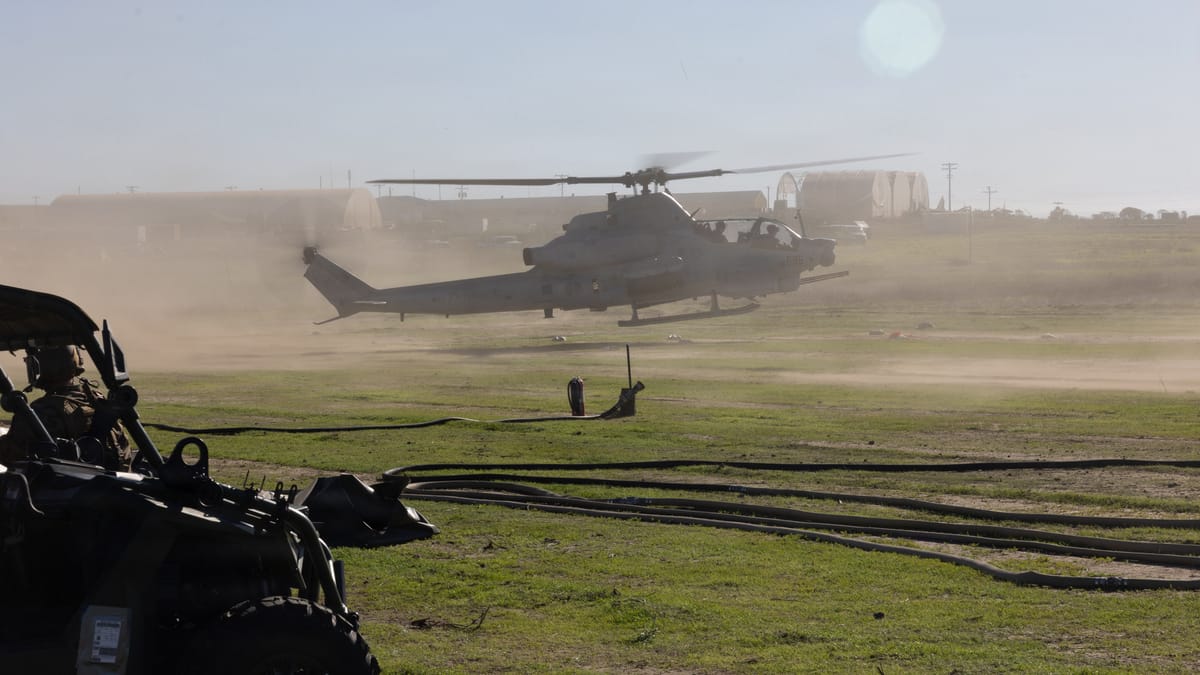
The Army eventually left the Cobra line behind for the Apache. The Marine Corps did not. The Marines took the Cobra idea and kept pushing it forward through the twin-engine SuperCobra and then the AH-1Z Viper. Bell describes the AH-1Z as an attack and reconnaissance helicopter with a modern four-blade rotor system, updated sensors, and the weapons integration expected of a current Marine attack platform.
That is why the Cobra is hard to talk about as a single aircraft. The Vietnam-era Cobra is gone from U.S. service. The lineage is not. The Viper is the proof that an old attack-helicopter concept can survive by becoming a new version of itself.
The Apache Became the Army’s Anchor
The Apache was the Army’s break from the Cobra.
After the Cheyenne failed, the Army moved into the Advanced Attack Helicopter program. Hughes, later McDonnell Douglas and then Boeing, won with the aircraft that became the AH-64. The Apache was larger, heavier, twin-engined, armored around the crew, and designed around anti-armor warfare.
It had the basic attack-helicopter layout that is now familiar: tandem crew, stub wings, a 30 mm chain gun, rockets, and anti-tank missiles. It also had room to evolve. Longbow radar, better sensors, improved weapons, upgraded engines, and the AH-64E configuration all kept the type relevant long after its 1980s entry into service.
Boeing’s current Apache page presents the AH-64E as a system that will remain in production into the 2030s and serve the U.S. Army and partner nations far beyond that. That is the replacement problem in one sentence: the Apache is old, but it is not static.
Every year a new helicopter program spends defining requirements, building prototypes, fighting budgets, and waiting for engines is another year the Apache fleet can receive upgrades. The baseline keeps moving. A replacement has to beat not the 1984 Apache, but the modernized Apache the Army already owns, knows how to maintain, and can keep improving.
Cheyenne Was Too Much Too Soon
The first major replacement failure came before the Apache.
The AH-56 Cheyenne was a dramatic aircraft: compound layout, pusher propeller, wings, high speed, heavy weapons, and performance that still looks impressive. U.S. Army coverage from the Army Aviation Museum describes the Cheyenne as ahead of its time, and the Army Historical Foundation’s history explains why it looked so promising.
It was also a warning. The Cheyenne was expensive, technically difficult, and caught between institutional fights over close air support and the changing needs of the Vietnam War. It was meant to solve tomorrow’s problem while the Army needed a working gunship today.
The program’s production contract was cancelled in 1969, development limped onward, and the aircraft was finally cancelled in 1972. The Army then moved to the Advanced Attack Helicopter competition that produced the Apache.
That sequence set a pattern. The replacement can look more advanced than the aircraft already flying. That does not matter if it arrives late, costs too much, or reaches maturity after the mission has changed.
Comanche Solved a Cold War Problem After the Cold War
The RAH-66 Comanche was the next great almost.
Comanche was designed as a stealthy armed reconnaissance and light attack helicopter. It promised low radar and acoustic signatures, internal weapons, advanced sensors, and the ability to scout ahead of heavier forces. In the right Cold War scenario, it made sense: find the enemy first, survive in contested airspace, and cue or support the attack force.
But by the time Comanche was nearing a production decision, the world had changed. The Soviet Union was gone. The Army was fighting in Afghanistan and Iraq. Unmanned aircraft were becoming more useful for reconnaissance. The service already had many Apaches. And Comanche needed its own expensive production, training, and sustainment system.
The Congressional Research Service later summarized the cancellation record plainly: before FARA, the Army had already cancelled three efforts to replace attack or scout helicopters, including Comanche in 2004, the Armed Reconnaissance Helicopter in 2008, and Armed Aerial Scout in 2014.
Comanche was not cancelled because it was boring. It was cancelled because an impressive aircraft still has to justify itself against cheaper upgrades, drones, and the aircraft already on the ramp.
FARA Met the Drone Age
The most recent failure is the clearest signal.
The Future Attack Reconnaissance Aircraft program began in 2018 to fill the armed reconnaissance gap left by the retired OH-58 Kiowa. The Army was using Apaches, unmanned systems, and workarounds to cover that mission, and FARA was meant to produce a fast, modern scout and attack aircraft.
Sikorsky offered Raider X. Bell offered 360 Invictus. Both were serious attempts to build the kind of helicopter that earlier programs had promised: faster, more connected, and better suited to a modern battlefield.
Then, in February 2024, the Army announced its Aviation Investment Rebalance. The service said it would end development of FARA at the conclusion of fiscal 2024 prototyping work, increase investment in unmanned aerial reconnaissance, and redirect money into enduring platforms such as Black Hawks, Chinooks, Future Long Range Assault Aircraft, and launched effects.
The Army’s explanation was direct. Aerial reconnaissance had changed, especially after lessons from Ukraine. Sensors and weapons on unmanned systems had become more common, farther-reaching, and cheaper. In that environment, the Army judged that FARA’s increased capability could be achieved more affordably and effectively through a mix of existing, unmanned, and space-based assets.
That is not just a budget decision. It is a doctrinal decision. It says the replacement for a scout-attack helicopter may not be another scout-attack helicopter.
Why Replacement Keeps Failing
The Cobra and Apache survive for four connected reasons.
First, they already exist in large numbers with trained crews, maintainers, weapons, simulators, manuals, supply chains, and tactics. A new helicopter has to replace all of that, not just beat a brochure specification.
Second, both designs have room to evolve. The Cobra became SuperCobra and then Viper. The Apache became Longbow and then AH-64E. When an existing aircraft can absorb better sensors, weapons, engines, software, and teaming concepts, the case for a clean-sheet replacement gets harder.
Third, attack-helicopter requirements keep colliding with reconnaissance requirements. The Army repeatedly tried to solve the armed scout problem with a manned helicopter. Comanche, ARH, AAS, and FARA all lived in that space. Drones have made the scout part of the mission less dependent on a pilot flying low and close to the enemy.
Fourth, the battlefield keeps punishing expensive single-purpose answers. Air defenses, cheap drones, electronic warfare, and long-range sensors all make low-altitude manned aircraft more vulnerable and more politically expensive to lose. That does not make attack helicopters useless. It does make the replacement argument harder.
The result is a practical stalemate. The United States can design new attack helicopters. It has done so. But each new design has to prove it is worth the money, risk, time, and disruption compared with upgrading the Cobra/Viper and Apache families while shifting more scouting work to unmanned systems.
So far, the old aircraft keep winning.
What Comes Next
The future is unlikely to be a simple Cobra-and-Apache replacement race.
The Army is still investing in aviation, but the 2024 rebalance points away from a new manned armed scout helicopter and toward a mix of enduring helicopters, unmanned reconnaissance, launched effects, and the Future Long Range Assault Aircraft. The Marine Corps continues to operate the AH-1Z as part of its aviation combat element, pairing the Viper with the UH-1Y Venom in a common H-1 family.
Apache modernization also keeps moving. Boeing says the Apache is being prepared for open systems, launched effects, and teaming with autonomous systems. In other words, the helicopter may become less of a lone gunship and more of a crewed command-and-weapons node inside a larger network.
That is probably the real answer. The Cobra and Apache are not immortal because no engineer can imagine something better. They persist because the mission around them keeps changing faster than replacement programs can settle down.
The U.S. attack helicopter may not be replaced by one perfect new attack helicopter. It may be absorbed into a layered system of upgraded crewed aircraft, drones, sensors, and long-range weapons.
Until that system is mature, the Viper and Apache remain useful enough, familiar enough, and upgradeable enough to keep flying.
Key Takeaways
-
The Cobra survived in U.S. service through the Marine Corps AH-1Z Viper, while the Army shifted from Cobra to Apache.
-
The Apache remains the Army’s attack-helicopter anchor because it has a large installed base and keeps receiving modernization.
-
Cheyenne, Comanche, ARH, AAS, and FARA show a repeated problem: advanced replacement programs can lose to cost, timing, mission drift, and technology shifts.
-
The Army’s 2024 FARA cancellation points toward unmanned reconnaissance and launched effects rather than another manned scout-attack helicopter.
-
The question is less whether the U.S. can build a new attack helicopter and more whether a new one still justifies the cost.

Simon Whistler
Simon Whistler hosts MegaProjects, bringing engineering, infrastructure, and military-machine stories into clear narrative focus for viewers who want the systems, tradeoffs, and human decisions behind the build.
Frequently Asked Questions
Is the original AH-1 Cobra still in U.S. service?
No. The Army retired its Cobras, and the Marine Corps retired the AH-1W SuperCobra in 2020. The Cobra lineage continues in the Marine Corps AH-1Z Viper.
Why did the Army replace the Cobra with the Apache?
The Army wanted a purpose-built attack helicopter with greater survivability, sensors, weapons capacity, and anti-armor performance. The Advanced Attack Helicopter program produced the AH-64 Apache.
Why was the AH-56 Cheyenne cancelled?
The Cheyenne was fast and technically impressive, but it was expensive, difficult to develop, and overtaken by changing requirements. Its final cancellation in 1972 led into the Apache-producing Advanced Attack Helicopter competition.
What was the RAH-66 Comanche supposed to do?
Comanche was meant to be a stealthy armed reconnaissance and light attack helicopter. It was cancelled in 2004 before production, after years of development and changing Army priorities.
Why did the Army cancel FARA?
In 2024, the Army said it would end FARA after prototyping and redirect aviation investment toward unmanned reconnaissance, enduring helicopter fleets, launched effects, and other priorities shaped by lessons from modern battlefields.
Does this mean attack helicopters are obsolete?
Not exactly. Attack helicopters still provide armed overwatch, precision fire, and crewed decision-making. The harder question is whether future reconnaissance and attack missions require a new manned helicopter or a mix of upgraded helicopters and unmanned systems.
Sources
-
Original MegaProjects video: Why The US Can’t Replace the Cobra and the Apache
-
Congressional Research Service: Future Attack Reconnaissance Aircraft proposed cancellation
-
U.S. Army: AH-56 Cheyenne still an aircraft way ahead of its time
-
Hero image source by Lance Cpl. Samantha Devine / U.S. Marine Corps, public domain.