

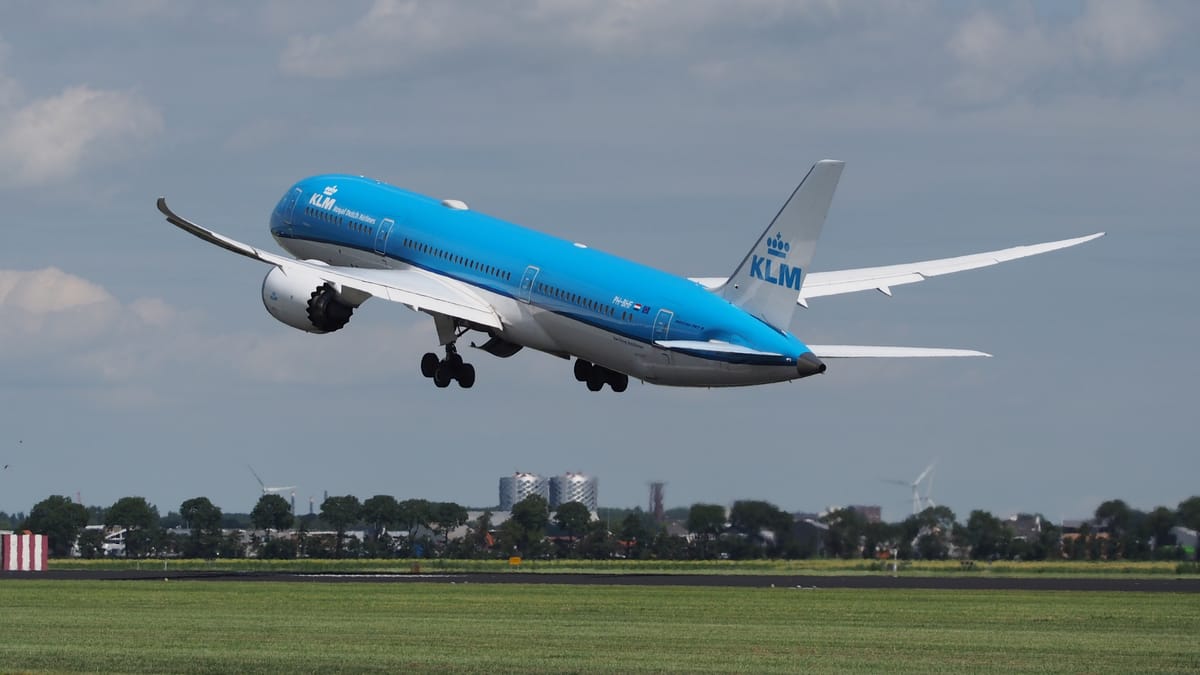
Imagine waking up to the news that nearly half of the world’s passenger planes have been grounded. No Boeing 737s taking off. No 787 Dreamliners in the skies. No word on when they’ll be back in service.
Global travel would stall almost instantly. Thousands of flights would be canceled. Millions of passengers stranded. Airline stocks would plunge. Airports would descend into chaos. And the broader economy would absorb a blow of historic proportions.
This isn’t purely theoretical. Boeing’s 737 Max was grounded before — for twenty months, the longest grounding in modern aviation history — and with safety failures, whistleblower allegations, and mounting public scrutiny still accumulating, some regulators and lawmakers are asking hard questions. If the answers don’t satisfy them, grounding entire fleets may not be off the table.
- Boeing jets in active service (2025)
- 14,000+
- 737s flying on any given day
- ~2,500
- Boeing's backlog of aircraft orders (2025)
- 5,953
- Direct Boeing employees
- 170,000+
- Jobs supported through Boeing's supply chain
- ~1.6million
- Estimated first-48-hour financial loss
- >$5billion
Boeing: The Backbone of Global Air Travel
Boeing controls roughly 40% of global commercial aircraft. Alongside Airbus, it forms a duopoly that together accounts for more than 96% of the world’s large passenger jets. That means just two companies control nearly all the planet’s commercial flight capacity.
Remove one of them, even temporarily, and the global system buckles. Airline schedules would collapse, ticket prices would soar, and the $4.1 trillion in economic activity tied to air connectivity would take an immediate hit.
As of 2025, over 14,000 Boeing jets are actively flying, carrying passengers, cargo, and critical supplies across more than 150 countries.
The scale is staggering. The Boeing 737 is the most produced commercial jet in history — over 12,000 units delivered since production began in 1966. The newer 737 NextGen and MAX series now dominate short- and mid-range routes. On any given day, there are nearly 2,500 737s in the sky at once. Ground the 737 family alone and you disrupt the schedules of hundreds of airlines and millions of passengers daily.
Then there’s the Boeing 777. More than 1,700 are currently in service, deployed by major carriers like Emirates, United Airlines, and Singapore Airlines as long-haul workhorses. Emirates — the largest international airline by revenue passenger kilometres — relies on the 777 for nearly 75% of its long-haul fleet.
The 787 Dreamliner, introduced in 2011, adds another 1,100-plus planes in service worldwide. Carriers like Qatar Airways, American Airlines, British Airways, and Japan’s ANA use it as their flagship. Without the 787, dozens of transcontinental routes — New York to Tokyo, London to Johannesburg — would become nonviable overnight.
Southwest Airlines flies an all-Boeing 737 fleet of 801 aircraft. Ryanair operates more than 500 Boeing 737s serving 230 destinations across Europe, North Africa, and the Middle East. Boeing is, quite simply, the backbone of most airlines.
Behind each aircraft sits a production network that rivals national infrastructure. A single 777 has over 3 million parts sourced from 500 suppliers across more than 50 countries. The 787 Dreamliner’s wings are built in Japan; its fuselage is constructed in Italy and South Carolina; final assembly takes place in Washington or North Charleston. Every one of those parts must function with near-flawless precision, because when things go wrong, the consequences are catastrophic.
When the 737 MAX was grounded in 2019, more than 380 aircraft were taken out of service. Airlines lost billions of dollars, and Boeing itself haemorrhaged $20 billion in direct losses, fines, and compensation — and that was just one model. As of 2025, Boeing holds a backlog of over 5,953 aircraft orders, the majority being 737s and 787s, meaning airlines are planning their futures around Boeing planes.
The dependency runs to national security as well. U.S. Air Force One is a custom Boeing 747, and many air forces around the world rely on Boeing for refueling tankers and cargo planes. The world is structurally dependent on one company, and if something causes those machines to go offline — even briefly — the consequences would be immediate, global, and severe.
What Would Happen in the First 48 Hours?
It would start with a press release. Maybe from the FAA. Maybe from Boeing itself. Or maybe from a whistleblower with documented proof that something had failed at a fundamental level.
The message would be: effective immediately, all Boeing commercial aircraft are grounded pending safety review.
Within minutes, flight boards would light up in red. In Singapore, passengers would be called back from the boarding gates. In Chicago, ground crews would scramble to deplane packed aircraft. In Australia, early-morning travellers would find themselves trapped in terminals.
By the end of Day One, over 35,000 flights would have been canceled — not delayed, canceled — leaving more than 4 million passengers without a seat.
The global airline sector operates on strict schedules and razor-thin margins. Grounding a single aircraft for a day costs tens of thousands of dollars in idle crew, maintenance, and lost revenue. Grounding thousands produces losses that quickly exceed any peacetime precedent.
During COVID-19, the global aviation industry suffered losses of $419 billion in 2020 alone — and that crisis unfolded over months. A Boeing-wide grounding would unfold in hours. Experts at the International Air Transport Association (IATA) estimate that grounding just the 737 MAX fleet in 2019 cost airlines roughly $1 billion per month. That was 387 aircraft. Grounding 10,000 to 14,000 at once would push losses well beyond $2.5 billion globally per month.
Stock markets would respond within minutes. Boeing’s share price would begin to plunge. Airline stocks would follow. Travel agencies would begin canceling summer itineraries. Business trips would be postponed. Governments would scramble to establish emergency task forces.
Meanwhile, passengers would be stranded worldwide. A nurse in Australia unable to reach her rural hospital. A tech conference in Los Angeles that folds overnight because half the attendees never arrive.
By the end of Day 2, more than $5 billion would have vaporized across the travel ecosystem. Within weeks, the losses would run to tens of billions, and millions would remain stranded.
Some economies are so tied to Boeing-powered air routes that their GDP depends on uninterrupted service. Small island nations — the Maldives, Fiji, the Seychelles — would be devastated not only by lost tourism but also by the severing of their own air lifeline to the outside world.
These aren’t dramatic hypotheticals. They mirror what happened when volcanic ash grounded European planes in 2010, when 9/11 shut U.S. airspace, and when COVID-19 shut down global aviation. But a Boeing grounding would be larger than any of those events, because there is no other plane maker capable of picking up the slack in the short term.
Airbus is booked solid for the next decade. Russian and Chinese models — the MC-21 and COMAC C919 — aren’t certified for most global routes. Retrofitting airport systems and retraining pilots for a new fleet takes years. Boeing is embedded in a complex, decades-old megaproject system of training schools, simulators, mechanics, spare-part depots, and certification programs.
At any given moment, thousands of student pilots, airline cadets, and commercial crews are mid-certification in Boeing training pipelines. A sudden halt would strand many of them or force costly requalification for Airbus models.
Beyond aviation itself, Boeing deals are often tied to defense contracts, technology transfers, and bilateral trade incentives. A forced grounding — especially one triggered by U.S. regulators — would spark diplomatic disputes, lawsuits, and potential trade retaliation. Boeing directly employs over 170,000 people and supports nearly 1.6 million jobs through its supply chain. A prolonged shutdown would send economic shockwaves far beyond the aviation industry.
Who Would Pull the Plug — and Why?
The entities that could stand between Boeing and the runway include the Federal Aviation Administration (FAA), the European Union Aviation Safety Agency (EASA), the Civil Aviation Administration of China (CAAC), and equivalents across dozens of jurisdictions. Any one of them could issue a directive grounding a specific model or, in a truly exceptional case, entire categories of Boeing jets. Once one major player moves, the rest tend to follow — that’s exactly how it unfolded with the 737 MAX.
Understanding what kind of crisis would justify pulling the plug requires looking at Boeing’s safety record.
In October 2018, Lion Air Flight 610 crashed into the Java Sea, killing 189 people. Five months later, Ethiopian Airlines Flight 302 went down six minutes after takeoff, killing all 157 on board. Both involved the 737 MAX 8, and both were linked to the same flawed software: MCAS, the Maneuvering Characteristics Augmentation System. Designed to stabilize the aircraft, MCAS instead aggressively forced the nose downward when faulty sensors fed it bad data.
Boeing had downplayed the system’s role in pilot manuals and had not properly briefed airlines on its operation.
China grounded the 737 MAX in March 2019. The EU, Canada, and the FAA followed within days. The aircraft stayed grounded for 20 months — the longest grounding in modern aviation history.
What appeared at first to be an isolated crisis was actually the start of something much larger. In 2020, Boeing halted deliveries of the 787 Dreamliner after discovering tiny gaps in the fuselage skin where sections of the carbon-fiber body had not been properly aligned during production — defects in areas that experience high stress during flight. In 2021, another issue emerged involving the forward pressure bulkhead, the critical component that maintains cabin pressure at cruising altitude.
Then came January 5, 2024. Alaska Airlines Flight 1282, a 737 MAX 9, suffered a structural failure mid-flight. A door plug panel — a filler plate for an unused emergency exit — detached at 16,000 feet, leaving a gaping hole in the fuselage. The aircraft landed safely and no one died, but video taken from inside the plane, showing air roaring through the hole and belongings being sucked out, went viral within hours.
The FAA investigation found that the panel had not been properly secured, and Boeing’s production records could not confirm who had last handled the section or whether the bolts had ever been reinstalled after routine work at a subcontractor’s facility. Alaska Airlines and United Airlines confirmed finding additional aircraft with loose bolts. The MAX 9 was grounded for weeks.
It still wasn’t over. Early 2024 brought multiple whistleblowers forward. John Barnett, a former quality manager at Boeing’s Charleston, South Carolina facility, had filed complaints with the FAA alleging that Boeing knowingly installed substandard parts and bypassed safety protocols, with production-quota pressure routinely leading to quality lapses being ignored or covered up. On March 9, 2024, just days after giving a deposition related to his case, Barnett was found dead in a hotel parking lot.
Local police ruled it suicide. The incident drew intense international attention.
Another whistleblower, Sam Salehpour, testified before Congress that more than 1,000 structural parts on 787 Dreamliners were improperly fastened, with gaps exceeding FAA specifications, and that he had been punished internally for raising concerns.
The pattern that emerged was no longer about individual faulty aircraft — it was about accountability systems and substandard protocols that allowed deliberate quality lapses to pass safety checks.
Under U.S. aviation law, the FAA has the authority to ground aircraft if there is “reasonable cause to believe continued operation would pose a safety risk.” If evidence were to show that Boeing’s safety problems are not isolated but structural — affecting multiple models, factories, and workflows — regulators would be compelled to act. Not just against the 737 MAX or the 787, but potentially against any aircraft emerging from the flagged production lines.
Despite everything, no regulator has yet pulled the emergency brake on Boeing as a whole. The cost of doing so would be staggering, and with no system in place to cover the gap Boeing’s departure would leave, the practical reality is that it remains easier to tighten safety laws and mandate performance checks than to ground the entire fleet. But regulators know the pressure is mounting, and if the evidence ever becomes overwhelming, they would be forced to act regardless of the economic consequences.
Public trust is already eroding — in early 2024, searches for “Is it safe to fly Boeing?” surged, online forums began tracking which flights used Boeing planes, and some passengers requested rebooking onto Airbus aircraft when possible.
Winners and Losers: Airbus, China, and the New Aviation Divide
If Boeing were sidelined, someone would need to fill the void — fast. That someone is almost certainly Airbus.
With Boeing removed, Airbus becomes the undisputed global leader in commercial aircraft production. It already holds roughly 56% of the narrow-body market following Boeing’s post-MAX stumble, and the A320neo family — Airbus’s direct rival to the 737 — would see an immediate surge in demand.
But dominance brings its own problems. Airbus’s order backlog already stands at over 8,617 commercial aircraft as of 2025, with production slots for the A320neo sold out until 2030. Even under normal circumstances, Airbus produces only 45 to 50 A320-family jets per month, with plans to scale to 75 by 2026.
Replacing every Boeing 737 and 787 currently flying would require doubling or tripling that capacity — a logistical puzzle involving engine suppliers, fuselage fabricators, avionics systems, thousands of subcontractors, and a web of international supply chains, each with its own bottlenecks. How fast can Airbus build new factories, train more workers, and certify new suppliers? Every day of delay costs airlines money and costs passengers time.
Then there’s China. The COMAC C919 — Beijing’s answer to the A320 and 737 — has been under development since 2008 and started limited commercial service in 2023 with China Eastern Airlines. Until now it has been treated largely as a domestic curiosity, a symbol of China’s industrial ambitions rather than a genuine threat to the duopoly. A Boeing collapse would change that equation.
The C919 uses LEAP engines — the same ones powering Airbus and Boeing narrow-bodies — and features avionics from Honeywell and other Western firms. It hasn’t cleared EASA or FAA hurdles, but political momentum can shift quickly when planes are grounded and demand surges. Global carriers desperate for capacity might take a second look, particularly in markets like Southeast Asia, Africa, or Latin America, where aircraft shortages may outweigh certification concerns.
The obstacle is production. With just eighteen aircraft delivered as of mid-2025, COMAC faces the same manufacturing bottleneck as Airbus. Even if output doubles annually, it won’t be a quick fix for global shortages. But geopolitically, the symbolism matters. A weakened Boeing gives China a clear opening to pitch its aviation ecosystem as a viable alternative — influence through infrastructure — and every foothold gained now could pay dividends for decades.
If Western regulators freeze Boeing’s production and Airbus can’t scale fast enough, a new kind of global aviation divide could emerge. Wealthier countries would secure fleets of newer, certified Airbus jets. Poorer nations would be left flying aging 737s, buying surplus aircraft from grounded fleets, or relying on uncertified alternatives. It’s a pattern already seen in vaccine distribution, green energy technology, and digital infrastructure.
It leads, predictably, to two-tiered safety, two-tiered access, and two-tiered economic recovery — worsening the very global inequality that aviation once helped shrink.
The knock-on effects extend to the megaproject scale. Saudi Arabia, India, and Indonesia are pouring billions into massive new airport developments — the New Delhi IGIA expansion, Indonesia’s Kertajati, and Riyadh’s King Salman International — all built around assumed aircraft deliveries from both Boeing and Airbus. The Saudi government has ordered nearly 80 Boeing 787 Dreamliners for its national carrier plans under Vision 2030. A Boeing failure would stall those ambitions and hamper the broader economic diversification they are meant to underwrite.
Is Boeing Too Big to Ground?
The uncomfortable question aviation regulators, governments, and industry leaders are now grappling with is whether Boeing is simply too big to ground.
The phrase “too big to fail” was born in the banking sector, applied to institutions so vital that their collapse would ripple catastrophically through markets and everyday life. The same logic now hovers over the sky.
Ultimately, this is a story about dependency. Boeing’s collapse — even a partial one — would reshape global aviation overnight. But it also exposes something deeper: the vulnerability of modern megaproject systems to industrial concentration. When too much of the world’s critical infrastructure rests on a single supplier, the failure of that supplier becomes a global emergency.
If Boeing is too big to ground, the real problem isn’t size — it’s accountability. Right now, too much depends on too little oversight.
The world has built an interconnected system on the back of a duopoly, and the cracks in that foundation are becoming harder to ignore. One alternative is diversification. Smaller manufacturers — Embraer in Brazil, Mitsubishi, COMAC in China, Russia’s Irkut — all exist. None has the scale, certification status, or market penetration to replace Boeing today.
But the EU could fund regional jet development programs. ASEAN nations could coordinate infrastructure sharing for the adoption of COMAC. Africa, one of the fastest-growing aviation markets, could co-invest in indigenous manufacturing capabilities with proven partners.
It wouldn’t be cheap. But relying on a duopoly — and accepting the systemic risk that comes with it — may prove even more costly in the long run.
Key Takeaways
- Boeing and Airbus together control more than 96% of the world’s large commercial passenger jets, making the global aviation system structurally dependent on just two companies.
- Over 14,000 Boeing jets were in active service as of 2025; grounding the 737 family alone would cancel millions of passenger trips per day.
- The 737 MAX crisis of 2019 — triggered by two fatal crashes linked to the flawed MCAS software — resulted in a 20-month global grounding and $20 billion in losses to Boeing, establishing the precedent that a full-model grounding is possible.
- A full Boeing grounding would produce losses exceeding $5 billion within 48 hours and tens of billions within weeks, dwarfing the financial scale of any previous aviation crisis.
- Airbus cannot realistically absorb Boeing’s capacity in the short term; its A320neo production slots are sold out until 2030, and scaling to meet demand would take years.
- A Boeing collapse could accelerate China’s COMAC into global markets, creating a geopolitical split in aviation infrastructure along economic lines.
- The core vulnerability exposed by this scenario is not Boeing’s size, but the lack of structural accountability and alternative suppliers in a system that the world cannot afford to lose.
Priya Menon
Priya Menon covers tunneling, ports, rail corridors, and the procurement choices that determine whether large public works become durable assets or permanent disputes.
Frequently Asked Questions
How much of global air travel depends on Boeing?
Boeing controls approximately 40% of global commercial aircraft, and together with Airbus accounts for more than 96% of the world’s large passenger jets. As of 2025, over 14,000 Boeing jets were in active service across more than 150 countries.
Has Boeing ever had its aircraft grounded before?
Yes. Following two fatal crashes — Lion Air Flight 610 in 2018 and Ethiopian Airlines Flight 302 in 2019 — the 737 MAX 8 was grounded worldwide for 20 months, the longest grounding in modern aviation history. The cause was a flawed software system called MCAS, which Boeing had downplayed in pilot manuals. More recently, the January 2024 door plug blowout on an Alaska Airlines 737 MAX 9 prompted another round of inspections and a temporary grounding of that variant.
Could Airbus step in and replace Boeing if it were grounded?
Not quickly. Airbus’s order backlog already exceeded 8,600 aircraft as of 2025, with A320neo production slots sold out until 2030. Even at peak production — around 50 jets per month — scaling to absorb Boeing’s capacity would require years and likely doubling or tripling factory output.
What role could China’s COMAC C919 play if Boeing were sidelined?
The C919 entered limited commercial service in 2023, but with only eighteen aircraft delivered as of mid-2025, it lacks the production scale to fill a Boeing-sized gap. It also hasn’t received EASA or FAA certification. However, a prolonged Boeing crisis could accelerate its adoption in markets like Southeast Asia, Africa, or Latin America, where aircraft shortages might outweigh regulatory concerns.
What are the safety issues that have raised the prospect of a broader Boeing grounding?
Beyond the two 737 MAX crashes, Boeing has faced a series of compounding problems: fuselage alignment defects on the 787 Dreamliner discovered in 2020, forward pressure bulkhead faults in 2021, the door plug blowout in 2024, and whistleblower testimony alleging systemic quality-control failures — including allegations that substandard parts were knowingly installed to meet production quotas.
What would it take for regulators to ground Boeing’s entire fleet?
Under U.S. aviation law, the FAA can ground aircraft if there is “reasonable cause to believe continued operation would pose a safety risk.” If evidence were to show that Boeing’s safety failures are structural rather than isolated — affecting multiple models, factories, and workflows simultaneously — regulators would likely be compelled to act across the board. The economic consequences of doing so are severe, which is why no regulator has yet taken that step, but mounting public pressure and a loss of trust could force their hand.
Sources
-
Original MegaProjects video: What If Boeing’s Passenger Jets Were Forced Offline?
-
Hero image source by Alf van Beem / Wikimedia Commons, public domain.
Related Projects
Boeing E-4: America’s Advanced Airborne Command Post
How the E-4 Nightwatch became America's airborne command center, built to keep national command authority alive through nuclear war, disasters, and crises.
The Boneyard: Where Aircraft Go to Die
Inside the 309th AMARG at Davis-Monthan AFB — how 3,200 aircraft are stored, maintained, and redeployed from the Arizona desert.
,_The_Netherlands_pic.JPG)