
They’re big, they’re formidable, and if you spot them coming at you from across the horizon, they’re foreboding and menacing. Of course, I’m talking about naval carriers – the premier, statement-making military engineering marvels sailing the seven seas.
When they first appeared, naval carriers made a major dent in the outline of warfare. These floating platforms shifted battle focus from vessel based artillery to air superiority, projecting power beyond the reach of guns.
At this very moment, more than a century after the launch of the first aircraft carrier, the modern combat world is witnessing yet another massive technological jump and the emergence of a new military branch with drones.
These man-made horror machines can terrorize a battlefield from half a world away, while the operators are in no danger at all, controlling the drones from the safety of their operation rooms.
The world’s major military forces are still investing greatly in their naval carriers, while at the same time developing entire drone brigades. But there’s one country in particular that is well on its way to link the seas and the skies in a novel fusion of drone technology and naval power. That country is Turkey.
Turkey’s military drones are some of the most advanced in the world. Right now, Turkey is synergizing them with its brand new naval carrier to bring forth an entirely new, never before seen hybrid naval force.
In this article, we’ll meet the TCG Anadolu – Turkey’s new multipurpose naval carrier and amphibious assault ship. While it’s theoretically no different in purpose from other vessels of its kind, it’s unlike anything we’ve seen before in application. As of this writing, the Anadolu is set to be the first major ship to achieve complete symbiosis between naval carrier and drones.
Turkey’s Modern Needs
If we take a short trip down memory lane and travel back to the year 2011, we can learn that the lack of naval presence was a hot topic in Turkish military circles.
The Turkish coastline is more than 7,200 kilometers – or 4,500 miles – long. This makes it the 18th longest coastline in the world. In comparison, Spain and France are 27th and 28th on that list, respectively, but Turkey’s naval presence was, at the time, seriously lacking in comparison.
Turkey is surrounded by four seas. The Mediterranean to the south, the Aegean to the west, the Sea of Marmara between Europe and Asia, and the Black Sea to the North. Aside from having to patrol endless miles of territorial waters, Turkey is also the home to one of the world’s most important water channels – the Bosporus Strait. This strait, found in northwestern Turkey, connects the Black Sea with the Sea of Marmara, and by extension, the Aegean and the Mediterranean Seas.
Turkey has also spent decades combating piracy and competing with Israel for maritime dominance in the eastern Mediterranean. It’s taken part in recent engagements near Syria and Mali, among others.
Add to that the fact that the Black Sea is a crucial corridor for the smuggling of drugs and radioactive materials, and it’s not difficult to see why Turkey was so insistent upon modernizing and improving its fleet.
In 2011, Turkey’s fleet mostly consisted of corvettes, frigates, offshore patrol vessels, and fast attack crafts, as well as landing ships. With too few vessels at their disposal, and with those vessels being woefully outdated, the Turkish Navy had resolutely decided that it was in dire need of modernization.
The biggest issue was the absence of a naval carrier. Turkey, an otherwise formidable military force, was being blown out of the water, quite literally, by its competitors.
Because of this, Turkish Navy Command was delighted when Sedef and Navantia, Turkish and Spanish shipbuilding companies with impressive resumes, finally committed to building the Anadolu in 2015.
Before Anadolu, Turkey did not have a naval carrier of any kind – a significant handicap in modern warfare. Carriers are essential in joint operations for two primary reasons: global reach and force projection.
Naval carriers allow the Air Force to conduct operations in areas that would otherwise be inaccessible simply due to their distance from the closest base. Bombing, counter-air, and air support operations can suddenly be conducted rapidly, in quick succession, and thousands of miles away from home, all thanks to this massive ship, which is essentially a floating military base. This also has a psychological effect in the form of force projection – the enemy is suddenly realizing that nowhere is safe, as operations can now be launched from anywhere!
The original plan was to build a ship akin to the Juan Carlos I – a multipurpose carrier of the Spanish Navy – but with a focus on helicopter-only use. The Turkish plan was to bin the Spaniards’ ski-jump ramp, since the ramp is a necessity for jet takeoff but totally useless for helicopters. It would only weigh the ship down, while unnecessarily enlarging its profile.
The Anadolu would primarily host the AH-1W Super Cobra and the S-70B-28 Seahawk, but the leadership tracked back on this decision after deciding to acquire Lockheed Martin’s F-35 Lightning IIs. The plan was to order up to 100 F-35s.
Turkey did eventually order 30 of these fifth generation fighters. The US Senate, however, quickly blocked the export of the fighter jets to Turkey after Turkey purchased the S-400 missile system from Russia. This was a no-go for the Americans because Russia was subject to US-imposed sanctions at the time.
Despite that, the Navy decided to keep the ramp, believing that it would one day receive them as it was promised. At the time of writing, however, the F-35s built for Turkey are part of the United States Air Force. It was recently reported that President Trump agreed to approve the sale and finally deliver the jets if Turkey decommissioned the S-400 system. How exactly will this unravel is yet to be seen.
In the meantime, the Anadolu would host and launch combat drones and other unmanned aerial vehicles until its hangars finally become home to the F-35s.
The back and forth on the ramp design certainly gave the engineers some sort of architectural whiplash, but the plans were nevertheless finalized, and the greatest Turkish naval vessel would finally start construction.
The Anadolu was supposed to take her maiden voyage in 2021, but the construction was delayed by constant changes to the original plans, as well as a small fire that broke out in 2019, causing damage to the coating paint.
In 2022, the Anadolu began sea trials, and after checking all the boxes, it was finally commissioned on April 10th, 2023.
Construction and Hybrid Design
The Anadolu is the largest ship in the Turkish Navy, at least at this moment in time, measuring up to 231 meters, or 757 feet, in length, with a 32-meter or 105-foot beam. The draft of the Anadolu is 6.8 meters or 22 feet deep, and she stands, or rather floats tall at 58 meters or 190 feet.
This makes it the 12th largest naval carrier in the world, with Italy’s Cavour edging it out of the 11th spot by about a meter in length and a 2 meter wider beam.
What makes the Anadolu truly stand out, though, is its adaptability, which in turn affects its weight.
Like a shapeshifter straight out of comic books, the Anadolu is a modular ship with two configurations – the amphibious assault configuration, and the aircraft carrier configuration. The crew can easily change the Anadolu’s configuration based on the assignment before them.
For clarity, the purpose of an amphibious assault ship in itself is dual. It’s designed to deploy for helicopters, landing craft, as well as heavy armour to the battlefield. At the same time, it’s there to logistically support the ground troops and, if needed, coordinate attacks. All amphibious assault ships are reminiscent of traditional naval carriers because of their design.
Some of them – like the Anadolu – can serve both purposes – they can be used as a naval carrier and an assault vessel. They are, however, fundamentally different in one major way – they cannot deploy conventional, fixed-wing jets.
Amphibious assault ships are designed to deploy VSTOL jets – VSTOL standing for Vertical and/or Short Take Off and Landing. These are jets that can either take off completely vertically or they require a very short runway to take off. The Harrier is perhaps the most famous VSTOL of all time.
Helicopters, by definition, perfectly fit this category as they take off and land completely vertically, as well as the aforementioned F-35s that are yet to be delivered to Turkey. F-35s are VSTOL jets that will be capable of taking off from the Anadolu’s relatively short runway. Even those jets can’t take off completely vertically, mind you, but their takeoff distance is less than 450 feet, or about 137 meters, which is well within the Anadolu’s limitations.
However, the Anadolu, just like all other amphibious assault ships, cannot launch CTOL jets – CTOL standing for Conventional Take Off and Landing – because its runway is simply too short.
Just to paint a clearer picture of how limited the Anadolu is as a runway, the largest aircraft carrier in the world, the USS Gerald R. Ford, is 337 meters, or more than 1,100 feet long. This makes it more than three times longer than the Big Ben and more than 100 meters longer than the Anadolu. Even that ship, the Big Daddy of carriers, hosts and launches mostly F/A-18 Hornets and F/A-18 E/F Super Hornets. These two beautiful birds were designed specifically for taking off and landing on a carrier, and they’re quite possibly the most well-optimized carrier-capable jets in existence. Both of them need about 300 meters or a bit under 1,000 feet to take off and land. The Anadolu is about 70 meters short in this regard, and it can’t possibly be used as a takeoff and landing base for CTOL aircraft.
In its amphibious assault configuration, the Anadolu’s 1,880 square meter garage can host 27 amphibious assault vehicles, namely the M113s, the Otokar Coba IIs, the BMC Vurans, and the FNSS ZAHAs used by the Amphibious Marine Brigade. The other garage, measuring about 1,410 square meters, is designed to handle heavier loads, which mostly relates to the M48 Pattons used by the Amphibious Marine Brigade, as well as Altays, Leopards I and II, M60 Sabras, and M60 Pattons, all used by Turkish Armoured Brigades. If the mission would require a massive number of tanks or lighter vehicles and the command needed to transport as many as possible on the Anadolu, the ship could theoretically accommodate 46 tanks and 77 light vehicles.
These heavy vehicles of course have to be transported from the Anadolu to the landing ground. For this, the Anadolu uses an 1,165 square meter dock that can host four mechanized landing craft, two air cushion landing craft, or two vehicle-personnel landing craft.
In this configuration, the ship weighs an astonishing 27,436 tons, which is noticeably heavier than its aircraft carrier configuration, weighing in at 24,660 tons.
The hangars can accommodate 12 medium-sized helicopters, but only 8 larger helicopters such as Chinooks, which are heavy-lift helicopters designed for transport. If the hangars and the light cargo garages are unified, the ship can host up to 25 medium-sized helicopters such as the Seahawk, which has been a mainstay on the Anadolu since it first hit the water. The Cobras and Super Cobras, which are also stored on the Anadolu, will soon be swapped for the T929 ATAK IIs. These helicopters are still in production, and they should finally be introduced to the Air Force in 2026.
Once the F-35s finally arrive, the Anadolu will accommodate up to 10 of them alongside 12 medium-sized helicopters, with the capacity to keep another six helicopters on deck.
The Anadolu also hosts various unmanned aerial vehicles on board, but more on that later.
Aside from the land vehicles and aircraft, the Anadolu is also equipped with a 30-bed hospital, 2 operation theatres, x-ray devices, sterilisation rooms, burn treatment units, emergency and intensive care units. They even have dental treatment units so you can get your cavities checked if you find yourself on the biggest ship in Turkey.
All of that is a lot of weight, and to force it through the waters, the Anadolu relies on five 8,000 kilowatt Man Diesel Generators that produce 11,000 horsepower. It also uses two 11 megawatt Siemens eSIPOD propulsion drive systems, and two 1,500 kilowatt bow thrusters. Thanks to that, the Anadolu reaches a comfortable cruising speed of about 16 knots, which is about 30 kilometers or 18 miles per hour.
At that speed the ship has a range of about 9,000 nautical miles, which is about 17,000 kilometers or 10,000 miles. This beauty isn’t dragging behind all the time, though – if a need presents itself, it can reach a top speed of 21 knots, which is around 39 kilometers or about 24 miles per hour.
The Anadolu can sail for a maximum of 50 days before refueling, although it would need to replenish its food and water supplies after about 30 days to keep the 1,200-strong crew from dehydrating and starving.
Armament and Sensors
Of course, technical details, preparation, and theory are only part of the equation that’s truly put to the test when a machine faces real combat. The question is – how does the Anadolu keep its personnel, cargo, and in the end – itself safe?
Well, first of all, the carrier is absolutely stacked with top of the line sensors.
You can’t fight your enemy unless you see it, and so the Anadolu relies on the Dutch SMART-S Mk2 3D Radar system. This top of the line system can detect elements up to 250 kilometers, which is about 155 miles or 130 nautical miles away. It’s also used in support of surface to air missiles. The very same technology is used by the French Charles de Gaulle naval carrier, among others, and the Turkish Navy already has experience with. They implemented the SMART-S Mk2 on the Bayraktar-class tank landing ship – the Sancaktar – which is, by the way, the world’s largest amphibious tank-landing ship.
Aside from the best radar system on the market, the Anadolu is outfitted with a dozen other infrared tracking systems, radars, and combat management systems.
A particularly important one is the ARAS-2023 diver sonar. The ship, specifically its loading bay, is vulnerable to enemy divers during loading and unloading heavy vehicles and personnel. ARAS-2023 is a portable system that can be deployed as the command sees fit and it’s capable of detecting a diver deployment vehicle up to a kilometer away. Closed circuit divers – those who deploy with a rebreather that recycles breath – are by far the most difficult to spot of all divers.
But the ARAS can detect them up to 400 meters away. It can also manage up to 2,000 contacts at a time, so unless the ship is stormed by an armada of underwater combatants, it’s highly unlikely that anyone will get close to it undetected.
Although it’s not confirmed, it’s presumed that the Anadolu is also protected by the HIZIR 100-N system, a torpedo countermeasure system for surface ships. The HIZIR detects and locates torpedoes launched at a ship, firing decoys that attract a torpedo and draw it away from the vessel.
When it comes to armament, the Anadolu is armed with a RIM-116 to destroy air targets, and a pair of Phalanx CIWS with their 20-millimeter radar guided Vulcan cannons to help with air targets, missiles, and small boats headed for the ship.
On top of that, the ship is host to 5 STOP weapon stations. The STOP is another Turkish-made weapon system, designed and manufactured by Aselsan. It’s fitted with a 25-millimeter autocannon, although it can be swapped for the legendary M242 Bushmasters which are present on the majority of US Navy vessels, as well as Bradleys and other armored vehicles. The STOP system is integrated with the ship’s sensors and it can be used to destroy…more or less anything, I suppose.
It’s a 25-millimeter cannon, after all, and there aren’t many vehicles or small vessels that can take a punch from it and stay afloat.
The final fixed weapon system aboard the Anadolu is the STAMP! STOP’s little brother can be fitted with 7.62 and 12.7-millimeter machine guns, as well as a 40-millimeter automatic grenade launcher.
Drones, Drones, Drones
The Anadolu, however, doesn’t need to rely only on its fixed armaments to take care of incoming threats. What makes this vessel truly special is the fact that it’s becoming the world’s first drone carrier. The Anadolu earned its title as the leader of a high-tech warfare charge on November 19th, 2024, when a Bayraktar TB3 drone took off from the ship and landed back on it. This was the first time in history that a fixed-wing unmanned aircraft of that size had successfully landed on such a short runway without the use of arresting gear.
Now, to clarify, this isn’t the first time a drone took off from and landed on a carrier. The American X-47B did it more than a decade ago, and that’s not the only example of a drone on a carrier. But the Anadolu is the first ship in the world that can be modified for drone use exclusively.
Turkey’s engineering history is incredibly rich when it comes to drones and warfare. We needn’t look further than towards Ukraine for an example of the effectiveness of drones in the field, particularly of the Turkish-made Bayraktar TB2 drone. Ukraine used these drones extensively in its defence from the Russian invasion and, according to Ukrainian officials, they played a key role in deterring Russian advances in the early stages of the conflict.
The Ukrainians were so happy with them that the Ukrainian Chief of General Staff Valery Zaluzhny posted operational photographs of one of the TB2s on his social media, including photographs of the destruction it caused to a Russian air defense missile system. Furthermore, Baykar agreed to open a construction plant for their drones in Ukraine, at the request of Ukrainian leadership, and the completion of the plant is expected in August of this year.
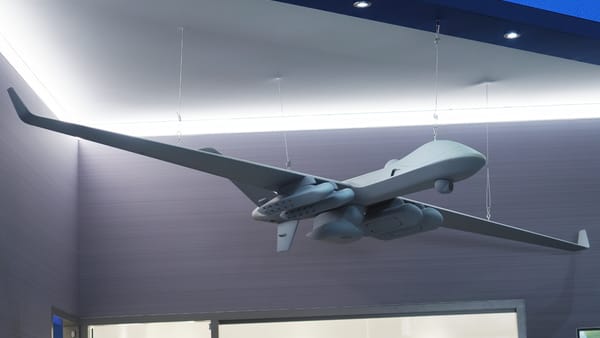
All of this to say that, when it comes to producing high quality drones and applying them effectively in combat, Turkey is one of the premier militaries in the world. It should therefore come as no surprise that Bayraktar produced two drones, the TB3 and the Bayraktar Kızılelma, specifically so they could be used on the Anadolu.
The latter is particularly exciting for the Turkish Navy as it’s the Turkish way of circumventing the sanctions the United States imposed on them by delaying the delivery of the F-35s. The Kızılelma, which translates to Red Apple, was designed to take off from the Anadolu without a catapult system and land safely, all while being controlled from Anadolu’s command center. The first prototype took its maiden flight in late 2022, which was well ahead of schedule. There are currently 4 prototypes in the testing phase, and if all the dials remain in the green, the Red Apples should become Anadolu inventory mainstays for a long time.
The Bayraktar TB3 drone is on a similar path. With very satisfying results in the testing phase, it’s expected to become a regular occupant of Anadolu’s hangars in no time.
The TB2 isn’t an option for the Anadolu because, unlike the TB3, the TB2 can’t fold its wings, while the TB3 is also more advanced in every other regard. It can carry almost double the payload, and it’s noticeably faster with roughly the same range.
Both the TB3 and the Kızılelma can be armed with antitank, air to air, precision guided munitions, rockets, air to surface munitions, and even supersonic missiles, while the Red Apple can also be armed with bombs. The drones will, of course, be used to support landing troops, but their purpose is dual, as they can also be deployed to protect the Anadolu if it finds itself under enemy fire.
In theory, the Anadolu should be able to operate between 30 and 50 TB3s and Kızılelmas. At this time, however, the drones haven’t yet been introduced into service, and it’s likely that it will take years for Baykar’s factories to fill Anadolu’s hangars with some of the most well-developed drones in existence.
With all of that being said, we can only speculate how all of this can change warfare. What happens when you have a naval carrier full of drones? What kind of ungodly assault can the Anadolu launch?
Well, we can’t hypothesize with TB3s and the Red Apples, but we can take a look at TB2s. So far, the TB2 either neutralized or assisted in neutralizing more than 1,000 terrorists in Syria. In 2018, Turkey used a TB2 to assassinate a leader of Kurdistan’s Worker Party. In 2023, when Turkey and Syria were devastated by a horrific earthquake reaching a magnitude of 7.8 on the Richter scale, TB2s were used in humanitarian efforts. 37 of them flew over the affected areas for more than 1,500 hours.
They were instrumental in search and rescue.
So imagine 30, 40, maybe even 50 of them launched from the same ship. Only this time, they’re quicker, and they can carry more ammo.
This kind of technological leap makes the Anadolu a formidable weapon. And this, quite frankly, isn’t even that surprising for Turkish standards. The TB2 drone was hailed by many political scientists and military analysts as a revolutionary weapon. It initiated a new method of war and kickstarted a wind of change in military doctrines around the world.
Combining those weapons with the logistic and mobile support of a ship as advanced as the Anadolu can prove to be a lethal symbiosis.
The Pride of Turkey
With its highly adaptive capabilities thanks to its dual modularity, the TCG Anadolu firmly secured its place at the top of the line of the world’s hybrid carriers and amphibious assault ships. Even more importantly, though, its mere existence is a power statement by Turkey’s Navy, as it now possesses one of the world’s premier dual-purpose carriers.
Moreover, and perhaps even more remarkably, the Anadolu is the centerpiece of Turkey’s ever developing drone puzzle. This puzzle is ushering some of the scariest, but also some of the most technologically impressive advancements in the field of warfare. The ability to serve as a mobile runway for the world’s most advanced drones makes the Anadolu one of the world’s most dangerous vessels, as it ensures that nothing’s out of reach for Turkey’s drones.
The Anadolu and her crewmembers have already more than proven their on-field capabilities in military exercises with American, Spanish, and Italian Navies in the past few years. It seems, however, that this is only the beginning of the expansive and rapid modernisation of the Turkish Navy.
Since the Anadolu first set sail, President Erdogan has, on more than one occasion, announced the development of a new carrier – one that would surpass the Anadolu in size and military capabilities. He’s even claimed Turkey would invest into a carrier that is “twice as large as the Anadolu”.
That, however, would make it larger than the USS Gerald R. Ford – the largest naval carrier ever built – so it’s hard to take that statement seriously.
According to some military industry insiders, though, Turkey truly is dead-set on building a new 60,000-ton aircraft carrier, with the expected name TCG Trakya being thrown around.
If this does materialise, this vessel would dwarf the Anadolu, and it’s speculated that it might set sail at some point in the mid-2030s. Only time will tell whether that’s political posturing or genuine ambition toward reaching a new level in maritime dominance.
For now, the TCG Anadolu remains Turkey’s flagship and the pride of this nation’s Navy.
Key Takeaways
- Turkey’s TCG Anadolu is a hybrid naval carrier and amphibious assault ship, integrating advanced drone technology.
- The Anadolu is the first major ship to achieve complete symbiosis between naval carrier and drones.
- Turkey’s military drones, such as the Bayraktar TB3 and Kızılelma, are designed to operate from the Anadolu.
- The Anadolu’s modular design allows it to switch between amphibious assault and aircraft carrier configurations.
- The Anadolu is equipped with advanced sensors and armaments, making it a formidable and adaptable military asset.

Simon Whistler
Simon Whistler hosts MegaProjects, bringing engineering, infrastructure, and military-machine stories into clear narrative focus for viewers who want the systems, tradeoffs, and human decisions behind the build.
Frequently Asked Questions
What is the TCG Anadolu?
The TCG Anadolu is Turkey’s new multipurpose naval carrier and amphibious assault ship. It is designed to achieve complete symbiosis between naval carrier and drones.
Why did Turkey decide to build the TCG Anadolu?
Turkey decided to build the TCG Anadolu to modernize its fleet and address the lack of a naval carrier, which was a significant handicap in modern warfare. The ship is essential for joint operations, providing global reach and force projection.
What are the dimensions of the TCG Anadolu?
The TCG Anadolu measures 231 meters in length, has a 32-meter beam, a draft of 6.8 meters, and stands 58 meters tall.
What types of aircraft can the TCG Anadolu accommodate?
The TCG Anadolu can accommodate up to 10 F-35 Lightning II jets, 12 medium-sized helicopters, and up to 25 medium-sized helicopters if the hangars and light cargo garages are unified. It also hosts various unmanned aerial vehicles.
What is the significance of the TCG Anadolu’s drone capabilities?
The TCG Anadolu is the world’s first drone carrier, capable of launching and landing fixed-wing unmanned aircraft. It hosts the Bayraktar TB3 and Bayraktar Kızılelma drones, which can be armed with various munitions and used for both offensive and defensive purposes.
What are the armament and sensor systems on the TCG Anadolu?
The TCG Anadolu is equipped with the SMART-S Mk2 3D Radar system, ARAS-2023 diver sonar, RIM-116 for air targets, Phalanx CIWS with 20-millimeter Vulcan cannons, 5 STOP weapon stations with 25-millimeter autocannons, and STAMP stations with 7.62, 12.7-millimeter machine guns, and 40-millimeter automatic grenade launchers.
What is the cruising speed and range of the TCG Anadolu?
The TCG Anadolu has a cruising speed of about 16 knots (30 kilometers per hour) with a range of approximately 9000 nautical miles (17000 kilometers). It can reach a top speed of 21 knots (39 kilometers per hour).
What is the crew capacity and endurance of the TCG Anadolu?
The TCG Anadolu can accommodate a crew of 1200 and can sail for a maximum of 50 days before refueling. It needs to replenish food and water supplies after about 30 days.
What future plans does Turkey have for naval carriers?
Turkey has announced plans to develop a new carrier that would surpass the TCG Anadolu in size and military capabilities. It is speculated that this vessel, potentially named TCG Trakya, could set sail in the mid-2030s.
Sources
- Original MegaProjects video: Turkey’s Insane Naval Aircraft Carrier
- Hero image source by Turkishnavyenjoyer / openverse, by.