
Introduction
The world’s oceans are a brutal, and unforgiving place. In the cold and murky depths, everything is a hunter; everything is hunted; and one day, everything is food. From sharks and barracuda whose teeth can shear any sort of flesh, to deep-diving whales that do battle with mighty cephalopods in near-complete darkness, to bioluminescent tricksters that can coax an unsuspecting fish straight into their mouths, there are no shortage of ways to be destroyed in the depths. But now, a new predator is emerging from the deep, one that’s traded in its gills and scales and its sharp teeth, in exchange for twisted metal, and cold, robotic intelligence.
Its name is the Manta Ray, a new and futuristic underwater drone that intends to redefine the very nature of underwater warfare. Hardy, independent, and entirely innovative, this newest DARPA project is one part an evolution into true modern warfare, and one part an evolution from the very same creatures that have prowled the depths for so long.
Origins and Development
The first indicator that the Manta Ray program ever existed, came from a February 2020 news release from America’s Department of Defense. Amidst a rather routine set of announcements giving money to Raytheon for aircraft-carrier radar, to Black Construction for an antenna facility, to the Charles Stark Draper Laboratory for some missile guidance systems, was one allotment to serve the Defense Advanced Research Projects Agency, better known around the world as DARPA. An exceptionally advanced agency that seeks to be on the cutting edge of tomorrow’s technology, and usually does a pretty good job of it, any big checks awarded to a DARPA client are going to be cause for intrigue, and this one was no different.
Lockheed Martin was getting twelve million US dollars, for something called the Manta Ray program, phase 1. What DARPA wanted, specifically, was “the research, development and demonstration of the Manta Ray extra-large unmanned underwater vehicle”, with an estimated date of completion less than a year after the release was sent out. Not long after, DARPA confirmed the program and sprinkled in a few details, not only the other companies DARPA wanted to work with, but that the Manta Ray they were building would be “long duration, long range, payload-capable”.
Not only was it intended to hang out underwater for a very long time, but it could travel quite a bit while doing so—and it was even intended to be armed.
Naturally, the emergence of a program to design an extra-large unmanned underwater vehicle—or UUV, basically a drone submarine—was cause for some pretty substantial curiosity around the defense world. Add to that, the fact that the program seemed to have a pretty cool, even badass name, and…well, what more could you want? A good bit more information about the program emerged in the following year, in February of 2021, when DARPA issued its own press release and announced that the program would be continued, partnering with three contractors—with Lockheed Martin not among them.
Instead, DARPA was working with the defense giant Northrop Grumman, the company Metron Incorporated, and Martin Defense Group, which is different than Lockheed Martin despite part of their names shared in common. Before long, Northrop Grumman and Martin Defense Group would be brought into phase two of the program, commencing in late 2021.
By the time those stage-two contracts were handed out, DARPA had already decided to let the public in on what exactly was going on…at least, in general terms. Per DARPA, the objective of the Manta Ray program was to develop UUVs that could operate not just as an unmanned drone, but as an autonomous one. The Manta Ray would be designed to operate for “extended durations without the need for on-site human logistics support or maintenance.”
Although DARPA was vague, the program was also aimed at addressing issues with energy management for long-endurance underwater drones, and, in keeping with a drone that was intended to do something that no other platform seemed to be doing at the time, it would pick up some extra skills as well. Those included ways to deal with undersea corrosion, avoid obstacles on its own, deal with the accumulation of plants, algae, and barnacles that typically happens underwater, and more. The drone would be able to detect and classify underwater hazards and “counter-detection threats”, while responding to changing conditions under the sea.
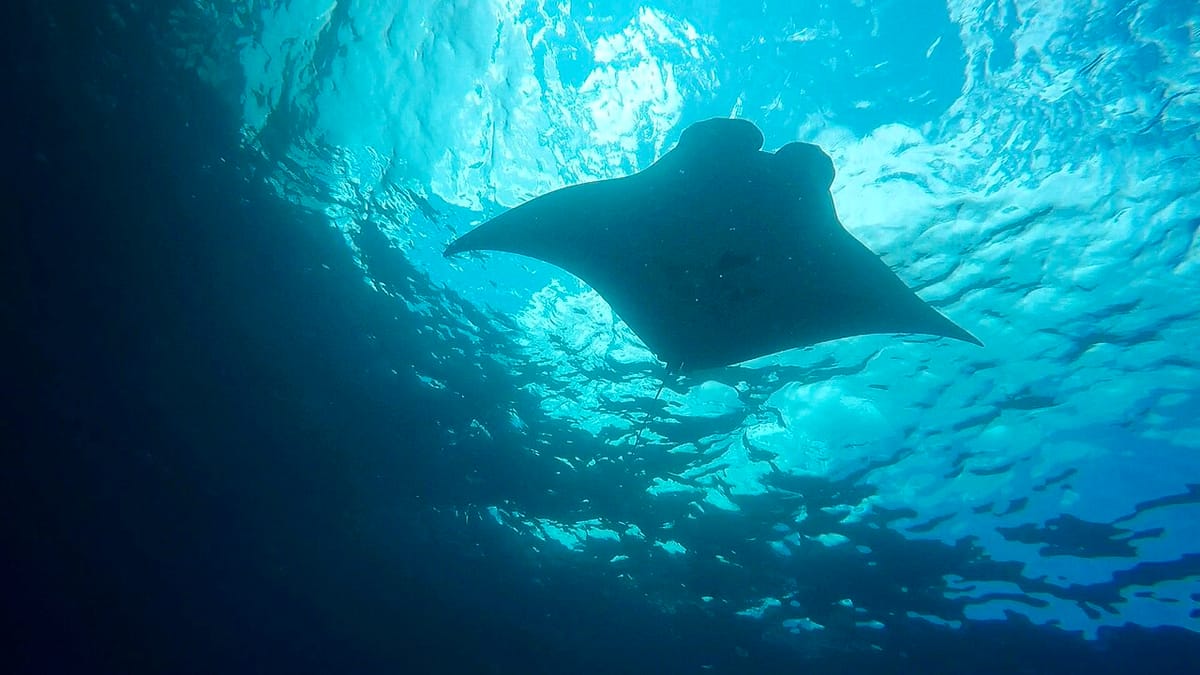
Critically, the role of the Metron company was specified further: to “advance progress on a novel energy harvesting subsystem”, or, that is to say, they were working on a way to keep the drone powered up that didn’t rely on any traditional power source or any existing method of collecting energy from the environment that was known at that time. Finally, the world even got to see some concept art, revealing a sleek, nearly seamless metal craft that, if it had been pictured flying in the air, would have been perfectly believable as a design for America’s next hyper-advanced stealth bomber. Underwater, though, it looked eerily like the program’s namesake, the manta ray.
By the end of 2021, it appeared that the Manta Ray program was going very well. DARPA and its partner organizations were already in possession of the technologies that they hoped would allow them to overcome the myriad challenges Manta Ray was supposed to deal with, and those technologies had already been checked out and found to be ready to move on. Said the program manager for the product, Commander Kyle Woerner, in late 2021, “Manta Ray is uniquely positioning itself to simultaneously introduce a new class of underwater vehicle while contributing key component technologies to other vital undersea programs.” Over the following months, and then years, phase two would involve the construction and testing of entire, full-scale underwater vehicles, integrating the requisite technologies even at that early stage.
Then, on April 8, 2024, Northrop Grumman dropped the big announcement. On that day, Northrop Grumman unveiled its Manta Ray to the world, in the form of a full-scale technology demonstrator. That demonstrator had already spent months performing full-scale, real-world testing off the coast of Southern California, a stretch of sea known for its complex ocean currents, its kelp forests, its underwater mountains and canyons, its abundant small and large sea life, and exceptional amounts of maritime traffic, including both large trade vessels and major US naval assets.
Per the program manager, Commander Woerner, the Manta Ray had passed its testing, and was confirmed ready to move on toward real-world operations. The great metal beast was now out on the water, and if DARPA’s confidence in the program is any indication, then there may be no going back.
Design and Characteristics
There’s a lot that the world doesn’t yet know about the Manta Ray, and with advanced stages of testing still in progress, it stands to reason that there are probably still things even the Manta Ray team doesn’t know about its creation’s capabilities—at least for now. Unfortunately, we won’t be able to provide information on things like a top speed, an endurance time underwater, or the specifics on its internal payload. We’d be glad to report those, of course, but as of now, DARPA has yet to decide that we should get an inside look at all their classified goodies.
But we do know some about the Manta Ray already. These days, the Manta Ray name refers not just to the program, but the specific prototype put forward by Northrop Grumman. Its precise dimensions are as-yet unannounced, and people connected to the project have been very hesitant on giving those sorts of figures, but we know that it’s very, very big.
Despite issues in establishing perspective in the images that have been released from its testing, the UUV appears to be at least a good bit larger than the rigid inflatable dinghies and the small observation boats that have been pictured around it. It’s a good bit longer than it is wide, featuring a nearly flat profile when looking at it straight-on. Its delta wings stretch out to either side before tapering into a rounded wing, appearing neither particularly long nor particularly short, while at the rear of the UUV, a vertical tailplane appears to be about three to four feet tall, judging by images that show people standing atop the Manta Ray.
While images of the Manta Ray haven’t yet shown its underbelly, we can glean that that’s where the propulsion mechanism is likely to be housed, considering that only the bare traces of a propulsion system can be observed at the very back of the drone. Toward the front of it, the Manta Ray features two dark slits almost where you’d imagine the eyes to be, although their purpose is unclear. The metal plating of the Manta Ray does include distinct edges and ridges, potentially increasing its profile for sonar detection, but whether that represents the finished product, or Northrop Grumman didn’t want to bother with a stealthier sleek coating for a prototype, is unknown.
Like the actual, living manta ray, its UUV sister is meant to navigate the ocean during its active phases via a sea-glider configuration. That should allow it to use less power to move, especially in long journeys where not much maneuvering would be required. Moving efficiently, the Manta Ray could conceivably be able to ride ocean currents in times of less urgent need, while gliding through the water at a fairly decent clip if it needs to get someplace fast. Alongside its underwater capabilities, we’ve learned more about how it’s moved around on land; per Northrop Grumman, it’s designed to break down and be fit into five standard-sized shipping containers, where it can then be shipped to a deployment location and reassembled in whatever place it’s expected to engage in combat operations.
Then, there’s the question of the Manta Ray’s energy-harvesting system. Per Northrop Grumman, the Manta Ray is capable of anchoring to the seafloor while in a low-power, dormant state. Animations of the Manta Ray’s purported capabilities show it releasing a harvester device, one that seems to draw its energy from currents of the ocean and harvest that energy on behalf of the Manta Ray.
In reality, though, the apparatus converts energy from something called the thermal gradient of the ocean, the difference in temperature between the ocean’s warmer water, generally flowing closer to the surface, and its colder water, generally further into the depths. As defense expert Alex Hollings put it via Sandboxx while describing the program: “In effect, UUVs like Manta Ray can use the Thermal Energy Pod like a gas station, returning to fill up any time their onboard stores are running low.”
But the Thermal Energy Pod is just one of the methods that DARPA is exploring to power the Manta Ray, and as far as we can tell via publicly available information, the agency hasn’t yet decided on which mechanism to use. The primary alternative is something called RED, or Reversed Electro Dialysis, which draws voltage from differences in water salinity—or, how salty the water is. To utilize this method, the Manta Ray would leverage a series of compartments separated by specially designed membranes, with some compartments holding fresh water, and the others, alternating with them, holding seawater. Let the water in each compartment interact in specific ways via the separating membranes, and they’ll actually generate their own electrical current, which the Manta Ray can then capture and store.
Perhaps most important of all, is the Manta Ray’s ability to go autonomous for long periods of time. It’s very, very, very hard to transmit messages underwater, to the point that most autonomous underwater vehicles have to either come back to the surface frequently to receive instructions, stay close to the source of their instructions, or maintain a wired connection to either a crewed vessel or a transceiver on the surface. But the Manta Ray is intended to be survivable underwater for a very long time, alternating back and forth between states of anchored dormant recharge and active movement through the water.
The specifics on how exactly that works, and whether the Manta Ray can receive further signals underwater via a mechanism that we don’t yet know about, are still very hazy. But we do know that it can send messages without coming to the surface, by leveraging small devices that Northrop calls “data bubbles” that can float back to the surface, use a communications antenna, and send information back to command elements while the UUV itself continues its work. But even a UUV that can just go incommunicado for a long stretch of time, and still remain functional while carrying out mission objectives, would be a major improvement on anything the US or other world nations are known to possess in their arsenals.
Of course, there’s still one question that looms above all else: What is the Manta Ray actually intended to do? Per DARPA itself, around the 2022 and 2023 range, the Manta Ray’s use was more scientific in purpose than anything else. In an interview with the agency’s internal Voices from DARPA podcast series, the program manager, Kyle Woerner, and a project adviser focused on potential civilian uses, like high-precision sonar mapping of the seafloor—a place where, as they noted, humans have only mapped about ten percent of territory at this moment in history. They also emphasized the drone’s potential to help understand the ocean environment, and the importance of having proof-of-concept that a UUV could last longer than a couple of days out on its own, harvesting its own energy rather than remaining dependent on other maritime assets to refuel.
But while all those potential benefits are certainly legitimate ones, and while it would undoubtedly be cool to have the Manta Ray doing its thing underwater for civilian and research purposes, the program’s close proximity to the US military, plus its leveraging of a major defense contractor, have led to zero illusions in the defense world about what its true purpose probably is. Northrop Grumman didn’t mince words either; at around the same time that DARPA was talking about seafloor mapping, the defense giant was publishing its own features on how the Manta Ray could “address the complex nature of undersea warfare”. Northrop Grumman emphasizes the Manta Ray’s high payload capacity, and its ability to create strategic surprise, while maintaining its own command, control, and communications capability. The information it collects will enhance the ability of other warfighting elements to do their work, while hypothetically, it could carry its own weapons onboard for solo missions or even work in concert with other naval elements in combined operations.
Changing Warfare?
Although it’s not yet in front-line service, the Manta Ray’s capabilities represent a major leap forward for the United States’ capabilities at sea, as well as an evolution in the nature of naval warfare overall. We’ve spoken many times about the changing nature of warfare to favor lower-cost, easy-to-produce swarms of drones, both in the air and on the water, and although price figures on the Manta Ray aren’t known, it’s clear already that the new UUV has a whole lot to offer in that regard.
First, there’s the Manta Ray’s potential use as an offensive weapon, where its autonomous survivability grants it a whole new level of potential utility. The payload capacity for the Manta Ray is unknown, but given the size of the UUV, it’s likely to be able to pack a good amount of heat. That payload could include things like sea mines, torpedoes, or even just a big internal bomb that would convert it into a kamikaze drone if need be.
Ukraine’s war against Russia in the Black Sea has proven just how effective surface drones can be when operating on the water, and a bigger, stealthier drone, operating under the waterline, could be a major threat to surface vessels if it were to launch similar sorts of attacks, steering close to a vessel and then exploding on impact. Like Ukraine’s relatively cheap surface drones can sink expensive Russian warships with hundreds of souls on board, the Manta Ray could probably do the same.
Add to that, the vessel’s capability for both long-range and long-endurance missions. To explain why that’s so helpful, we’ll use a hypothetical, a potential conflict between America, backing up Taiwan, and China, playing out in the South China Sea. Launch that conflict today, and American naval and air assets in the region will have to do their best to hold out, while reinforcements steam across the Pacific in a way that China could easily track with its own spy satellites.
But let’s say that America launches a hundred, three hundred, a thousand Manta Ray UUVs right now, in peacetime, from the west coast of the United States, in their own territorial waters. After a season or so spent crossing the Pacific at their own slow, nearly undetectable pace, an entire major fleet of Manta Rays could loiter off the Taiwanese or even the Chinese coast undetected, popping up to the surface every few weeks and checking in to see if there’s any encrypted message to shift them into readiness mode, and then returning to a dormant state where they could remain basically indefinitely until a crisis ever flared up. If it did, and a thousand bomb-laden Manta Rays all came to life with instructions to intercept a Chinese fleet, then that potential war might be over before it begins.
We should be very clear here, that’s an imagined hypothetical, and one that makes a lot of suppositions about what the Manta Ray can do and how. But even if the craft’s capabilities are different in practice, the capacity for this drone to add massive disruptive elements to a future war are critical to understand anyhow.
Then, there’s all the things that the Manta Ray could offer in an active defense role—with potentially the most critical use, being submarine detection. As the defense expert we quoted earlier, Alex Hollings, explained it, the United States currently has very limited capacity to scan its coastal waters for submarines from foreign nations, and what it would take to build enough ships to fill that role, would ultimately be both cost-prohibitive and far too slow. But produce a high number of Manta Rays, and send them on patrol across the waters outside the US, and they could make a really massive difference in informing America about what’s going on in its friendly seas.
If the US wishes, the Manta Ray could monitor threats as they move, beaming information back while tracking them, almost undetectable in their wake. Using a trail of data bubbles, the Manta Ray can send updates on its location, the threat it’s dealing with, and its current course, all while seamlessly remaining in pursuit. Or, if need be, a Manta Ray could conceivably respond with force, attacking enemy submarines while they’re deep in the ocean and susceptible to quick destruction or stranding because of the intense pressure around them.
And when taking a broad view of what this platform could be capable of, it could have a global impact in seemingly limitless ways. The Manta Ray could conceivably be tasked with making secretive deliveries to special-forces soldiers far afield, showing up in the dead of night on a quiet beach halfway across the world before disappearing again just moments later. It could conduct reconnaissance at depths that submarines can’t go to, and in places where America’s full-size subs are simply too big to pass undetected.
Swarms of them could operate in companion roles to individual surface vessels or submarines, or even entire fleets, hybridizing the US Navy in similar fashion to the US Air Force. It could lay mines or detect minefields, evaluate maritime emergencies, or sneak in close to foreign ports and naval bases in order to conduct reconnaissance. And we’d be willing to bet that if these are potential uses we can think of, then the best minds at the Pentagon are already several steps ahead.
At this moment in history, it seems clear that the future of naval warfare will have little in common with its past. Major warships seem, day after day, to be more a concentration of spent money and vulnerable human lives than expressions of true power, and the nations and navies of the world are in the early stages of a scramble to compensate. But in a sphere where new tactics and technologies are emerging constantly, the Manta Ray has the potential to put the United States miles ahead of the competition, prowling the deep to deal with the threats of today, and prevent, or win, the wars of tomorrow.
Key Takeaways
- The Manta Ray is an extra-large unmanned underwater vehicle (UUV) developed by DARPA, designed for long-duration, long-range missions.
- The Manta Ray program aims to create autonomous UUVs capable of operating without human logistics support or maintenance.
- The drone uses innovative energy-harvesting systems, such as thermal gradients and salinity differences, to power itself underwater.
- The Manta Ray’s potential applications include offensive and defensive roles, submarine detection, and strategic surprise in naval warfare.
- The UUV can send messages via ‘data bubbles’ that float to the surface, allowing it to remain operational underwater for extended periods.

Simon Whistler
Simon Whistler hosts MegaProjects, bringing engineering, infrastructure, and military-machine stories into clear narrative focus for viewers who want the systems, tradeoffs, and human decisions behind the build.
Frequently Asked Questions
What is the Manta Ray?
The Manta Ray is a futuristic underwater drone developed by DARPA, designed to redefine underwater warfare. It is an extra-large unmanned underwater vehicle (UUV) capable of long-duration, long-range missions with a significant payload.
Who are the key contractors involved in the Manta Ray program?
The key contractors involved in the Manta Ray program are Northrop Grumman, Metron Incorporated, and Martin Defense Group. Lockheed Martin was initially involved but was not part of the later phases.
What are the primary objectives of the Manta Ray program?
The primary objectives of the Manta Ray program include developing UUVs that can operate autonomously for extended durations without human logistics support, managing energy for long-endurance missions, and addressing issues like underwater corrosion and obstacle avoidance.
How does the Manta Ray harvest energy?
The Manta Ray can harvest energy using a Thermal Energy Pod that converts energy from the ocean’s thermal gradient. Alternatively, it can use Reversed Electro Dialysis (RED) to generate electrical current from differences in water salinity.
What are the potential military uses of the Manta Ray?
The Manta Ray can be used for offensive and defensive purposes, including carrying payloads like sea mines or torpedoes, conducting submarine detection, and performing reconnaissance missions. It can also support special forces operations and minefield detection.
How does the Manta Ray communicate while underwater?
The Manta Ray uses ‘data bubbles’ that float to the surface and transmit information via a communications antenna, allowing it to send messages without surfacing.
What are the dimensions and design characteristics of the Manta Ray?
The precise dimensions of the Manta Ray are not officially announced, but it is described as very large, longer than it is wide, with a nearly flat profile. It features delta wings, a vertical tailplane, and a propulsion mechanism likely housed in its underbelly.
What is the significance of the Manta Ray’s autonomous capabilities?
The Manta Ray’s autonomous capabilities allow it to operate for extended periods without human intervention, making it highly survivable and effective for long-endurance missions. This reduces the need for frequent surface communications or refueling.
How does the Manta Ray’s design mimic its namesake?
The Manta Ray’s design features a sleek, nearly seamless metal craft with a flat profile and delta wings, resembling the shape of a manta ray. This design helps it navigate the ocean efficiently using a sea-glider configuration.
What are the potential civilian uses of the Manta Ray?
The Manta Ray can be used for high-precision sonar mapping of the seafloor, understanding the ocean environment, and conducting scientific research. Its long-endurance capabilities make it ideal for such missions.
Sources
- Original MegaProjects video: The Manta Ray: How America’s Futuristic Underwater Drone will Change Warfare.
- https://www.defense.gov/News/Contracts/Contract/Article/2091020/
- https://idstch.com/military/navy/darpa-manta-ray-developing-new-class-of-uuvs-capable-of-carrying-large-payloads-and-long-endurance-missions-to-support-persistent-operations/
- https://www.darpa.mil/news-events/2021-02-05a
- https://www.darpa.mil/news-events/2020-03-10
- https://www.popularmechanics.com/military/navy-ships/a31669695/darpa-manta-ray-submarines/
- https://www.navalnews.com/naval-news/2021/12/darpa-selects-two-teams-to-build-test-innovative-manta-ray-uuv/
- https://www.darpa.mil/news-events/2022-10-20
- https://news.northropgrumman.com/news/features/engineering-imitating-life
- https://www.navaltoday.com/2022/09/27/new-class-of-unmanned-undersea-vehicles-emerging/
- https://www.thedefensepost.com/2023/09/29/darpa-underwater-drone-milestone/
- https://caseagrant.ucsd.edu/california-commercial-fisheries/ocean-environment
- https://www.montereybayaquarium.org/act-for-the-ocean/california-ecosystems/the-challenge
- https://www.darpa.mil/news-events/2024-05-01
- https://schmidtocean.org/cruise-log-post/the-many-challenges-of-underwater-communication/
- https://www.northropgrumman.com/what-we-do/sea/manta-ray
- https://edition.cnn.com/2024/05/13/tech/australia-us-undersea-drones-ml-hnk-intl/index.html
- https://www.sandboxx.us/news/northrop-grummans-manta-ray-submarine-could-be-a-boon-for-anti-submarine-warfare/
- https://www.c4isrnet.com/unmanned/2024/05/02/northrops-colossal-manta-ray-underwater-drone-passes-at-sea-tests/
- https://www.c4isrnet.com/unmanned/2024/05/02/northrops-colossal-manta-ray-underwater-drone-passes-at-sea-tests/
- https://www.independent.co.uk/news/world/americas/us-military-manta-ray-drone-b2538410.html
- https://www.telegraph.co.uk/us/news/2024/05/02/us-navy-test-underwater-manta-ray-drone-military/
- https://www.forbes.com/sites/davidhambling/2021/02/12/darpas-new-energy-harvesting-manta-ray-is-a-submarine-like-no-other/