These days we take it for granted that we can transmit text, audio and even images all over the world. In fact, there’s a good chance you’re reading this article wirelessly across the ocean or over thousands of miles.
It’s only been this way for a bit over a century, though, and there was a time when the scientific consensus believed that sending electromagnetic signals like radio waves over the horizon was impossible. Due to this belief, famous inventor Nikola Tesla came up with a different idea for sending information wirelessly over long distances: conducting an electrical current through the Earth itself.
While his initial plan was simply aimed at sending messages from the US to the UK and ships at sea, it eventually evolved into a design for a global, wireless energy system, with devices drawing power from the Earth with no need for wires. As grand as these visions were, Tesla’s colleagues, competitors and financiers were less than convinced, and the story of the Tesla Tower quickly went from one of optimism and ingenuity to eccentricity, tragedy and, some say, madness.
The World Wireless System
Tesla Tower, or Wardenclyffe Tower as it was officially called because Tesla had bought the land in Shoreham, Long Island, from developer James S. Warden, was the principal part of the inventor’s design for transmitting electricity through the Earth. Like most scientists at the time, Tesla believed that radio waves, which he doubted even existed, would travel in straight lines and therefore be useless in transmitting energy or information over the horizon since they’d just shoot into space.
Instead, in the late 1890s, Tesla began experimenting with the electrical charge of the Earth itself. He theorized that if he injected a current into the ground at the right frequency, the Earth’s charge would amplify it into waves that could be harnessed from anywhere on the planet for power or communication. To complete the required circuit, the charge would be returned through the air. This relied on a theory by Mahlon Loomis who posited that there was a layer of Earth’s atmosphere that was highly conductive.
Tesla had not tested this theory extensively, but he had achieved wireless power transmission at his facility in Colorado Springs using the Tesla coil, or “magnifying transmitter” as he called it, one of his most famous inventions patented in 1891. This involved illuminating Geissler vacuum tubes planted in the ground several miles away with an electrical current sent through the Earth, though some still debate the veracity of this experiment.
Tesla was apparently convinced, though, and believed he could transmit power not just over a few miles in Colorado but around the whole world. People could power machines or pick up audio and other informational signals from anywhere around the globe without having to plug into a grid, and as the current returned through the atmosphere, it would even create a glow that could be used to light cities and shipping lanes.
This world wireless system would rely on a system of 30 towers like the one Tesla ultimately built at Wardenclyffe. These would take power generated by industrial alternators and pump it into the Earth at low-frequency long waves. Upon returning to New York from Colorado Springs, Tesla’s utopian visions of a future with global wireless power had grown to leviathan proportions and included harnessing the sun as a power source, weather control and the end of war. He immediately began writing to important investors to get funding for the Wardenclyffe Tower.
Deep Pockets
Tesla’s ventures in Colorado Springs had been funded by John Jacob Astor, a friend of Tesla’s and one of the richest men in the world who would later die in 1912 in the sinking of the Titanic. Back in New York, Tesla moved into the luxurious Waldorf Astoria Hotel on Park Avenue, where he wined and dined other potential investors, starting with George Westinghouse, an engineer and entrepreneur who had made a fortune manufacturing electrical equipment.
Tesla proposed that Westinghouse provide all the electric machinery while retaining ownership and receiving a large share of Tesla’s company. Westinghouse declined but did lend the inventor $6,000, which is well over $200,000 today according to the CPI.
John Jacob Astor also bought 500 shares of the company, but Tesla had little luck convincing investors until wealthy banker and magnate J.P. Morgan became interested in wireless transmissions after Italian inventor Guglielmo Marconi managed to use radio signals to send reports of the America’s Cup yacht races to New York from Long Island. Morgan was convinced that wireless transmission would replace the transatlantic telegraph cable and wanted to bet on which horse would win the wireless race.
After meeting, Morgan signed a contract for an investment of $150,000 in exchange for 51 percent ownership of Tesla’s company. This was no small sum, the equivalent of over $5 million today.
A Change in Plans
With Morgan’s money, Tesla went straight to work. He placed orders for generators and transformers with Westinghouse and bought 200 acres of land on Long Island from James S. Warden who was in the process of building a resort community called “Wardenclyffe-On-Sound.” Together the two men envisioned Wardenclyffe becoming the hub of the world wireless system and a radio city filled with factories and housing for thousands of workers.
However, this dream was short-lived, and Tesla’s associates quickly lost their optimism for his project.
Guglielmo Marconi soon proved the scientific consensus wrong, including Tesla, by transmitting radio signals over the horizon. In December 1901, the Italian scientist transmitted three clicks, Morse code for the letter S, across the Atlantic from Poldhu, Cornwall, to St. John’s, Newfoundland in Canada. This was 2,200 miles or 3,500 kilometers, much farther than was thought possible, and though modern scientists are actually skeptical of Marconi’s claims, it was enough to worry Tesla and his investors.
The competition seemed to motivate Tesla, who decided his system at Wardenclyffe would have to be even bigger and more powerful. He wanted to quickly demonstrate the system’s effectiveness by transmitting Morse code wirelessly to Europe as well as telephone and image, not to mention electrical power.
Specifically, Tesla decided he needed a tower at least 300 feet tall and possibly as tall as 600 feet, so between 90 and 180 meters. The problem was that this would cost more than the $150,000 J.P. Morgan had agreed to, most of which Tesla still hadn’t received. Instead it would cost $450,000, three times as much. Morgan refused, foreshadowing the financial problems Tesla was about to face.
Construction Begins—and Ends
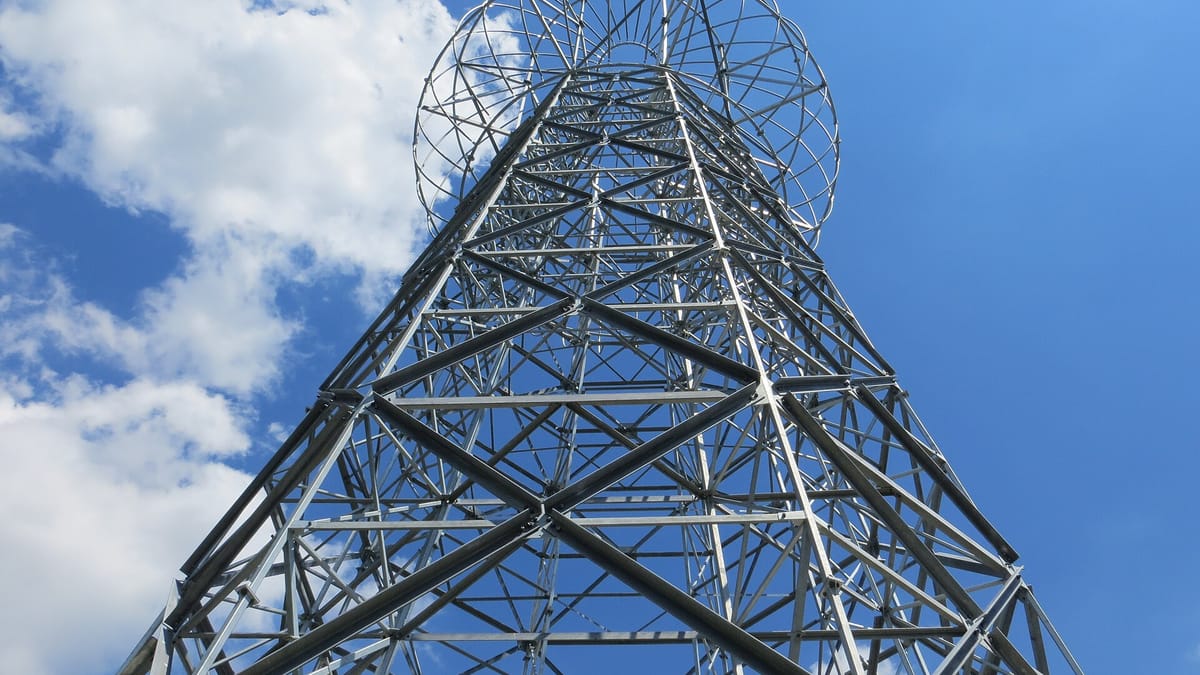
Ultimately Tesla conceded to build a tower just 186 feet or 57 meters tall. It stood on a wooden frame but had a steel cupola at the top that measured 68 feet or 21 meters in diameter and weighed 55 tons. Tesla connected the tower to the Earth via a steel-lined hollow shaft measuring 10 by 12 feet or 3 by 3.5 meters inserted 120 feet or 37 meters into the ground. Tesla claimed that at the bottom of the shaft, he had pushed 16 iron pipes measuring 300 feet or 90 meters even deeper into the ground.
He would then send the current through these pipes to “[take] hold of the Earth.” He stated that this would allow him “to have a grip on the Earth so the whole of this globe can quiver.”
Below the tower, Tesla built a facility designed by his friend and architect Stanford White. It housed a laboratory, instrumentation room, boiler room and machine shop as well as a room for the coal-fired 200-kilowatt Westinghouse alternating-current generator. The inventor brought in extensive equipment including transformers, glass blowing machinery, X-ray machines, Tesla coils and even a remote-controlled boat.
Little else is known about the facility because Tesla minimized press contact, which has led to creative speculation about other aspects of the Wardenclyffe complex. For instance, the tower’s cupola featured a five-foot hole in its top where Tesla mounted ultraviolet lights. No one knows what these were for, though some guess they were meant to create an ionized path to tap into the conductive layer of the atmosphere that was central to Tesla’s theories.
Other mysterious parts of the facility include four tunnels 100 feet or 30 meters long radiating north, south, east and west from the tower’s main shaft. Were they part of the tower’s electric connection to the Earth’s resonance or merely drainage tunnels? No one is sure.
With little inside information getting out, everything appeared to be going great to the public. In 1902 Tesla told the press, “We have been sending wireless messages for long distances from this station for some time,” and in June of that year he more or less moved his operation permanently to Wardenclyffe, abandoning his laboratory in Manhattan.
However, Tesla’s private correspondence paints a much different picture. By the fall of 1901, letters between him and Stanford White show the inventor was already worried about foreclosure on the facility. By 1903 Tesla was desperate and wrote to J.P. Morgan: “Will you help me or let my great work—almost complete—go to pots?” Morgan basically blew him off with his response: “I have received your letter and in reply would say that I should not feel disposed at present to make any further advances.”
After receiving the banker’s rejection on 14 July 1903, Tesla initiated what has come to be the greatest mystery of the Wardenclyffe facility. That night the Tesla Tower turned on and shot flashes of light up into the Long Island sky, which it continued to do for several nights after. Tesla never said what the flashes meant, and the tower never turned on again.
Breakdowns
Things only got worse. Not only was Marconi regularly sending radio transmissions with increasing sophistication, but the 1903 Wall Street panic made investors more cautious and skeptical. Tesla continued looking for funding and even approached the US Navy but had no luck. J.P. Morgan ignored the inventor’s continued pleas or replied curtly through his secretary.
Everything finally broke down in 1906. Stanford White was murdered by Harry Kendall Thaw after the architect had an affair with his wife, actress Evelyn Nesbit. One of Tesla’s investors, William Rankine, also had a heart attack and passed away. Tesla’s manager of the Wardenclyffe facility, George Scherff, quit, presumably because he wasn’t getting paid. Many modern historians suspect Tesla had a nervous breakdown as a result of these events.
Still living at the Waldorf Astoria, Tesla took out a mortgage on the Wardenclyffe property to pay the considerable bill he’d racked up, something he had to repeat in 1908. With no new money forthcoming and debts being called in, Tesla finally abandoned Wardenclyffe in 1911.
The Check Comes
In 1912 Tesla’s investors started asking questions. Namely, where was their money? Tesla didn’t have an answer for them. The truth was, he couldn’t even pay his rent, much less the investments that the press had estimated at over a million dollars, nearly $36 million today.
In fact, he still owed $20,000 to George C. Boldt, the owner of the Waldorf Astoria. That’s more than half a million dollars when adjusted for inflation. Boldt eventually foreclosed on the two mortgages Tesla had taken out on the Wardenclyffe facility, but it did little to satisfy the debt. Boldt demolished the Tesla Tower and sold it for $1,750-worth of scrap. He then put the land up for sale.
The property passed through numerous hands before ending up with Agfa Corporation, a Belgian-German manufacturer of various photography, film and imaging products. They ran a factory on the site, which they closed in 1992. After cleaning it up, Agfa put the property up for sale in 2009 for $1,650,000. A nonprofit organization bought it in 2013 with funding from an unlikely source: The Oatmeal webcomic.
From Ruin to Remembrance
The Wardenclyffe site had already been marked as a testament to Tesla’s ingenuity in 1976. With the facility’s main building still standing, representatives from the Brookhaven National Laboratory installed a plaque from Yugoslavia commemorating Tesla, who had been born in Serbia, at the time part of Yugoslavia, in 1856.
However, the plaque was stolen in 2009, and Tesla fans decided they wanted something grander to honor the visionary. Matthew Inman, creator of The Oatmeal, took up the reins and joined The Tesla Science Center at Wardenclyffe nonprofit organization to start an Indiegogo crowdfunding campaign to create a museum and educational science center on the property. They raised their goal of $850,000 in just a week, in part due to donations from business magnate Elon Musk, founder of Tesla Inc., prompting a matching grant from the State of New York and allowing them to purchase the land.
Now mostly restored, the Tesla Science Center at Wardenclyffe offers tours of the historical facilities, educational programs, rotating exhibits and celebrations. They plan to expand their educational programs to provide even more ways to engage children in the arts and sciences and encourage and improve science education. Renovations of the facilities are ongoing as well.
Plus, the center offers a number of virtual programs and tours. Anyone with an Internet connection around the world can “visit” the historical site and revel in Tesla’s genius and the ambition, if not fulfilled, of his dream of a world wireless power system.
Oh yeah, and if you took that plaque, give it back.
Key Takeaways
- Nikola Tesla’s Wardenclyffe Tower aimed to transmit electricity wirelessly through the Earth.
- Tesla’s vision for global wireless power faced skepticism from investors and competitors.
- Financial struggles and personal tragedies led to the abandonment of Tesla’s Wardenclyffe project.
- The Wardenclyffe site is now a science center honoring Tesla’s innovative work.
- Tesla’s initial funding came from wealthy investors like J.P. Morgan and John Jacob Astor.
Simon Whistler
Simon Whistler hosts MegaProjects, bringing engineering, infrastructure, and military-machine stories into clear narrative focus for viewers who want the systems, tradeoffs, and human decisions behind the build.
Frequently Asked Questions
What was the original purpose of Tesla’s Wardenclyffe Tower?
The original purpose of Tesla’s Wardenclyffe Tower was to transmit electricity through the Earth, aiming to send messages from the US to the UK and ships at sea. It eventually evolved into a design for a global, wireless energy system.
How did Tesla plan to transmit power wirelessly?
Tesla planned to transmit power wirelessly by injecting an electrical current into the ground at the right frequency, which would amplify into waves that could be harnessed from anywhere on the planet for power or communication.
Who were the main investors in Tesla’s Wardenclyffe project?
The main investors in Tesla’s Wardenclyffe project included John Jacob Astor, George Westinghouse, and J.P. Morgan. Morgan invested $150,000 in exchange for 51 percent ownership of Tesla’s company.
What was the height of the Wardenclyffe Tower?
The Wardenclyffe Tower was ultimately built to be 186 feet tall, though Tesla initially planned for a tower at least 300 feet tall and possibly as tall as 600 feet.
What happened to the Wardenclyffe Tower after Tesla abandoned it?
After Tesla abandoned the Wardenclyffe property in 1911, the tower was demolished and sold for scrap in 1917. The property passed through numerous hands before ending up with Agfa Corporation, which closed its factory on the site in 1992.
How was the Wardenclyffe site preserved and turned into a museum?
The Wardenclyffe site was preserved and turned into a museum through the efforts of The Tesla Science Center at Wardenclyffe nonprofit organization, which raised funds through an Indiegogo crowdfunding campaign and purchased the land in 2013.
What was the significance of the flashes of light from the Wardenclyffe Tower in 1903?
Tesla never explained the significance of the flashes of light from the Wardenclyffe Tower in 1903, and the tower never turned on again after those nights.
What was the role of the Tesla coil in Tesla’s wireless power experiments?
The Tesla coil, or ‘magnifying transmitter,’ was used by Tesla to achieve wireless power transmission at his facility in Colorado Springs. It involved illuminating Geissler vacuum tubes planted in the ground several miles away with an electrical current sent through the Earth.
What was the impact of Marconi’s success on Tesla’s Wardenclyffe project?
Marconi’s success in transmitting radio signals over the horizon motivated Tesla to make his system at Wardenclyffe even bigger and more powerful, but it also led to increased competition and financial difficulties for Tesla.
What is the current status of the Tesla Science Center at Wardenclyffe?
The Tesla Science Center at Wardenclyffe is mostly restored and offers tours of the historical facilities, educational programs, rotating exhibits, and celebrations. They plan to expand their educational programs and continue renovations of the facilities.
Sources
- Original MegaProjects video: The Tesla Tower: The Incredible Story of the World’s Most Powerful Wireless Energy System
- https://en.wikipedia.org/wiki/Agfa-Gevaert
- https://patents.google.com/patent/US1119732
- https://en.wikipedia.org/wiki/Free_energy_suppression_conspiracy_theory
- https://en.wikipedia.org/wiki/Geissler_tube
- https://en.wikipedia.org/wiki/George_Westinghouse
- https://en.wikipedia.org/wiki/Guglielmo_Marconi
- https://en.wikipedia.org/wiki/History_of_the_Tesla_coil
- https://en.wikipedia.org/wiki/John_Jacob_Astor_IV
- https://en.wikipedia.org/wiki/Mahlon_Loomis
- https://en.wikipedia.org/wiki/Nikola_Tesla
- http://www.teslasociety.com/warden.htm
- https://en.wikipedia.org/wiki/Serbia
- https://en.wikipedia.org/wiki/Tesla_coil
- https://www.pbs.org/tesla/ll/ll_colspr.html
- https://teslasciencecenter.org/
- https://teslasciencecenter.org/wp-content/uploads/2022/04/THE-PROBLEM-OF-INCREASING-HUMAN-ENERGY_Century_Magazine.pdf
- https://en.wikipedia.org/wiki/Waldorf_Astoria_New_York
- https://en.wikipedia.org/wiki/Wardenclyffe_Tower
- https://en.wikipedia.org/wiki/Wireless_power_transfer
- https://en.wikipedia.org/wiki/World_Wireless_System
- https://www.in2013dollars.com/us/inflation/1900?amount=6000