The Iconic T-34 Medium Tank: Saviour of the Motherland … or Hunk of Junk?
In today’s examination we are going to cover the design, production and performance of one of the most iconic tanks of WWII. A Soviet tank that was considered a mechanical marvel, a formidable beast of steel that struck fear into the hearts of Axis tankers, chasing them back all the way to Berlin.
But we are also going to discuss another tank.
One that was dismissed as a total lemon, a blob of hideous scrap metal, a death trap for expendable Soviet tank crews, a vehicle that could not oppose the early stages of Operation Barbarossa.
The first tank I am talking about is, of course, the T-34 medium tank.
And the second tank I was referring to is, no surprise here … the T-34 medium tank.
Much like Marmite or Nickelback, military history buffs either love it, or hate it — but surely cannot ignore it.
So, let’s explore together the history of this tank, and find out if the T-34 was in fact a hunk of junk, a saviour of the motherland … or maybe both?!?
Early Designs
The story of the T-34 begins in 1937.
Back then, a large part of the Soviet tanks consisted of ‘BT’ fast tanks. These vehicles had shown their limitations during the Soviet intervention in the Spanish Civil War, where they had shown their vulnerabilities in an urban warfare setting, especially against opponents using guerrilla tactics.
Paradoxically, BT’s performed well enough against other armoured units, but were easy prey to light infantry weapons such as petrol bombs, especially if hurled from the top of a building.
The high command of the Armoured and Motorized forces of the Red Army, or ABTV, on August 15th, 1937 issued resolution number 94, calling for the design of a new fast tank.
The desired specs were for the new vehicle to have a 400 hp Diesel engine, 20 to 25 mm of armour, and a 45 to 75 mm gun which could be raised at a steep angle, so as to take out those pesky Spaniards throwing bombs from the top floors.
A design team — KB-24 — was assembled at Factory Number 183 in Kharkov, by chief designer M.I. Koshkin. In October 1937, Koshkin received an updated set of requirements, which required for the armour to be sloped.
In March 1938, Koshkin and his team delivered the first design, called ‘BT-20’. They had incorporated another spec desired by top military brass: a wheel-and-track suspension system. This system allowed for the tracks to be removed from the tank when travelling on road. It helped to preserve the integrity of the tracks for when they were most needed, but it also made the suspension far more complex and expensive to assemble.
Koshkin objected to using this type of system, and in May 1938 the Defence Committee gave KB-24 permission to design two tank prototypes, one with the wheel-and-track system, one without.
In February 1939 Koshkin handed in his next piece of work, a design for what was now called A-20 — in both versions, with and without the dual suspension system. On the 27th of the month, the Defence Committee approved the construction of both prototypes.
On 4 May 1939 the Defence Committee met at the Kremlin, and gave KB-24 permission to design two prototypes of the A-20 – one with the track-and-wheels suspension, and one without. The designs were ready by February 1939, and on 27 February the Defence Committee approved the construction of both prototypes.
The early specimens were ready in June 1939, and began their test runs in July. Both models performed well, reaching top speeds of up to 85 km/h!
The prototype featuring the track-only traction, now called A-32, was slower than the other, but its simpler suspension system allowed to increase the thickness and weight of the armour.
The Defence Committee was encouraged by this detail, and in December they commissioned the production of ten track-only prototypes with a 45mm frontal armour. At this stage, the new model tank was already referred to as T-34.
By February 1940, the first two ever T-34s had rolled off the factory floor at Kharkov, ready for a programme of tests.
In early factory trials, the T-34s proved to be faster and more agile than the BT’s, but they also demonstrated some glaring disadvantages. For example: the sloped armour was a guarantee of extra protection — more on this later! — but it hampered the visibility of the crew. Moreover, the interior was very cramped, and the V-2 Diesel engine failed after 25 hours of operations.
Nonetheless, Koshkin and his designers boarded the T-34 for the next test: on March the 6th they set off from Kharkov to Moscow, covering the distance in 10 days. Once arrived, the T-34s were inspected by Stalin himself, surely a nerve-wracking ordeal for Koshkin!
But the dictator was pleased, so the tanks moved to the next stage of tests. At an Army training ground, the T-34s were shot at with 37mm and 45mm anti-tank guns, taking very little damage.
Then, on June 7th 1940, the Soviet Council of Peoples Commissars ordered Factory 183 to commence mass production of the T-34.
Mechanical Marvel?
OK, so that T-34 you ordered has finally arrived at the dealership, it’s got that lovely ‘brand new tank smell’ and you can’t wait to go spin some doughnuts in the car park.
Or, if you are like me, you just want to check if the child seat fits.
But before I hand you the keys, let me slap its roof like a good salesman and tell you more about this bad boy.
Early T-34 models were 2.4 metres high, 7.5 metres long and 2.9 metres wide. In basketball players, that’s one Sun Mingming, three Sun Mingmings, and one Sun Mingming with his arms stretched up high, respectively.
The interior was rather cramped, though, fitting only four crew members, preferably not fit to play basketball.
With a full crew, and at full-combat readiness, a T-34 weighed some 25 metric tons, which is 27.5 non-metric tons. So, a sizable beast, and yet a nimble one, as it could easily clear obstacles as high as 0.8 metres, or 2.6 feet.
Such feats were propelled by the V-2 Diesel engine, with a standard output of 400 to 450 hp, meaning that at full weight the tank could reach a top speed of 48 km/hr, or 30 mph. When topped with 460 litres of diesel, a T-34 had a maximum range of 300 km, or 188 miles, provided it travelled on paved roads. If trudging through uneven terrain, the tank could travel as far as 183 km, or 114 miles.
These engines had been first designed and developed in 1933 at another factory in Kharkov, the Diesel Engines Plant. It took years for the Plant to improve their creation: only in 1939 engine tests proved that it could run continuously for 250 hours. The following year it was deemed ‘worthy’ of the T-34, entering mass production at Factory Number 75 in June 1940.
Mass-produced specimens were of lesser quality than the test prototypes, but Factory 75 guaranteed they could run for 150 hours. In reality, for most of WWII, V-2 engines had an average lifespan of 100 hours, one of the many issues which affected the T-34.
Another aspect which designers did not nail from the start was the armament.
The original gun mounted on T-34s was the L-11 model, with a calibre of 76.2 mm, or 3 inches. The L-11 had a muzzle velocity of 555 metres per second, which sounds incredibly fast to me, but apparently it wasn’t enough for the shell to pierce standard armour plating.
Fortunately, a better gun was already in development, the F-34 model.
This weapon also boasted a 76.2 mm calibre, as well as a barrel length of 3.16 metres, or 10 feet. More importantly, an armour piercing shell could fly off the muzzle at a speed of 680 metres per second. For reference, that’s more than 1,500 miles per hour.
Thanks to the speed generated by the F-34 gun, its shells could penetrate 60mm of steel armour. That’s more than 2 inches, by the way, and it could do so at a distance of 1,000 metres, or 0.6 miles.
The F-34 gun was mounted on the turret, of course, another feature which was an apparent weakness from the very start. Designer Koshkin devised a small turret, with steeply sloped sides. This made it a hard target for enemy gunners, sure, but it also limited the mobility and visibility of the poor sods who had to operate inside it.
A T-34 commander would normally sit inside the turret, identifying potential threats and targets from within. While German tank commanders could peer out from a whole set of periscopes, their Soviet counterparts only had access to one single periscope and one view slit, severely limiting their field of vision.
The turret had a positive aspect, though. It was fitted with an MB-20 electric motor, which allowed it to perform a complete 360 degrees turn in just 10 seconds.
But perhaps the most celebrated characteristic of the T-34 was its armour, thick and sloped.
As mentioned earlier, the front plate consisted of 45 mm, almost 1.8 inches, of steel. And not just any steel. This was a special alloy, called MZ-2, developed by the researchers at the Mariupol Factory. This alloy was sturdy, yet ductile, so that it could be compressed without it breaking.
The protection offered by this thick plate of steel was compounded by its sloping armour, angled at 60 degrees. This presented two advantages: shells which hit the T-34 at an angle, would be deflected by the inclined surfaces, and glanced off dealing little to no damage.
As per shells flying towards the medium tank while parallel to the ground, they were in for a surprise, as the angle in the sloped plate would effectively double its thickness. In other words: a 45 mm plate, inclined at 60 degrees, can offer the same protection as a 90 mm non-inclined plate!
Baptism of Fire
On June 22, 1941, Germany and its allies invaded the Soviet Union. It was time for the T-34 to prove its mettle!
From the very start, German Panzer crews realised that the medium tank was a tough cookie.
At the onset of the invasion, the most modern German tanks were the Panzer III’s and IV’s. They both boasted a thicker front armour than the T-34, but it was not sloped. The Axis tanks deployed guns which were shorter than their Soviet counterpart, hence firing shells at a lower muzzle velocity.
As a consequence, very rarely did hits from the panzers manage to penetrate the T-34’s armour. German artillery fared slightly better, especially when using 88mm guns, but these were still rare in the summer of 1941.
The T-34 seemed to outclass its foes. And yet, the early stages of Barbarossa were marked by decisive Axis victories.
To put it simply, the T-34 was not a wonder weapon, far from it, and its use in combat brought to the fore many of its flaws.
The entire cabin was cramped and not fitted with shock absorbers, which made it extremely fatiguing for the crews to travel for a prolonged time.
As mentioned earlier, the driver and the commander — who also doubled as a gunner! — suffered from poor visibility, which left much of the initiatives to their enemies. Moreover, most early T-34s lacked a radio, meaning that platoon leaders had to communicate with flags!
But what mostly let the crews down were the mechanical failures.
The transmission failed so frequently that crews took to carrying a spare. The gearbox got stuck more often than not, to which tankers responded by hitting it with a sledgehammer! Crews couldn’t even rely on the tracks on their T-34, as they could come apart from simple wear and tear, leaving them stranded in the middle of a battlefield!
These mechanical faults, frustratingly, accounted for about 50% of total losses of the T-34s in the early stages of Barbarossa.
As per the other 50% … well, we know that the T-34s were superiors in terms of fire power and armour compared to Panzer III’s. But the Germans could still score some serious hits with their anti-tank guns!
When the German shells hit hard enough, the Soviet armour had a tendency to ‘spall’ — this is when the internal side of the armour could spew out a shower of sharp metal splinters, severely wounding the crews.
And if their tank caught fire, crews often found it difficult to open on time the single, extremely heavy turret hatch. An alternative was to use the fire extinguishers on board. Good luck with those, as they emitted toxic carbon tetrachloride in the cramped interior.
In addition to the specific flaws of the T-34 themselves, the units equipped with such tanks suffered from some serious disadvantages.
First of all, the T-34s were still driven by rookie crews in the summer of 1941. And their commanders were even more inexperienced!
You see, in 1936 Marshal Tukhachevsky had successfully introduced the Deep Battle — or Gluboky Boi — doctrine, which advocated for the use of large, massed formations of tanks to smash enemy lines and penetrate in depth beyond them. After Stalin’s Great Purge, however, Tukhachesky had been executed, and his theories had fallen out of favour. By 1941, the armoured doctrine inspired by Gluboky Boi had made a comeback, but senior officers had little to no practical experience of how to manoeuvre large tank formations, leaving them an easy prey to the Axis armoured spearheads.
As a result, the invaders quickly encircled the armoured units of the Special Western Military District, defeating them by July 8th 1941.
A Return to Form
As the war progressed, German tanks were constantly outnumbered by the Soviets, but their technical capabilities improved steadily.
In the summer of 1942 Axis armoured units were equipped with long-gunned Panzer III’s and IV’s, giving them the capability to knock out T-34s from a long range. Moreover, the first Tiger I’s appeared in the same year, followed by the Panthers in 1943.
The T-34, on the other hand, remained largely unchanged, except for some limited improvements.
For example, the turret design was improved by adding an extra escape hatch, and the front armour was increased from 1.8 to almost 3 inches, or 75 mm. Engineers also added external fuel tanks, extending range by 50%.
It was only at the end of 1943, however, that the T-34 was equipped with a more powerful weapon. This was the new 85mm gun, which replaced the previous 76mm one, and was specifically designed to knock out the recently introduced Panther tanks.
This gun had been adapted from the Model 1939 anti aircraft gun, it had a muzzle velocity of 792 metres per second, or 2,600 feet per second, releasing shells which could penetrate 94 mm or 3.7 inches of sloped armour at a distance of almost one kilometre, or 1,000 yards.
Despite these advancements, Soviet armour continued to suffer heavy losses against the Axis.
In 1942 alone, the Red Army lost some 15,000 tanks, of which the majority were T-34s. The Soviet industrial complex, however, could withstand the onslaught. The major armaments factories were dismantled and then reassembled piece by piece east of the Urals, far from the Wehrmacht’s reach.
In 1943, the indefatigable Soviet workers produced 15,500 T-34s, almost three times as many as German tank output.
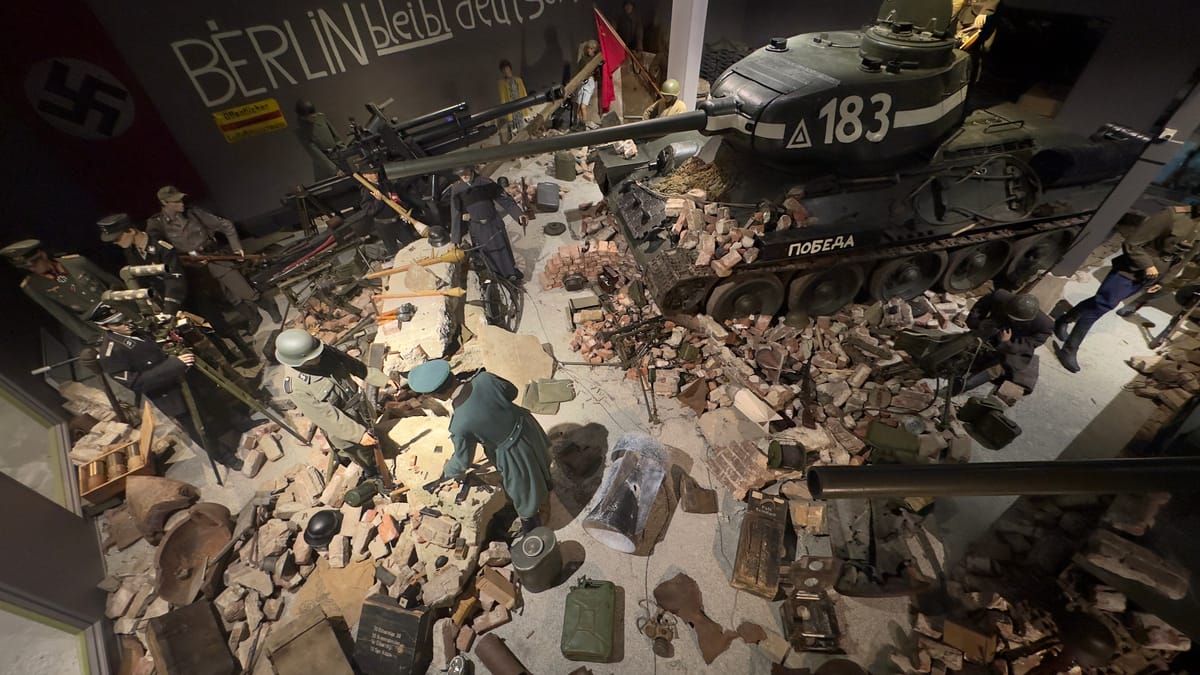
In July and August 1943, the T-34s were the star of the show at the Battle of Kursk, the largest tank battle in history. The Soviet medium tanks faced the German Tigers and Panthers, undoubtedly superior — but they still came out on top.
This was a matter of numbers, of course, but not only.
By this stage, Red Army commanders had learned, or rather, re-learned the lessons of Marshal Tukhachevsky, and knew how to make the best use of large armoured units consisting of fast medium tanks.
This was the essence of the Deep Battle doctrine, after all: waves of frontal assaults followed by deep thrusts into enemy lines — and the masses of newly produced T-34s perfectly fit the bill!
As we all know, the Red steamroller successively pushed back the Axis forces, chasing them all the way back to Berlin.
This success contributed to cementing the status of the T-34 as a fearsome machine. Production lines continued to crank out some 30,000 tanks between the end of the war and 1949, when the legendary medium tank was definitely replaced by a new model, the T-54.
Despite the designs becoming obsolete in 1949, the tanks themselves continued to see service with the Red Army, its Warsaw Pact allies, as well as Egypt and Syria until 1973.
Conclusion
Let’s return to our initial question.
What definition can best sum up the legacy of the T-34: was it a piece of junk or a formidable weapon?
Our answer would be: neither. When it was first released, the T-34 was arguably the best medium tank in the world — at least as far as its gun and armour were concerned. It was made with cheap, standardised parts, meaning that Soviet factories could assemble thousands of specimens much more quickly than their enemies and allies. During the course of the war, a total of 54,550 T-34s were produced.
On the other hand, we know that a T-34 could be knocked out of commission even before entering combat, as a result of mechanical failure, or simple wear and tear. And when T-34s did get into battle, they were vulnerable to superior German armament, at least from 1942 onwards.
In fact, out of those 54,550 tanks I mentioned earlier, a total of 44,900 were irrecoverable losses. That’s 82%!
Those numbers may convey two completely opposite messages.
You may look at those figures and think: ‘well, it looks like the Soviets lost a lot of tanks!’
But you may also think: ‘sure, but it also looks like they were able to quickly and constantly replenish their losses!’
And that’s the point we should be focusing on.
The T-34 medium tank can be assessed on a tactical level, by its Overall Combat Power. In other words, it can be judged based on its capability to win individual engagements or battles. From this perspective, the T-34 was plagued by several flaws and was technically inferior to many of its adversaries. As a result, it never achieved better than a one to three kill-loss ratio.
But a tank should be judged also on a strategic level — in other words, its capability to win a war.
From this point of view, the T-34 was definitely a winning tank.
Soviet factories were able to manufacture great numbers cheaply, quickly and easily, sending hundreds of new specimens into battle every single month, thus overpowering the Axis invaders by tanks whose quality was satisfactory at best, but whose quantity was absolutely overwhelming.
Key Takeaways
- The T-34 was designed in the late 1930s to address vulnerabilities of Soviet tanks in urban warfare.
- The T-34 featured sloped armor and a powerful gun, making it a formidable opponent early in WWII.
- Early T-34 models suffered from mechanical issues, including frequent engine and transmission failures.
- Soviet industrial capabilities allowed for rapid production of T-34s, overwhelming Axis forces with quantity.
- The T-34’s strategic impact was significant, despite its tactical limitations and high loss rate.

Simon Whistler
Simon Whistler hosts MegaProjects, bringing engineering, infrastructure, and military-machine stories into clear narrative focus for viewers who want the systems, tradeoffs, and human decisions behind the build.
Frequently Asked Questions
What was the initial purpose of the T-34 tank design?
The T-34 tank was designed in response to the limitations shown by the BT fast tanks during the Spanish Civil War. The Soviet high command sought a new fast tank with a 400 hp Diesel engine, 20 to 25 mm of armour, and a 45 to 75 mm gun that could be raised at a steep angle.
What were the key specifications of the early T-34 prototypes?
The early T-34 prototypes, known as A-20, featured a wheel-and-track suspension system and sloped armour. They were designed to have a 400 hp Diesel engine and a 45mm frontal armour.
How did the T-34 perform in its initial tests?
The T-34 prototypes performed well in tests, reaching top speeds of up to 85 km/h. The track-only prototype, A-32, was slower but allowed for increased armour thickness due to its simpler suspension system.
What were some of the initial mechanical issues with the T-34?
Early T-34 models had several mechanical issues, including a cramped interior, poor visibility for the crew, and a V-2 Diesel engine that failed after 25 hours of operation. The transmission and gearbox were also prone to frequent failures.
How did the T-34 fare against German tanks during the early stages of Operation Barbarossa?
The T-34 was initially seen as a tough opponent by German Panzer crews. However, it suffered from mechanical failures and inexperienced crews, leading to significant losses despite its superior firepower and armour compared to early German tanks.
What improvements were made to the T-34 during the war?
Improvements to the T-34 included increasing the front armour from 45 mm to 75 mm, adding an extra escape hatch to the turret, and equipping it with an 85mm gun designed to counter the Panther tanks. External fuel tanks were also added to extend the range.
How did the T-34 contribute to the Soviet victory in World War II?
The T-34’s mass production and deployment in large numbers allowed the Soviets to overwhelm Axis forces. Despite its mechanical issues, the T-34’s quantity and the re-adoption of the Deep Battle doctrine played a crucial role in pushing back the Axis forces.
What was the total production and loss rate of the T-34 during World War II?
A total of 54,550 T-34 tanks were produced during the war. Out of these, 44,900 were irrecoverable losses, representing an 82% loss rate. However, the high production rate allowed the Soviets to continually replenish their losses.
What was the legacy of the T-34 tank?
The T-34 is remembered as a formidable weapon due to its mass production and strategic impact. While it had tactical flaws and was technically inferior to some adversaries, its quantity and the ability to quickly replenish losses were key to the Soviet victory.
What was the Deep Battle doctrine and how did it relate to the T-34?
The Deep Battle doctrine, introduced by Marshal Tukhachevsky, advocated for the use of large, massed formations of tanks to smash enemy lines and penetrate deeply. The T-34’s production and deployment fit this doctrine, contributing to the Soviet strategy of overwhelming Axis forces.
Sources
- Original MegaProjects video: The T-34: The Greatest Tank of WW2?
- https://www.scribd.com/book/444691237
- https://www.researchgate.net/publication/358208746_Inter-Factory_Cooperation_during_Production_of_the_T-34_Tank_at_Krasnoe_Sormovo_Plant_in_1941_Plans_and_Reality
- https://www.popularmechanics.com/military/weapons/a32439030/t-34-soviet-tank-history/
- http://www.amazon.co.uk/exec/obidos/redirect?path=ASIN/1782744754&link_code=as2&camp=1634&tag=militaryhistorye&creative=6738
- http://www.historyofwar.org/articles/weapons_t-34_production.html
- https://www.operationbarbarossa.net/the-t-34-in-wwii-the-legend-vs-the-performance/
- https://science.howstuffworks.com/t-34-medium-tank.htm
- https://warfarehistorynetwork.com/article/the-t-34-tank-the-story-of-soviet-russias-rugged-armored-vehicle/
- Hero image source by Wolfmann / openverse, by-sa.