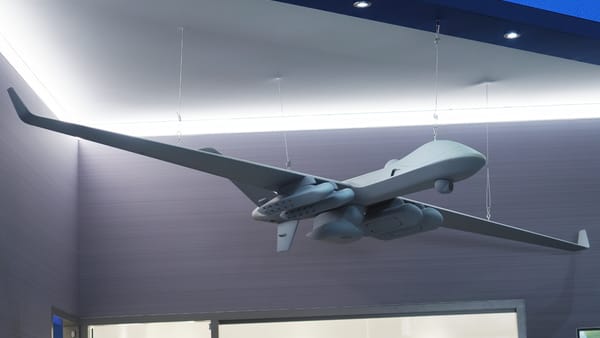
It’s one of the most-impressive weapons in the entire British and French arsenals.
A long-range, air-launched attack missile, the Storm Shadow — known in France as SCALP — is designed for taking out reinforced targets. Topped with a two-stage warhead that first breaks into a bunker and then detonates, it can unleash death and destruction from over 250 km away. Used offensively in Iraq, Libya, Syria, and Yemen, it has a track record that would make most other munitions envious.
Yet while Storm Shadow has been deployed in countless conflicts, it’s not because of its usage in the Middle East that most people have heard of it.
Rather, it’s because of its recent successes on the battlefields of Ukraine.
Sent to Kyiv by Britain and France in mid-May 2023, Storm Shadow is the most-significant weapon donated since the first HIMARS arrived last summer. Already credited with taking out command posts, it has also brought swathes of Russian and Russian-occupied territories within Ukrainian range… potentially altering the course of the war.
In this article, we’re investigating the history and engineering of Storm Shadow — as well as its current role giving the Russian MOD nightmares.
Killing From a Distance
If you’re a modern army with an interest in blowing up some remote enemy command post, you might just find yourself turning to the Storm Shadow.
Known in military parlance as a “long-range, air-launched, stand-off attack missile,” Storm Shadow is today a set piece weapon in the arsenals of both the British RAF and French Armée de l’air. But it also shows up in the stockpiles of other nations.
In the Middle East, Qatar, UAE, Saudi Arabia, and Egypt all field Storm Shadows. In Europe, it can be found in the militaries of Italy, Greece, and — since this spring — Ukraine.
Even distant India possesses the missile. A missile that’s compatible with all sorts of fighter jets.
According to Air Force Technology, Storm Shadow can be:
“Integrated into Tornado GR4, Tornado IDS, Saab Gripen, Mirage 2000, Rafale, Eurofighter Typhoon and F-35 Joint Strike Fighter (JSF) aircraft.”
On top of that, Ukraine recently modified their Su-24 Fencer jet fighters to likewise carry it in their battle against Putin’s genocidal regime.
So, given it’s so prevalent in some parts of the world, now might be a good time to pivot to a fundamental — if simple — question.
What, exactly, is it?
The work of European defense conglomerate MBDA Systems, Storm Shadow is a 5.1 m long missile designed to travel far, travel fast, and avoid detection and interception by enemy defenses.
Equipped with a Turbomeca Microturbo TRI 60-30 turbojet engine, it can reach a blistering Mach 0.8. Or what us non-specialists would call either 987 km/h or just “really bloody fast”.
At these speeds, the missile can travel over 250 km — homing in on a target with deadly, near-unstoppable efficiency.
That efficiency is one of the key reasons so many countries pay big bucks to get their hands on it. And we really mean big: a single munition costs an eye watering £790,000. At time of writing, that’s equivalent to just under a million dollars.
So, yeah. Sadly out the price range of any readers hoping to fix one to their model airplane and terrorize the neighbors.
But for anyone with the money and military structures to afford it, it’s worth the outlay.
When fired, the Storm Shadow dives toward the Earth — hugging the terrain as it zips along at such a low altitude that it’s a nightmare to detect.
The path it takes is pre-programed, as are the details of the target it’s after. That means pilots can just fire and forget, leaving the onboard advanced navigation system to do all the work.
Those pilots can also be certain that it’s not going to accidentally smash into a civilian structure. According to manufacturer MBDA, an onboard system repeatedly checks the upcoming target against preloaded images, to make sure it’s hitting the right building.
And what a variety of buildings it’s designed to hit.
Unlike some advanced missiles, Storm Shadows are not intended for moving targets. Instead, they’re meant to be used to destroy valuable, stationary things like airbases, ports, or reinforced command centers.
That last one explains a crucial part of the warhead’s design.
Operating on a two-stage principle, the warhead is intended to go smashing through meters of concrete or layers of rock — its first stage burrowing deep into solid targets.
That done, the second stage then deploys, and does what an expensive missile is meant to do. It detonates. And, with a launch weight of 1,300 kg, there’s enough explosive material for one hell of a bang.
In most cases, that explosion will be the first anyone knows about the attack.
By all accounts, Storm Shadow is a stealthy weapon, one designed to avoid detection. It can be deployed in even the foulest weather to cover up its approach.
The impact this is having on the war in Ukraine is something we’ll be discussing shortly. But first, time for a quick detour. One that will take us back to the birth of this deadliest of missiles.
A detour into the history of Storm Shadow.
Birth of a Weapon
The first recorded use of a Storm Shadow in combat came way back in 2003, during the Invasion of Iraq.
As one of only three nations to join the USA from the beginning of its Middle Eastern adventure, the UK was deeply involved in the initial phases of the conflict. Some 45,000 British servicemembers were deployed — the largest since the 1991 Gulf War.
That meant the British military wanted to be equipped with the latest technology. And so it was that Storm Shadow wound up entering service ahead of schedule. Announcing its arrival to the world by being fired from an RAF Tornado GR4 during the fighting.
Yet while this would be the first confirmed combat use of a Storm Shadow, it wasn’t the start of the missile’s story.
No, to truly understand the history, we need to go back to before attacking Iraq was even a creepy gleam in George W. Bush’s eye.
All the way back to 1997, when the UK MoD and France’s Direction Générale de l’Armement both awarded huge grants to a fancy new conglomerate known as Matra BAe Dynamics.
Formed by a merger of missile manufacturers in both nations just the year before, the firm was supposed to herald a new era of Franco-British military cooperation. But it wouldn’t be just Paris and London that wound up being involved.
Just after the turn of the millennium, the company likewise merged with Italy’s main missile builder. A few years later, Germany’s LFK would also be brought in.
The result was that, by the time Storm Shadow was seriously under development, three major European capitals had a vested interest in MDBA producing something spectacular. More, if you include the monetary investment Greece had fronted.
Remember, this was the era of European harmony, when Britain was still a paid-up member of the EU. Creating a cross-border manufacturer that could turn out high-end weapons was in everyone’s interest.
On this score, MDBA would certainly deliver.
By 2004, both the UK and France were equipped with the missile. Although, in Paris’s case, it would take a lot longer before it was used in combat.
It wasn’t until the 2011 Air Campaign in Libya that a French fighter jet deployed a Storm Shadow — known in Paris as a SCALP — during offensive operations.
By then, the weapon was well on its way to making its presence felt across the world.
Along with Iraq and Libya, Storm Shadows would soon also used in Syria and Yemen.
In the first case, they came courtesy of coalition airstrikes against government targets that had unleashed a chemical weapons attack. In the second, they were fired by Saudi fighter jets during their notorious air campaign against Yemeni rebels.
Come the end of the 2010s, then, the Storm Shadow was a battle-tested weapon that had been used across the Middle East.
It had even led to a spin-off ship-launched version used by the French Navy, known as the Scalp Navale.
Yet for all its undoubted successes, not everything was plain sailing.
In the UK, the retirement of the RAF Tornado in favor of Typhoons had created an expensive headache, as the military was forced to modify the new jets to allow them to keep using Storm Shadows.
Known as Centurion, the program ran from 2018. But it wouldn’t be until 2021 that an RAF Typhoon finally fired one in a combat situation — using the missile to penetrate a cave system used by ISIS in Iraq.
As the new decade dawned, the Storm Shadow was in a good place. A combat-tested missile, recently modified to remain relevant until 2030, that was still being used in major missions. Not exactly the stuff of global fame, but well-known enough by military geeks.
However, something was about to happen that would change all that. That would turn the Storm Shadow from an obscure — if powerful — piece of kit, into something known across the Western world.
We’re talking, of course, about the Ukraine War.
Missiles Over Ukraine
It seems weird now to look back on the earliest days of the Ukraine War, and realize just how terrified Western nations were of provoking Russia.
Back then, the idea that NATO countries would send Kyiv multiple rocket launchers, or main battle tanks, or air defense batteries seemed as incomprehensible as Klingon poetry. Famously, Germany’s then-defense minister, Christine Lambrecht, balked at donating anything beyond 5,000 helmets.
Well, all we can say is: what a difference a year makes.
While Western nations may have been wary about sending advanced weapons in spring 2022; come spring 2023, the UK felt able to send one of its best long-range missiles.
The introduction of Storm Shadow to the Ukraine War came on May 11, when Defense Minister Ben Wallace announced before Parliament that missiles from the UK’s stockpile of 800 would be shipped immediately.
Just days later, France joined in, pledging to send additional SCALP versions.
While the Kremlin did its usual huffing and puffing and threatening Britain with nuclear war, Ben Wallace was quick to turn the blame back on Putin, saying:
“We will simply not stand by as Russia kills civilians (…) Russia must recognize that its actions alone have led to such systems being provided to Ukraine.”
If you’re struggling to work out why Moscow might be so paranoid about small quantities of a single missile, you need to remember what happened last time a long-range Western weapon was introduced into the conflict.
The crib sheet answer? The Russians were absolutely hammered by it.
Back in summer of 2022, the Russian army had gotten over its initial run of embarrassing defeats outside Kyiv and settled into a new groove. Instead of a lightning-fast strike with elite units, it was using artillery barrages to slowly grind forward in the Donbas, destroying everything in its path.
With way more ammunition and ranged guns than Kyiv, this suited Russia just fine. Indeed, it was beginning to look like the Kremlin had the upper hand.
But then HIMARS arrived on the scene, and all of Putin’s plans went to hell.
Multiple rocket launchers with ranges of 80km, HIMARS could hit targets way behind the Russian front lines. Which they duly did: destroying command posts, blowing up depots and smashing supply lines with gusto.
So chaotic was that summer for Russian logistics that it’s been credited with helping Ukraine liberate Kherson in the fall.
Sadly, though, it couldn’t last. As think tank RUSI has documented, the Russians eventually got their act together and moved their main logistics hubs some 120 km from the front, out of reach of HIMARS. They also adapted their air defense to intercepting the incoming missiles.
With a range of over 250 km, though, the Ukrainian hope is that Storm Shadows can repeat in 2023 what HIMARS did so well in 2022.
That means hitting Russian ammo dumps and fuel depots far, far behind the front lines. It means blowing up command posts and killing officers who can’t even remotely be said to be “in the field”.
It even means being able to hit occupied territories… including Crimea.
Of course, there are differences. For one thing, Ukraine had a relatively decent supply of missiles for HIMARS, while it’s thought their Storm Shadow and SCALP stockpiles are relatively small.
That means it’s unlikely we’ll see total chaos in the Russian forces over this summer. Rather, we’re more likely to see surgical strikes on a few high-value targets.
Still, the actual military impact may come second to the psychological one.
As RUSI likewise pointed out, just knowing Ukraine has access to Storm Shadows makes Russia’s life a misery. Logistics hubs will have to be dispersed to avoid becoming targets. Air defense crews will have to choose whether to continue monitoring for HIMARS, or adjust their priorities for the new missiles. Russian commanders will become ever-more scared of approaching the front.
For the Ukrainian Air Force, that additional range also makes their jobs safer. No longer will they have to brave regions covered by Russian air defenses to fire off a shot.
Still, as Ben Wallace told the UK media, Storm Shadows — for all their advantages — aren’t a superweapon.
Moscow’s Kalibr cruise missiles — for example — have a much longer range: 2,000 km, compared to Storm Shadow’s 250 km.
And Putin is free to fire those Kalibrs at Ukrainian territory! As part of the deal to get the missiles, Ukraine’s leadership had to agree not to deploy them against targets inside Russia.
The final issue is the limited number of craft Ukraine has that are capable of carrying them.
MiG-29 Fulcrums and Su-25 Frogfoots can only carry 500 kg payloads. With one Storm Shadow weighing almost three times that much, it means only a fraction of Ukraine’s Air Force can even deploy them.
Despite all this, at time of writing Storm Shadows had already been fired multiple times over contested territory. At least one Russia military headquarters has been blown up in Berdyansk, while logistics hubs in Donbas seem to have been bombed.
Whether Storm Shadow lives up to the hype as Kyiv’s counteroffensive unfolds is something we’ll have to wait and see.
But we don’t want to end this article talking about the present. About wars underway right now.
Time to instead turn our gaze towards the future. Towards the next decade, when Britain and France are due to replace their Storm Shadow and SCALP stockpiles.
The question then, is: what comes next?
Weapon of the Future
Although it looks like an acronym used in the early days of texting, FC/ASW is — in reality — nothing less than the future of defense technology in France and Britain.
Standing for “Future Cruise/Anti-Ship Weapon” (or futur missile anti-navire/futur missile de croisière if you’re feeling suitably Gallic), FC/ASW is intended to replace Storm Shadow in 2030. A way of making sure the British and French militaries stay relevant in a changing world.
The fact the two are working so closely together on the project is thanks entirely to the Lancaster House Treaties.
Signed back in 2010, the two treaties were effectively the Franco-British way of looking at the accelerating military might of nations like China and going “yeah, we’re probably not gonna be able to handle this individually, are we?”
A huge pooling of resources and capabilities, the treaties turned both militaries into one another’s biggest partners. A partnership that even managed to survive the fractious divorce known as Brexit.
And good thing it did because the FC/ASW is gonna take years to complete!
Work officially began in 2017, with the launching of a joint program to replace not just Storm Shadow and SCALP, but also the air and ship launched Exocet, and the Harpoon anti-ship missiles.
At time of writing — six years down the line — FC/ASW is still only about halfway through the Concept Phase. And that means there’s still plenty of speculation among those of us without security clearances about what it will eventually look like.
We know that, like Storm Shadow, it will be manufactured by MBDA Systems. We know, too, that Rolls Royce and Safran Power Units have recently joined the project.
But the actual specifics remain shrouded in mystery. Including as to whether it will be a hypersonic missile or not.
The general assumption seems to be that it will be another sub-sonic stealth missile like Storm Shadow. But it’s not certain, especially with the UK recently making a lot of noise about wanting hypersonic capabilities.
Realistically, though, any hypersonic missile is likely to be a separate development to FC/ASW. At least, we hope so: because there’s definitely room in the Franco-British arsenals for both types. Especially after Russian hypersonic missiles have underwhelmed in the Ukraine War.
Still, whatever the FC/ASW winds up being, it’ll be interesting to see if its legacy can ultimately compete with that of Storm Shadow.
In this one missile, Britain and France managed to find themselves in possession of a quietly iconic weapon. One that is now being used to great effect in Ukraine.
To be honest, it’s still too early to tell if it will grip the public imagination the same way HIMARS, or the Javelin, or the TB2 drone did. Perhaps the era of ordinary Ukrainians writing folk songs about, and painting murals dedicated to the most-effective Western weapons is over. It may be that, in a year or two, even the most clued-in Ukrainians outside the military will say “Storm What?”
Nonetheless, this is a weapon that — right now — has a chance to make a difference. To help Ukraine push Russia back beyond its borders. To level a playing field Vladimir Putin has sought to unfairly tilt in his direction.
We can only hope it’s a role that the Storm Shadow missile succeeds in playing.
Key Takeaways
- Storm Shadow is a long-range, air-launched missile designed for destroying reinforced targets.
- The missile has been used in conflicts in Iraq, Libya, Syria, and Yemen.
- Ukraine received Storm Shadow missiles from Britain and France in mid-May 2023.
- Storm Shadow can travel over 250 km and is designed to avoid detection and interception.
- The missile’s two-stage warhead is designed to penetrate and then detonate within reinforced structures.

Simon Whistler
Simon Whistler hosts MegaProjects, bringing engineering, infrastructure, and military-machine stories into clear narrative focus for viewers who want the systems, tradeoffs, and human decisions behind the build.
Frequently Asked Questions
What is the Storm Shadow missile?
The Storm Shadow is a long-range, air-launched, stand-off attack missile designed to take out reinforced targets from over 250 km away. It is equipped with a two-stage warhead and is known for its stealth and precision.
Which countries use the Storm Shadow missile?
The Storm Shadow missile is used by the British RAF and French Armée de l’air, as well as the militaries of Qatar, UAE, Saudi Arabia, Egypt, Italy, Greece, Ukraine, and India.
What is the cost of a single Storm Shadow missile?
A single Storm Shadow missile costs approximately £790,000, which is equivalent to just under a million dollars.
What types of aircraft can launch the Storm Shadow missile?
The Storm Shadow missile can be integrated into Tornado GR4, Tornado IDS, Saab Gripen, Mirage 2000, Rafale, Eurofighter Typhoon, and F-35 Joint Strike Fighter aircraft. Ukraine has also modified their Su-24 Fencer jet fighters to carry it.
What is the history of the Storm Shadow missile?
The Storm Shadow missile was first used in combat during the Invasion of Iraq in 2003. It was developed by MBDA Systems, a European defense conglomerate, with significant contributions from the UK, France, Italy, and Greece. It has since been used in conflicts in Libya, Syria, and Yemen.
How does the Storm Shadow missile avoid detection?
The Storm Shadow missile dives toward the Earth and hugs the terrain at a low altitude, making it difficult to detect. It also operates in various weather conditions to cover up its approach.
What is the role of the Storm Shadow missile in the Ukraine War?
The Storm Shadow missile has been supplied to Ukraine by Britain and France and has been used to target Russian command posts and logistics hubs. It is seen as a significant weapon that could alter the course of the war by bringing Russian and Russian-occupied territories within Ukrainian range.
What is the FC/ASW missile?
The FC/ASW (Future Cruise/Anti-Ship Weapon) is intended to replace the Storm Shadow and SCALP missiles in 2030. It is a joint project between Britain and France, aimed at maintaining their military relevance in a changing world.
What are the limitations of the Storm Shadow missile in the Ukraine War?
The Storm Shadow missile has a limited range compared to Russian Kalibr cruise missiles and can only be carried by a fraction of Ukraine’s Air Force. Additionally, Ukraine has agreed not to deploy them against targets inside Russia.
What is the significance of the Storm Shadow missile’s two-stage warhead?
The two-stage warhead of the Storm Shadow missile is designed to first break through reinforced targets like bunkers and then detonate, maximizing its destructive power against stationary, high-value targets.
Sources
- Original MegaProjects video: Storm Shadow: Ukraine’s Deadly New Cruise Missile
- https://www.airforce-technology.com/projects/storm-shadow-missile/
- https://rusi.org/explore-our-research/publications/commentary/putting-russias-army-shadow-storm
- https://www.thedrive.com/the-war-zone/39792/british-typhoons-have-used-storm-shadow-cruise-missiles-for-the-first-time-in-combat
- https://www.thedrive.com/the-war-zone/ukraines-storm-shadow-missiles-are-a-big-problem-for-russia
- https://www.mbda-systems.com/product/storm-shadow-scalp/
- https://www.bbc.com/news/world-europe-65813770
- https://www.thinkdefence.co.uk/2022/11/storm-shadow/
- https://www.navalnews.com/naval-news/2022/02/future-cruise-and-anti-ship-weapon-fc-asw-program-reaches-new-milestone/
- https://wavellroom.com/2022/09/20/high-time-for-hypersonic-missiles-the-challenges-of-fielding-hypersonic-weapons-for-uk-defence/
- Hero image source by U.S. Secretary of Defense / openverse, by.