
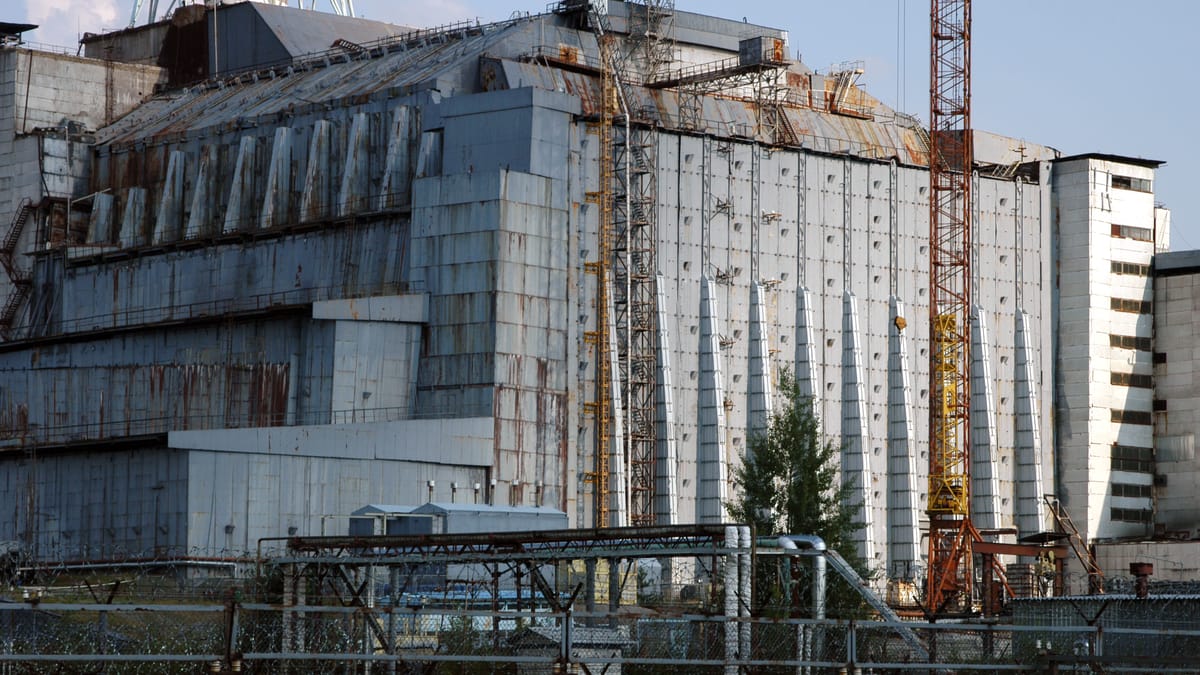
At 1:23 and 48 seconds exactly on the 26th of April 1986, Reactor Number 4 at the Chernobyl Nuclear Power Plant in the Ukrainian SSR of the Soviet Union exploded, and then, two to three seconds later, it exploded again; the single greatest nuclear disaster in human history had begun.
At the centre of it all was a single, now battered and mangled RBMK Reactor; a device that had previously been lauded and celebrated as a monument to both socialist construction generally, and the advanced glories of Soviet industry specifically, thanks to its ability to provide cheap and clean energy to countless amounts of people. Now, however, it was but an obelisk to its blind naivety; one that was billowing radioactive material right up into the atmosphere, and foreboded abject disaster if the situation wasn’t brought under control and contained, both literally and figuratively, with all possible haste.
And it is the RBMK Reactor itself that we are going to be taking a look at today. The disaster more broadly has been discussed many, MANY times before us, so there’s no sense in retreading that stagnant water, but the reactor itself, and its bungled design that directly led to the disaster, THAT is something that is direly under appreciated… so… let’s begin!
Basic Principles of Nuclear Reactors
Before we get into the ‘meat’ of the video, as it were, it is worth us taking the time to get our heads around how nuclear reactors ACTUALLY work. Partly, this is because it’ll be a useful grounding for the rest of the video, but it’s also just due to the fact that such things are interesting; and if you’ve found yourself on this channel, we’re happy to assume that machines of all stripes, particularly the big and powerful ones, are right up your street.
And let us begin the explanation with the basics, that being that nuclear reactors produce energy via the process of splitting atomic nuclei, a naturally occurring phenomenon dubbed ‘nuclear fission.’ In man-made environments, this naturally occurring process can be concentrated and made controllable, where it then produces an IMMENSE heat, which is used to boil water, creating steam, which is then used to spin turbines attached to whopping great generators, and there you have it – electricity.
It really is a remarkably simple process at its core, the real challenge in it all comes from allowing nuclear fission, and the subsequent production of electricity, to happen efficiently, and above all else, SAFELY.
Now, to go into a bit more depth, so we can show you what we mean about the challenges, nuclear reactors operate by initiating and maintaining a so called ‘sustained chain reaction,’ i.e. a continuous series of nuclear fission events where each reaction produces enough neutrons to maintain the process at a steady rate; giving you a constant flow of heat, therefore steam, therefore electricity – happy days!
As for what that ‘fission event’ that actually splits the fissile atoms is, it’s a simple collision, specifically a collision between neutrons, and the nuclei of fissile atoms such as Uranium-235. ‘235’ in this instance refers to the mass number of the Uranium, which is the total number of protons and neutrons in its nucleus (92 protons and 143 neutrons), other sorts of Uranium, such as 238, which has 92 protons and 146 neutrons making up its mass number, are NOT fissile. As for why, to simply it QUITE a bit; Uranium is quite happy and content with 146 neutrons, and very unhappy with 143 of them, and so it becomes ‘unstable,’ and is more susceptible to having its bonds messed about with – as it wants to get to its happy place.
A fission event, as you may have already deduced, also releases a LOT of energy, with the energy released from but a single gram of Uranium-235 going through fission being equivalent to the energy that released by burning three tons of coal. Primarily, this energy comes in the form of kinetic energy, which keeps the atoms moving, and enables that ‘sustained chain reaction,’ and heat, which is then harnessed to boil the water, and generate electricity.
A question, though. Because if you have a whole load of fissile material inside of a reactor, bouncing about the gaff and having a grand old time of it splitting away, what stops the total reaction rate just exponentially growing, to both literally and figuratively explode?
Well, if just left to do its thing, absolutely nothing at all is the answer to that, and so, if left to its own devices, that is exactly what a nuclear reactor will do: it’ll just keep going and going and going, and then, BANG, once the reactor can no longer contain the pressure.
As a result, you need systems and mechanisms in place that allow to you calm down the reaction rate and keep it at a nice balance point between producing plenty of heat, but not so much that it gets out of hand and becomes dangerous.
This is done through the use of ‘Coolants’ and ‘Moderators.’ A coolant is exactly what it sounds like; something that is pumped into the reactor to absorb the heat of the fissile events. Usually, it will be water or gas which is used for this purpose, which also in turn then goes on power the turbines when heated up.
Moderators, on the other hand, directly disrupt the rate of fissile events in the reactor, and calm things down that way. They also can be the same substance as used as a coolant, with water, for example, also being used in this way, because whereas it will absorb heat, it will also slow down the neutrons produced during fission.
Then there’s various mechanisms that can be used to slow down the rate of reaction; chief among which are the ‘control rods.’ Composed of materials like boron or cadmium, these rods absorb excess neutrons, which would otherwise be off on their way to produce more fissile events, and thus allow operators to regulate the reaction rate. This REALLY do work a treat too, as during the Three Mile Island incident, for examples, the rapid insertion of all control rods completely halted the nuclear chain reaction; preventing a catastrophic meltdown despite the fact the reactor had lost the bulk of its coolant and moderators.
Do remember control rods specifically too, as they’ll become VERY important in the Chernobyl story later on.
It’s also worth noting that different reactor types have evolved differently to optimise the balance between safety, efficiency, and economic viability, as their creators see it. This has led to the creation of two dominate reactor types, ‘Pressurised Water Reactors,’ or PWRs, and ‘Boiling Water Reactors,’ or BWRs. The former uses high-pressure water to transfer heat to a secondary loop for steam generation, while the latter generates steam directly within the reactor vessel to drive turbines.
Don’t stress too much about the technical nitty gritty of those types, however, as what we REALLY want you to take away is the fact that they are the dominate types today, and the RBMK reactor is NEITHER type. It instead is its own unique thing, that uses graphite as a moderator and water as a coolant, and also makes use of individual pressure tubes for each fuel assembly.
That last detail in particular is an interesting one. For starters, it’s why RBMK reactors look so weird as compared to other types, with the hundreds of squares arranged in a big circle – each one of them is a fuel assembly, but its also interesting as a choice that reflects THE issue with the RBMK: cost cutting.
You see, while such a design does have legitimate advantages; such as being able to refuel while the reactor is in operation by just popping those fuel assemblies out and quickly sticking a new one back in, in reality the major advantage was cost saving, as such a design allowed the Soviet Union to avoid having to manufacture a single, robust, and enormous pressure vessel for each of its reactors; something that was both expensive, and very, VERY difficult given the state of Soviet Industry.
And if you think the lack of a pressure vessel is bad given, you know, explosions and all that, well then that’s nothing compared to the fact that the RBMK worked using something called a ‘positive void co-efficient.’ More generally, a ‘void co-efficient’ when it comes to nuclear reactors, refers to how the reactor’s reactivity changes when steam bubbles, ‘voids,’ replace liquid coolant in the reactor core.
A positive one of those, as in an RBMK, means that as steam bubbles form in the coolant, the reactor’s reactivity increases instead of decreasing; literally ‘positive,’ ‘plus,’ ‘more’ – goes up! This occurs because steam absorbs fewer neutrons than liquid water, allowing more neutrons to sustain the fission chain reaction, which can lead to a dangerous feedback loop of rising power and temperature.
In contrast, a negative void coefficient, as you find in both PWR and BWR reactors, works in the opposite way: as steam bubbles form, the reactor’s reactivity decreases. This happens because the reduced density of the coolant absorbs fewer neutrons, but instead of increasing reactivity, the slowed reaction rate stabilizes the system. This negative feedback loop acts as a natural safety mechanism, preventing the reactor from overheating and helping to maintain steady operating conditions even during power fluctuations.
A positive void coefficient, naturally, is not ideal. Think of it almost like air brakes on a railway locomotive; in the same way that we have figured out that having air brakes which are applied by default, and lifted off by air pressure, and so will slam themselves back on if anything goes awry, is far safer than having brakes which are unapplied by default, and so risk being locked in the ‘open’ position during operation, a nuclear reactor with a negative void co-efficient, that naturally wants to reduce its reactivity as steam is generated, and requires a bit of titivation to keep reactivity up, is FAR safer than one which naturally wants to rise, and requires titivation to push it down instead: far better to have a cold reactor in the event of a whoopsie daisy than a blown up one.
Normally, however, a positive void co-efficient is something you can work with, and it’s no major issue. But if, say, you find yourself in a situation that is getting a bit bum squeaky, and your immediate priority is killing reactivity for the sake of safety, due you think the whole ‘initial spike in reactivity when you add more coolant’ thing might just come back to bite you on the arse a bit?
It certainly did at Chernobyl, that’s for sure, as we are slowly reaching towards explaining.
The Specifics of the RBMK
Now, where were we? Ahh yes, that was it, the RBMK being a corner cut heap of junk.
And let’s continue the explanation by coming back to control rods. Because, given that they are designed to not just keep the reactivity manageable, but also be the last line of defence against disaster, by being able to all just be slammed in on a oner and kill the reaction dead… how big of a tit do you suppose you’d have to be to tip your control roads with a material that INCREASED reactivity?
Well, in the case of the Kurchatov Institute of Atomic Energy, the designers of the RBMK, the answer to that question would be a pair of giant, bouncing, swinging down to the knees double-z’s, because that’s exactly what they chose to do; with the control rods being mostly boron carbide, with just a little smidge of graphite on the end.
Amusing anecdotes aside, however, and in contrary to what a certain 2019 telly show would have you believe, the control rods were NOT graphite tipped to save on cost, and instead, they were designed that way to enhance ‘neutron economy,’ i.e. the efficient use of neutrons to sustain a controlled chain reaction by maximizing fission events while minimizing losses through absorption or leakage, and graphite, being an excellent neutron moderator, slows down fast neutrons into thermal neutrons that are more likely to sustain the nuclear fission process. When the graphite tips were inserted into the reactor, they displaced neutron-absorbing water in the control rod channels, momentarily increasing reactivity by boosting the local neutron flux.
This design choice was made to improve reactor efficiency and operational flexibility, especially at low power levels; essentially, you could tease the reactor with ‘just the tip’ of the control rods to keep its reactivity up, and if you wanted to kill reactivity, you could just push through that spike, and which point the boron carbide would start doing its thing, and reduce reactivity FAR more than the graphite was increasing it.
And if you’re wondering what that little spike of reactivity from the tip of the rods would to a RBMK that was right on the brink of going bang, if you were to say, slam all the control rods in to initiate an emergency SCRAM shutdown and kill the reactivity, just like they did at Three Mile Island; hold that thought – because yes, you have seen EXACTLY where this is going.
There’s A LOT more we could talk about, as the RBMK was just full of unnecessary cost cutting measures, such as the lack of pressurised containment vessel, and weird little design quirks, such as the graphite tipped control rods, but as our main goal here is to just give you a detailed enough understanding of both nuclear reactors generally, and the RBMK specifically, so that you can have a quality idea of what went down back in 1986… we’ll leave it there.
And that means we can get onto THE main event of the story…
The Chernobyl Disaster
The sequence of events that led to disaster began with preparations for a planned safety test designed to evaluate the reactor’s ability to maintain cooling during a power loss; in short, using the energy present in an already spinning turbine to keep the reactor’s coolant pumps going during the minute or so it took for a set of emergency diesel generators to kick in and take over.
This test required the reactor to operate at a reduced power level. However, RBMK reactors, as explained earlier, were highly unstable under low-power conditions due to their positive void coefficient. Despite this known risk, plant operators faced significant pressure to complete the test, leading to the circumvention of key safety protocols. Automatic shutdown systems were disabled, and the emergency core cooling system was overridden, removing critical safety layers.
At midnight, operators attempted to lower the reactor’s power output, but a procedural misstep caused the power level to plummet to near-zero. In response, nearly all control rods were manually withdrawn to restore power—an action that drastically reduced the reactor’s safety margin. By 1:23 a.m., the reactor was in an extremely precarious state, with minimal coolant flow, a dangerously high positive void coefficient, and almost no control rods in place.
The test commenced, triggering a chain of events that quickly spiralled out of control. As the turbine slowed, the coolant flow decreased, and steam began to form within the reactor channels. Due to the RBMK’s positive void coefficient, the formation of steam caused a rapid increase in reactivity. This feedback loop escalated the reactor’s power output, pushing it far beyond safe operating limits.
The operators activated the AZ-5 button to initiate an emergency SCRAM shutdown, inserting all control rods simultaneously.
However, as detailed earlier, the control rods’ graphite tips temporarily increased reactivity upon insertion. This design flaw caused a sudden and catastrophic power surge. Within three seconds, the reactor’s output skyrocketed to an estimated 10 times its maximum capacity. The intense heat generated during this surge caused the fuel rods to rupture and the reactor’s pressure tubes to burst.
The resulting steam explosion destroyed the reactor core and blew the 1,000-ton upper biological shield into the air – straight up and out of the reactor building via the roof.
The explosion exposed the graphite moderator to the atmosphere, igniting fires that further spread radioactive material. A secondary hydrogen explosion, caused by a zirconium-water reaction, compounded the devastation. The initial blast and subsequent fires released a massive plume of radioactive isotopes, including iodine-131, cesium-137, and strontium-90, into the atmosphere.
Emergency responders arrived quickly but were ill-equipped for the scale of the disaster. Many were unaware of the radiation levels they faced and worked without adequate protection. Their efforts to extinguish the fires and stabilize the site were heroic but came at a great cost. Dozens of first responders succumbed to acute radiation sickness within days, and many more suffered long-term health consequences.
And Yet, it Could Have Been Worse
Estimates of the death toll from Chernobyl vary widely. The International Energy Agency, for example, reports that there were approximately 30 immediate deaths among plant workers and first responders, immediate in this instance being defined as death within a week or so, for radiation exposure on the night of the explosion, with a further 30 or so being added for deaths caused by radiation exposure among those groups immediately after the blast, but that took longer to claim their victims.
This is roughly in line with the Soviet Union’s official stance, which right up until its collapse maintained that ‘only’ 31 people were directly killed by the disaster; all of them being plant workers and first responders.
Both figures, however, mask an unpleasant reality; that being that the true death toll is much, MUCH higher. So high in fact, that if we apply a lens of ‘lives shortened because of the disaster’ to get a more accurate picture, that initial figure of 30-60 or so LEAPS, with the United Nations placing the figure at 4,000, and Green Peace and the book Chernobyl: Consequences of the Catastrophe for People and the Environment placing the figure at up to 200,000 and 985,000 respectively.
This huge variation in total predicted death toll is rooted in the simple fact that linking specific cancer cases directly to the disaster remains VERY challenging due to a plethora of difficult to gauge factors such as general background radiation exposure, genetic predispositions, and variations in data collection methodologies across different regions, and all of that’s before you get to the matter of the latency period of radiation-induced cancers, as cases may emerge years of even decades after initial exposure.
But while we know for certain that the REAL figure is far higher than it initially appears, whatever it may actually be, the truly mind-boggling thing about the death is that even despite the inflated true figure, things could have easily been way, WAY worse, had the disaster played out differently.
Among the chilling possibilities was the risk of a second explosion, one that would have been inconceivably more devastating than the one we did get. You see, after the first explosion ruptured the reactor core, intense heat from the molten fuel rods began melting through the reactor’s base, and beneath the reactor lay a large water reservoir, part of the emergency cooling system.
Had the molten core material, or ‘corium’ as it is known, reached this water, a massive steam explosion could have ensued. According to physicist Valery Legasov, such a secondary explosion could have had a yield of 3 to 5 MEGATONS of TNT equivalent; for reference, an American W87 warhead, as used in the LGM-30 Minuteman ICBM, has a maximum yield of ‘only’ 475 kilotons…
Using ‘Nukemap’ as our reference, as their maths is actually VERY well done, such a blast, at its maximum predicted yield of 5 megatons at ground level, would have a fireball big enough to completely burn the towns of Pripyat and Chernobyl off of the map, killing every single one of the 63,000 people who lived in the two cities instantly.
Then there’s the matter of radiation, as not only would nearly ALL the radioactive materials of Reactor 4 be thrown up into the atmosphere, but so would that of Reactors 1, 2, and 3 – as they would be totally obliterated by the blast. Exact numerical predictions for the total death toll are hard to come by, not least due to the fact that the number of variables at play make it almost a matter of quantum science to even begin trying to figure out; but to give you an idea, Valery Legasov predicted that such an event would render the Western Soviet Union, Eastern Europe, and even select slithers of Central Europe TOTALLY uninhabitable for centuries, as cleanup of the Chernobyl Exclusion Zone was hard enough, and so to do the same for half a continent would be flatly impossible. Of course, those living under the vast cloud of radiation as it settled would too be condemned to death, sooner or later, and that constituted untold MILLIONS of people.
But while that alternative scenario was by far the most terrifying, there were others that still presented the possibility of the disaster being FAR worse. For example, another scenario involved the possibility of widespread ignition of the reactor’s graphite moderator. The initial explosion and subsequent fires exposed portions of the graphite core to the open air, where it could have easily caught fire and spread uncontrollably.
A fully engulfed graphite fire would have dispersed radioactive particles over a far greater area than the actual disaster did, due to the unique thermal and chemical properties of graphite. Graphite, which serves as a neutron moderator in RBMK reactors, is highly combustible when exposed to oxygen at high temperatures, as it can sustain a fire even under low-oxygen conditions. This risk was exacerbated by the intense heat generated during the explosion and subsequent fires, which created an environment where ignition was nearly inevitable.
Once ignited, the burning graphite could have released significant amounts of radioactive isotopes such as cesium-137 and strontium-90, further contaminating the surrounding regions and posing severe long-term health and environmental hazards.
Fortunately, the gallant efforts of the first responders prevented that situation from occurring, but, had they been a bit later in their arrival, or a bit more “f*ck this we’re bailing” when they started tasting metal in the air, this nightmare scenario could well have played out.
Conclusion
In the aftermath of the Chernobyl disaster, sweeping changes were implemented to address the RBMK reactor’s critical design flaws. The most significant modification was the redesign of the control rods to eliminate the graphite tips, ensuring that their insertion would no longer cause a temporary spike in reactivity. Additionally, automatic shutdown mechanisms were improved, and the emergency core cooling systems were upgraded to enhance reactor safety during low-power operations.
Operational protocols also underwent significant revision. A stricter regulatory framework was established, with enhanced oversight to ensure compliance with safety procedures. Training programs for operators were intensified, focusing on the importance of adhering to safety measures and understanding the unique dynamics of RBMK reactors.
Today, seven of the 26 RBMK reactors made are still in operation, but the extensive improvements have mitigated the risks that once made them so dangerous, and so, these reactors are now considered safe, with international nuclear safety bodies acknowledging the effectiveness of the modifications… so no need to worry!
Key Takeaways
- The Chernobyl disaster began with an explosion at Reactor Number 4 on April 26, 1986, due to a flawed RBMK reactor design.
- RBMK reactors use graphite as a moderator and water as a coolant, with individual pressure tubes for each fuel assembly.
- The RBMK’s positive void coefficient and graphite-tipped control rods contributed to the catastrophic power surge during the disaster.
- Emergency responders faced severe radiation exposure, with initial deaths and long-term health consequences.
- Post-disaster modifications have improved RBMK reactor safety, with seven still operational today.

Simon Whistler
Simon Whistler hosts MegaProjects, bringing engineering, infrastructure, and military-machine stories into clear narrative focus for viewers who want the systems, tradeoffs, and human decisions behind the build.
Frequently Asked Questions
What is the RBMK reactor?
The RBMK reactor is a type of nuclear reactor that uses graphite as a moderator and water as a coolant. It is known for its unique design, which includes individual pressure tubes for each fuel assembly, allowing for refueling while the reactor is in operation.
What happened at the Chernobyl Nuclear Power Plant on April 26, 1986?
On April 26, 1986, Reactor Number 4 at the Chernobyl Nuclear Power Plant exploded twice within a few seconds, marking the beginning of the worst nuclear disaster in history. The explosion was caused by a series of events during a safety test, leading to a catastrophic power surge and subsequent explosions.
What is a positive void coefficient?
A positive void coefficient in a nuclear reactor means that as steam bubbles form in the coolant, the reactor’s reactivity increases. This can lead to a dangerous feedback loop of rising power and temperature, making the reactor less stable.
What design flaws contributed to the Chernobyl disaster?
Several design flaws contributed to the Chernobyl disaster, including the use of graphite-tipped control rods that temporarily increased reactivity upon insertion, the lack of a pressurized containment vessel, and the positive void coefficient which made the reactor unstable at low power levels.
What were the immediate deaths attributed to the Chernobyl disaster?
Approximately 30 immediate deaths among plant workers and first responders occurred due to radiation exposure on the night of the explosion, with an additional 30 or so deaths caused by radiation exposure among those groups immediately after the blast but took longer to claim their victims.
What is the estimated long-term death toll from the Chernobyl disaster?
Estimates of the long-term death toll vary widely, with the United Nations placing the figure at 4,000, and Green Peace and the book ‘Chernobyl: Consequences of the Catastrophe for People and the Environment’ placing the figure at up to 200,000 and 985,000 respectively.
What could have made the Chernobyl disaster even worse?
The disaster could have been much worse if a second explosion had occurred, potentially with a yield of 3 to 5 megatons of TNT equivalent, which would have rendered large areas of the Western Soviet Union, Eastern Europe, and parts of Central Europe uninhabitable for centuries.
What changes were made to RBMK reactors after the Chernobyl disaster?
After the Chernobyl disaster, significant modifications were made to RBMK reactors, including the redesign of control rods to eliminate graphite tips, improvements to automatic shutdown mechanisms, and upgrades to emergency core cooling systems. Operational protocols were also revised to enhance safety.
How many RBMK reactors are still in operation today?
As of the information provided, seven of the 26 RBMK reactors made are still in operation. These reactors have undergone extensive improvements to mitigate the risks that once made them dangerous.
What is the role of control rods in a nuclear reactor?
Control rods are used to regulate the rate of nuclear fission in a reactor. They are composed of materials like boron or cadmium, which absorb excess neutrons, allowing operators to control the reaction rate. In an emergency, they can be inserted to halt the nuclear chain reaction.
Sources
- Original MegaProjects video: The RBMK: The Shoddy Nuclear Reactor That Nearly Killed Millions
- Hero image source by IAEA Imagebank / openverse, by-sa.