At some point in our distant past, faced with a snarling predator that intended them harm, one of our ancient ancestors realised that throwing a stone was a far better defensive technique than charging in and going head to head. Thus was born a military technique that’s stuck with us to this day; hurting an adversary from a distance while being out of claw range, thus granting a much better chance of walking away un-mauled. From throwing spears, to bows, to cannons and mortars, global militaries have sunk untold billions into keeping allied soldiers out of range while doing as much damage to the other side as possible.
With that concept in mind let’s take a look at one of, if not the most advanced cruise missile deployment system currently in use: Rapid Dragon. Rapid Dragon is a United States Air Force (USAF) and Lockheed developed cruise missile deployment advancement that is more or less a perfect solution as far as offensive military missile operations are concerned. The impressive system is able to deploy long range, highly accurate cruise missiles in seconds, though not only does Rapid Dragon launch from an airborne platform granting enormous manoeuvrability, it also does so with astounding cost efficiency. Best of all, the risk to the soldiers involved in deployment is remarkably low, more or less giving us the military holy grail: effectiveness, flexibility, safety and cost efficiency. There is, however, one more factor that officially pushes Rapid Dragon over the top and into legendary status.
That ancient ancestor, still faced with a snarling predator, just had another realisation; throwing a handful of stones rather than a single stone greatly increases the chances of at least one projectile finding its target, even if the barrage does come at the cost of overall accuracy. The ancestor perhaps didn’t refer to throwing a handful of stones as a “swarm attack,” but we do today, and it’s a brute force solution that militaries have been relying on for centuries. Today, of course, the situation is somewhat different, but even if we’re talking about a barrage of cruise missiles rather than a hail of arrows, the same basic principle still applies; launch many projectiles, hope that some projectiles do manage to score a hit, and the worst that can happen is a wasted stock of arrows. Cruise missiles are somewhat more expensive than arrows, mind you, at a cost of $1 million a pop, but at least you only have to deal with justifying military costs rather than writing letters to grieving parents.
Rapid Dragon, as well as being efficient, manoeuvrable and safe, is also capable of deploying between 4 and 45 cruise missiles simultaneously. All the missiles will seek out their targets, and all are capable of autonomously traveling nearly 1,000km to find that target. If you’re wondering how Rapid Dragon is capable of this impressive feat, why it launches so many missiles at once, and if it’s the new ultimate answer in all military conflicts going forward; well, that’s exactly why we’re here today.
The Rapid Dragon Reborn
Enormous, ballista-like crossbow carts firing multiple bolts simultaneously are mentioned throughout history. One description from 950CE quoted by a Tao Gu describes:
“They had crossbow catapults such that when one trigger was released, as many as 12 connected triggers would all go off simultaneously. They used large bolts like strings of pearls, and the range was very great. The Jin people were thoroughly frightened by these machines. Literary writers called them Ji Long Che (Rapid Dragon Carts).”
This is where the modern Rapid Dragon cruise missile deployment system gets its name, and, but for a few key words Tao Gu’s description isn’t that far off in either case.
But before we get into exactly how Rapid Dragon works, let’s first get a bit of context. In the grander scheme of military evolution the concept of Rapid Dragon perhaps isn’t as ground-breaking as you might think. The biggest advancement it’s currently providing is in terms of cost above all else, with similar concepts going back as far as the 80s.
In the 80s, when it seemed like the B-1 bomber might be cancelled the Cruise Missile Carrier Aircraft (CMCA) Project was developed, a then fairly revolutionary idea to transform existing Boeing 747-200 cargo planes into rapid deployment missile systems. Should CMCA have been fully developed, 50 to 100 cruise missiles would have been ejected out the side of the plane via a rotary deployment system, with a semi-autonomous, dynamically capable targeting computer feeding coordinates to each missile as needed. The US military ultimately decided to go with the B-1 bomber instead, but this is an example that the concept of autonomous missile swarm attacks goes back at least 40 years.
Later, in 2010 the Air Force Institute of Technology proposed the idea of a palletised missile drop solution; a design far closer to how Rapid Dragon eventually turned out. Notably, in this case the research kicked off due to reports that near-peer adversaries of the United States, those capable of similar or equal military research and development, were exploring area-of-denial tactics specifically designed to counter the US’s projected naval and aerial capabilities. So, the origin of Rapid Dragon itself was a counter to what the US thought its adversaries were developing, demonstrating rather eloquently that military conflict really is just an endless race to counter an enemy’s technology, or even to pre-counter what it’s assumed the enemy is developing.
The 2010 palletised concept was further refined and ultimately gave us the Rapid Dragon deployment system that is in use today. The finished product works as follows; a customisable, disposable “deployment box” or “palette” is loaded into the cargo hold of virtually any unmodified, airdrop capable supply plane, with the common C-130s and C-17s being prime examples.
This flexibility, right off the bat, is enormously beneficial, with militaries around the world far more likely to already be in possession of supply-drop planes as opposed to enormous, specialised bombers like the B-52 Stratofortress. More to the point, a B-52 requires a vast runway of about 3,000m (10,000ft), while a C-130 supply plane can make do with a runway of just 910m (3000ft).
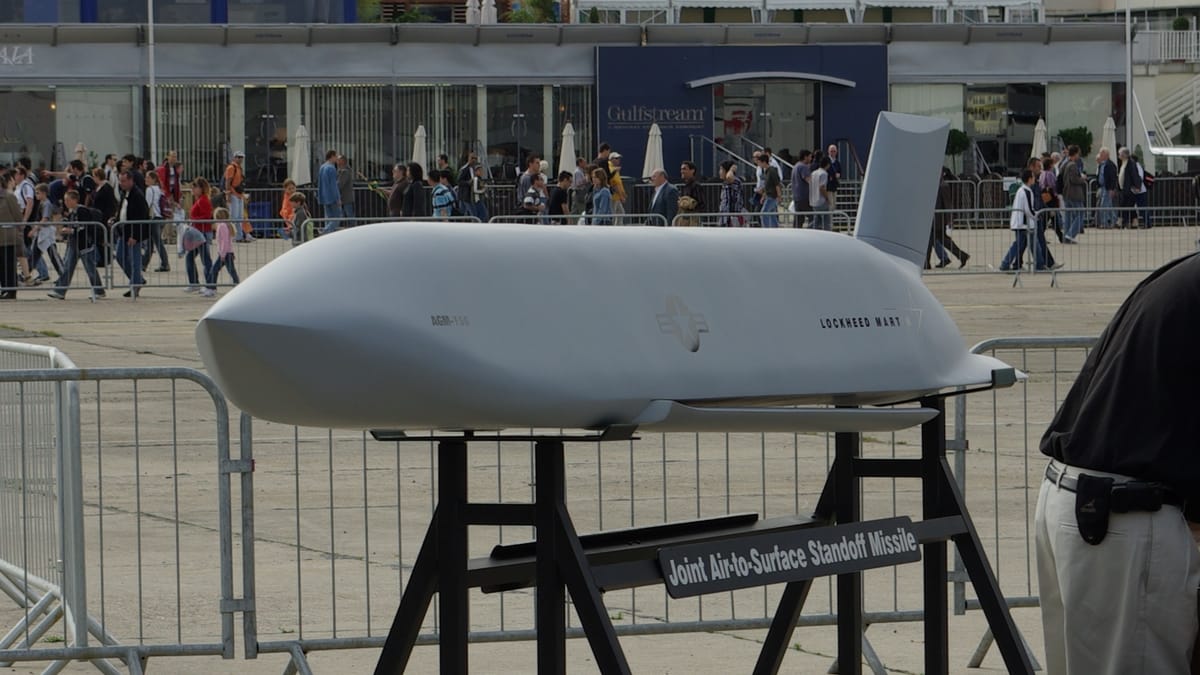
Each Rapid Dragon deployment box, once fitted into the cargo hold of a supply plane, can hold up to 4 cruise missiles, in this case AGM-158B JASSM-ER missiles, Joint Air to Surface Standoff missiles. The ER refers to “extended range,” and “Stand-off” refers to the missile being launched outside the range of enemy counter attacks.
Once airborne the supply plane simply dumps the deployment box as it would any other cargo and flies off to engage in other missions, leaving everything else to the Rapid Dragon. The plane’s crew need not even designate a target as this is done remotely, meaning that only a standard supply-drop mission crew without any additional training is required. The Rapid Dragon disposable deployment box, rather astoundingly, is fully autonomous in virtually all regards; target information is provided to the missiles instantaneously once received, and each missile will ignite to seek out its target upon being deployed.
Plus, you can bet that once arriving at the target the missiles aren’t likely to miss. Or, at least they aren’t likely to miss depending on circumstances, which we’ll get to in a bit.
Looking at the deployment process in more detail, each palette operates via a deceptively simple, yet rather brilliant airborne configuration. First, the palette deploys a parachute which it uses to slow its descent and achieve stability. Once stability is attained, the missiles are released via gravity, thus allowing them to clear the box and ignite their engines. Each missile must then execute a sharp “pull up manoeuvre,” allowing it to level out and reach an appropriate altitude, after which the missile proceeds with its strike mission as any other cruise missile would.
Only, in this case we’re talking about a swarm of cruise missiles ranging between 4 and 45. Additional palettes can be loaded into a cargo plane as the situation and space allows, with the current stated maximum pegged at 45 based on the cargo space available in the larger C-17.
Now, if the thought of 45 cruise missiles heading your way isn’t enough to make you uncomfortable, it’s probably because you aren’t aware of what a cruise missile with a 450kg (1000 pound) warhead is capable of. Each AGM-158B JASSM-ER missile is equipped with a 450kg WDU-42/B penetrator armour piercing warhead, and the best context we can give is that if you think you’re safe in a tank or other armoured vehicle; probably not. You’re not safe short of either not being anywhere near the impact zone, or perhaps being in a well-fortified underground bunker; more on this later as well.
So with all of this being said and sounding very impressive, is Rapid Dragon an ultimate barrage missile attack that simply can’t be defended against?
Pick Your Target and Pray
The short answer is that, yes, missile swarms are incredibly effective, doubly so when they’re coming from an elusive, distant platform such as a mobile aircraft that may attack from an unexpected angle. To get an idea of just how effective a Rapid Dragon swarm attack is, let’s approach it from the position of a defender rather than an attacker.
According to US military doctrine, there are four methods of defending against cruise missile attacks; active defensive measures, attack operations, passive defensive measures, and control, communication, computers and intelligence (C4I).
Active measures and attack operation measures both refer to destroying cruise missiles before they have a chance to impact a target, though each option in a very different way. Starting with the second option, attack operations are the idea that destroying cruise missiles in enemy territory before they launch, or destroying the infrastructure required to launch them, negates the problem entirely. You might suggest that this is the best solution, but it also happens to be extremely difficult to achieve. Not only does it require knowing where the launch sites are in advance, itself a monumental task, it also requires penetrating an appropriate means of attack into enemy territory.
Keep in mind that launch sites may be established relatively quickly, can be hidden in the landscape such as in thick foliage, or may even be left out in the open but be disguised to be undetectable from the air. Take, for example, that in World War 2 allied forces launched a catastrophic, sustained air attack in which 98,000 tons of bombs were dropped in an effort to destroy V-1 missile launch sites. Despite these efforts, using various deceptive means Germany managed to keep V-1 missile sites operational. So consider then how difficult it must be to attempt attack operations against cruise missiles that can be deployed not only from virtually any airstrip, but may also be launched from very common, non-descript supply planes.
Moving on to the second means of defence; active measures. Active measures refers to shooting down a cruise missile while it’s in flight, and as you can imagine shooting down a small, relatively silent missile flying close to the ground is even more challenging than destroying them before they launch. But, it is technically possible depending on a number of factors.
For a cruise missile to be shot down the defender must have an incredibly capable air defence system, one that can detect the incoming missile at as long a range as possible, then rapidly communicate with the appropriate forces with enough time for defensive action to be taken. Just this is challenging and requires advanced, properly calibrated long range radar capability.
Now, as is always the case in warfare, as touched on earlier, when a new threat is introduced to the battlefield an attempt at a counter measure is just as quickly developed, at least it is if the defender wants to maintain some balance of power. Such was the case when long range missiles were introduced in WW2, ultimately giving rise to defensive Surface to Air Missile (SAM) systems. The S-300 and S-400 family of SAM systems are a prime example, developed by Russia over many decades to automatically detect and shoot down incoming missiles and aircraft. This family of technology includes mobile land-based SAM systems, as well as those designed to operate on ships.
So if you had sufficient advanced warning, and assuming you were able to move your vehicle or ship mounted SAM defensive systems into place, would you be able to deal with a Rapid Dragon cruise missile barrage? Sorry to say, but that’s exactly why Rapid Dragon was designed for swarm attacks in the first place. Automated SAM defensive systems are notorious for not only struggling with low flying cruise missiles, able to engage only at short distances, but also for being unable to deal with more than a certain number of targets at once. So chances are you’re not getting all of them even if you do manage to get some, and it’s probably best you move quickly in the direction of an underground bunker.
Alternatively, you can try and shoot down the incoming Rapid Dragon barrage from the air, though, spoiler, you are going to run into the exact same problem. If the missiles are detected at long range and an aircraft with the required look-down/shoot-down radar capability is in the right position, you can attempt to shoot down the incoming missiles. But, once again we’re talking about a barrage, and although you can make an effort to prioritise certain missiles and try to minimise the damage those that do get through inflict, your options ultimately also boil down to ducking, covering, and hoping for the best.
At this point it’s really starting to seem like the Rapid Dragon missile system is an unstoppable game changer. But before you get comfortable with that idea, let’s take a look at the last two defensive solutions.
Can’t Hit What You Can’t See
The last two defensive methods, the ones that the US relies on prominently, also happen to be the most effective, at least right now; passive and C4I. These techniques refer to simply making it as difficult as possible for an enemy to identify a strategic location in the first place, as opposed to the last resort of trying to shoot missiles down. As with Germany in WW2, if there are no visible targets to shoot at you’ve more or less diffused the situation, at least for the time being. Yes, the enemy can endlessly carpet bomb locations they suspect you’re inhabiting, but as we already know from Germany’s success this isn’t particularly effective.
The US boils its passive defensive techniques down to “deceive and disperse,” meaning that military forces are spread out and strategic ground targets are hidden by camouflage and other deceptive means. Most importantly and perhaps most obviously, key military assets are also not all stationed in the same location. So, if one strategic target is discovered and destroyed, the military operation as a whole can still continue on effectively.
It’s a lot more complicated than just this very brief summary, of course, with it being significantly more difficult to disperse military assets when arriving at a battlefield, as opposed to already being entrenched in a battlefield when adversaries arrive. Hiding is also only a tenuous solution at best, and the threat of being discovered and attacked is a constantly monitored problem that all active militaries face on a permanent basis.
Now, all these stealth and trickery solutions aren’t to say that Rapid Dragon or long range cruise missiles are being taken lightly, and in fact missile attacks of this nature are considered one of the biggest, evolving challenges on modern battlefields. But, as with all military technology, cruise missiles only make up part of a much bigger, much broader game of chess being played in multiple complicated layers across many different fields. It will be interesting, if somewhat alarming to see how modern warfare does develop from this point onwards, though how the US’s adversaries respond to the new threat is something we’ll probably tackle in a different video.
As far as the existing Rapid Dragon is concerned, reports say that development is currently revolving around palettes being adapted to accept AGM-158C LRASM, Long Range Anti-Ship Missiles, as well as AGM-158D JASSM-XRs, extreme range missiles. XR missiles will effectively increase the range of Rapid Dragon to a rather astonishing 1,900km. There is also word that the system is being adapted to drop precision mines, as well as to rapidly deploy mass fleets of drones.
If anything, images of fleets of drones being dropped from the bottom of a plane really do make it seem like we’re finally in the science fiction future promised by “futuristic” 80s and 90s action films.
Key Takeaways
- Rapid Dragon is a US Air Force system that deploys multiple cruise missiles from cargo planes.
- The system is cost-efficient, flexible, and minimizes risk to soldiers during deployment.
- Rapid Dragon can launch between 4 and 45 missiles simultaneously, each capable of traveling nearly 1,000km.
- Defending against Rapid Dragon is challenging due to its swarm attack capability and low-flying missiles.
- The US employs passive defense and C4I strategies to counter Rapid Dragon and similar threats.

Simon Whistler
Simon Whistler hosts MegaProjects, bringing engineering, infrastructure, and military-machine stories into clear narrative focus for viewers who want the systems, tradeoffs, and human decisions behind the build.
Frequently Asked Questions
What is Rapid Dragon?
Rapid Dragon is a United States Air Force (USAF) and Lockheed developed cruise missile deployment system that can deploy long-range, highly accurate cruise missiles in seconds from an airborne platform.
How many cruise missiles can Rapid Dragon deploy simultaneously?
Rapid Dragon can deploy between 4 and 45 cruise missiles simultaneously.
What type of missiles does Rapid Dragon use?
Rapid Dragon uses AGM-158B JASSM-ER missiles, which are Joint Air To Surface Standoff missiles with extended range.
What is the range of the missiles deployed by Rapid Dragon?
The missiles deployed by Rapid Dragon can autonomously travel nearly 1,000km to find their target.
How does the Rapid Dragon system work?
The Rapid Dragon system uses a customizable, disposable ‘deployment box’ or ‘palette’ loaded into the cargo hold of an airdrop-capable supply plane. Once airborne, the plane drops the palette, which deploys a parachute to slow its descent and release the missiles.
What are the defensive measures against Rapid Dragon?
The defensive measures against Rapid Dragon include active defensive measures, attack operations, passive defensive measures, and control, communication, computers, and intelligence (C4I).
What is the warhead capacity of the AGM-158B JASSM-ER missiles?
Each AGM-158B JASSM-ER missile is equipped with a 450kg WDU-42/B penetrator armor-piercing warhead.
What planes can be used with the Rapid Dragon system?
The Rapid Dragon system can be used with virtually any unmodified, airdrop-capable supply plane, with common examples being C-130s and C-17s.
What future developments are planned for the Rapid Dragon system?
Future developments for the Rapid Dragon system include adapting palettes to accept AGM-158C LRASM (Long Range Anti-Ship Missiles) and AGM-158D JASSM-XRs (extreme range missiles), as well as deploying precision mines and mass fleets of drones.
What is the historical inspiration behind the name ‘Rapid Dragon’?
The name ‘Rapid Dragon’ is inspired by ancient Chinese descriptions of enormous, ballista-like crossbow carts that could fire multiple bolts simultaneously, known as ‘Rapid Dragon Carts.’
Sources
- Original MegaProjects video: Rapid Dragon: The USAFs Incredible New Missile System
- Hero image source by Duch.seb / openverse, by-sa.