
No megaproject on Planet Earth is built without a reason. Whether it’s a building meant to inspire the masses and bring pride to a nation as it rises taller than any other on Earth, an aircraft finely tuned to fly on the edge of space and outrun anything that might pursue it, or a glamorous, gaudy planned city meant to stroke the ego of whatever dictator foots the bill, humanity does not build just for the sake of building. So if there is a record to be broken, if there is a human achievement that can yet be surpassed, there’s going to have to be a reason compelling enough to make it happen.
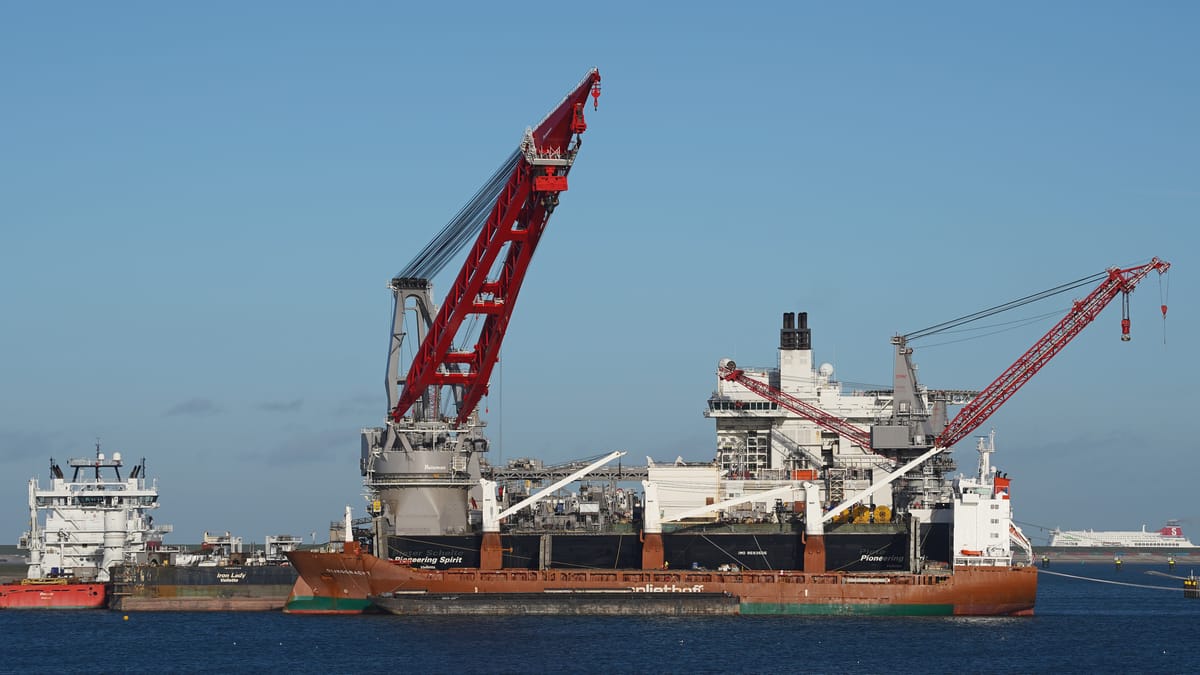
The Pioneering Spirit is one such record-breaking beast, a behemoth that holds the distinction of being the biggest, heaviest vehicle ever made. It’s not a bulldozer that can bring down mountains, not a gargantuan battle tank that lets its nation win wars just by speaking its name, and it’s not an aircraft, not a rocket, not even a space station. It’s a ship so gigantic, so utterly massive, that when it cuts through the water, there is truly nothing that can compare. And why does it exist? Why did humanity endeavor to build such a record-breaking machine?
The answer is oil, and the creation in question is the Pioneering Spirit.
Design and Development
In order to understand the megaproject that is the Pioneering Spirit, we first have to understand another of humanity’s creations, one that is as important to our modern world as it is routinely forgotten or overlooked: the oil rig, or, as it’s better understood, the offshore oil production platform. Oil rigs are not the prettiest pieces of construction in the world, and not by a long shot; they’re hulking expanses of steel, concrete, and very little else, usually with cranes hanging off the side, ugly half-rusted spires jutting into the sky, and an exterior that’s so profoundly not built to please the human eye that it can be hard to keep track of what’s actually going on there. But they’re important nonetheless, dredging up immense amounts of offshore oil without which a good proportion of human machinery would just grind to a halt.
There are a few kinds of oil rigs: some that rest on pillars that connect all the way to the seabed, some that float and are anchored to the seabed with mooring lines, and some attached to slender towers that can stretch and bend back and forth with the currents of the sea. In order to understand their relationship to the Pioneering Spirit, we only need to understand one other thing about them—which is that they’re a nightmare to build and assemble on the open ocean. If you’re going to create such a thing out in the middle of nowhere, you’ve got to transport all the materials, all the people, all the construction equipment, and all the other supplies you’ll need out to basically the middle of nowhere, and support an operation for months or even years until this great, big thing can be constructed.
But all the way back in the mid-1980s, the technical director of a company called Allseas had an idea. Allseas is a Swiss company that had been founded just recently, working with undersea oil pipelines, but the idea the company had was related to a problem that existed above the surface of the water. Wouldn’t it be nice, Allseas thought, if companies could construct their oil rigs while still on land, put the entire, fully-built hunk of metal onto a ship, steam out to the middle of the ocean, and simply plop the rig down wherever it needed to go?
It would be way more convenient for everybody, and even the highest price-tag a company like Allseas could conceive of would still be a hell of a lot better than the cost of an oil company trying to build their rig in the usual way. In 1987, Allseas laid claim to the idea and pledged publicly that they’d one day build it—and then they sat on the idea for twenty years as they went and did other things.
But even the designs that Allseas had on paper were pretty impressive, and every so often, a new group of technical engineers would take a look at the plans and make some tweaks. They knew the thing would have to be truly huge in order to hold the oil rigs they carried, and to literally have enough space for them onboard. At first, they’d envisioned building a gigantic catamaran-style ship, taking two massive super-tankers connected together across part of the twin hulls, while leaving a large slot in between them near the forward half of the ship, the bow, where it could pull up to a platform and put down the oil rig, while a complex system of ballasts would keep the entire apparatus from capsizing while it held a several-thousand-ton rig out on the end of a crane. Around 2004, the plan changed from joining together two supertankers to building a single, huge catamaran hull from scratch, so that they could include some advanced bells and whistles that would make the whole thing work a lot better.
Then, in 2007, Allseas announced that they were ready to take the leap. They were going to build their great ship, a twin-hulled platform that could install and remove entire oil rigs in one go. Their creation would be capable of incredible feats of strength, with the lifting system at the bow of the ship capable of lifting 48,000 metric tons of weight, and the lift system at the stern capable of picking up another 25,000 metric tons. The ship would also be able to lay undersea pipe, in keeping with Allseas’ primary mission, and it would perform that task at depths of up to thirteen thousand feet below the surface of the ocean. It would be named the Pieter Schelte, after the father of Allseas’ owner, a man named Edward Heerema—except, wait, no it wouldn’t, because as it turned out, the real-life Pieter Schelte had very much been a Nazi, serving in the Waffen-SS during World War II. A name change in February 2015 would give the ship its more enduring moniker, the Pioneering Spirit, and by then, the thing was in the water. After a several-year-long assembly process, joined by South Korean shipbuilding giant Daewoo—that’s Hanwha Ocean today—the ship was deemed ready to set sail by late 2014. In November of that year, it departed from South Korea, and two months later, it arrived in Rotterdam to be commissioned. Its lift system was installed, it passed all its final checks, and in August of 2016, the Pioneering Spirit set sail on the job for the very first time.
Specs and Capabilities
Even among its own category of global super-ships, the Pioneering Spirit is something to behold. From tip to tail, it measures a full length of 477 meters, or 1,565 feet with its beams extended. When measuring just the ship itself, it’s the third-longest ship in the world, after only the Seawise Giant and the Emma Maersk. It claims a breadth of 124 meters, 407 feet, at the parts of the structure in which the two catamaran hulls join together, while the catamarans themselves are each a little over thirty meters, or about a hundred feet wide. The Pioneering Spirit’s central slot measures 122 meters long by fifty-nine meters wide, 400 feet by 194 feet, making it more than able to service most of the world’s oil rigs. As noted previously, the ship’s topside lift capacity is a full 48,000 metric tons. That’s twenty-two times the weight of the London Eye, 200 times the Statue of Liberty, almost five times the weight of the Eiffel Tower, or, if you prefer real units of measurement, 326,496 Shaquille O’Neals. At maximum draught, the ship displaces a full one million tons of water, making it the heaviest, or highest-displacement vehicle ever created. That’s nineteen times the displacement of the Titanic, and nearly ten times that of the Gerald R. Ford-class aircraft carrier.
Despite its incredible size, the Pioneering Spirit is a mover when it wants to be; from port to port, it can hit a maximum speed of 14 knots when at its transit weight—that’s sixteen miles per hour or twenty-six kilometers per hour. With a maximum draught of 27 meters and a minimum draught of ten meters, it’s both too deep in the water and too wide around the midsection to squeeze through waterways like the Suez Canal or the Saint Lawrence Seaway, and if faced with the prospect of making it through the Panama Canal, both the crew of the Pioneering Spirit and the Panamanian government would probably have a collective nervous breakdown. But powered by thirteen Rolls-Royce diesel-electric azimuth thrusters with 360-degree rotation, it’s got more than enough power to get itself to any place where it can fit without scraping the seabed.
The price-tag for all that? 2.4 billion pounds.
Beyond its physical dimensions, the Pioneering Spirit is impressive for other reasons too. It can support a full crew of up to 571 people sleeping two-to-a-cabin, with more than enough hands on deck to participate in complex oil rig installation and pipe-laying operations. Crews typically hail from over twenty different nationalities, comprising three teams: a marine crew, a construction crew, and an engineering crew.
The people onboard live and work there for five weeks at a time, performing twelve-hour shifts, and they enjoy a laundry, catered food, a bar, a gym, and a karaoke room. According to Allseas, its average crew member will walk up to twenty kilometers a day aboard the ship, even before they arrive at the gym in their off-hours. The ship doesn’t ever actually shut off, owing to just how difficult and energy-intensive it is to get the entire thing roaring back to life after it goes offline, and even while it’s in port, it requires dozens of people to be onboard at a given moment.
The ship’s onboard navigation systems allow it to construct a 360-degree radar-constructed view around the ship, and it carries a high-precision acoustic positioning system and other underwater systems to allow it to keep a highly precise view of the seabed. It can become semi-submersible, sort of squatting itself down into the water while straddling its intended payload inside its slot, and offloading massive amounts of ballast in order to lift and transfer weight onto its support beams. The ship is equipped with an immensely powerful onboard lift system, able to pick up a full-capacity payload a couple of meters off the ground or the level of the water, and it’s equipped with several other large cranes, including one called a sheerleg, which allows it to lift the welded-steel jacket structure that affixes shallow oil rigs to the seafloor.
It’s got a pipe-laying system called the Stinger that guides pipes to the bottom of the ocean, and it’s backed up by two barges designed special to support it. The Iron Lady measures 200 by 57 meters, 656 by 187 feet, and can carry heavy structures into shallower waters where the Pioneering Spirit would run aground, while the aptly named Bumblebee stores and carries around the Stinger apparatus when it’s not being used. It’s equipped with a helipad that can host choppers as big as the Sikorsky S-92, and it can carry yet another 27,000 tons of undersea pipe on board.
Service Life and Succession
The Pioneering Spirit performed its first real-life lift as a working ship on August 22, 2016. On that day, the ship performed its funky deadlift on a 13,500-tonne offshore oil rig, in the Norwegian coastal waters of the North Sea. The lift didn’t go perfectly; the Pioneering Spirit collided with part of the platform during the operation, but the platform was going to be removed anyway and the ship was mostly fine. Once lifted, the Pioneering Spirit carried the thing all the way to Lutelandet, Norway, where it was dropped off for dismantling onshore. A few months later, the Pioneering Spirit performed another North Sea removal, getting rid of the iconic, three-legged Brent Delta platform off the coast of Shetland. The ship lifted the 24,000-tonne platform off its support structure in the span of seconds, setting a world record as it did so, and even that only strained the Pioneering Spirit to about half of its overall lifting capacity.
In the following years, the ship has performed all manner of rig installations and extractions, mostly in and around the North Sea, but also off the coast of France, in the Baltic and Black Seas, and off the coast of Africa. In 2019, the Pioneering Spirit performed what was, at that time, among the heaviest offshore lifts in history, on a 26,000-ton rig that’s part of Norway’s Johan Sverdrup oil field. It also performed its lightest lift to date in that same year, on a measly 3,800-ton accommodation platform. It’s worked on the NordStream and TurkStream pipelines, and, of course, it’s posed for quite a few lovely photographs for enthusiasts to appreciate.
But that’s not all that the Allseas company can envision for Pioneering Spirit’s future. With a new global focus on offshore wind power production, the ship is an ideal mechanism to install next-generation wind turbines, which are incredibly heavy and too big for most ships to handle. Pioneering Spirit can handle complex tasks of transportation and installation that go far beyond the capabilities of most vessels, and until anybody else builds something of a comparable size, it’ll be able to pick up quite a few contracts in a market consisting exclusively of itself.
Not only that, but the ship’s size insulates it from the harsh weather conditions that so often interrupt turbine installation, and it can handle more jobs at a faster clip than installation campaigns that use other mechanisms to do the job. In broader terms, the Pioneering Spirit will be at the forefront of the global transition away from fossil fuels and toward renewables; as the highest-capacity oil rig removal vessel in the world, it’ll be responsible for undoing the decades’ worth of installation and construction work that allowed global oil companies to run their offshore industry in the first place.
At the time of writing, the Pioneering Spirit is sitting in the port of Rotterdam in the Netherlands, after having finished its most recent job off the coast of Mauritania and Senegal. There, it was laying pipe for an ultra-deepwater liquified natural gas project, at depths of up to 2,700 meters below the surface of the ocean.
Finally, there’s the question of succession, and identifying the next vessel that will take the Pioneering Spirit’s place in the record books. Since 2018, Allseas has referenced plans to build an even bigger vessel, one that will allow the company to get in on the long and very expensive process of dismantling and removing the world’s largest oil rigs. Its name is the Amazing Grace, and at a price tag of about three billion dollars, it’ll essentially be a bigger, badder rendition of the Pioneering Spirit.
When fully built, according to Allseas’ then-CEO, it would feature a lift capacity of 72,000 metric tons, one and a half times that of the Pioneering Spirit. But as of now, the Amazing Grace is just a plan on paper, and it’s not likely to be built anytime soon. In 2020, the concept was shelved indefinitely, and at the time of writing, it hasn’t yet been resuscitated.
Until it is, it appears that the Pioneering Spirit will remain the most massive ship on the high seas, reshaping the world we live in, one oil rig at a time.
Key Takeaways
- The Pioneering Spirit is the largest and heaviest ship ever built, designed for transporting and installing oil rigs.
- The ship’s primary purpose is to facilitate the construction and removal of offshore oil rigs, making the process more efficient.
- With a lift capacity of 48,000 metric tons, the Pioneering Spirit can handle some of the heaviest offshore lifts in the world.
- The Pioneering Spirit is also equipped to lay undersea pipes and support the installation of offshore wind turbines.
- The ship’s future role includes aiding the global transition from fossil fuels to renewable energy sources.

Simon Whistler
Simon Whistler hosts MegaProjects, bringing engineering, infrastructure, and military-machine stories into clear narrative focus for viewers who want the systems, tradeoffs, and human decisions behind the build.
Frequently Asked Questions
What is the Pioneering Spirit?
The Pioneering Spirit is the largest construction ship in the world, designed to install and remove entire oil rigs in one go.
Who built the Pioneering Spirit?
The Pioneering Spirit was built by Allseas, a Swiss company, in collaboration with the South Korean shipbuilding giant Daewoo (now Hanwha Ocean).
What are the key specifications of the Pioneering Spirit?
The Pioneering Spirit measures 477 meters in length, has a breadth of 124 meters, and can lift up to 48,000 metric tons with its topside lift capacity. It displaces one million tons of water, making it the heaviest vehicle ever created.
What is the primary function of the Pioneering Spirit?
The primary function of the Pioneering Spirit is to transport and install offshore oil rigs and lay undersea pipes. It can also be used for installing offshore wind turbines.
How many people can the Pioneering Spirit accommodate?
The Pioneering Spirit can support a full crew of up to 571 people, who live and work on the ship in shifts.
What was the first real-life lift performed by the Pioneering Spirit?
The first real-life lift performed by the Pioneering Spirit was a 13,500-tonne offshore oil rig in the Norwegian coastal waters of the North Sea on August 22, 2016.
What is the Amazing Grace?
The Amazing Grace is a planned successor to the Pioneering Spirit, intended to have a lift capacity of 72,000 metric tons. However, as of the time of writing, the project has been shelved indefinitely.
What kind of amenities does the Pioneering Spirit offer to its crew?
The Pioneering Spirit offers its crew amenities such as a laundry, catered food, a bar, a gym, and a karaoke room. Crew members typically work twelve-hour shifts and live on the ship for five weeks at a time.
What is the maximum speed of the Pioneering Spirit?
The Pioneering Spirit can reach a maximum speed of 14 knots (approximately 16 miles per hour or 26 kilometers per hour) when at its transit weight.
What was the cost of building the Pioneering Spirit?
The cost of building the Pioneering Spirit was 2.4 billion pounds.
Sources
- Original MegaProjects video: Pioneering Spirit: The Largest Construction Ship in the World
- https://www.caralb.com/2021/05/31/offshore-platforms/
- https://maintenanceandcure.com/maritime-blog/the-difference-between-vessel-and-platform-rigs/
- https://www.deeptrekker.com/resources/oil-energy-platforms
- https://www.marineinsight.com/offshore/5-biggest-oil-platforms-in-the-world/
- https://allseas.com/equipment/pioneering-spirit-offshore-construction-vessel/
- https://allseas.com/offshore-wind-and-renewables/?_gl=1t42kng_upMQ.._gaMzA0NjQ2NjMwLjE3MTI4MDE5MTY._ga_MZ8Y7ZBM0N*MTcxMjgwMTkxNS4xLjAuMTcxMjgwMTkxNS4wLjAuMA
- https://www.ship-technology.com/projects/pioneering-spirit-heavy-lift-construction-vessel/?cf-view
- https://www.marinetraffic.com/en/ais/details/ships/shipid:420864/mmsi:249110000/imo:9593505/vessel:PIONEERING_SPIRIT
- https://www.vesselfinder.com/vessels/details/9593505
- https://allseas.com/pioneering-spirits-jacket-lift-system/
- https://www.onesteppower.com/post/world-largest-vessel-pioneering-spirit
- https://www.projectcargojournal.com/equipment/2022/11/11/inside-allseas-pioneeringspirit-video/?gdpr=deny
- https://www.vesselfinder.com/news/27605-Allseas-completes-infield-pipelay-scope-for-BPs-GTA-LNG-project-offshore-Mauritania-and-Senegal
- https://www.projectcargojournal.com/equipment/2022/11/11/inside-allseas-pioneeringspirit-video/?gdpr=deny
- https://www.offshore-mag.com/field-development/article/16754711/pioneering-spirit-proves-strength-stability-with-record-topsides-lift
- https://ocre-offshore.com/project/pioneering-spirit/
- https://www.esru.strath.ac.uk/EandE/Web_sites/98-9/offshore/steel.htm
- https://www.offshore-mag.com/vessels/article/16760989/pieter-schelte-the-heavyweight-contender-for-north-sea-abandonment-program
- https://www.ship-technology.com/projects/pioneering-spirit-heavy-lift-construction-vessel/
- https://news.sky.com/story/pioneering-spirit-worlds-largest-vessel-sets-record-after-24000-tonne-oil-platform-lift-10855332
- https://allseas.com/wp-content/uploads/2016/08/2016-0822-Pioneering-Spirit-completes-maiden-heavy-lift-project_web.pdf
- https://www.reuters.com/article/us-oil-gas-decommissioning-idUSKBN1FR26O/
- https://www.projectcargojournal.com/offshore/2020/07/22/plans-for-larger-pioneering-spirit-shelved-indefinitely/
- Hero image source by kees torn / openverse, by-sa.