

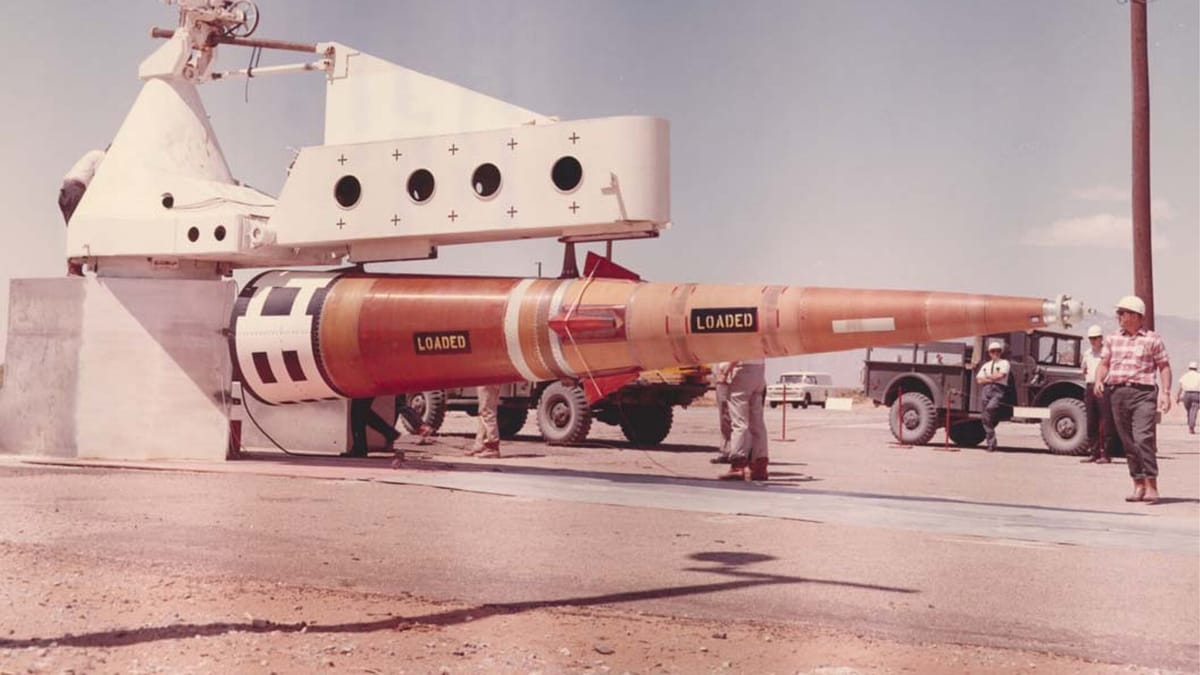
It’s the 1960s, the Cold War is in full swing, and the Americans and Soviets are racing to see who can build the biggest nukes, fit them on a missile, and threaten the other with complete annihilation, a story we’re all familiar with. While it is true that at this time much of the focus was indeed on making nuclear weapons bigger and more efficient, another, more meticulous type of nuclear weapon was also in development – a neutron bomb. They’ve been nicknamed the cleanest of bombs, the cruelest of bombs, and, by Soviet General Secretary Brezhnev, capitalist bombs. Today, we’re going to show you the science behind neutron bombs and what makes them so deadly.
A New Nuke
On October 31st, 1961, the Soviet Union dropped the largest nuclear weapon ever developed. This was the Tsar Bomba, which they tested in Russia’s far north near the Arctic Sea. When it detonated, it exploded with a force equal to at least 50 megatons of TNT, about 3,800 times more powerful than the bomb dropped on Hiroshima 16 years earlier. The blast was so unbelievably large that it annihilated everything within a radius of nearly 35 kilometers, or 22 miles.
And at a staggering 100 kilometers or 60 miles away, you would still receive third degree burns. It was so massive that it shattered windows as far away as Finland and Norway, a distance equal to the space between London and Berlin, or San Francisco and Phoenix. A truly monstrous bomb to be sure, a horrifying weapon of the largest scale that would lay waste to anything and everything.
And that was exactly the problem with it, and, indeed, the problem with all the other nukes.
You see, while the arms race was trudging forward, there was more to the cold war than the simple mutually assured destruction of each side. In fact, at the time, both sides were also preparing for a potential conventional war between NATO and the Warsaw Pact, a war that would be perhaps supplemented by nuclear bombs, instead of the total destruction of the planet. For this reason, both sides developed their own tactical nuclear weapons, a type of smaller warhead that could be used more for a battlefield purpose, instead of the type you’d launch at something like New York or St.
Petersburg. But there was still a glaring issue with these – what if the war were to break out in, say, Germany, which, at the time was divided between east and west, and was seen as the most likely place for a war to break out? You wouldn’t want to risk using even a smaller tactical nuclear weapon there, as you’d not only be decimating the infrastructure of your own side, but you’d also be risking the escalation of the war into a full-scale nuclear one once again.
So physicists got thinking, and the solution they came up with was the neutron bomb, first credited to American physicist Samuel T. Cohen. The basic idea behind Cohen’s neutron bomb is to minimize the blast radius as much as possible while simultaneously maximizing the amount of neutron radiation released.
If this perfect balance is achieved, you are left with a bomb that doesn’t result in a very large explosion, but releases enough high-energy neutrons to still be lethal on a large scale. And because these neutrons largely pass through solid objects, they can kill anyone nearby, even inside of buildings or bunkers, without dealing much damage to the structures themselves.
And this is all achieved by carefully adjusting the material proportions used in the bomb.
For example, in a standard hydrogen bomb, while the main source of energy is nuclear fusion, it actually begins with fission. The first step is the detonation of a small fission bomb, which then reacts with thermonuclear fuel, such as deuterium and tritium, to create a chain reaction of nuclear fusion which results in an immense explosion. During this chain reaction, incredibly high numbers of free neutrons are produced and blasted in every direction, but these stay trapped within the bomb thanks to a thick radiation case, usually made of depleted uranium. This case prevents the neutrons from escaping, allowing them to further react with the bomb’s fuel inside and release even more energy, and, because the case is made of uranium, it itself also reacts with the neutrons, adding considerable force to the explosion.
In a neutron bomb, however, the material used to make this radiation case is changed to something non-fissile, such as steel. Because the neutrons won’t interact with this metal nearly as much as they would with the uranium, most of them pass right through it, escaping into the surrounding environment. This release of the neutrons in turn lowers the blast yield because they aren’t reacting with the bomb’s components, so we now have the added benefit of a smaller explosion.
For comparison, in a regular hydrogen bomb the radiation released as gamma rays and neutrons comprises only about 5% of the bomb’s total energy, the rest of the energy being released in the gargantuan explosion. In a neutron bomb, however, the percentage of energy released as radiation is closer to 40%.
And these neutrons are really, really dangerous. In fact, when comparing the potential damage done to biological tissue, neutron radiation is about 10 times more powerful than an equal exposure of gamma radiation, you know, the radiation that turned Bruce Banner into the Hulk. The reason it’s so dangerous is because of something called neutron activation, which is what happens when the free neutrons are captured by an atom.
This capture results in the transmutation, or change, of the atom into a different isotope, often a radioactive one. So, essentially, the collision of these free neutrons turns things radioactive, and is especially effective at doing so in places like your eyes, muscles, nerves, and synovial tissues of your joints. The damage can instantly cause cells to die, stop replicating, or even change function, and this damage is so severe that you would have a 50% chance of death if you were standing just one mile from ground zero of a neutron bomb detonation.
Though, this death would not be instant, and would probably take a few days to really incapacitate you. Closer than this, though, and you’re looking at permanent injuries and a very high chance of a quick death.
A Versatile Weapon
So what could these neutron bombs be used for? Well, the US Military had some pretty good ideas:
The first, and primary use was against Soviet armored divisions. The Soviet Union was a tank producing beast, and the Warsaw Pact alliance had more than twice the amount of tanks NATO did for most of the Cold War. And the United States not only had far less tanks, but it would also have to get them across the Atlantic Ocean before they could help defend Europe, so this was a big scare.
Neutron bombs would hypothetically be a quick solution to this, able to be dropped among the formations of tanks to quickly incapacitate their crews without having to individually blow up them all up with anti-tank weapons. Additionally, if the perfect neutron bomb were constructed, it would be possible to drop them on these tanks even while they’re driving down narrow streets of European capitals. Not only this, if the neutron bombing could disperse their well-planned formations into thinner lines or even single tanks, it would be much easier for allied ground forces to hunt them down.
The other application of them here is called area denial use. Because the neutrons can induce radioactivity in the materials they encounter, blankets of neutron bombs can be dropped to prevent enemy units from advancing through a certain area. This could be even more effective if the nuclear casing was made of something that was neutron activated, like zinc 64. When zinc 64 is activated by a neutron, it becomes zinc 65, which emits gamma radiation and has a half-life of nearly 250 days.
If this were spread over a wide area, you can imagine a radioactive no man’s land that no one dares to cross.
But it’s the third potential application that got the most attention: missile defense. The idea that you could launch nuclear weapons to destroy incoming ballistic missiles was nothing new, but there was a big drawback to it. You see, as you go higher in altitude and the atmosphere begins to thin out, the blast force from the nuke begins to drop off.
You can solve this by using a bigger warhead, but then if the bomb goes off a bit lower in the atmosphere you’ve made more problems than solutions. On top of this, there was an understandable fear that detonating hydrogen bombs in the upper atmosphere could permanently rip a hole in the earth’s protective layer, so even if we all were to survive the nuclear war, we’d simply die from the effects of having a weaker atmosphere.
Neutron bombs, in theory, could solve this problem. Firstly, their explosion would be minimal enough to avoid damaging the atmosphere, while at the same time maintaining a similar result regardless of altitude, as the release of neutrons doesn’t depend on the density of air. The neutrons would quickly reach the incoming warhead, and begin reacting with its fissile material, burning up some of the bomb’s fuel and causing it to simply ‘fizzle out’ instead of exploding as intended.
It would also do serious work on the missile’s electronics, which could ruin its navigation systems. This was a serious line of inquiry, and some believe it was the true intent behind inventions like the AIM-26 Falcon, an American air-to-air nuclear missile. If this missile were to be tipped with a neutron warhead, it could detonate near a Soviet bomber and render its nuclear arsenal ineffective before they could even be dropped.
The United States began production of its first neutron bomb in 1974, the W66. 120 were completed, with about 70 kept on active duty for several years. But, when the public became aware that the US planned to keep the bombs in western Europe, mass protests erupted in Germany, France, and Italy, the plans were cancelled, and the bombs never crossed the ocean. After a few years, they started slowly being decommissioned, but the program was suddenly revived when it was discovered that the USSR had tested their own version in 1978.
However, by the end of the cold war, the US began scrapping its stockpiles, and a few years later had completely dismantled its neutron bomb stockpile. This was also because the program had largely been overshadowed by Ronald Reagan’s Strategic Defense Initiative, or Star Wars, which was much flashier and had captured the public’s attention, stealing it away from the humble neutron bomb.
Other countries to later develop them include France, China, India, Pakistan, and Israel, allegedly, though the general consensus between basically everyone is that there isn’t a current need for such a weapon. For example, Chinese nuclear scientists in 1988 stated that their tests were purely for research purposes in case the technology was needed later in the future.
While you can technically say that any low-yield nuclear bomb can be considered a neutron bomb, the one place that neutron bombs are currently officially deployed is in Russia, who finished the research started in the Soviet Union and, in 1995, developed the ABM-3 Gazelle system. Currently, 68 neutron warheads are deployed around Moscow in this system, set up as a last-resort defense for an incoming nuclear ballistic missile attack.
No Place for the Neutron
So, despite years of fanfare, controversy, and research, the neutron bomb doesn’t seem to have much of a place in modern warfare. Even at the peak of its production and research, it had many critics, and for good reason. If they had gone on to mass production and deployment in Europe, it’s possible that the USSR would have simply invested in proper neutron shielding for their tank crews, rendering the whole thing useless. This shielding can include boron, which is an excellent neutron absorber, and can also be alloyed with steel to make it even easier to use.
The other problem is the damage to buildings. Yes, the whole point of the neutron bomb was to leave buildings unharmed, but that’s not exactly feasible. While the blast radius could be minimized significantly, it can’t be lowered beyond a certain point, which would still damage buildings in a wide radius. At that point, there isn’t much benefit to the neutron bomb, as you’re also spreading harmful radiation that could potentially irradiate the region as well.
It’s like having all the disadvantages of an atom bomb without any of the advantages. Not to mention the expense that comes with producing hundreds or even thousands of them.
But the biggest problem was the ever-present threat of nuclear escalation. Even though the blast is smaller, at the end of the day, it is still a nuclear weapon. Using a neutron bomb as a radiological weapon could easily trigger the other side to use a small tactical nuclear bomb, which could then escalate into full-scale Armageddon.
Key Takeaways
- Neutron bombs were developed to minimize blast radius while maximizing neutron radiation.
- The US and USSR explored neutron bombs for tactical use, such as against armored divisions.
- Neutron bombs were considered for missile defense due to their altitude-independent effectiveness.
- Public protests and the Strategic Defense Initiative led to the US dismantling its neutron bomb stockpile.
- Neutron bombs faced criticism for potential nuclear escalation and limited practical benefits.

Simon Whistler
Simon Whistler hosts MegaProjects, bringing engineering, infrastructure, and military-machine stories into clear narrative focus for viewers who want the systems, tradeoffs, and human decisions behind the build.
Frequently Asked Questions
What is a neutron bomb?
A neutron bomb is a type of nuclear weapon designed to minimize the blast radius while maximizing the release of neutron radiation. This makes it lethal to living beings without causing extensive structural damage.
Who is credited with the idea of the neutron bomb?
The neutron bomb is first credited to American physicist Samuel T. Cohen.
How does a neutron bomb differ from a standard hydrogen bomb?
In a neutron bomb, the radiation case is made of a non-fissile material like steel, allowing neutrons to escape and reducing the blast yield. In a standard hydrogen bomb, the case is made of depleted uranium, trapping the neutrons and increasing the explosion’s force.
What are the potential uses of neutron bombs?
Neutron bombs were considered for use against Soviet armored divisions, area denial, and missile defense. They could incapacitate tank crews without destroying the tanks, create radioactive no-man’s lands, and disable incoming ballistic missiles.
When did the United States start producing neutron bombs?
The United States began production of its first neutron bomb, the W66, in 1974.
Which countries have developed neutron bombs?
Countries that have developed neutron bombs include the United States, France, China, India, Pakistan, Israel, and Russia.
Why did the United States stop producing neutron bombs?
The United States stopped producing neutron bombs due to public protests in Europe, the discovery that the USSR had tested their own version, and the overshadowing of the neutron bomb program by Ronald Reagan’s Strategic Defense Initiative.
What is the current status of neutron bombs in modern warfare?
Neutron bombs do not seem to have much of a place in modern warfare. They have many critics and practical issues, such as the potential for nuclear escalation and the damage they can still cause to buildings.
Where are neutron bombs currently deployed?
Neutron bombs are currently officially deployed in Russia as part of the ABM-3 Gazelle system, which is set up as a last-resort defense for an incoming nuclear ballistic missile attack around Moscow.