
Ask the Kremlin about Metro-2, and you’ll get silence. Or a smile. Or nothing at all. Officially, it doesn’t exist. Unofficially? It was the Soviet Union’s — and now Russia’s — secret subway, buried beneath Moscow, built to move the powerful while the world above burned.
This wasn’t a public transport project. It was a Cold War panic room on rails. A hardened tunnel system connecting the Kremlin to bunkers, command posts, and a rumoured underground city. No third rail. No station signs. Just diesel locomotives, pressure-sealed doors, and air systems designed to survive nuclear fallout.
For decades, it was rumour. Then came the leaks. The maps. The offhand admissions from ex-KGB officials. Now, we know the core of it exists — at least one deep line running from central Moscow to a subterranean complex at Ramenki. And there might be more.
So how much is real? How much is Cold War myth? And could the whole thing still be active — waiting silently, sealed and ready, beneath one of the most heavily guarded cities on earth?
Stalin’s Underground Ambitions
The idea of a clandestine subterranean transport in Moscow reportedly dates back to the Stalin era, and as early as the 1930s, alongside the construction of the public Moscow Metro, secret spurs and tunnels were allegedly built to serve the Soviet leadership.
During World War II, these hidden passages saw use too — notably on 7th of November 1941, when Joseph Stalin travelled by a special underground train to attend a secret wartime ceremony at Mayakovskaya station. According to researcher Vladimir Gonik, Stalin accessed the metro directly from an underground tunnel beneath his downtown command post, avoiding surface streets altogether.
After the war, as Stalin grew ever more concerned about the looming threat of assassination as his famous late-stage paranoia really set in, it is believed that he ordered the creation of a dedicated secret metro line — a single-track “Kremlin Subway” — to connect central Moscow with a secure location outside the city. Vladimir Shevchenko, who served as a top Kremlin aide, later acknowledged the existence of this line, describing it as a narrow-gauge private rail line running from the Kremlin to Stalin’s “Nearer Dacha” — ‘Dacha’ being a Russian term for a second home in the sticks — in Kuntsevo.
According to him, this was the only military come government only underground railway back then, and further, he also noted that additional subterranean connections were established between key government sites in central Moscow, such as between the General Staff building and other state facilities.
Later, construction of Metro-2 proper began in the early 1960s, under the direction of the KGB’s 15th Directorate and the Ministry of Defence, under the codename ‘D6’. As for what we know about what was actually built, that would be everything and nothing, in a nutshell. Allow us to explain.
What We DO Know
While a lot of Metro-2 is buried — both literally and figuratively — some things we do know with a fair degree of certainty. Not rumours, not whispers, not Cold War scaremongering — just the cold, steel-lined, pressure-sealed facts. So, here’s what’s real — or at least, real enough to have left behind physical infrastructure, official admissions, or declassified blueprints.
The confirmed core of the system starts with a single-track tunnel that diverges quietly near Sportivnaya station on the Sokolnicheskaya Line. From there, it drops sharply under the Moscow River, heading southwest towards Ramenki. This isn’t your average commuter tunnel either, it plunges to depths of around 150 to 200 metres, far beyond anything in the civilian metro — and Moscow’s network isn’t exactly what you’d call a cut and cover system anyway, with many stations having been buried deep to dually serve as nuclear fallout shelters.
At least one vertical shaft along the route also houses a dedicated high-speed elevator, designed for quick, discreet surface access — and equally quick lockdown. Reinforced walls separate this from the public network, and at key divergence points, hermetically-sealed blast doors slam down tight enough to shrug off everything short of an actual nuclear detonation.
Sitting at the heart of it all is ‘Kremlin Complex Number 103’ — the name given to the Kremlin’s buried command node. It’s not just a bunker. It’s a fully functional underground hub that links, via hardened tunnels, to multiple critical locations beneath central Moscow. This includes a platform deep under the Kremlin itself — around 55 metres down — which stretches out in reinforced tendrils to connect Lubyanka, Zaryadye, the old Party Central Committee HQ, and other administrative blocks.
Each connection is also lined with concrete and steel, forming a network that can shuffle personnel and material across the city without ever touching the surface. One crucial segment, simply referred to in some records as the “Branch Line,” links 103 to the outbound D-6 line — the one that leads directly to the ‘Ramenki Underground City’. The entire thing was purpose-built to move government, military, and intelligence staff securely and invisibly, even under wartime conditions.
As for the so-called ‘Underground City’ at Ramenki — a term never officially acknowledged — what we know is mostly drawn from leaked accounts, speculative reporting, and a handful of vague official nods. It’s widely believed to be a large civil defence complex, designed to house thousands in the event of a nuclear crisis. Sources describe it as self-sufficient, with provisions like diesel power generation, food and water storage, and independent air filtration — though no complete blueprint or photo set has ever surfaced. Still, the consistency of these descriptions across multiple sources suggests a substantial subterranean installation beneath western Moscow.
The entire complex also sits nearly 180 metres underground and is accessed by a series of vertical shafts, service tunnels, and maintenance corridors. And at its centre is a proper underground train terminus — a final stop for the Metro-2 line, complete with storage bays, turnaround points, and thick-layered concrete protection that would make any NATO bunker blush. Internal security infrastructure is in place throughout — blast doors, access locks, and bulkhead zones — all tailored to keep this place running if the city above has already been turned to glass.
It isn’t just Ramenki and the Kremlin though. The Metro-2 system includes multiple auxiliary nodes — sites that keep the system’s lungs and stomach working when the surface isn’t safe. One of them, Matveevsky or DV-1, is buried near the Matveevskaya rail yard.
It’s got a sloped tunnel that links to the main line and is fitted with track, allowing it to serve double-duty as both air intake and secondary rail access. There’s a support garage buried down there too. The other site, DV-2 near the Rizhskaya metro junction, functions in the same role — deep ventilation and emergency ingress.
These stations are deliberately nondescript at ground level: brick sheds, fencing, a couple of industrial chimneys. Unless you know exactly what to look for, you’d walk past them thinking they were just boring Soviet-era utility stations. But underground, they house reinforced shafts, fuelled generators, and pressurised air systems fitted with gas-tight seals and CBRN-rated filtration units.
In short — they keep people breathing, even when the world above has gone full apocalypse.
There are smaller shelters scattered around the city too — many of them independent of Metro-2, but tied into the broader system in subtle ways. One of the most public is Bunker-42, hidden under Taganskaya Square. It’s about 65 metres deep and was once linked by secret corridors to the Taganskaya Circle Line station.
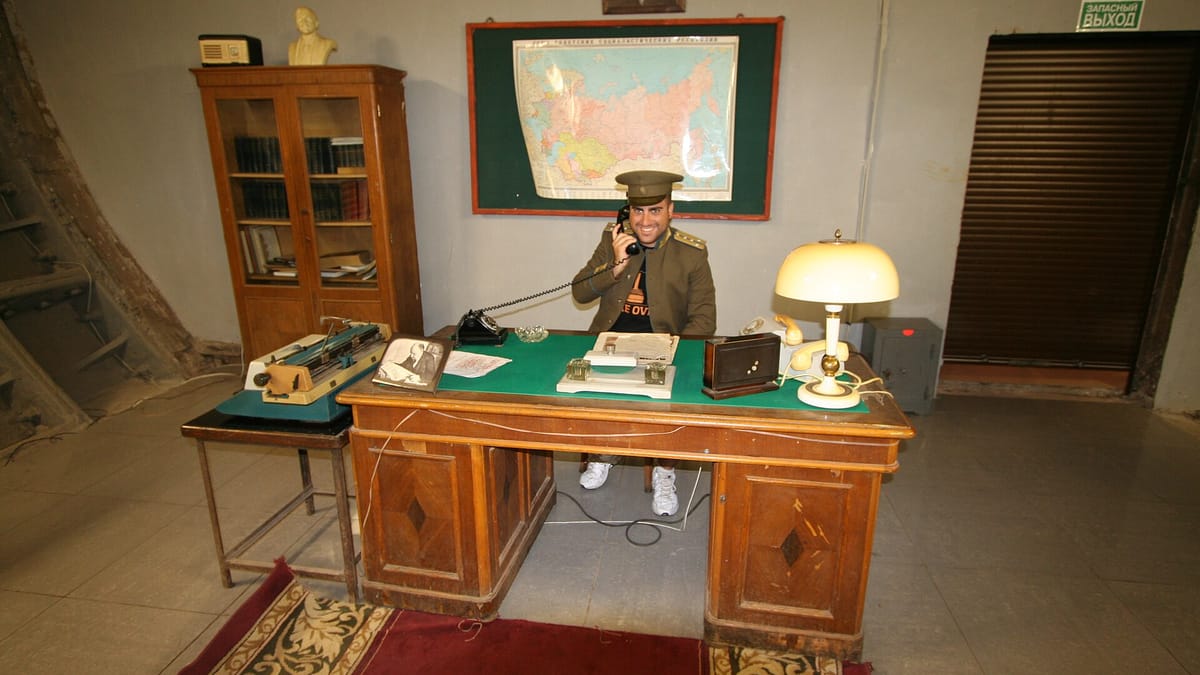
There were reportedly two tunnels — one for personnel, one for equipment — linking Bunker-42 to nearby stations like Taganskaya. Today, most of the complex operates as a museum, but original Cold War infrastructure remains intact: blast doors, filtered air chambers, and comms bays. While dioramas and tour guides often imply a connection to Metro-2, no hard evidence confirms such a link. If any crossover ever existed, it was likely for emergency or internal use only — and remains officially unverified.
And while this sounds a bit fantastical, the construction techniques are familiar. Soviet tunnel engineering followed a strict template, and Metro-2 is no exception — cast-iron or concrete-lined tunnels, with the standard Russian broad-gauge track — 1520mm between the metal bits — laid throughout. Most lines are single-track tubes, narrow and tight, with just enough space for maintenance walkways along the side.
No decorations, no station signs, no electronic displays. These aren’t public-facing. They’re functional.
Platforms are barely more than concrete lips beside the rail. Wall panels house emergency gear, basic lighting strips, and sometimes direct access to shaft elevators or bunker vestibules. Everything’s compartmentalised: pressure-sealed doors, negative-pressure vestibules, gas dampers, sealed power conduits — the works.
If a fire breaks out, or a pressure wave rolls through one segment, the rest of the network survives.
The trains that run through Metro-2 aren’t what you’ll see in any public Moscow Metro photo too. There’s no third rail here — the system is powered entirely by self-contained units. Rolling stock uses either battery-electric or diesel-electric propulsion, deliberately chosen so the trains keep running even in the event of a total power grid failure.
Early models were modified from standard metro vehicles — passenger cars like the Ezh6 refitted with battery packs and sandwiched between two locomotives. Later on, the Soviets built purpose-made four-car diesel units and lightweight inspection trolleys, reportedly gasoline-powered, for quick access and maintenance runs through the sealed environment.
Train lengths are short — usually no more than two to four cars — partly due to the narrowness of the tunnels, but mostly because they don’t need to carry crowds. This system was never meant for public transport; it’s a wartime transit system for key personnel and kit, not commuters. Everything uses the same coupler and gauge specifications as the regular metro though, which is no coincidence.
It means rolling stock can be serviced off-site when necessary — usually during the small hours when no one’s watching. Within Ramenki itself, there are believed to be sidings and service bays underground too, making basic repair operations possible without needing to break cover.
Structurally, Metro-2 is built for survivability. The entire network is compartmentalised into segments that can be sealed off in seconds. Massive blast doors sit at every station, junction, and vent shaft — designed not just to block explosions, but to seal against chemical or biological contamination. When locked, they form airtight pressure barriers between sections.
Behind those are airlocks, concrete vestibules, and steel-lined corridors with pressure control. If you were sheltering in one part of the network and a fire broke out two stops down the line, the system could isolate it, pressurise your section, and carry on like nothing happened.
The air systems are a marvel in Soviet overengineering too — gotta give them credit for that. Rather than relying on a central supply, the ventilation grid is modular and distributed. Air is pulled in from DV-1 and DV-2 through reinforced trunk lines and then routed through pressurised ducting systems that snake through the entire network. Each section has its own in-line filters, usually installed in pairs or triplets so they can rotate usage or be replaced without dropping airflow.
These filters are NBC-capable — that’s nuclear, biological, chemical — and include emergency shutoff dampers and gas-tight seal plates. If something nasty gets into the intake, the entire airflow can be sealed and rerouted before it hits human lungs.
Lighting inside the system is about what you’d expect: stark, functional, and power-conscious. Wall-mounted incandescent strips line the tunnels, powered via internal cabling that runs through sealed conduit. If main power fails, portable generators and onboard vehicle lights can be used to light corridors temporarily. Drainage is handled through sloped tunnel floors and sump tanks, with sealed pump chambers at each major node.
These tanks feed into deep injection wells or closed-loop reservoirs, so the network doesn’t rely on Moscow’s municipal drainage grid to stay dry. It’s all completely isolated.
In total, the Metro-2 system as we know it connects the Kremlin, Ramenki, Lubyanka, Zaryadye, DV-1, DV-2, Bunker-42, and the interface spur at Sportivnaya. That’s the solid spine of it — the bits supported by physical structures, aerial photos, blueprints, or admission slips from ex-officials. Could there be more? Of course there could.
Some maps — including those from 1991 U.S. military intel — suggest up to four full lines stretching across the city and into the suburbs, toward places like Vnukovo-2 Airport, Zarya military base, and Barvikha’s government compound. Whether those were ever built or simply planned on paper, we just don’t know. But what’s been confirmed already is impressive enough — a vast, militarised subterranean transit network, sealed against the end of the world, and hidden in plain sight beneath one of the most heavily guarded capitals on earth.
Breaking the Secrecy
For decades, the Soviet public knew nothing of Metro-2 — officially anyway, as the Soviet period Muscovite we asked about it said it was basically common knowledge come the 1980s — not that it was knowledge that anyone lost any sleep over, or even really cared about at all.
But the official secrecy began to crack following the collapse of the Soviet Union, as officials and curious journalists alike cautiously started to discuss the once-taboo topic. One of the first public revelations came in July 1992, when Arguments and Facts, a weekly Russian newspaper, published an interview with Oleg Gordievsky on “the supreme secret of the KGB.” In it, a single cryptic remark about a “huge underground city” confirmed what basically everyone in Moscow, and the U.S. Intelligence Services, had long since already known.
Then, that same summer, writer Vladimir Gonik’s novel introduced the term “Metro-2” into popular culture. But it was Western media that provided a more concrete picture shortly thereafter, as in August 1992, Time magazine ran a piece titled “Moscow’s Secret Plans” in which correspondent James Carney, citing former KGB sources, described exactly what had been built.
He mentioned the Ramenki bunker — with its vast size and 30-year provisions — and explicitly stated that “the Kremlin and other key buildings in Moscow are still linked by underground rail tunnels.” He even named the KGB’s Ninth Directorate as being involved in construction.
This was a watershed moment — a mainstream confirmation in print that Metro-2 was real. Russian officials, when pressed, gave terse responses. Igor Malashenko, a Russian TV executive, for example, acknowledged an old underground communications centre outside Moscow, at Sofrino, that had since fallen into disrepair, and moved on, thus dodging the true question, but also implying that such facilities — even if they did exist at one time — were now obsolete and out of use.
The trickle of insider testimony then continued into the 2000s. Perhaps the most authoritative voice was Mikhail Poltoranin, a former Russian Minister who in the early ’90s had chaired a governmental commission on secret archives.
In 2008 he spoke openly about Metro-2, stating that “it is an extensive network of tunnels and an emergency command centre in case of war, where you can command the nuclear forces of the country.” He also confirmed that the system “can hide a lot of people — its maintenance was necessary” and that it includes “branches that go to the suburbs so that the command could move away from the epicentre of a nuclear attack.”
Coming from a former top official, these words carried weight. However, he did also state that by the 21st century, surviving a nuclear war in those tunnels was no longer a realistic strategy, hinting that the era of such huge bunkers might be past. The truth, or a damage controlling blag meant to not totally give away Moscow’s current civil defence strategy? Ultimately, no one knows — or no one knows who is able and willing to talk about it publicly anyway.
Another semi-official confirmation of Metro-2’s existence did also come from Dmitry Gayev earlier on, and given that he was the Moscow Metro for many years, he was a man worth listening to. In a 2007 interview, when asked about the existence of secret transport tunnels, Gayev responded wryly, “I would be surprised if they did not exist.” He refused to deny anything, and even mused about the possibility of using those tunnels for public transport one day — though he noted, “It is not for me to decide, but for those organizations on whose balance sheet these objects are held.” That careful yet telling answer was reported by Izvestia — a Russian broadsheet — and then widely picked up: the man in charge of Moscow’s subway was strongly implying that a parallel subway was real.
In October 2008, Svetlana Razina, head of the independent metro workers’ union, also added a detailed recollection to the by then nicely growing body of information: a secret recruitment of a driver for special lines, and mention of special short trains on those lines.
Her account corroborated technical aspects of Metro-2 that had been speculated — the use of battery-electric locomotives and small trains. Around the same time too, even state media briefly dropped its guard, as the Russian state-owned news agency TASS included a paragraph in a 2007 article saying that the “existence [of Metro-2] is no longer denied even by responsible officials” and describing unofficial maps showing lines to locations like Barvikha, site of a government sanatorium, Bor, a government compound, Vnukovo-2 airport, and Zarya, a former military town.
One early version of the TASS report also stated the system was now under FSB control — the successor agency to the KGB. That line was swiftly removed from later versions, possibly a self-censorship move, but it lives on in web archives. While no official confirmation exists, this handover is widely assumed. Given the FSB’s responsibility for state security infrastructure, it would make sense for them to oversee any such classified assets — assuming they remain operational.
By the 2010s then, Metro-2 was an open(ish) secret, acknowledged in broad strokes, though still officially classified — a peculiar limbo which the system remains in to this very day.
What has been confirmed so far — by firsthand witnesses, declassified intel, and the like — is only the tip of the iceberg. And even as we speak, historians are scrambling through declassified Kremlin documentation to collect together every bit of information we can on Metro-2, with a particular one to keep an eye on being Dmitry Yurkov, who put together an excellent tome titled Secret Soviet Bunkers: Special Urban Fortifications from the 1930s–1960s, which discussed the origins and early history of Metro-2 in very decent depth.
However, don’t expect anything detailed on the more recent history of Metro-2 from him, as, despite his only using declassified material, he’s actually had a bit of bother from the FSB and Russian Prosecutor General’s office about his work — which is exactly why he cut his book’s focus off when he did… just in case anything still useful to the outside world might unwittingly find its way into its pages.
Explorers and Legends
Fortunately, while more recent details of Metro-2 might be harder to come by officially, urban explorers and amateur researchers have stepped in to help fill in the gaps.
Among them, the most notorious were the ‘Diggers of the Underground Planet,’ a Moscow-based group that claimed in 1994 to have located an actual entrance to the fabled network. They kept the exact location a secret, however, and while the authorities offered no comment, it is notable that security around suspected subterranean Metro-2 sites noticeably increased soon after.
They didn’t take any photos, sadly, or at least none that they published. But photos would eventually emerge, specifically in 2001, when a treasure trove showing rusted warning signs, massive blast doors, and what appeared to be a station platform in a deep, concrete-lined tunnel appeared online. This was then slowly topped up over later years as more and more budding explorers found their way in.
Western intelligence, which tends to be more liberally declassified than its Russian equivalent, also stepped in to help plug some gaps, as we’ve already touched upon. However, take this with a pinch of salt — in much the same way as you would with the intentionally vague comments of officials — because while it can indeed be alluring to buy into the American vision of Metro-2 as an utterly huge network, their conclusions ultimately were just very, very well educated speculation.
Separating Myth from Reality
To bring us to a close then, let’s separate myth from reality and take one last review of what we do know.
We know that at least one deep-level, government-only metro line exists beneath Moscow, connecting the Kremlin to the sprawling Ramenki bunker complex. We know there’s an interface spur at Sportivnaya, that the trains are battery or diesel-powered, and that the system was built with a single goal in mind: to keep the machinery of state moving if the surface world stopped.
That’s the confirmed reality — a concrete, steel, and deeply buried Cold War contingency plan that very likely still has a heartbeat today.
But beyond that? The rumours persist. Maps hint at extra lines. Explorers whisper of sealed platforms and doors welded shut. Even now, researchers like Dmitry Yurkov hit hard limits on what they can publish — not because the facts aren’t there, but because the Kremlin has decided they shouldn’t be.
And in that silence, Metro-2 becomes more than infrastructure. It becomes symbol: of paranoia, of planning, of a regime that feared the end enough to dig its own lifeboat — and maybe, just maybe, never stopped building it.
Will we ever find out for certain? Only if someone finally opens the blast doors.
Key Takeaways
- Metro-2 is a secret, government-only subway system beneath Moscow, built for Cold War survival.
- The confirmed core of Metro-2 runs from central Moscow to the Ramenki bunker complex.
- Metro-2 features diesel or battery-powered trains, pressure-sealed doors, and NBC-capable air filters.
- The system includes auxiliary nodes for ventilation and emergency access, such as DV-1 and DV-2.
- Official acknowledgment of Metro-2 began in the 1990s, with details revealed through leaks and interviews.

Simon Whistler
Simon Whistler hosts MegaProjects, bringing engineering, infrastructure, and military-machine stories into clear narrative focus for viewers who want the systems, tradeoffs, and human decisions behind the build.
Frequently Asked Questions
What is Metro-2?
Metro-2 is a secret subway system buried beneath Moscow, built to move the powerful while the world above burned. It was a Cold War panic room on rails, connecting the Kremlin to bunkers, command posts, and a rumoured underground city.
When was the idea of Metro-2 first conceived?
The idea of a clandestine subterranean transport in Moscow dates back to the Stalin era, as early as the 1930s, alongside the construction of the public Moscow Metro.
What is the confirmed core of the Metro-2 system?
The confirmed core of the system starts with a single-track tunnel that diverges near Sportivnaya station on the Sokolnicheskaya Line, heading southwest towards Ramenki. It includes a dedicated high-speed elevator, reinforced walls, and hermetically-sealed blast doors.
What is the Kremlin Complex Number 103?
Kremlin Complex Number 103 is the name given to the Kremlin’s buried command node. It is a fully functional underground hub that links to multiple critical locations beneath central Moscow, including the Kremlin itself, Lubyanka, Zaryadye, and other administrative blocks.
What is the Ramenki Underground City?
The Ramenki Underground City is believed to be a large civil defence complex designed to house thousands in the event of a nuclear crisis. It is self-sufficient with provisions like diesel power generation, food and water storage, and independent air filtration.
What are the auxiliary nodes in the Metro-2 system?
The Metro-2 system includes multiple auxiliary nodes, such as Matveevsky (DV-1) and DV-2 near the Rizhskaya metro junction. These sites serve as deep ventilation and emergency ingress points, with reinforced shafts, fuelled generators, and pressurised air systems.
What kind of trains run on Metro-2?
The trains that run through Metro-2 are powered by battery-electric or diesel-electric propulsion. They are short, usually no more than two to four cars, and are designed to keep running even in the event of a total power grid failure.
How is the Metro-2 system built for survivability?
The entire network is compartmentalised into segments that can be sealed off in seconds. It includes massive blast doors, airlocks, concrete vestibules, and steel-lined corridors with pressure control. The ventilation grid is modular and distributed, with NBC-capable filters.
What is the current status of Metro-2?
Metro-2 is an open secret, acknowledged in broad strokes, though still officially classified. It remains in a peculiar limbo, with historians and researchers scrambling through declassified documentation to gather information.
What role do urban explorers play in uncovering Metro-2?
Urban explorers and amateur researchers have stepped in to help fill in the gaps about Metro-2. They have claimed to locate entrances and have published photos showing rusted warning signs, massive blast doors, and station platforms in deep, concrete-lined tunnels.