
The ability to refuel without having to land allows fighter pilots to stick to their flight plans and keep crunching the ever-so-sweet miles under their wings, getting them closer to the target they’ll inevitably erase from existence.
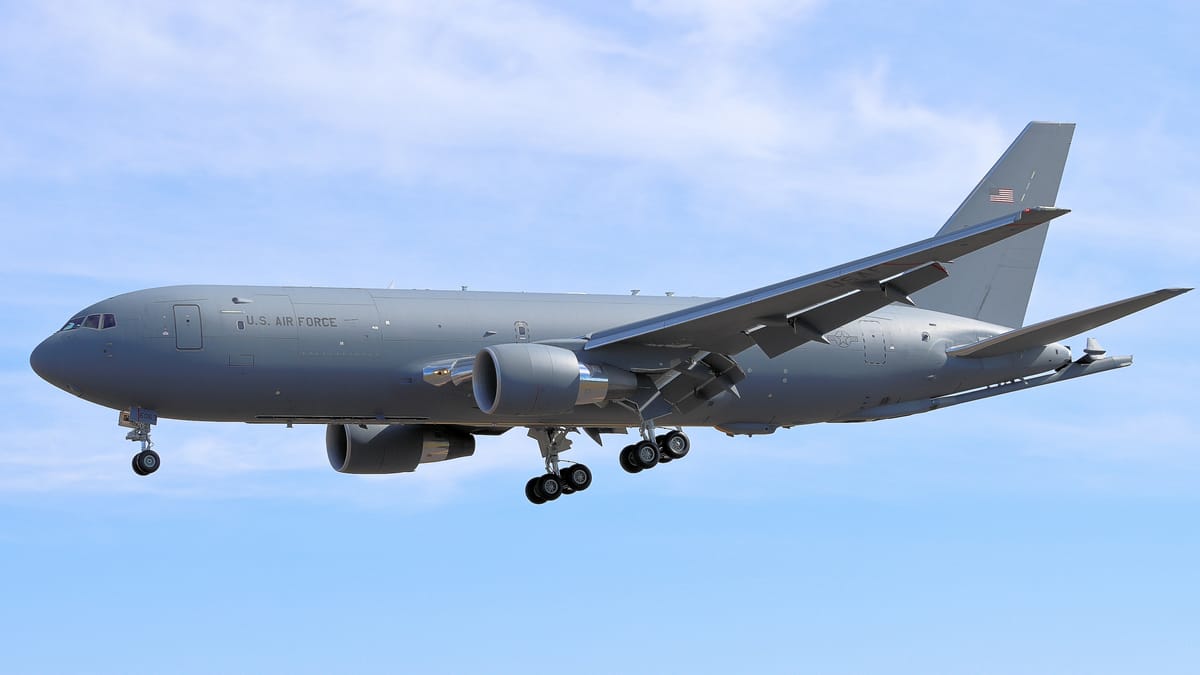
To do this, though, you need a literal flying gas pump—meet the KC-46 Pegasus.
A monster of an airplane designed to take off with a dozen Olympic swimming pools’ worth of fuel, this air tanker is capable of flying around the entire planet and refueling dozens of fighters at a time, leading the line in the US Air Force’s mid-air fuel logistics.
The Pegasus’s path to existence, however, was everything but clear skies and calm winds—this tanker is a child of bureaucratic hell, scandals, corruption, and controversies. In fact, the program that gave birth to the Pegasus was started because a few government officials couldn’t keep their hands clean.
The KC-X Program
In the early 2000s, Boeing KC-135 Stratotankers were well known as the Air Force’s old and reliable aerial tankers. They had been using them since the late 1950s, and the tankers proved invaluable in the Southeast Asia theater. You can check out our in depth video on the Stratotanker if you want to learn every tiny niche detail about it, but in essence, it allowed F-105s, F-4s, and B-52 bombers to reach targets that would be far too distant without aerial refueling. Four decades later, though, the Stratotankers were proving obsolete.
Between 1993 and 2003, the number of maintenance hours on these massive birds doubled, while the overhaul costs tripled. Aside from already having to pay for the fuel and the crew, the American taxpayers had to cash out about $10,000 dollars for maintenance for every single hour of a Stratotanker’s flight time. Father Time started doing his thing, and the bird was starting to lose its status as the old and reliable tanker. The costs would only grow with time, and it became clear that the Air Force needed new flying tankers.
The first idea was to buy 80 and lease 20 Boeing KC-767 tankers, but this deal fell through. Why? Because of corruption of course! A government official by the name of Darleen Druyun boosted the price for Boeing while working for the Department of the Air Force. It was later found out that she was, at the time, preparing to leave the Department and join Boeing.
This controversy, dubbed “the biggest Pentagon scandal in 20 years” by the media, was so monumental it resulted in the termination of Boeing’s CFO Michael Sears and the resignation of their CEO Philip Condit, with Boeing having to pay $615 million dollars in fines—not to mention that almost everyone involved went to prison.
After the ‘buying existing tankers’ fiasco, the Air Force decided to go back to the drawing board and get an entirely new fleet of tankers. A fresh start for a fresh fleet.
In January of 2007, the USAF started the KC-X Aerial Refueling Aircraft program. The $40 billion dollar contract, which translates to about $62 billion today, called for 179 tankers—four for system development and demonstrations, and 175 for production.
The only two companies gunning the contract down were Boeing with a design based on the 767, and Airbus who had partnered up with Northrop Grumman with a design based on the A330. About a year later, the Department of Defense opted for the latter option, dubbed the KC-45A. Boeing protested, submitting a note with the Government Accountability Office, and the GAO upheld the claim, recommending the rebidding of the contract. Just a few months later, the Air Force reopened the bidding a year later with clearer criteria.
And wouldn’t you know it, Boeing, in spite of their tarnished name, won after rebidding, with the official decision being made public in early 2011. Despite being massively behind schedule, the first prototype of the new generation of tankers was designated KC-46A, and it would take its maiden test voyage in late 2014.
Pegasus Design
The Pegasus is essentially a Frankenstein’s monster type of airplane, incorporating elements from various Boeing 767 variants.
They used the fuselage of the 200ER variant with the wings, landing gear, cargo door, and floor of the 300F variant. The flaps were copied from the 400ER variant, with a Dreamliner-like glass cockpit. Overall, the Pegasus measures 159 feet or 48.5 meters in length with a wingspan of 156 feet, or 47.5 meters.
What’s really relevant for an aerial tanker, though, is its cargo and fuel capacity.
With a maximum takeoff weight of 415,000 pounds or almost 190 tons, it easily blows its predecessor, the Stratotanker, out of the air, as the grandaddy of air tankers tops out at 322,500 pounds, or 146 tons.
The key of its transport capabilities doesn’t lie in the weight, but in the layout of its cargo area. This is incredibly important since tankers aren’t only expected to refuel other airplanes mid-flight—they’re also expected to transport cargo and passengers.
The Pegasus has three configurations for this purpose. In its cargo configuration, it can fit three times more pallets than the Stratotanker with 18 pallets of cargo. This is the same pallet capacity as the C-17 Globemaster, a plane designed for the sole purpose of transport. The KC-46 can also fit 30% more people than the Stratotanker with 114 in its passenger configuration, and two times more patients than a Stratotanker in case of an aeromedical evacuation with 54 patients. 24 of those patients can fit in with their rescue baskets, also known as litters, while the five-strong medical team is seated in the front of the Pegasus with the flight crew.
The crew can switch between configurations in no more than two hours—a job that usually takes other cargo plane crews about five hours.
Interestingly, the Stratotanker can still take on more pure weight, it’s just that the configuration is less optimal, to put it mildly.
The Pegasus can take off with a maximum cargo capacity of 65,000 pounds or 30 metric tons, or five fully grown African bush elephants for clearer measurement. The Stratotanker, in comparison, could fit 83,000 pounds of cargo, which is about 37.5 tons, or about six entire elephants and the trunk and head of another. Hopefully there would be enough room to fit a cage for the madman who butchered the seventh elephant.
The most important element to an aerial tanker is, of course, the fuel capacity. The Pegasus can carry approximately 10% more fuel than the Stratotanker with more than 212,000 pounds or 96 tons of fuel on board. Its predecessor could carry no more than 200,000 pounds or 90 tons of fuel.
The Pegasus can therefore refuel 30 F-16 Fighting Falcons, for example, while the Stratotanker couldn’t refuel more than 28.
But wait a minute—you might be thinking—that doesn’t sound like that big of a difference, and truth be told, it isn’t, until you consider the final factor that ensures the KC-46’s supremacy—range.
The Pegasus has an incredible range of more than 7,300 miles or close to 12,000 kilometers, which is almost five times greater than the Stratotanker’s range. That means that the Pegasus could make the New York—Los Angeles trip three times, while the Stratotanker would run out of fuel and crash somewhere around New Mexico during its first trip.
Additionally, the Stratotanker itself can be refueled mid air, essentially turning its range global.
To push the flying tanker onward, Pegasus relies on two Pratt & Whitney PW4062 engines, with each one creating 62,000 pounds of force. This is another field in which the Stratotanker simply can’t compare, as its four CFM F108 engines produce 86,400 pounds of force combined. When level, the Pegasus cruises at a speed of around 530 miles, or 850 kilometers per hour, while it can shift a gear and speed up to 570 miles or 910 kilometers per hour if necessary. Returning to our New York—Los Angeles example, the Pegasus makes that trip in less than five hours.
Despite the many different things the Pegasus can do, it still requires no more than three crew members to operate. Two of them are, of course, the pilots, and the third crew member is the refueling boom operator. The boom is, for lack of better words, the long tube that extends from the Pegasus into another plane and pumps fuel in it.
Many people find it incredible that the legendary B-2 stealth bomber has a bed in it because of how long missions can get, and the Pegasus isn’t any different from that. It actually comes with three bunks, a kitchen, and a lavatory. At maximum capacity, the Pegasus can accommodate 15 crew members, and it’s FAA certified to transport 58 passengers, even though it can, if necessary, onboard 114 people. However, it’s likely that a Pegasus would onboard that many people only in the case of urgent evacuation.
To keep all of those people safe, the Pegasus is equipped with top of the line countermeasures to detect and avoid threats. This includes an infrared missile system with flares, a hardened hull to protect the plane from nuclear, chemical, and biological threats, as well as additional armor for the flight deck. The massive bird is fitted with the Advanced Battle Management System, which connects it to other units on the water, ground, and in the air, allowing Pegasus to conduct reconnaissance tasks and relay that information to other units. This is, once again, why the range of the Pegasus is so important—staying in the air for longer during a recon mission can make the difference between life and death in the field.
Aside from recon capabilities, the KC-46 also has some electronic warfare capabilities, but the specifics are, obviously, a military secret.
A part of the design that the Air Force is particularly careful about, especially nowadays, is the Maneuvering Characteristics Augmentation System, known as MCAS. The MCAS is a flight stabilizing feature designed to avoid stalling, and it was introduced on the Pegasus because of the imbalances caused by fuel redistribution after refueling another plane. As the Pegasus loses fuel, it starts shifting around the containers, and this means that pilots constantly have to deal with weight redistribution mid-air, which is a huge no-no in aviation, as it can cause a disbalance and crash a plane. The purpose of this system is to automatically reposition the plane in such a way that the redistribution of weight doesn’t destabilize it.
In 2018 and 2019, however, this very same system was found guilty for causing two plane crashes. Two Boeing 737s operated by Lion Air and Ethiopian Airlines, respectively, crashed, tragically killing everyone on board in both instances. It was later found that the MCAS, and I hope I don’t get assassinated for saying this because it is Boeing’s system we’re talking about, was at fault for the planes nosing down for no reason.
This system was introduced into the design of the Pegasus long before those accidents took place, though, and unlike those models, the KC-46 system automatically disengages if the pilot moves the stick—it doesn’t take control away from the pilot.
The Air Force nevertheless began reviewing training procedures in 2019, following the accidents.
How The Flying Horse Operates
The Pegasus is nowadays in service all over the world. The United States Air Force received their first Pegasus in 2019, which was well past the 2016 due date, and as if being late wasn’t bad enough, the Pegasus was bogged with a plethora of problems.
The first issue the Air Force spotted was the inadequate boom pressure during the refueling of the A-10 Warthog. The boom in the Pegasus uses 1400 pounds of thrust resistance, which is an international standard, while the A-10 can only generate 650 pounds. This was actually the fault of the Air Force, which they admitted, as they didn’t provide Boeing with the specifications of the refueling requirements for the A-10.
Another issue was the distortion of the Remote Vision System which happened because of glare in certain conditions.
The problem of cargo locks would quickly present itself too. In September of 2019, the Air Force restricted the plane from transporting cargo and passengers because the cargo locks kept unlocking mid-flight—certainly not something you want happening with passengers on board.
It would take another two years for all of these problems to get fixed on all existing KC-46s, and operational use was only allowed in 2021. Even then, however, it was limited. The Pegasus could only spread its wings in the United States, deemed unfit for deployment in combat areas as it could only refuel four aircraft—B-52s, F-15s and 16s, and the F/A-18.
In 2022, six years after the original delivery date of the first aircraft and three years after the actual delivery, the Air Force greenlit the Pegasus for general operational use. In retrospect, it seemed like Boeing delivered a half-baked product that required years of work to get it up in the air safely.
In 2024, however, one Pegasus completed a 45 hour-long flight around the entire planet as part of Project Magellan. During its flight, it refueled several aircraft and it itself was refueled a few times, proving its operational capacity.
When refueling, the Pegasus can use both a refueling boom and drogue pods.
A refueling boom is a rigid tube protruding from the back of an air tanker.
A drogue is a completely different story.
The drogue is a sort of a basket at the end of a long, flexible hose that comes out of a pod—the Pegasus has a drogue pod on each wing. Once the hose with the drogue is released, the drogue itself acts as a funnel for the aircraft receiving the fuel—the pilot of the refueling aircraft aims to essentially stab the drogue with the aircraft’s probe. Once the probe and the drogue make contact, the drogue leads the probe to a valve, and when the valve locks, the refueling can start.
Some planes, like the Pegasus, use both the stiff boom system and the drogue system, and it can, in theory, refuel up to three aircraft at once as they don’t get in each other’s way. This is a huge advantage in comparison to other tanker aircraft, as it’s saving the refueling aircraft a whole lot of time, which can make the difference between success and failure during missions.
To guide the refueling process, a crew member uses one of the two on-board Aerial Refueling Operator Stations. These stations use the remote vision system which is equipped with cameras, allowing the operator to aim the boom. To allow operators refueling in the dark, the system comes equipped with stereoscopic glasses.
Despite the high technological capacity of this system, it too had some issues. As mentioned earlier, glare issues, depth depiction issues, and curvature distortions can occur with the remote vision system, which obviously makes it more difficult for the operator to aim the boom. This, however, will most likely be solved with the release of an update for the system.
At this point in time, Boeing produced 98 Pegasi with the United States Air Force alone planning to obtain 188 of them, while that number might even go up to 288 if the Air Force decides to exercise all their options provided by the new tanker program. The United States, however, isn’t the only operator of this aircraft.
Japan made an order of six aircraft, with some of them already introduced. Israel already purchased four, with the contract allowing another four if Israel deems it necessary, and as of 2025, Turkey is also seriously considering renewing its tanker fleet with the Pegasus.
A Work In Progress
The Pegasus seems to be its own bad luck charm. When taking a retrospective look at the project, it seems everything around it went wrong at every step of the way.
First of all, the program that requested a new design, and ultimately landed with the Pegasus, was pushed forward only because a corruption scandal prevented the United States from buying and leasing already existing aircraft.
Then, the original proposal for the Pegasus was rejected, and it took years for the design to win the second round of proposals.
The development of the Pegasus was painfully slow and it was delivered a few years after the due date, and even after delivery it was an unfinished product. A work in progress that the Air Force keeps upgrading to this day.
Even today, its service record is not perfectly clean.
Just recently, in July of 2025, the boom of one Pegasus was severely damaged during a routine refueling of an F-22 east of Norfolk, with the pilots landing the damaged bird safely.
On top of all that, the Air Force won’t be completing its 188-strong fleet of KC-46 tankers any time soon.
With all of that in mind, it’s right to ask—is there something going right with this aircraft?
And truth be told, it did do one thing right—the Pegasus rejuvenated the Air Force’s tanker fleet. Although the fleet is not complete, it is much younger and more durable than the aging Stratotankers which spent more time in the workshop than in the air towards the end of their service.
Even though the Pegasus went through a very long period of both on-ground and aerial turbulence, the biggest problems are now ironed out and there’s no reason not to expect a strong performance from this aerial tanker.
Key Takeaways
- The KC-46 Pegasus is a large aerial refueling tanker designed to carry significant fuel and cargo.
- The Pegasus’s development was marked by corruption scandals and bureaucratic issues, delaying its deployment.
- The Pegasus can refuel multiple aircraft simultaneously using both boom and drogue systems, enhancing mission efficiency.
- Despite initial problems, the Pegasus has proven its operational capacity with a global flight and ongoing upgrades.
- The Pegasus has replaced aging Stratotankers, providing the US Air Force with a more modern and durable fleet.

Simon Whistler
Simon Whistler hosts MegaProjects, bringing engineering, infrastructure, and military-machine stories into clear narrative focus for viewers who want the systems, tradeoffs, and human decisions behind the build.
Frequently Asked Questions
What is the KC-46 Pegasus?
The KC-46 Pegasus is an aerial refueling tanker designed to carry a large amount of fuel and refuel multiple aircraft mid-flight. It is part of the US Air Force’s mid-air fuel logistics.
What was the KC-X Program?
The KC-X Program was initiated in January 2007 by the US Air Force to replace the aging KC-135 Stratotankers. It aimed to procure 179 new aerial refueling tankers.
What are the key design features of the KC-46 Pegasus?
The KC-46 Pegasus incorporates elements from various Boeing 767 variants. It has a maximum takeoff weight of 415,000 pounds, can carry 18 pallets of cargo, 114 passengers, or 54 patients, and has a fuel capacity of over 212,000 pounds.
What is the range of the KC-46 Pegasus?
The KC-46 Pegasus has a range of more than 7,300 miles or close to 12,000 kilometers, which is almost five times greater than the KC-135 Stratotanker’s range.
What are the refueling capabilities of the KC-46 Pegasus?
The KC-46 Pegasus can refuel up to 30 F-16 Fighting Falcons and can use both a refueling boom and drogue pods to refuel multiple aircraft simultaneously.
What issues has the KC-46 Pegasus faced since its introduction?
The KC-46 Pegasus has faced several issues, including inadequate boom pressure during refueling of the A-10 Warthog, distortion of the Remote Vision System due to glare, and problems with cargo locks unlocking mid-flight.
What is the current status of the KC-46 Pegasus in the US Air Force?
As of 2024, the US Air Force has 98 KC-46 Pegasus aircraft and plans to obtain up to 288 if all options are exercised. The aircraft has been cleared for general operational use and has completed long-duration flights around the globe.
What other countries operate the KC-46 Pegasus?
Japan has ordered six aircraft, Israel has purchased four with an option for another four, and Turkey is considering renewing its tanker fleet with the Pegasus.
What is the Maneuvering Characteristics Augmentation System (MCAS) in the KC-46 Pegasus?
The MCAS is a flight stabilizing feature designed to avoid stalling caused by fuel redistribution after refueling. It automatically disengages if the pilot moves the stick, ensuring the pilot retains control.
What is the significance of the KC-46 Pegasus for the US Air Force?
The KC-46 Pegasus has rejuvenated the Air Force’s tanker fleet, providing a more durable and younger fleet compared to the aging KC-135 Stratotankers.
Sources
- Original MegaProjects video: The KC-46 Pegasus
- Hero image source by Airwolfhound from Hertfordshire, UK / openverse, by-sa.