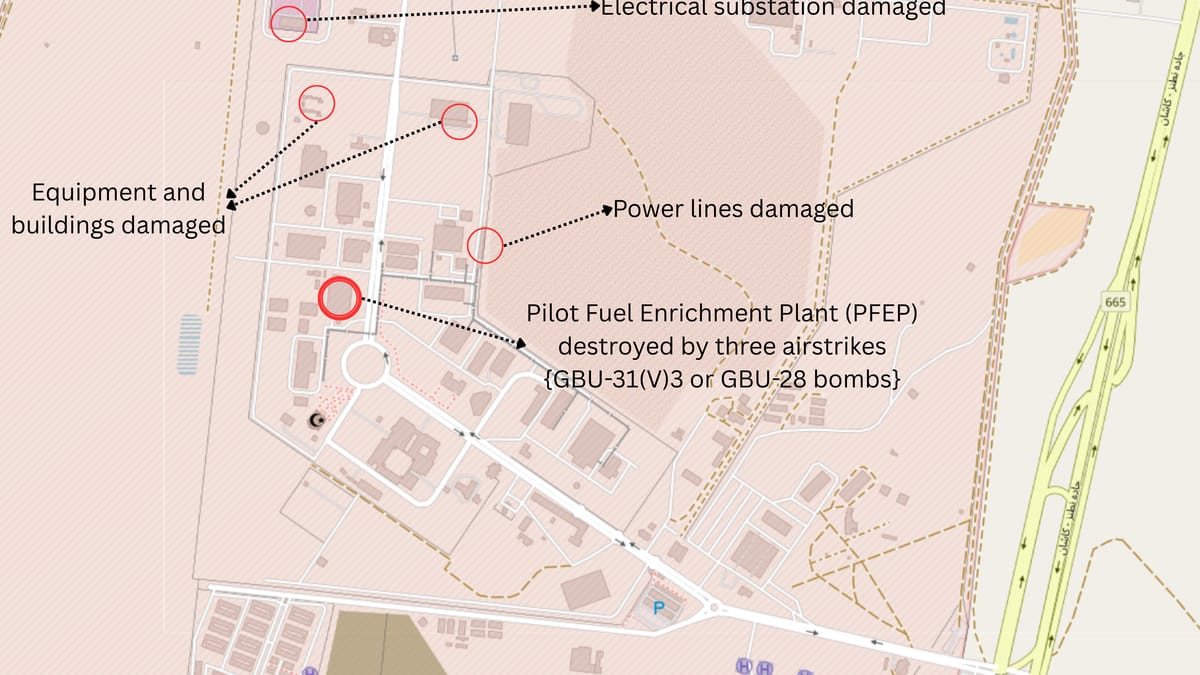
The Iranian nuclear program—we have been hearing about this for over two decades at this point. Tehran has maintained that it is for peaceful purposes; Israel asserts it is for nuclear annihilation; others have fallen somewhere between the two extremes.
Whatever you may think about it, it’s nothing short of impressive. Deep beneath the Iranian desert, in halls larger than aircraft hangers, thousands of centrifuges spin nearly 63,000 times per minute. Each one stands about the height of a person but thinner than a telephone pole. The noise is deafening—a high-pitched whine that never stops. Together, they’re doing something that only a small handful of nations have mastered: enriching uranium on an industrial scale.
This facility is Natanz, and it’s just one piece of Iran’s sprawling nuclear megaproject—a decades-long engineering feat that’s both surprised the international community and cost the country dearly. But what makes this truly extraordinary: they built this while cut off from the world. Especially in the last two decades, Iran has been under some of the harshest sanctions imaginable.
So how did a country that went from having next to zero knowledge of nuclear engineering in 1979 end up allegedly on the cusp of joining the world’s nuclear-armed states?
This is the story.
Disclaimer
A quick note before we begin. This article was written in the immediate aftermath of Israel’s Operation Rising Lion and the United States’ bombing of several of Iran’s largest nuclear facilities. It is unclear how much damage has been done or what comes next. This is not the story of where Iran goes next—it’s the story of how it got here, up to May 2025.
The Revolution’s Aftermath
November 4, 1979—a day that would shape Iran’s relationship with the international community for decades. What started as a student protest quickly spiraled out of control. Within hours, angry crowds had stormed the US Embassy, overwhelming its defenses and trapping everyone inside. For 444 days, 66 American diplomats and staff would remain hostages in what became one of the most dramatic international crises of the twentieth century.
This wasn’t merely a revolution, it was a message to the world that the new Islamic Republic was uncompromising and would chart its own course, unconcerned by the implications its actions may have on its standing with world powers. And those implications came swiftly.
The German engineers from Siemens who had been constructing two massive 1,200-megawatt nuclear reactors at Bushehr—each capable of powering a city the size of San Francisco—packed their equipment and expertise onto the first flights out. Behind them, they left billions of dollars worth of half-finished infrastructure and a nuclear program in shambles.
But the revolution’s isolation was nothing compared to what followed. When Saddam Hussein launched his war against Iran, he knew exactly where to aim his bombs. Between 1984 and 1988, Iraqi aircraft struck the abandoned Bushehr facility six times. These weren’t random hits—they were precision strikes designed to obliterate Iran’s most advanced technological assets, and there was no one left to stop them.
The message that the Iranian government took to heart—partially because of Saddam’s brutality, and partially through their own self-imposed isolation from the international community—was that they stood alone. No longer could they depend on Western expertise, nor could they leave their nuclear projects exposed to air raids. They would continue to build, in secret, and alone.
In 1985, Iran’s leaders made their fateful decision. They would rebuild. And this time, they would trust no one.
The Underground Years
To get a better feel for what Iran actually attempted, we need to take a moment to cover the physics behind all this and what uranium enrichment actually involves. Don’t worry, we’re not going to drag you through a university level nuclear physics course, we promise.
In nature, uranium comes in two types: U-238 and U-235. They’re nearly identical—you can’t tell them apart without a chemical test. But they are radically different from one another and serve radically different roles: it’s U-235 that’s useful in terms of designing pretty much any type of nuclear project. Reactors to power cities need uranium that’s 3-5% U-235. For a nuclear weapon, you’re looking at needing 90% or higher U-235.
The issue here is that uranium in its natural state is roughly 99.3% U-238 and 0.7% U-235. Getting this even to the 3-5% threshold needed for nuclear power plants is a feat of modern engineering. This form of uranium is slightly lighter than its more common U-238 counterpart, which gives scientists the ability to refine it to separate the two by spinning it at incredibly high speeds.
Sounds simple, right? Well, let’s just say we simplified that a little bit. These are not your home washing machine spin cycles. We’re talking about aluminum tubes spinning at 60,000 to 70,000 revolutions per minute—that’s over 1,000 times per second. This means that the outer edge of the rotor is moving faster than the speed of sound. This is such a fine-tuned operation that even a speck of dust can throw the whole thing catastrophically out of balance.
The incredible thing is that despite these incredible speeds, each centrifuge only achieves only a tiny bit of separation. To get from natural uranium to reactor fuel requires thousands of machines connected in elaborate cascading setups, each one feeding slightly more enriched product to the next. The whole system has to run continuously for months or years.
Given the extreme technical specs of such an operation, Iran knew that going it truly alone without any help from abroad would take decades. This is where their neighbor in Pakistan enters the fray—or, more specifically, the Pakistani A.Q. Khan network. Khan was himself a nuclear scientist who had stolen centrifuge designs from Europe in the 1970s and smuggled them to Islamabad and played a central role in the development of their own nuclear program.
In a move of incredible irresponsibility for pure personal gain, he was now selling that knowledge and schematics to the highest bidder.
Through intermediaries and secret meetings in Dubai hotel rooms, Iranian agents acquired the blueprints for the P-1 centrifuge from this network, the same basic design that Pakistan had used for its nuclear energy and weapons program. These weren’t cutting-edge designs by any means—the P-1 was based on early 1970s technology that was already obsolete by international standards. They were limited to only being able to enrich a tiny amount of uranium, but they were nevertheless the start of Tehran’s ambitions.
The Iranians wasted little time and got to work, setting up shop covertly in the Kalaye Electric Company—they did not want this getting out when the project was still in its infancy. To the outside world passing by, this building was a nondescript factory that made electrical equipment. But inside, Iran’s best and brightest got to work on the ins and outs of nuclear engineering.
Progress was slow, and setbacks were frustratingly common—even a stray fingerprint on the machine could be enough to throw things out of alignment and grind the whole operation to a halt. They never managed to get a high degree of reliability from the obsolete designs.
They initially started small. First, a test cascade of just 19 centrifuges. When those held up, they expanded to 129 machines.
At each stage of expansion, though, they ran into new problems: these machines were so fine-tuned and operated at such an extreme fringe of what human design can produce that even something as simple as slowing them down can be problematic, and this presented an unexpected challenge given all the work that went into speeding them up. They require a slowdown process to stabilize the centrifuge, and something like a power outage would send vibrations through the machine that could trigger rotors to scrape their side casing, resulting in a fatal shower of metal destroying the whole centrifuge.
While it’s hard to know for sure how high failure rates were in these early years, IAEA officials have stated that the failure rates can amount to ten percent per year.
But Iran was learning. By 1999, after more than a decade of trial and error, they achieved a milestone: enriching uranium from natural 0.7% up to 1.2% U-235. It was nowhere near the 3.5% needed for reactor fuel, let alone weapons-grade. But it proved—at least to themselves, who were the only ones who knew at this point—that they’d mastered the basic principles and, more importantly, had begun training a generation of Iran’s best and brightest in real-world applications of nuclear engineering.
While scientists were continuing their work in the Kalaye Electric facility, construction crews began an entirely new project in the desert near Natanz in the late ’90s. Still scarred by the destruction that Saddam’s air force had inflicted on their research facilities during the war, they wanted to ensure their future facilities would be as well-protected as humanly possible.
In preparation for building Natanz, Iran’s engineers had studied details about every air strike they could get their hands on. They analyzed what was known about America’s bunker-buster bombs, which were a relatively new development then. They knew Israel had previously destroyed Iraq’s Osirak reactor in 1981 to prevent Baghdad from advancing its nuclear program. This became part of Israel’s “Begin Doctrine,” which they made clear would not be a one-time strike but rather the policy of all future Israeli governments to engage in preemptive strikes to prevent enemies from acquiring nuclear weapons.
To put it mildly, Tehran was terrified of facing the same setbacks. They knew that if their program was discovered, they would likely face the same sort of strikes from Israel. This only further emphasized the importance of making their facilities as bomb-proof as possible.
Natanz was designed to be enormous. The plans called for two underground enrichment halls, each one taking up 25,000 square meters—that’s six football fields of floor space per hall. All of this was designed to be 8 meters underground, protected by a 2.5 meter thick concrete “shield” above the facility. Above this, engineers were to pile an additional 22 meters of dirt and rock.
Altogether, this offered over 30 meters of semi-fortified protection from whatever their enemies could drop on them. This was more than capable of withstanding any conventional ordnance, and would even hold up against all but the most advanced forms of aerial bombardment.
Building underground at this scale presented other obstacles, though. Most of these centered around the fragility and sensitivity of the centrifuges, which are incredibly sensitive to even the slightest vibrations. Engineers essentially put the entire facility on shock absorbers, installing special isolation systems that could absorb the impact from minor tectonic shifts that would be imperceptible to people on the surface.
Temperature control and power were two more challenges: this enrichment process both requires a massive amount of energy and produces an enormous amount of heat. Remember, they were still compensating for efficiency with volume here: if one centrifuge draws, say, 100 watts—they had to multiply that by the 50,000 machines they were planning for. That’s 5 megawatts for the centrifuges themselves, which doesn’t even address the massive industrial-grade cooling systems they would need to compensate for the enormous amount of heat that the facility would generate.
Despite these challenges, Iran was locked in. And it started paying off: with Natanz’s completion, they were ready to scale up from a hidden workshop into something that could be considered more of an industrial scale. By 2002, all the pieces were beginning to come together: the first cascade of 164 centrifuges was assembled, with components for thousands more ready.
Iran had at this point spent 17 years building in secret. But secrets this big don’t stay hidden forever.
Exposure, and the Race Against Time
All of this development and research had gone on largely in the dark. US and Israeli intelligence had been suspicious that Tehran wanted to pursue a nuclear route and were keeping tabs on their efforts dating back to the 1990s—in particular, the growing imports of components required for centrifuge development.
All of this was kept top secret though, with most of the international community knowing next to nothing about Tehran’s ambitions or progress. That is, until 2002.
In August that year, a group of Iranian dissidents made a startling announcement at a press conference in Washington, D.C. Alireza Jafarzadeh, who was the spokesperson for a controversial Iranian group that somehow had managed to get on the wrong side of both the US and the Ayatollah, announced to the world that Tehran had a secret nuclear program and was building two facilities that would be capable of producing material that could fuel a nuclear bomb.
Given the group’s isolated relationship with the international community, there was some skepticism about the validity of their claims. They would, however, prove to be largely correct: even a stopped clock’s right twice a day.
The International Atomic Energy Agency (IAEA) immediately demanded access to the facilities in accordance with international nuclear agreements.
By February 2003, IAEA Director Mohamed El Baradei arrived at the Natanz facility and was alarmed at what he found. The sophistication of the Iranian program actually exceeded what the initial reports suggested. The plant at the time of his arrival contained 164 assembled centrifuges, along with components for 1,000 more in storage. Environmental samples revealed traces of enriched uranium, indicating that the facility was in operation.
Iran was backed into a corner by this point and could only deny so much without losing all credibility with the international community. At this point, they admitted that they had been conducting secret nuclear research and development activities for the past 18 years, including hidden uranium enrichment experiments, plutonium separation tests, and massive facility construction.
Despite getting caught and in spite of the widespread condemnation from its neighbors and broader international community, Tehran doubled down on its project. They had come this far and weren’t going back—the die was cast, to borrow a phrase.
By 2006, Iran had successfully overhauled the P-1 centrifuges which by this point had become massively outdated and had long since reached the limits of their enrichment capabilities. They constructed 164 centrifuges along their domestically designed IR-1 model, which successfully enriched uranium to 3.5%—reactor grade.
Iran insisted—as it does to this day—that this was for purely peaceful nuclear energy. At this time, they had in certain circles the benefit of the doubt—3.5% is precisely the level you need to fuel a nuclear power plant. But even here, anything more than a surface level analysis raises questions as to just how honest they were: Iran was building far more centrifuges than they would need to fuel a nuclear power plant.
The massive underground halls at Natanz were designed to hold 50,000 machines—this is enough to produce fuel for a dozen power plants. Keep in mind that on top of this, they had a total of one reactor—and it was unfinished.
The UN Security Council wasn’t buying Tehran’s rationale. They passed multiple resolutions demanding Iran cease enriching uranium entirely—although this largely fell on deaf ears, as they only began installing even more centrifuges.
The numbers can speak for themselves here: in 2007, they had 3,000 centrifuges spinning in Natanz. By 2009, that figure had grown to over 8,000. The underground halls, which had sat largely empty for years, began to fill with row after row of these machines.
Another revelation came in September 2009, when Western intelligence agencies uncovered and made public a second massive nuclear facility at Fordow. This place took the security of Natanz to a different level—it is carved deep into a mountain, through 80 meters of solid rock and granite. This was a true mountain bunker and possibly one of the most difficult to penetrate facilities in the world.
While perhaps impenetrable through conventional approaches, 2010 shook the Islamic Republic’s confidence in the facility with the unraveling of the Stuxnet virus allegedly programmed by the US and Israel that began programming the centrifuges to literally destroy themselves. Given how sensitive these machines are to even the slightest change in operation, it didn’t take much—no exploding pagers were needed here. All said and done, this destroyed somewhere in the vicinity of 1,000 centrifuges.
While devastating in the moment, this proved to be only a minor setback for Iran though. Within a year, they’d not only replaced all of the destroyed machines but had massively upgraded their cyber security to ensure that such an attack would never be successful again.
Perhaps more important, though, was their decision in the light of this attack to increase their enrichment all the way up to 20 percent. The physics of this comes into play again here: the difficulty of enriching uranium is not a linear process, where taking it to 10% would be as difficult as it would be to take it from 60% to 90%, for instance.
Their announcement that they would enrich up to 20% meant that they were far closer capability wise to weapon-level purity than a linear understanding of the percentages would indicate to a lay observer.
Iran’s justification to the international community was that they would be using this to power the Tehran Research Reactor in order to make medical isotopes for cancer treatment. This has the veneer of authenticity: their reactor would use this uranium to create medical radioisotopes used in millions of cancer diagnostic scans worldwide.
This did not hold up to scrutiny very well, though. The international community had access to the specs for the Tehran Research Reactor—it was tiny. It would take about 5 kilograms of 20% enriched uranium per year to keep it running. Their project was producing orders of magnitude more than this, and they were showing no signs of slowing down—quite the opposite, they were speeding up.
The world was not fooled. It is here that Iran can really be seen as going it alone, breaking off any semblance of wanting to pursue this exclusively for non-weapons related purposes—and what followed was its result.
Industrial Scale and the Nuclear Deal
By 2011, Iran’s nuclear program had reached truly industrial scale. The numbers speak for themselves: nearly 19,000 centrifuges installed across Natanz and Fordow, with about 10,000 actively enriching uranium. Iran was producing 150 kilograms of low-enriched uranium per month, plus 5-7 kilograms of 20% enriched material.
They weren’t just adding machines—the days of quantity over quality were over. They were innovating, which given their international isolation has to be acknowledged as a rather impressive feat. The IR-2m centrifuge that was rolled out in 2013 was four times as efficient as the IR-1 model, which in and of itself had been a large leap ahead from the days of the P-1 design they had purchased.
This allowed Iran to accumulate over 7,000 kilograms of low-enriched uranium and nearly 200 kilograms exceeding 20%. Meanwhile, they achieved another milestone around this time: the Bushehr nuclear power plant, which had been abandoned by the Germans all those years ago, finally went critical—the technical term for achieving a self-sustained nuclear reaction.
International concern was at an all time high. North Korea, one of the only other states that matched Iran’s isolation on the global stage, was ambitiously pursuing its own nuclear program—and it seemed increasingly likely that they would be successful in this pursuit. Pyongyang had earned the title of the “hermit kingdom” because it truly was the most isolated country on earth, and did not seem willing to negotiate in good faith on just about anything—even if that meant widespread famine throughout the country as a result of international sanctions combined with their poor food production.
Iran, it was hoped, would be more willing to negotiate. While talks initially went nowhere given then-President Mahmoud Ahmadinejad’s hardline approach. As a prerequisite to any negotiations, he insisted on several demands that amounted to essentially a poison pill from the get-go, especially demanding that any deal explicitly recognize Iran’s right to enrich uranium. In general, he was a difficult man to work with—he intentionally antagonized the international community with repeated Holocaust denial statements as well as a rather frequent affinity for declaring that Israel would be “eliminated.”
The election of President Hassan Rouhani in 2013 presented a more realistic way to negotiate with Tehran. While much power rests with the Ayatollah, the President is free to engage in international negotiations—which Rouhani was willing to do.
Amid sanctions that were crushing Iran’s economy—oil exports, which formed the bedrock of their GDP, had plummeted from 2.5 million barrels per day to just 1 million, the Rial had lost more than 80% of its value, inflation was unchecked. Rouhani was far more willing to negotiate than his predecessor.
After two years of intensive negotiations, the result was the Joint Comprehensive Plan of Action (JCPOA), finalized in July 2015. Under the deal, Iran accepted some restrictions: they would reduce operational centrifuges from 19,000 to just 5,060, limit enrichment to 3.67%, shrink their enriched uranium stockpile from over 7,000 kg to just 300 kg, pour concrete into the Arak reactor core to permanently disable it, and accept continuous IAEA monitoring with cameras and sensors throughout their facilities.
The deal wasn’t without controversy—critics pointed out that many restrictions would sunset after 10-15 years, potentially allowing Iran to resume large-scale enrichment legally. Arab nations like Saudi Arabia and the UAE viewed the agreement with deep suspicion, fearing it would legitimize Iran’s nuclear capabilities and strengthen their regional rival. Israel was deeply skeptical about it, and Republicans in the United States were dead set against it.
In exchange, Iran would get sanctions relief. Implementation was swift and dramatic. By January 2016, Iran had removed 13,000 centrifuges—more than two-thirds of their fleet. They shipped out tons of enriched uranium to Russia. The underground halls at Natanz that once hummed with thousands of machines stood largely empty. In one of the most dramatic moves, Iran removed the reactor core from Arak and filled it with concrete, rendering the reactor permanently inoperable.
For three years, the deal held. But in May 2018, everything changed. The United States, under President Donald Trump, withdrew from the JCPOA and reimposed crushing sanctions. Iran’s oil exports plummeted again. The other parties to the deal—Europe, Russia, and China—tried to salvage it, but they couldn’t offset American economic pressure.
Whether or not this was justified is a subject for another day, but it was a decision that led us to where we are today in 2025.
The Threshold Approaches
Despite ongoing attempts from Europe to salvage the JCPOA, the deal was effectively dead. If the US wasn’t going to play ball, neither was Tehran. In the minds of many European leaders, this was a catastrophe that they believed would all but guarantee Iran would achieve nuclear proliferation. Others, most notably in Washington, Jerusalem, as well as several notable Arab states, viewed this as a better alternative—they believed that the JCPOA only prolonged the inevitable, and by the time the deal expired, Tehran would have benefited from the broad loosening of sanctions and would thus be both free to pursue a nuclear weapon while also benefiting from significant inflows of cash.
Regardless of the mindsets here, Iran was done. They were not willing to re enter into nuclear talks for a newly negotiated deal and began breaching one limit from the JCPOA at a time. Each one was carefully calibrated to both demonstrate capability and test the international response. First, they exceeded the 300 kilogram uranium stockpile limit. Then, they started enriching above 3.67%.
By this point more or less unchecked by anything the international community could throw at them—sanctions had already been cranked back up to high levels—Iran really went full speed ahead. They rolled out the IR-4 and IR-6 designs, which were ten times more efficient than the original IR-1, only to outdo themselves in short succession with the IR-8 and IR-9 models, with the latter claiming to be fifty times more efficient at uranium enrichment as their original model.
Things really began to fall off a cliff by this point—in January 2021, they announced that they would begin enriching to 20% at Fordow, their mountain fortress. They achieved this within weeks, and by April that year made a follow-up announcement that they would enrich to 60%.
Iran had maintained that their research and enrichment were all for peaceful purposes, and pointed to their membership in the Non-Proliferation Treaty and ongoing acceptance of IAEA monitoring. While they may have been able to pull off that claim in the beginning, all credibility that this program was for energy alone was lost by this point. There is simply no civilian justification for 60% enrichment. No power reactor uses it, no research facility needs it.
Taking this material from 60% to 90%—weapons grade—is a very short step.
It didn’t take long to approach this level—only a matter of days after beginning the process with their IR-6 centrifuges at Natanz. By late that year, they were producing kilograms monthly. In 2022, they installed even more sophisticated cascades at Fordow that would take natural uranium—remember, this clocks in at 0.7% enrichment—to 60% in one continuous process. By 2023, a damning IAEA report revealed that they had discovered uranium particles that had been enriched as high as 83.7% at Fordow.
Iran actually did address this—they claimed it was an “unexpected fluctuation”—although by this point it largely fell on deaf ears.
The current numbers paint a sobering picture for anyone still maintaining that the Iranian program had not at least transformed into a weapons-aimed one. As of late 2024, Iran has over 12,000 operational centrifuges, including thousands of advanced models, more than 275 kilograms of 60% enriched uranium with no civilian use, and thousands more kilograms of 20% uranium.
International analysts calculated Iran’s “breakout time” in the lead up to the strikes—the time needed to produce enough weapons-grade uranium for one bomb—at just 4-5 weeks. With their advanced centrifuges and 60% stockpile, they’ve completed most of the journey to weapons-grade material.
All this while containers of Iranian oil are quite literally sitting around going bad because the sanctions regime has made it impossible to sell. One thing is clear: this is not for energy.
Conclusion
Iran’s nuclear program is different things to different people—and often gets combined in discussion without appreciating the nuances and differences in aspects here. To some, this is nothing other than an existential threat. To others, it’s a symbol of national determination and progress for peaceful purposes in spite of widespread global opposition. To others still, it’s a necessary weapons program that will offer the only deterrent that would stop Iran’s enemies from seeking to topple it.
Debates on this subject often lump together different components and aspects of this issue. Whether or not Iran does or should have a right to enrich uranium to levels needed for nuclear power is a separate question from whether they should have the ability to enrich as they have been lately. Regardless of the claims from the Iranian government, recent moves can be seen as nothing other than a clear indication that they are intent on developing this into a nuclear weapon.
All this said, and regardless of the fallout from the 2025 conflict with Israel and the United States, this can be seen as nothing short of a monumental accomplishment for the Islamic Republic. Consider how far they’ve come: they’ve constructed elaborate and sophisticated underground facilities, developed indigenous technology progressing from 1970s Pakistani designs to cutting-edge centrifuges, and trained a generation of Iranian scientists in the specifications to do all of this. What’s more, they did all this while essentially cut off—especially in the latter years—from international markets and without much technical support or training from outside their borders.
That said, all this has come at a massive cost. They have impoverished much of their population because of the results of international sanctions which, depending on your perspective, they were either unwilling to work to improve for years or willing to endure without negotiating seriously since the program was unveiled in 2002.
Where this program goes from here is anyone’s guess—only time will tell, and we’ll be sure to keep you updated as it unfolds. That is neither the subject nor scope of today’s conversation, though—this is the story of how Iran built one of the most impressive megaprojects in total international isolation.
Key Takeaways
- Iran’s nuclear program, despite international sanctions, has developed sophisticated underground facilities and advanced centrifuges.
- The program began in the 1980s, driven by a desire for self-reliance after the Iranian Revolution and the Iran-Iraq War.
- Iran’s enrichment capabilities have progressed from obsolete Pakistani designs to cutting-edge centrifuges, enriching uranium to high levels.
- The Joint Comprehensive Plan of Action (JCPOA) temporarily limited Iran’s nuclear activities, but the U.S. withdrawal in 2018 led to renewed enrichment.
- As of 2025, Iran’s nuclear program is seen as a significant threat, with the capability to produce weapons-grade uranium quickly.
Simon Whistler
Simon Whistler hosts MegaProjects, bringing engineering, infrastructure, and military-machine stories into clear narrative focus for viewers who want the systems, tradeoffs, and human decisions behind the build.
Frequently Asked Questions
What is the Natanz facility?
The Natanz facility is an underground enrichment complex in Iran designed to house thousands of centrifuges for uranium enrichment. It is built to withstand aerial bombardment and is protected by a thick concrete shield and layers of dirt and rock.
Why did Iran build its nuclear facilities underground?
Iran built its nuclear facilities underground to protect them from aerial bombardment, particularly from Israel, which has a policy of preemptive strikes against nuclear threats.
What is the significance of the 20% uranium enrichment level?
Enriching uranium to 20% is a significant step towards weapons-grade material, as it is much closer to the 90% needed for a nuclear weapon than the 3-5% required for nuclear power plants.
What was the Joint Comprehensive Plan of Action (JCPOA)?
The JCPOA was a 2015 agreement where Iran agreed to limit its nuclear activities in exchange for sanctions relief. It included restrictions on the number of centrifuges, enrichment levels, and stockpiles of enriched uranium.
What happened after the U.S. withdrew from the JCPOA in 2018?
After the U.S. withdrew from the JCPOA and reimposed sanctions, Iran began breaching the limits set by the agreement, increasing its uranium enrichment levels and stockpiles.
What is the ‘breakout time’ in the context of Iran’s nuclear program?
The ‘breakout time’ refers to the time needed for Iran to produce enough weapons-grade uranium for one nuclear bomb. As of late 2024, it was estimated to be around 4-5 weeks.
What was the impact of the Stuxnet virus on Iran’s nuclear program?
The Stuxnet virus, allegedly developed by the U.S. and Israel, caused significant damage to Iran’s centrifuges, destroying around 1,000 of them. However, Iran quickly replaced the destroyed machines and improved its cybersecurity.
What is the significance of the IR-6 centrifuge model?
The IR-6 centrifuge model is significantly more efficient than previous models, capable of enriching uranium to high levels more quickly. It played a crucial role in Iran’s ability to enrich uranium to 60% and beyond.
What was the role of the A.Q. Khan network in Iran’s nuclear program?
The A.Q. Khan network provided Iran with blueprints for the P-1 centrifuge, an outdated but functional design that helped Iran start its uranium enrichment program.
What is the Fordow facility?
The Fordow facility is a highly secure underground nuclear site carved into a mountain, designed to be resistant to conventional aerial attacks. It is used for uranium enrichment and is one of Iran’s most fortified nuclear sites.
Sources
- Original MegaProjects video: Iran’s Nuclear Project
- https://apnews.com/article/iran-nuclear-uranium-enrichment-germany-israel-c9b3669a7721bd8929d465117c81b70f
- https://en.wikipedia.org/wiki/Hassan_Rouhani
- https://www.jpost.com/middle-east/ahmadinejad-predicts-us-demise-israels-disappearance
- https://www.reuters.com/article/world/in-new-york-defiant-ahmadinejad-says-israel-will-be-eliminated-idUSBRE88N0HG/
- https://en.wikipedia.org/wiki/Mahmoud_Ahmadinejad
- https://www.pbs.org/frontlineworld/stories/iran403/background.html
- https://www.nytimes.com/2005/08/08/international/chronology-of-irans-nuclear-program.html
- https://en.wikipedia.org/wiki/Begin_Doctrine
- https://www.cnbc.com/2025/05/31/damning-iaea-report-spells-out-past-secret-nuclear-activities-in-iran.html
- https://www.criticalthreats.org/analysis/the-iranian-nuclear-program-timelines-data-and-estimates-v3-0
- https://www.criticalthreats.org/analysis/iran-prepared-to-deter-and-defend-against-a-military-strike-while-increasing-leverage-for-talks-with-the-biden-administration
- https://www.timesofisrael.com/explainer-the-handful-of-facilities-at-the-core-of-irans-nuclear-program/
- https://www.armscontrol.org/factsheets/status-irans-nuclear-program-1
- https://www.nti.org/education-center/facilities/natanz-enrichment-complex/
- https://www.iranwatch.org/our-publications/articles-reports/explainer-irans-centrifuges
- https://apnews.com/article/iran-nuclear-natanz-uranium-enrichment-underground-project-04dae673fc937af04e62b65dd78db2e0
- https://www.armscontrol.org/act/2014-06/features/agreeing-limits-irans-centrifuge-program-two-stage-strategy
- https://apnews.com/article/iran-iaea-us-nuclear-talks-inspectors-585750d54eea24ed39f229b701313998
- https://www.atlanticcouncil.org/blogs/new-atlanticist/strange-bedfellows-saudi-arabia-israel-oppose-iran-nuclear-deal-for-different-reasons/
- Hero image source by WeatherWriter / openverse, by-sa.